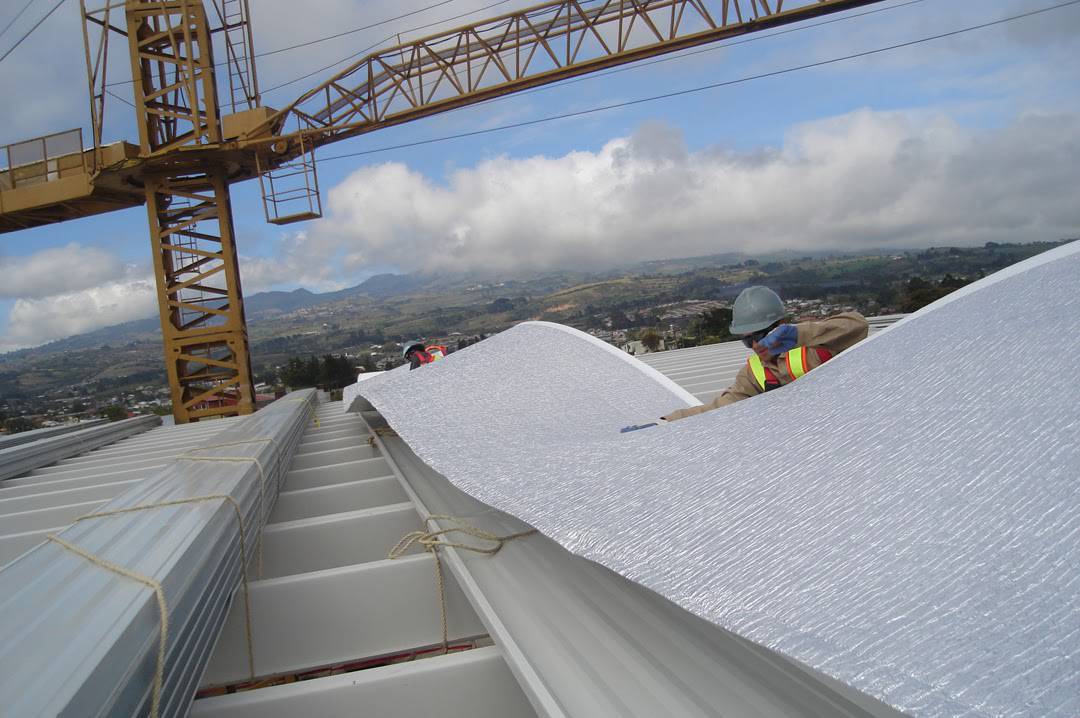
1. Stops Condensation
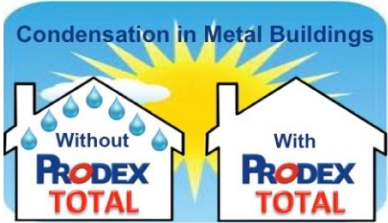
It can seem like a tropical rain forest inside an unprotected metal shed. It's worse on those days where there is a greater contrast between temperatures at night vs. day. This typically occurs when relatively warm moist air comes in contact with a relatively cold surface.
Protect your valuable contents from damaged caused by moisture.
The buildings we're primarily referring to are non-conditioned buildings. This would include barns, airplane hangers, garages, storage units and many warehouses.
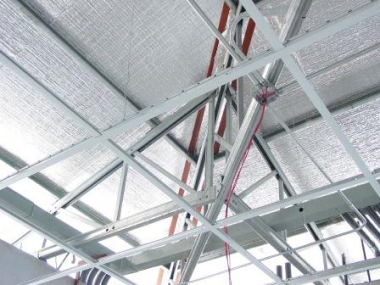
Using Prodex Total as your metal building or warehouse insulation will eliminate the moisture (condensation) from forming on the metal sheeting. Prodex creates a shield (a new interior surface) that is warmer (or at least above the dew point). Prodex Total keeps the warm-moist air from reaching the cooler metal exterior skin.
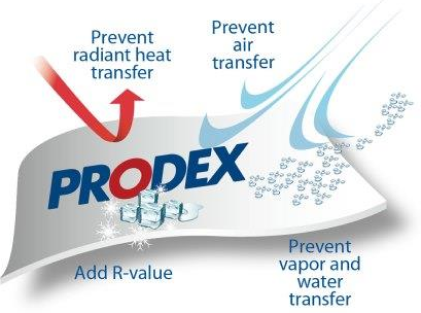
2. Prevents Heat Transfer in and out
Heat - Mid-summer sun rays hitting the metal sheeting radiates downward (inside). It makes it unbearably hot and humid inside.
Cold - Winter temperatures turn metal sheeting cold. The cold sheeting creates the effect of an ice box making it colder inside the building than out. This also adds to the condensation problem.
R-value is the measurement of a material's ability to stop heat transfer. If two products have the same R-value, they have the same efficiency in stopping heat transfer.
I thought I had a Higher R-value - Fiberglass Insulation Blankets Lose R-value
Once metal sheeting gets cold it creates a situation where it's colder inside the building that out. To combat this you need an insulation that doesn't lose its thermal protection when you need it most!
The Prodex R-value is not affected by humidity. Metal building insulation blankets (fiberglass), lose R-value once damp (and it will get damp in a metal building). Once fiberglass insulation gets damp, it will stay damp. Not only will you have trapped moisture in the blanket causing rot, rust, oxidation, mold etc., the damp blanket will provide less and less R value as the moisture builds. Couple this with the fact that fiberglass insulation does not prevent radiant heat transfer (primary source of heat flow) and you can see why fiberglass insulation is not the recommended insulation for pole barns.
Ever wonder why it's so hot and wet inside a metal shed in the summer and so cold and wet in winter? The metal skin magnifies the heat of the summer sun and frigid temperatures of the winter. Metal is a very good conductor of heat and cold. In hot weather, metal framing and sheeting rapidly radiate the sun's heat into a building. In cold weather it rapidly releases the heat out of your building. When warm air comes in contact with the cool metal sheet, condensation occurs.
3. Stops Air Transfer
Air flow carries moisture that impacts the temperature and integrity of the building. Air-flow affects a building's behavior in fire (spread of toxic smoke and gasses). Air barriers also separate garages from conditioned spaces. In this case an air barrier would also serve as a "gas barrier" an obvious safety feature. Prodex Total is an air barrier.
5. Doesn't Support Rodents, Bugs and Birds
Unlike fiberglass insulation, Prodex Total does not provide for the nesting of rodents, bugs and birds. Rodents, bugs and birds aren't able to digest the foil.
6. Installs Easily
It's a lot easier and less expensive to install a roll of Prodex than a bulky 6 inch roll of fiberglass. Pinching 6 inches fiberglass between the framing and sheeting is not easy. Prodex Total can be installed before or after your metal sheeting. For fastest and easiest installation, install before applying your sheeting. Video of retrofit strap install method | More install methods
7. Vapor Barrier
Prodex is a class 1 vapor barrier. A vapor barrier (moisture barrier) refers to any material that prevents moisture from passing through the walls or roof of a building. This material can be plastic or better yet, Prodex Total Insulation - closed cell polyethylene foam and reflective reinforced foil facing. Prodex Total Insulation (Vapor Barrier, Class 1. perm<0.1 ).
No Leak - Prodex Total Plus seals around nails and screws.
8. Won't Promote Mold Or Mildew
Resistance to Growth of FUNGI
Aspergillus niger
Aspergillus avus
Aspergillus versicolor
Penicillium funiculosum
Chaetomium globosum

Metal Building Insulation For Sale - Prodex Total

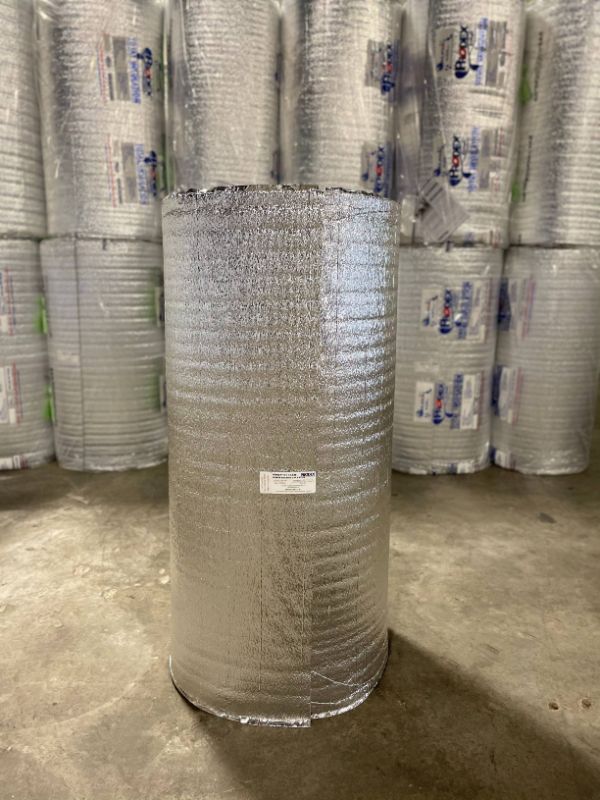
5M Plus: R17
Select one of these 5M items: 48 inch, Fast Action, 62 inch Fast Action, 72 inch, 24 inch or 16 inch. Thickness: 5mm (0.2") closed cell polyethylene foam covered on both sides with reinforced reflective foil.
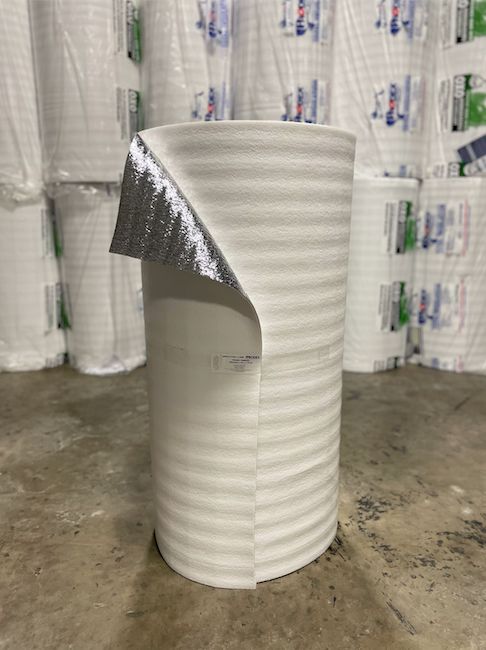
WHITE 5M Plus: R15.3
Thickness: 5mm (0.2") closed cell polyethylene foam with reflective reinforced foil on one side and plastic white finish film on the other side. Ideal where white finish is preferred.
Calculate amount of insulation required for your building
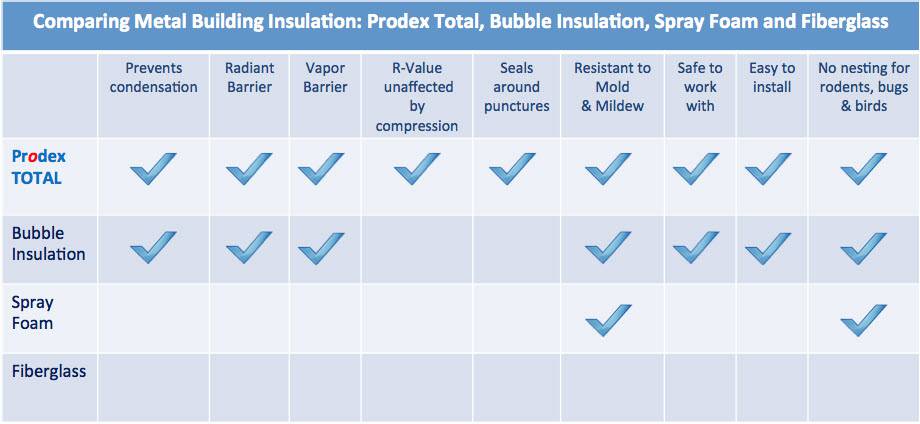
COMPARING METAL BUILDING INSULATION
Fiberglass, Spray Foam and Bubble vs PRODEX In Steel Buildings
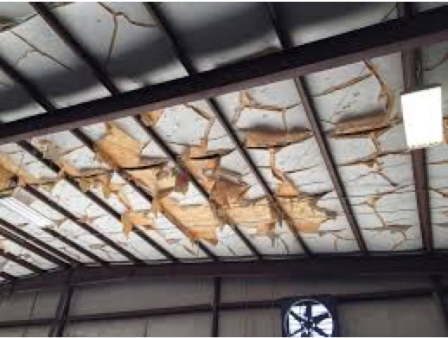
Fiberglass Loses R-value And Cracks In Metal Buildings
Once fiberglass insulation gets wet (and it will get wet, due to condensation) it will lose R-value! Water trapped between fiberglass insulation and the exterior of a building will also cause mold, fungus growth, rust and oxidation - Conditions that will degrade the metal and shorten the service of the structure. In addition, fiberglass insulation does not prevent radiant heat transfer (the primary source of heat-flow in and outside your building). The Prodex Total R-value is not affected by humidity. This feature cannot be over emphasized. There will always be some humidity in a metal building and your insulation must work in these conditions.
Take a look at the white vinyl facing the next time you're in a metal building - It will be either sagging, or sagging and flaking. This is due to the added weight of water. Behind the white vinyl is a wet, mold filled blanket that will eventually cause the white vinyl to crack and fall off. At some point, when you're exposed to the toxic fibers, you'll be forced to remove the insulation - Hopefully before it does too much damage to the metal framing. Avoid an insulation that collects moisture, attracts mold, cracks and needs to be replaced. If you insist on using fiberglass, use it in conjunction with Prodex Total, so the Prodex can keep the moisture out of the fiberglass.
For those of you the like to get into the weeds, I'll explain in more depth why fiberglass loses R-value once wet.
Fiberglass insulation is composed of woven fiber stands. The fiber strands contain hundreds of small air pockets. The air pockets provide the insulation. Once exposed to moisture, the air pockets fill up with water (rather than air) and the insulation loses the ability to provide R-value.
We repeat! If fiberglass is used as metal building or pole barn insulation rather than Prodex Total, you'll have moisture issues (typically hidden behind facing), Loss of R-value (consequence of the moisture) and heat gain.
Disadvantages of Spray Foam Insulation In Metal Buildings
- High spray foam insulation cost
- It doesn't prevent radiant heat transfer (the primary source of heat transfer into and out of a building - especially metal buildings and pole barns.
- Do it yourself spray foam insulation can't be done by yourself to retrofit an existing building structure because of the chemicals and processes involved.
- Nearly impossible to use in conjunction with another insulation type.
- R-value will diminish slightly with age.
- With the exception of cementite foams, spray foam insulation can release toxic fumes when it burns.
- According to the U.S Environmental Protection Agency, there is insufficient data to accurately assess the potential for exposures to the toxic and environmentally harmful isocyanides which constitute 50% of the material.
- Depending on usage, building codes and environment, most foams require protection with a thermal barrier such as drywall on the interior of the house.
- Can shrink slightly while curing if not applied on a substrate heated to manufacture's recommended temperature.
- Although CFC's are no longer used, many use HCFCs or HFCs as blowing agents. Both are potent greenhouse gases, and HCFCs have some ozone depletion potential.
- Most, such as Polyurethane and Isocyanine insulation, contain hazardous chemicals such as benzene and toluene. These are a potential hazard and environmental concern during ray material production, transport, manufacture and installation.
- Many spray foam insulations are made from petrochemicals and may be a concern for those seeking to reduce the use of fossil fuels and oil.
- Most spray foams require protection from sunlight and solvents.
MJbirdie: Wednesday, March 02, 2020
Dear Insulation4Less,
The spay foam was flaking from the building I just bought. It was a mess. It took me two days to scrap the balance of it off. Your 10M went up quick. I used some big head screws and some metal strips to attach it to my framing. I could tell the difference instantly. Good stuff
John S. Wednesday, Feb 13, 2019
Dear Insulation4Less,
I was considering using spray foam for a retrofit of my 50 x 100 warehouse roof. My primary concern was condensation and heat. I'm glad I went your direction. In addition to saving money, I think I got a better product for my money given my needs. No issues of yet. I'll stay in touch.
Bubble Insulation In A Metal Building

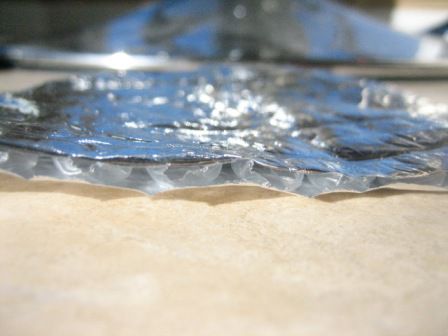
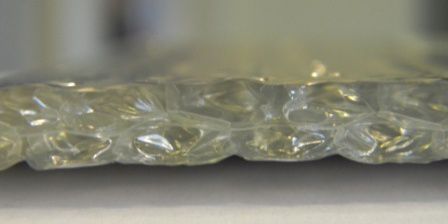
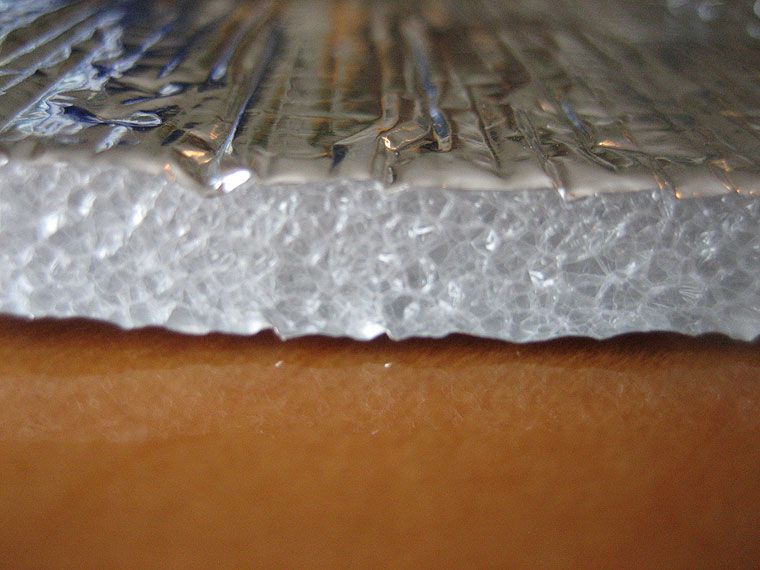
Take a look at the photos above. Even if you didn't know anything about double bubble insulation or Prodex Total, which would you choose? The obvious choice is Prodex Total. It has a high quality core that keeps its shape when exposed to forces. Prodex Total 5M plus has a nominal thickness of 5mm (0.2"). Prodex Total 10M is 10mm (0.4"). Both are closed cell polyethylene foam covered on both sides with reflective reinforced foil facing.
Under pressure, the Prodex micro-cells do not collapse -- With a pressure of 6 PSI Prodex compresses just 6%. When the load is relieved it takes back its initial shape. The density of the foam is between 1.25 lb/ft (sq) - 1.87/ft (sq). This gives the material real body.
Because Bubble insulation has a core composed of air rather than closed cell polyethylene foam, it lacks the long-term consistence in performance of Prodex Total. Learn more about bubble insulation.
Buy Metal Building Insulation With Confidence
Independent Reviews at Site Jabber. Site Jabber is the leading destination for customer reviews of businesses. We include their link (bottom right of every page) because they only allow customer reviews.
BBB report. For over 100 years, BBB has set the standard for ethical business behavior. We're proud to maintain an "A to A+" rating. This rating takes into account a company's size in its relation to complaints.
ICC-ES Recognized - ICC-ES is an evaluation service that takes independent test data for a variety of products and analyses it against a uniform Acceptance Criteria that is recognized internationally.
Prodex adds an extra layer of credibly by submitting these rolls to the ASTM Rima International verification program. By having a third party verification, Prodex assures its clients that the insulation complies with industry standards, and is suitable for any construction system.
Over a million order totaling more than 5 billion square feet of insulation sold.
Dear Insulation4Less,
My name is David. I am the Warehouse Manager for Schlossadler Wines, Inc. We are an international boutique wine distributor with a 9,300 sq. ft. warehouse in Oceanside, CA. Approximately one month ago the owner of the company (my boss) came to me with the task of researching, ordering, and installing insulation for the ceiling of the entire building by myself. With limited experience in this particular area under my belt, I accepted the project anyway. I honestly didn't even know where to start. I sent detailed photos along with our information and questions to your sales team. They replied promptly with very easy instructions and recommendations as to "what type" and "how much" product should be ordered to complete our mission. Now, one month and about 200 hours later, my boss is extremely happy, our stock is cool, and I've received a very generous bonus!!
Thanks Insulation4Less, I will definitely spread around the words: "foil-foam-foil!"
Sincerely,
David W.
Warehouse Manager
Schlossadler Wines, Inc.
Oceanside, CA
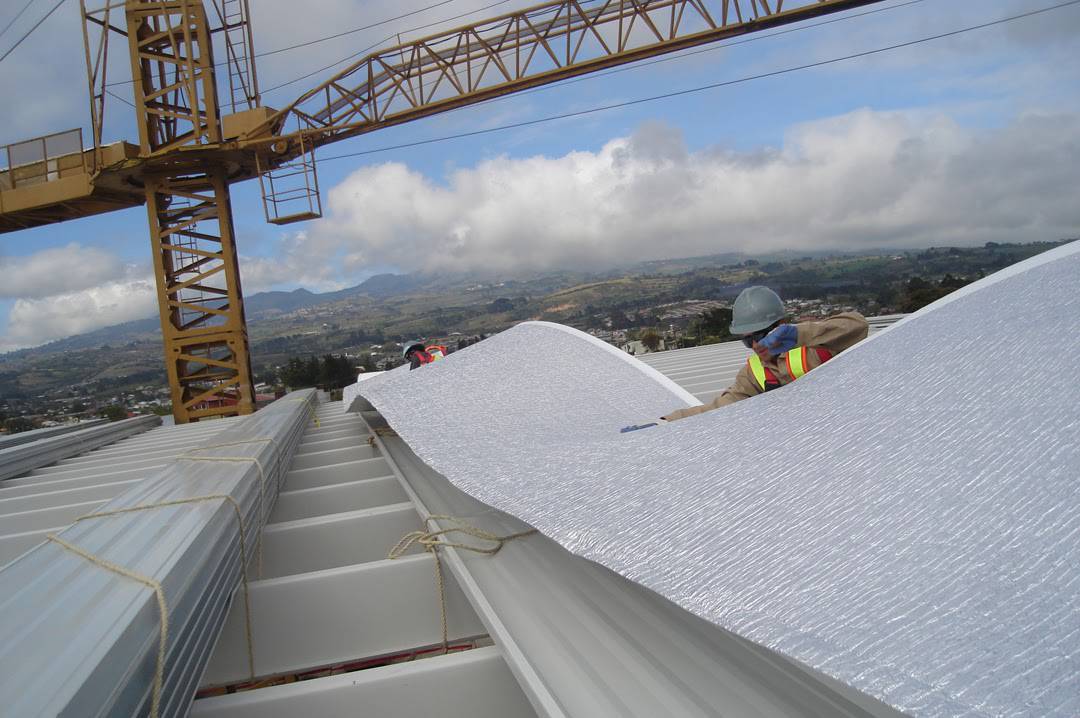
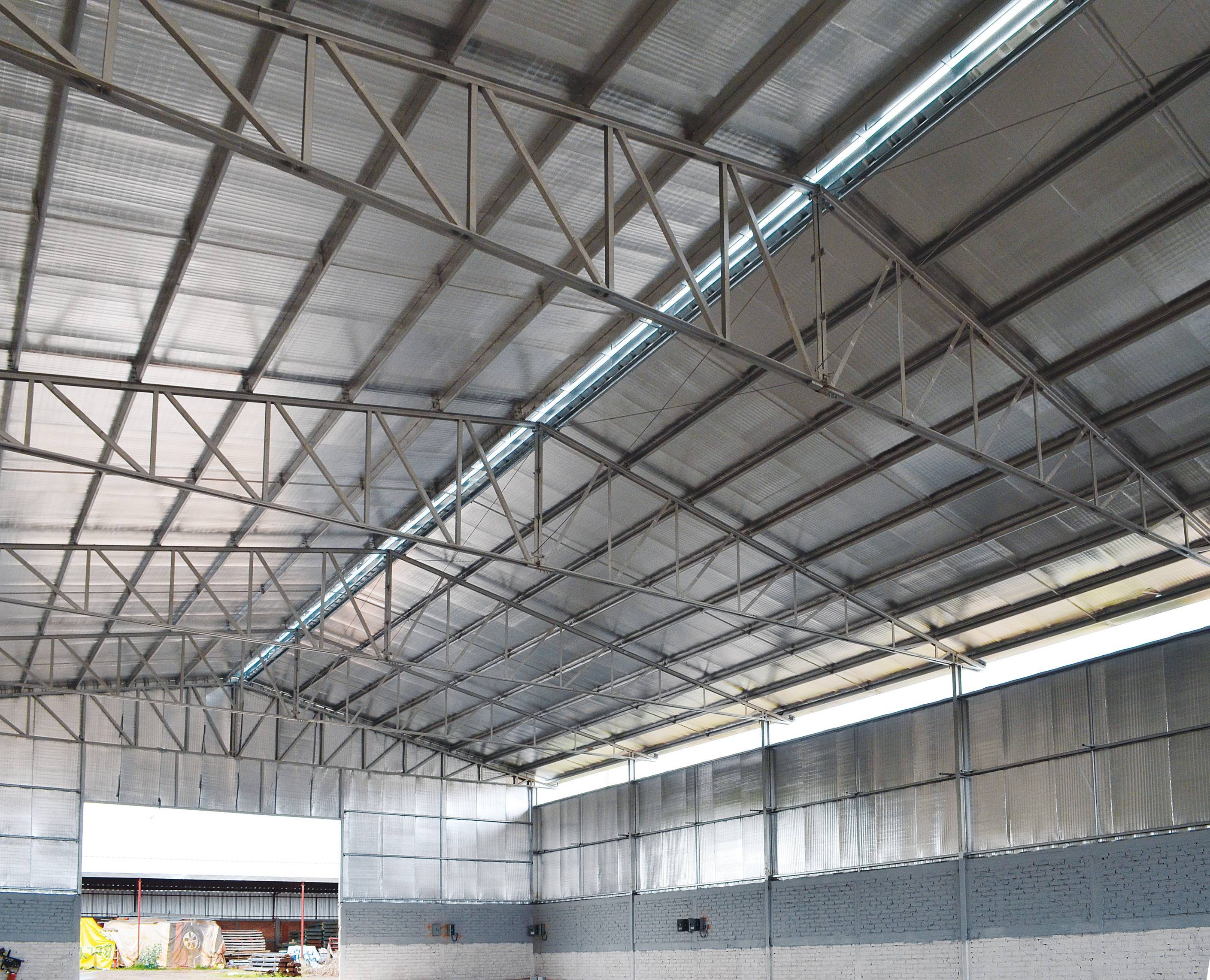
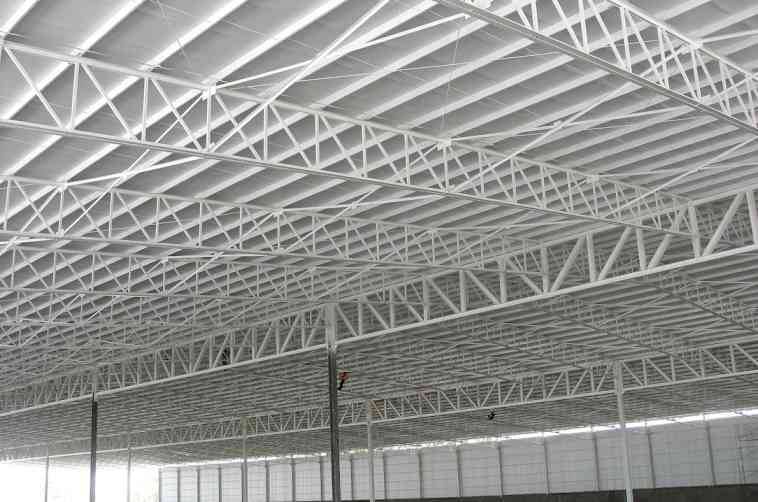
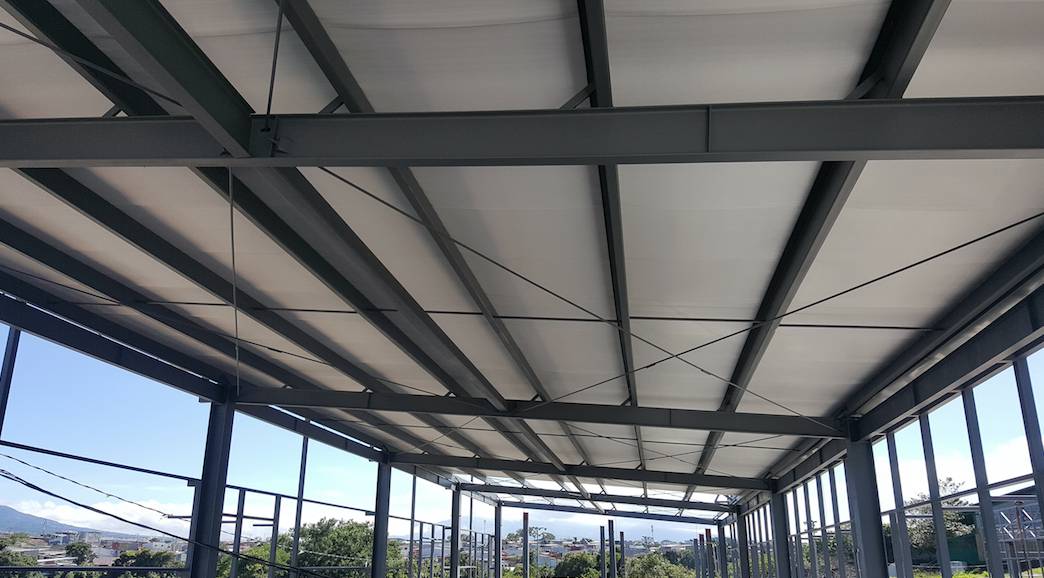
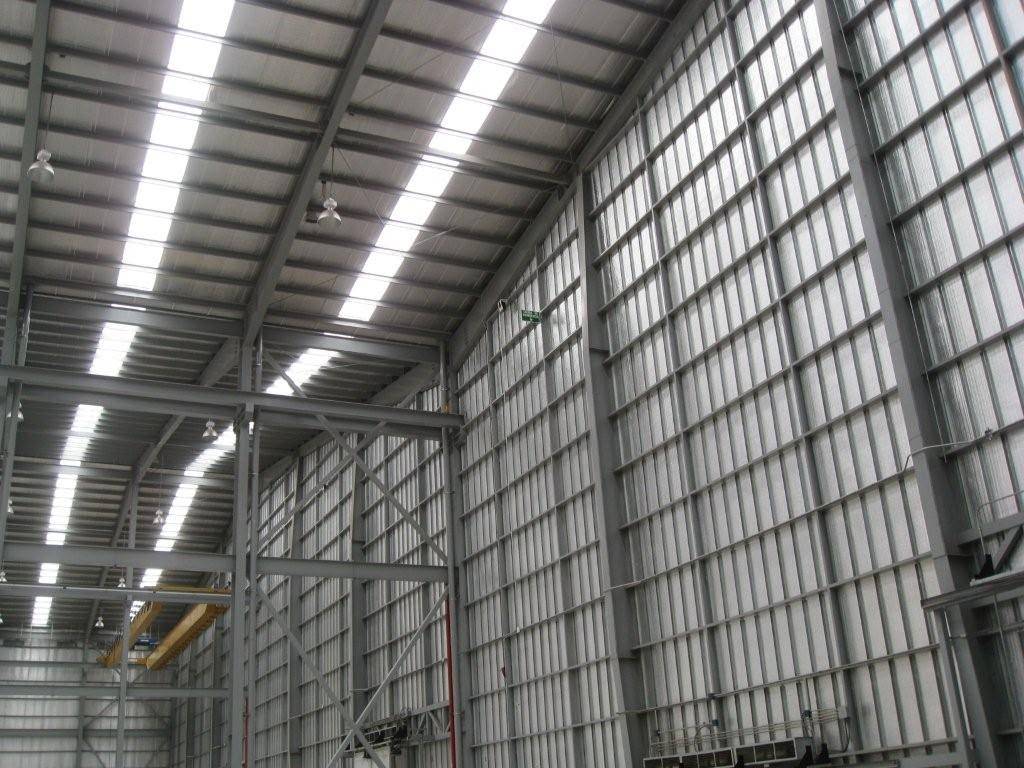
INSULATION + Radiant Barrier + Vapor
Barrier + Air Barrier
ALL IN ONE PRODUCT!
One solution to Cold, Heat and Condensation - You'll be warm in winter, cool in summer and dry all the time.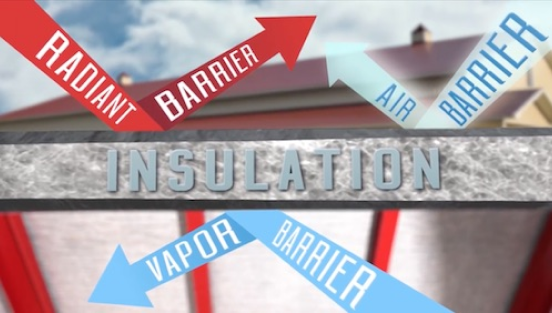
Insulation for metal buildings plays an important role in weather protection, noise and more. Without it, you can end up with leaks, mold, mildew and even unwelcome critters.
Whether you have a primary drive for insulating your metal building or you’re eager to reap the entire list of benefits, your insulation must stop heat, cold, condensation and air to provide the best value.
Metal building insulation can be used in commercial buildings and warehouses, airplane hangars and metal churches, barns and garages, garden sheds and Quonset huts, shipping containers, crawl spaces, and home structures, such as basements, attics and storage spaces.
In other words, if the structure requires protection from either, heat, cold, moisture or air, you’re likely to benefit from the protections of insulation.
Scorching sun, freezing wind or rattling hail? No problem. Deafening noise interrupting your home office meetings? Easily solved.
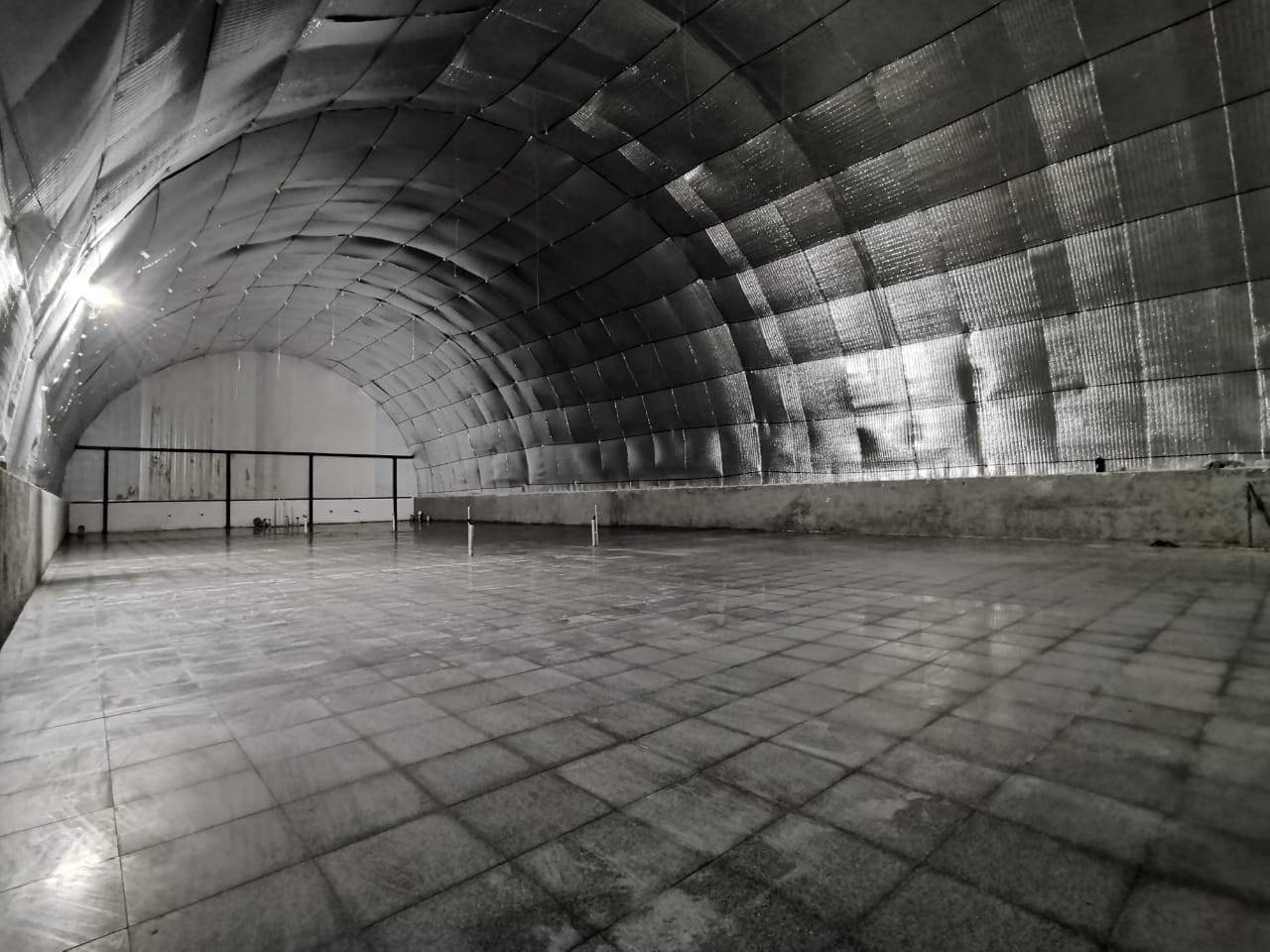
Prodex is a new-generation multifaceted product that serves as an all-in-one: it stops condensation, heat, cold and air, absorbs the sound of rain and hail, helps prevent rodents, bugs and birds, and prevents the occurrence of fungi like mold and mildew.
The reflective nature of Prodex keeps the temperature consistent on the inside and outside of the sheeting and prevents condensation. It creates an air barrier that is directly related to the safety of the building in case of fire.
Due to its light weight, it is easy to install, work with and transport, which makes it a preferred alternative for insulation of metal buildings, for both professional insulation companies and DIY homeowners.
In hot sunny climates, the use of radiant barriers like Prodex can significantly lower cooling costs due to decreased heat transfer and reduced need for air-conditioning appliances.
Insulation4less provides quality insulation for steel buildings corresponding to your needs, preferences and budget. We also provide fast delivery services, installation methods and expert advice to help ensure you get the best value for your money.
From our Fast Action Prodex Total to our 10M, we have many different Prodex options to choose from and each will leave you with lasting benefits for your metal building insulation project.
In home applications, Prodex Total is used as stand alone and supplemental insulation - The choice depends on your insulation needs.
Because bubble insulation has a core composed of air rather than closed cell polyethylene foam, it lacks the long-term consistency in performance of Prodex Total Insulation.
Bubble wraps are composed of either one (single bubble) or two (double bubble) layers of air bubbles sandwiched between two metalized surfaces. Once the surface of single or double bubble is punctured, it collapses.
Foil only radiant barriers are typically perforated and composed of two metalized surfaces with a mesh woven in for strength. It is not a vapor barrier - It is not insulation. Because foil only products have no membrane (substance between the layers of reflective material) transference of heat and or cold can occur.
Reflective Insulation is a system that reduces the transfer of heat across air space by the use of two surfaces having high thermal reflectance and low emittance (typically metalized film) + an inner substance + trapped airspaces.
The R-value of reflective insulation is the measurement of the system rather than a measurement of just the product. Measuring the R-value of the system (a real-world application) is a truer measurement vs. a measurement of the product only. For example, what good is the posted R-value of fiberglass given that once installed in an environment that includes any moisture it loses R-value? Virtually all real-world environments include some humidity. Unlike fiberglass the R-value of Prodex Total insulation is NOT affected by humidity.
Equipment needed: Reflective tape, a utility knife, a staple or screw gun
Insulation Over Trusses
- Drape the selected Prodex type over the trusses.
- Let the insulation sag a minimum of 2 inches.
- Apply decking.
- Apply the selected Prodex directly on the decking.
- Use 1”x 3” furring strips on top of the insulation.
- Install tiles.
- Apply the desired Prodex insulation directly on decking or shingles.
- Use 1”x 3” furring strips on top of the insulation.
- Install the metal roof.