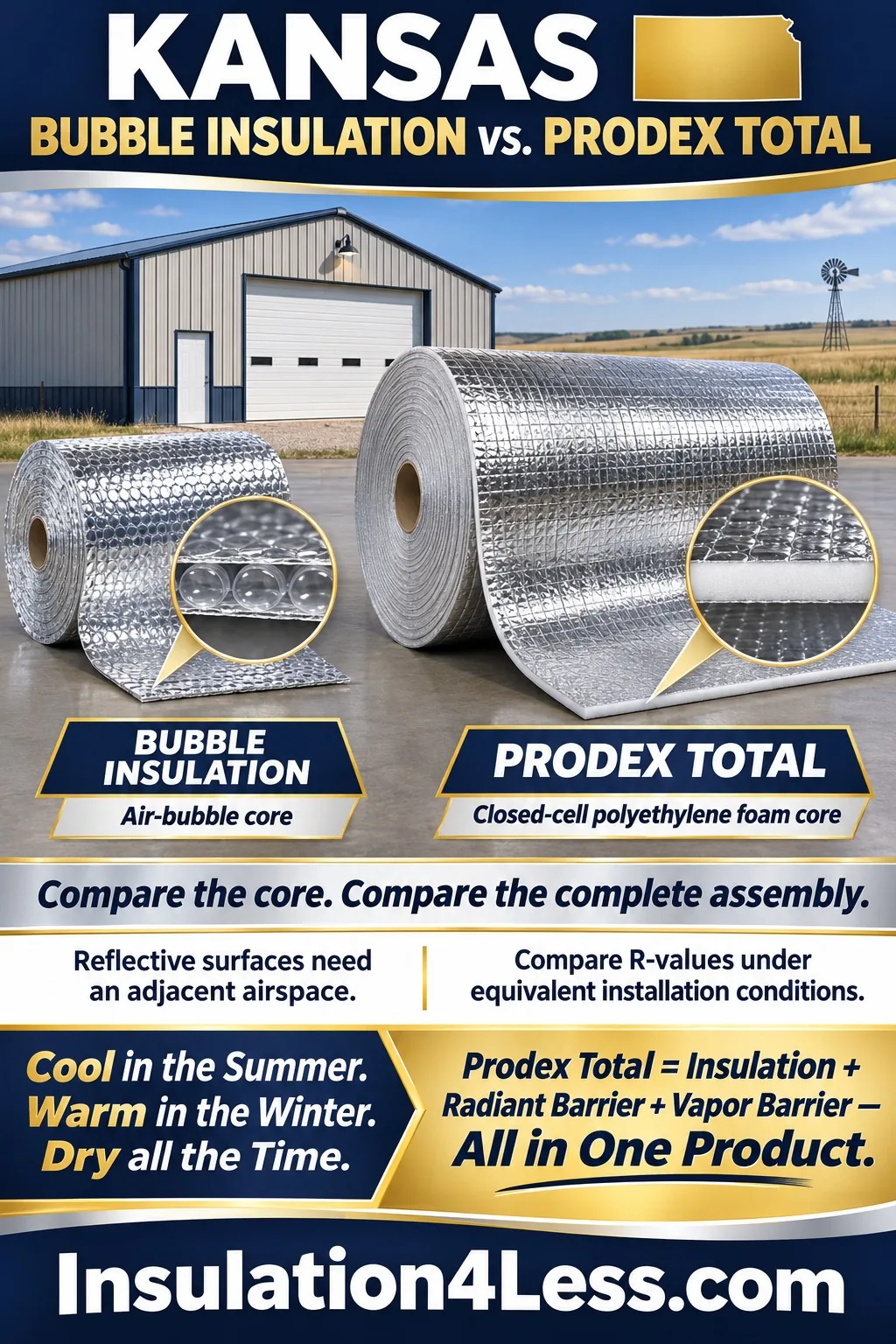
Kansas Bubble Insulation vs. Prodex Total: What to Compare Before You Buy
Reflective insulation rolls can look similar from a distance. Shiny facing, lightweight construction and compact packaging can make different products appear interchangeable.
The differences become clearer when you examine the core material, product specifications and intended installation.
For a Kansas farm shop, pole barn, home or storage building, compare more than the appearance of the foil. Consider thermal resistance, radiant heat control, moisture management and the complete roof or wall assembly.
Bubble insulation uses an air-bubble core. Prodex Total uses a closed-cell polyethylene foam core. Both product selection and installation details matter when deciding which approach fits your project.
For related applications, visit our Kansas insulation guide.
Cool in the Summer. Warm in the Winter. Dry all the Time.
Prodex Total = Insulation + Radiant Barrier + Vapor Barrier — All in One Product.
What Is Bubble Insulation?
Bubble wrap insulation contains plastic air bubbles combined with reflective facing. Products may use a single bubble layer or multiple bubble layers, with different facing combinations.
Those differences matter. A foil-faced product and a white-poly-faced product should not automatically be assigned the same performance characteristics.
Review the specifications for the exact roll you are considering, including its core, facings, tested ratings and installation requirements.
Single Bubble Insulation
Single bubble insulation uses one bubble layer within the product.
Its suitability depends on the intended application and the performance required from the finished assembly. A low purchase price alone does not establish whether it meets the needs of a heated shop or another conditioned building.
Reflective Bubble Insulation
Reflective bubble insulation combines its bubble core with reflective surfaces.
Those surfaces need an appropriate adjacent airspace to provide their radiant-barrier function. The reflective facing does not eliminate the need to plan thermal resistance, seams, attachment and moisture control.
How Prodex Total Differs
Prodex Total contains closed-cell polyethylene foam rather than an air-bubble core.
Its foam core contributes thermal resistance, while its reflective facing reduces radiant heat transfer when facing an appropriate airspace. In a properly detailed installation, the product can also provide air- and vapor-control functions.
This construction difference should be part of the comparison. Similar-looking reflective faces do not mean the products have identical cores, tested performance or installation requirements.
Our national comparison of bubble insulation and Prodex Total provides additional product information.
Reflective Surfaces Need an Airspace
A reflective surface reduces radiant heat transfer across an adjacent airspace. This principle applies to both reflective bubble products and Prodex Total.
When foil is pressed directly against another solid material, that interface does not provide the same radiant-barrier benefit.
For example, a reflective face beneath metal roofing needs the airspace specified by the selected assembly. Installing the material tightly between two solid surfaces creates a different arrangement from a tested assembly that includes reflective airspaces.
Our reflective insulation guide explains how installation conditions affect performance.
Compare R-Values Under Equivalent Conditions
An advertised R-value needs context.
A material R-value describes the thermal resistance of the material under specified conditions. An assembly rating describes a particular arrangement that may include airspaces and other components.
Before comparing products, check whether the ratings refer to the same type of measurement. Also review insulation thickness, airspace dimensions, heat-flow direction and the other conditions associated with each test.
Do not assume that adding a second bubble layer doubles the R-value of the completed installation. Likewise, do not treat a reflective assembly rating as the material-only rating of the roll.
Choose the insulation system around the required performance of your building.
Kansas Metal Building Applications
A steel shop or warehouse needs an insulation plan that considers radiant heat, winter heat loss and moisture reaching cold metal surfaces.
Compare the proposed bubble installation with the proposed Prodex Total installation as complete systems. Identify the airspaces, supports, seam treatment and any additional insulation required.
Where continuous insulation is specified, carry it across the secondary framing rather than leaving exposed members between insulated sections.
Our Kansas metal building insulation guide explains these planning considerations. For product benefits and buying information, explore the best metal building insulation.
For installation methods, review how to insulate a metal building.
Kansas Pole Barn Applications
A pole barn used for equipment storage has different insulation requirements from a heated farm shop or barndominium.
Before choosing a reflective roll, establish whether insulation will follow the roofline or a flat ceiling. Then plan wall coverage, air sealing and moisture control around that boundary.
Compare the exact products and assemblies rather than selecting solely by roll price or foil appearance.
Read our Kansas pole barn insulation guide. The national pole barn installation guide explains methods for new construction and existing buildings.
Condensation Control Requires More Than Reflective Facing
Condensation can form when moist air encounters a sufficiently cold surface. Reflective facing alone does not guarantee a dry building.
An effective plan considers indoor moisture sources, ground moisture, ventilation, air leakage and insulation placement. Seams, edges and penetrations require suitable detailing where the insulation serves as an air or vapor barrier.
Repair roof leaks before covering the underside of the roofing. Also review existing vapor-resistant layers before adding another one.
Compare the vapor-control properties of the exact bubble product with those of the selected Prodex Total roll. Do not assume all reflective products have identical specifications.
Choosing a Prodex Total Roll
10M Prodex Total Plus is the most popular and thickest reflective insulation roll in the Prodex Total range.
It features a 10 mm, approximately 0.4-inch, closed-cell polyethylene foam core with reflective foil on both sides. Each 4-foot × 85.3-foot roll covers 341 square feet and features heat-welded seams.
The 5M Plus range is 5 mm thick and includes white, black or rustic finishes on one side, with reflective foil on the other.
Select the roll together with the installation method, desired interior appearance and available airspace.
When Additional Thermal Resistance Is Needed
A continuously heated or cooled building may require additional insulation to achieve the specified assembly performance.
Fiberglass and Prodex Total can serve complementary roles. Fiberglass provides cavity thermal resistance, while properly installed Prodex Total adds insulation and can contribute radiant heat and vapor control.
Added R, radiant heat and vapor control.
Our Kansas fiberglass vs. Prodex Total comparison explains these roles.
If you are evaluating other materials, review our guides to spray foam insulation for metal buildings and pole barns and foam board insulation.
Compare the Installed Project
Roll price is only part of the purchasing decision.
Consider coverage per roll, overlaps, cutting waste, required accessories, attachment methods and installation access. Include any additional insulation needed to complete the specified assembly.
For existing buildings, inspect the material already installed. If facing is separating or the insulation is damaged, identify the product and assess the conditions before selecting a replacement. Appearance alone does not establish the cause of the damage.
For overhead applications, our Kansas roof and ceiling insulation guide provides related planning information.
Estimate Quantities Before Ordering
Measure the roof and wall surfaces you intend to cover. Account for roof slopes, end walls, overlaps and transitions rather than relying on floor area alone.
Read how much insulation you need, then use the Advanced Insulation Calculator to estimate quantities for the selected application.
Confirm the product, complete assembly, support method and seam treatment before purchasing.
Choose Insulation by Construction and Performance
For a Kansas insulation project, compare the core material, facings, tested conditions and installation requirements.
Bubble products use air-bubble cores. Prodex Total uses closed-cell polyethylene foam. Both reflective appearance and advertised ratings need to be understood in the context of the finished assembly.
Explore 10M Prodex Total Plus, review the appropriate installation guide and choose a system suited to your building.
Cool in the Summer. Warm in the Winter. Dry all the Time.
Prodex Total = Insulation + Radiant Barrier + Vapor Barrier — All in One Product.