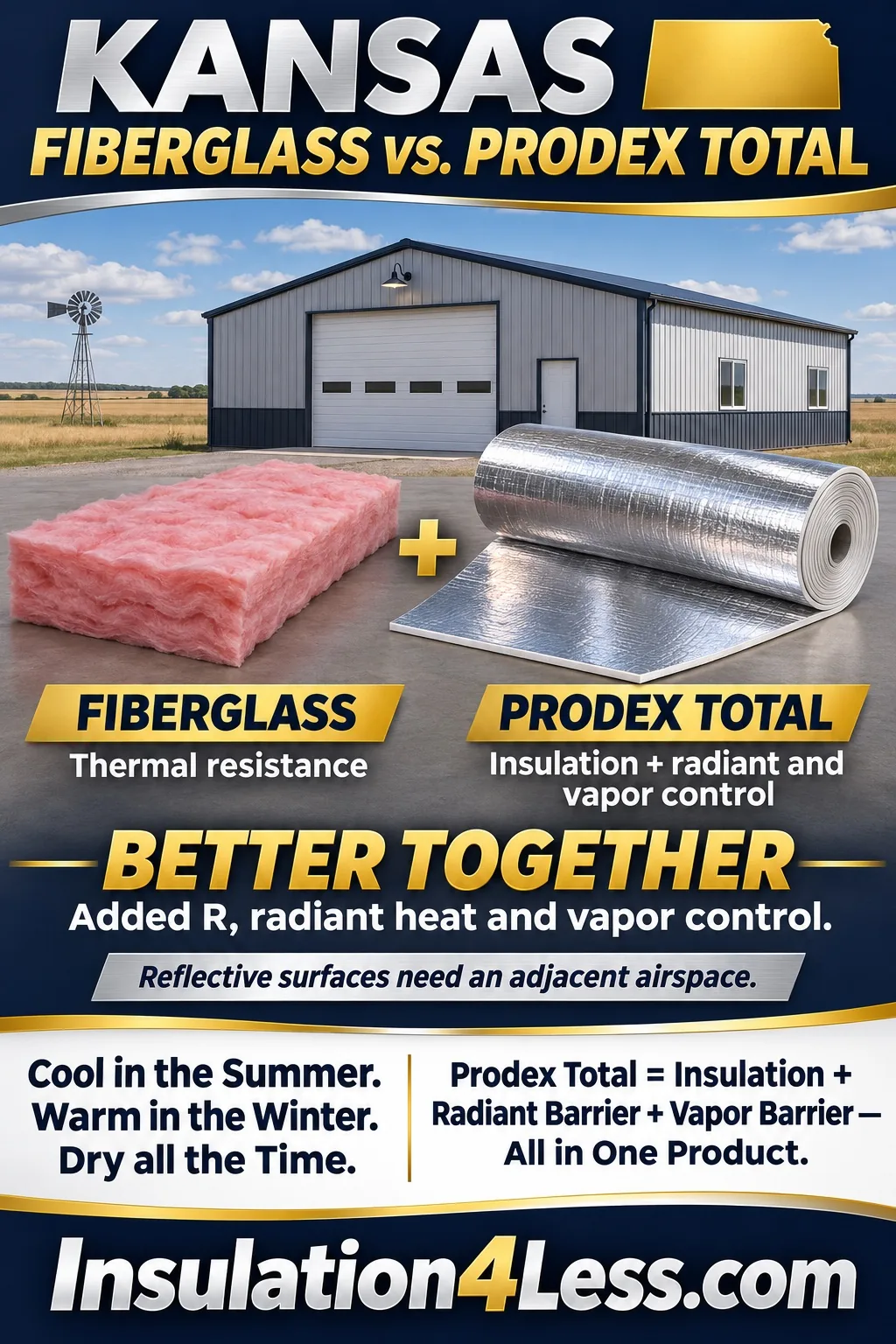
Kansas Fiberglass vs. Prodex Total Insulation: Differences and Combined Benefits
Choosing insulation for a Kansas building involves more than comparing roll thickness or advertised R-values. A heated farm shop, steel warehouse and traditional house have different construction details and performance needs.
Fiberglass and Prodex Total address those needs in different ways. Fiberglass provides thermal resistance through a fibrous structure that holds air. Prodex Total combines a closed-cell polyethylene foam core with reflective facing, adding insulation and providing radiant-barrier and vapor-barrier functions in a suitable installation.
The materials can also work together. The right choice depends on the complete roof, wall or floor assembly, including framing, airspaces, air sealing and moisture management.
Visit our Kansas insulation guide for related applications.
Cool in the Summer. Warm in the Winter. Dry all the Time.
Prodex Total = Insulation + Radiant Barrier + Vapor Barrier — All in One Product.
How Fiberglass and Prodex Total Differ
Fiberglass Provides Thermal Resistance
Fiberglass insulation uses fine glass fibers to hold air within its thickness and resist heat flow. Its performance depends on the specific product and correct installation.
Available space matters. Compressing fiberglass, leaving gaps or installing it around obstructions without proper fitting can reduce the performance of the completed assembly.
Fiberglass itself does not create a continuous air or vapor barrier. Some products include facings that serve additional functions, so evaluate the complete product rather than the fibers alone.
Explore available fiberglass metal building insulation when planning a Kansas shop, warehouse or agricultural building.
Prodex Total Combines Foam and Reflective Facing
Prodex Total uses closed-cell polyethylene foam rather than a fibrous core.
The foam contributes thermal resistance. Reflective facing reduces radiant heat transfer when it faces an appropriate adjacent airspace. A properly detailed installation can also provide continuity for air and vapor control.
These functions depend on product selection and installation. Seams, edges, penetrations and connections to surrounding materials all require attention.
Our reflective insulation guide explains these principles.
Compare R-Values Under Equivalent Conditions
A meaningful comparison begins with understanding what each published rating measures.
A material R-value describes the thermal resistance of the material under specified test conditions. An assembly rating describes a particular arrangement that may include insulation, airspaces and other components.
Do not compare a fiberglass material rating directly with a reflective assembly rating without examining the tested configurations.
For either product, review insulation thickness, airspaces, heat-flow direction and the other conditions associated with the rating. Then determine whether the proposed installation matches that arrangement.
A thin reflective roll should not automatically be treated as a replacement for every specified thickness of fiberglass. Likewise, fiberglass thickness alone does not describe a building’s radiant heat, air leakage or moisture-control performance.
Radiant Heat Beneath Kansas Metal Roofs
A sun-heated metal roof can radiate heat toward the building interior. This can affect comfort in farm shops, warehouses and pole barns.
Prodex Total’s reflective surface addresses radiant heat transfer across an adjacent airspace. That space is essential to the radiant-barrier function.
Fiberglass can touch one face of the Prodex where the selected assembly permits it. However, that contact does not create the reflective airspace on that face. The opposite reflective face may still provide its radiant-barrier function if it faces a suitable airspace.
For application planning, see our Kansas roof and ceiling insulation guide.
Moisture Control Requires a Complete Plan
Protecting Fiberglass Performance
Fiberglass performs best when it remains dry, properly supported and at its specified thickness. Water intrusion, displacement and installation gaps can compromise the assembly.
Prodex Total can form part of a system designed to limit moisture reaching fiberglass or cold metal surfaces. Its placement and seam treatment must suit the construction.
Roof leaks, ground moisture and indoor humidity still need to be addressed separately.
Avoiding Moisture Traps
Adding a vapor-resistant layer changes how an assembly manages moisture.
Before combining materials, identify existing facings and other vapor-resistant layers. Consider where moisture may enter and how the assembly can dry.
Simply adding more layers does not guarantee better moisture control. Plan the arrangement for the building’s use, construction and indoor conditions.
Fiberglass and Prodex Total Can Work Together
A combined system can use fiberglass for cavity thermal resistance and Prodex Total for additional insulation, radiant heat control and vapor control.
Added R, radiant heat and vapor control.
For example, a suitable metal building assembly may position Prodex Total between the metal sheeting and fiberglass, with an appropriate airspace facing a reflective surface. The fiberglass supplies additional thermal resistance while the Prodex layer contributes other enclosure functions.
The exact arrangement must follow the selected installation method. Preserve the fiberglass’s specified thickness, maintain the intended airspace and detail seams and transitions.
Compare the national guidance on Prodex Total vs. fiberglass for metal buildings and Prodex Total vs. fiberglass for pole barns.
Choosing an Assembly for Your Kansas Building
Metal Buildings
Steel framing, metal panels and wide roof areas require coordinated thermal and moisture planning.
Consider whether insulation will be installed before the exterior panels or retrofitted from inside. Where continuous insulation is specified, carry it across the secondary framing rather than leaving exposed members between insulated sections.
Our Kansas metal building insulation guide explains local applications. Explore steel building insulation for product benefits and how to insulate a metal building for installation methods.
Pole Barns
A wood-framed equipment shelter and a continuously heated farm shop need different insulation plans.
Choose the roof or ceiling boundary first, then coordinate wall coverage, airspaces and moisture control. A combined fiberglass and Prodex system may be appropriate where the building needs additional thermal resistance.
Read our Kansas pole barn insulation guide and instructions on how to insulate a pole barn.
Homes
House assemblies require coordination between cavity insulation, continuous layers, weather protection and interior finishes.
Before adding Prodex Total to an existing fiberglass installation, assess the current construction, moisture conditions and intended drying paths.
Our Kansas house insulation guide covers related residential applications. The national home insulation resource provides further product and application information.
Choosing a Prodex Total Roll
10M Prodex Total Plus is the most popular and thickest reflective insulation roll in the Prodex Total range.
It features a 10 mm, approximately 0.4-inch, closed-cell polyethylene foam core with reflective foil on both sides. Each 4-foot × 85.3-foot roll covers 341 square feet and features heat-welded seams.
The 5M Plus range is 5 mm thick and includes white, black or rustic finishes on one side, with reflective foil on the other.
Choose the roll alongside the assembly design, available space, desired interior appearance and attachment method.
Compare Installed Systems and Material Quantities
Purchase price is one part of the comparison. Also consider required accessories, installation access, supports, seam treatment and any additional insulation needed to complete the assembly.
Measure the surfaces each layer will cover. A continuous roll installed across framing may require a different layout from fiberglass fitted within cavities.
Read how much insulation you need, then use the Advanced Insulation Calculator to estimate quantities for the selected application.
Choose Materials That Work Together
For a Kansas building, the useful comparison is how each material contributes to the required assembly.
Fiberglass supplies thermal resistance. Properly installed Prodex Total adds insulation and can contribute radiant heat, air and vapor control. Together, they can address several performance needs within one coordinated system.
Review the relevant installation guide, confirm the complete assembly and explore 10M Prodex Total Plus for your project.
Cool in the Summer. Warm in the Winter. Dry all the Time.
Prodex Total = Insulation + Radiant Barrier + Vapor Barrier — All in One Product.