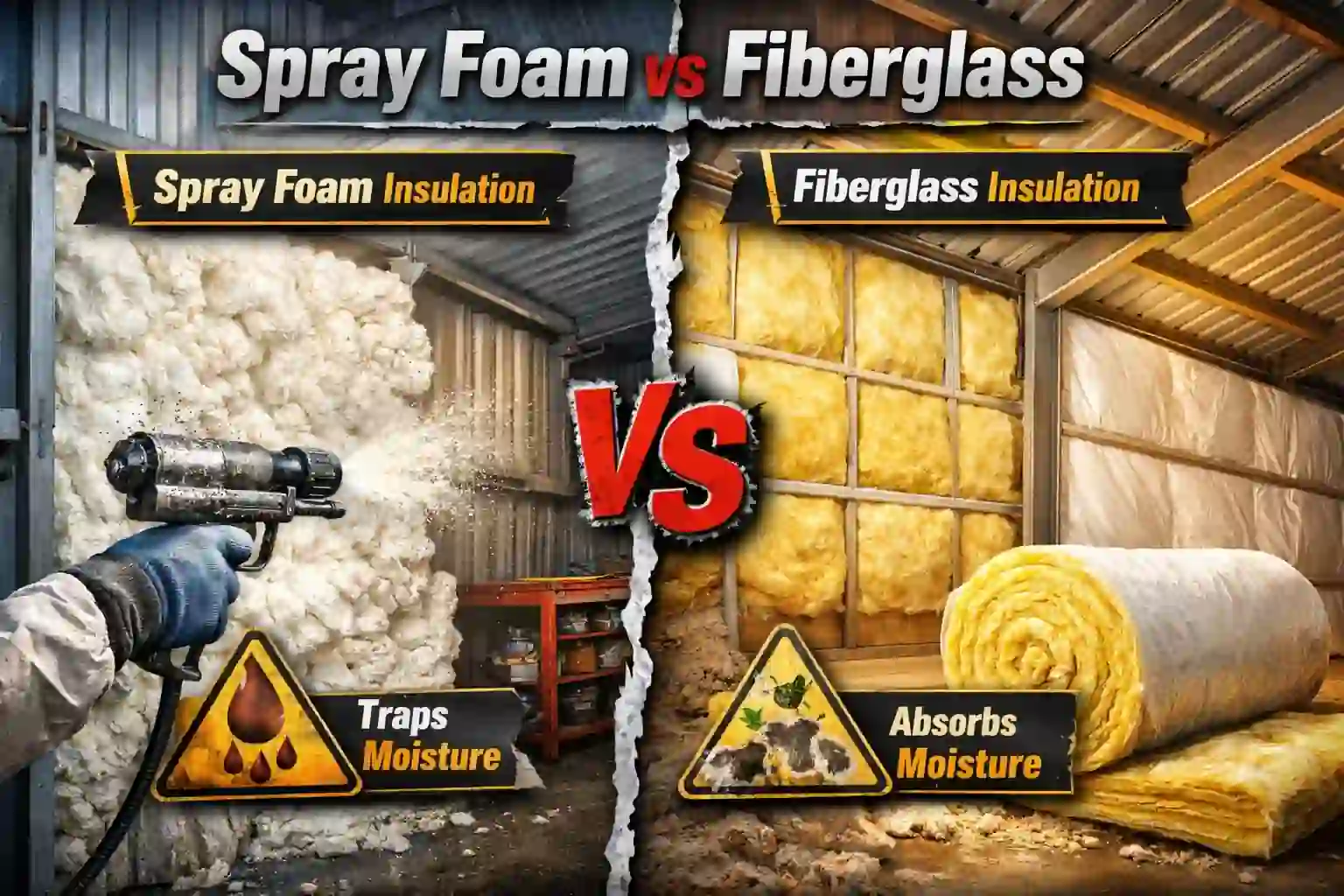
Spray Foam vs. Fiberglass Metal Building Insulation (And the Best Option)
Metal buildings are popular for workshops, garages, warehouses, agricultural buildings, and commercial spaces because they’re durable and cost-effective. But they also come with one major issue that building owners often underestimate: condensation and temperature control.
Steel heats up fast, cools down fast, and reacts instantly to humidity changes. That combination creates the perfect environment for moisture problems, rust, mold, and uncomfortable interior temperatures.
Most people compare spray foam metal building insulation vs. fiberglass metal building insulation. But there’s a third option designed specifically for metal buildings — Prodex Total Insulation — and in many cases, it outperforms both.
Why Metal Buildings Need Insulation That Stops Condensation
Condensation forms when warm, humid air contacts cold metal panels. The moisture in the air turns into water droplets on the underside of the steel, leading to issues that can quickly become expensive.
Common problems caused by condensation in metal buildings include:
Rust and corrosion on metal panels and framing
Mold and mildew growth
Wet insulation that loses effectiveness
Damage to stored equipment, tools, and materials
Higher energy bills due to poor thermal performance
For a deeper breakdown of why metal buildings sweat and what actually stops it, see:
https://www.insulation4less.com/metal-building-insulation-stop-condensation-heat-cold-and-air
Spray Foam Metal Building Insulation: Pros and Cons
Spray foam insulation is widely used in metal buildings because it expands to fill gaps and creates an air seal. In theory, that makes it a strong option for energy efficiency.
Benefits of Spray Foam in Metal Buildings
Creates an air seal that reduces drafts
Can provide a high R-value (especially closed-cell foam)
Fills cracks and hard-to-reach spaces
Drawbacks of Spray Foam Metal Building Insulation
Despite its popularity, spray foam has several disadvantages in metal buildings:
It does not reflect radiant heat, which is one of the biggest drivers of heat gain and loss in metal structures
It can trap moisture between the foam and the steel, which can lead to hidden corrosion over time
It is expensive compared to other insulation methods
Installation typically requires professional equipment and labor
Repairs or modifications later can be difficult because foam is permanent once applied
If you want the full side-by-side comparison, you can reference:
https://www.insulation4less.com/prodex-total-insulation-vs-spray-foam-insulation-for-metal-buildings
Fiberglass Metal Building Insulation: Pros and Cons
Fiberglass is one of the most common insulation materials in the U.S. It’s often chosen because it’s affordable and familiar.
Benefits of Fiberglass in Metal Buildings
Lower upfront material cost
Easy to find and widely available
Can be installed without specialized equipment
Drawbacks of Fiberglass Metal Building Insulation
Fiberglass insulation has several issues that are especially important in metal buildings:
It can absorb moisture from condensation, reducing performance and increasing mold risk
It can sag, compress, or shift over time, creating gaps and weak spots
It does not block radiant heat, which is a major factor in metal building comfort
It may require additional vapor barriers and careful sealing to perform well
For the detailed comparison, see:
https://www.insulation4less.com/prodex-total-insulation-vs-fiberglass-insulation-for-metal-buildings
Why Prodex Total Insulation Is the Best Option for Metal Buildings
Spray foam and fiberglass both have strengths, but neither is engineered specifically for the unique conditions inside metal buildings.
Prodex Total Insulation was designed to address the most common metal building problems in one system:
Condensation control
Radiant heat reflection
Vapor barrier protection
Waterproof durability
Long-term performance
Prodex Total Insulation Helps Stop Condensation Before It Starts
One of the biggest advantages of Prodex Total Insulation is that it is built to prevent condensation — not just cover it up.
Unlike fiberglass (which can hold moisture) or spray foam (which can trap moisture behind it), Prodex Total helps create a barrier that supports a drier, more stable interior environment.
Prodex Total Reflects Radiant Heat (A Major Advantage in Metal Buildings)
Metal buildings are heavily impacted by radiant heat from the sun. This is why they get so hot in summer and lose heat so fast in winter.
Prodex Total includes a radiant barrier that reflects heat rather than absorbing it, which helps improve comfort and reduce energy loss.
Prodex Total Is Waterproof and Vapor-Tight
Moisture is one of the biggest enemies of metal building insulation.
Prodex Total does not absorb water and does not break down when exposed to humidity — making it ideal for garages, shops, barns, warehouses, and storage buildings.
Prodex Total Is Easier to Install Than Spray Foam
Spray foam is often marketed as a premium insulation, but it usually requires professional crews, spray equipment, and safety precautions.
Prodex Total installs in rolls and can be installed quickly and cleanly, without the mess, odor, or permanent application issues of spray foam.
Comparing All Three Options: Prodex vs Spray Foam vs Fiberglass
| Feature | Prodex Total | Spray Foam | Fiberglass |
|---|---|---|---|
| Condensation Control | Prevents before it forms | Conceals moisture | Prone to moisture absorption |
| Moisture Resistance | 100% waterproof | Can trap moisture | Absorbs water |
| Radiant Heat Reflection | Yes (~97%) | No | No |
| Installation | DIY-friendly rolls | Professional only | DIY |
| Cost | Moderate | High | Low upfront |
| Maintenance | Easy | Difficult | Moderate |
Based on comparisons from Insulation4Less data.
Shop Prodex Total Insulation for Metal Buildings
If you want an insulation system that outperforms both spray foam and fiberglass in metal buildings, Prodex Total Insulation is one of the smartest options available.
Shop Prodex Total Insulation here:
https://www.insulation4less.com/insulation/prodex/10m-prodex-total-insulation
Final Thoughts: Spray Foam vs. Fiberglass Metal Building Insulation
When comparing spray foam metal building insulation vs. fiberglass metal building insulation, it’s easy to focus only on R-value and cost.
But metal buildings demand more than that.
They need insulation that controls moisture, reduces radiant heat, prevents condensation, and stays effective long-term.
That’s why Prodex Total Insulation is a superior option for many metal building applications — delivering the benefits of multiple insulation systems in one product, without the common downsides of spray foam or fiberglass.
What is the best insulation for a metal building?
The best insulation for a metal building is one that controls condensation, resists moisture, and reduces radiant heat. Prodex Total Insulation is designed specifically for metal buildings and often outperforms spray foam and fiberglass — especially when condensation control is the priority.
For more details on stopping condensation, heat, cold, and air movement in metal buildings, visit:
https://www.insulation4less.com/metal-building-insulation-stop-condensation-heat-cold-and-air
Is spray foam good for metal buildings?
Spray foam can work in metal buildings because it seals air leaks and can provide a strong R-value. However, spray foam does not reflect radiant heat and may trap moisture against steel panels in some applications, which can lead to hidden corrosion over time.
For the full comparison, see:
https://www.insulation4less.com/prodex-total-insulation-vs-spray-foam-insulation-for-metal-buildings
Is fiberglass insulation good for metal buildings?
Fiberglass insulation is affordable and commonly used, but it can absorb moisture from condensation. Once fiberglass gets wet, it loses performance and may contribute to mold and mildew problems — which is a major concern in metal buildings.
For the detailed breakdown, see:
https://www.insulation4less.com/prodex-total-insulation-vs-fiberglass-insulation-for-metal-buildings
What insulation stops condensation in metal buildings?
Insulation that includes a vapor barrier and radiant barrier is most effective at stopping condensation. Prodex Total Insulation is designed to prevent condensation by controlling vapor and reducing temperature swings.
If you want a full explanation of why metal buildings sweat and how insulation stops it, visit:
https://www.insulation4less.com/metal-building-insulation-stop-condensation-heat-cold-and-air
Which is cheaper for a metal building: spray foam or fiberglass?
Fiberglass is usually cheaper upfront. Spray foam typically costs significantly more due to professional installation. However, both systems can require extra moisture-control solutions in metal buildings.
A helpful comparison guide is here:
https://www.insulation4less.com/prodex-total-insulation-vs-spray-foam-insulation-for-metal-buildings
What is the difference between Prodex and spray foam insulation?
Spray foam mainly provides air sealing and R-value. Prodex Total combines radiant heat reflection, vapor barrier protection, and insulation performance — while also being waterproof and easier to install.
You can compare them directly here:
https://www.insulation4less.com/prodex-total-insulation-vs-spray-foam-insulation-for-metal-buildings
What is the difference between Prodex and fiberglass insulation?
Fiberglass provides traditional insulation but is vulnerable to moisture. Prodex Total is waterproof, does not absorb condensation, reflects radiant heat, and acts as a vapor barrier — making it more effective for metal buildings.
https://www.insulation4less.com/prodex-total-insulation-vs-fiberglass-insulation-for-metal-buildings
Does Prodex insulation need a vapor barrier?
Prodex Total Insulation already functions as a vapor barrier, so in most metal building applications it does not require an additional vapor barrier like fiberglass often does.
You can also review the metal building condensation guide here:
https://www.insulation4less.com/metal-building-insulation-stop-condensation-heat-cold-and-air