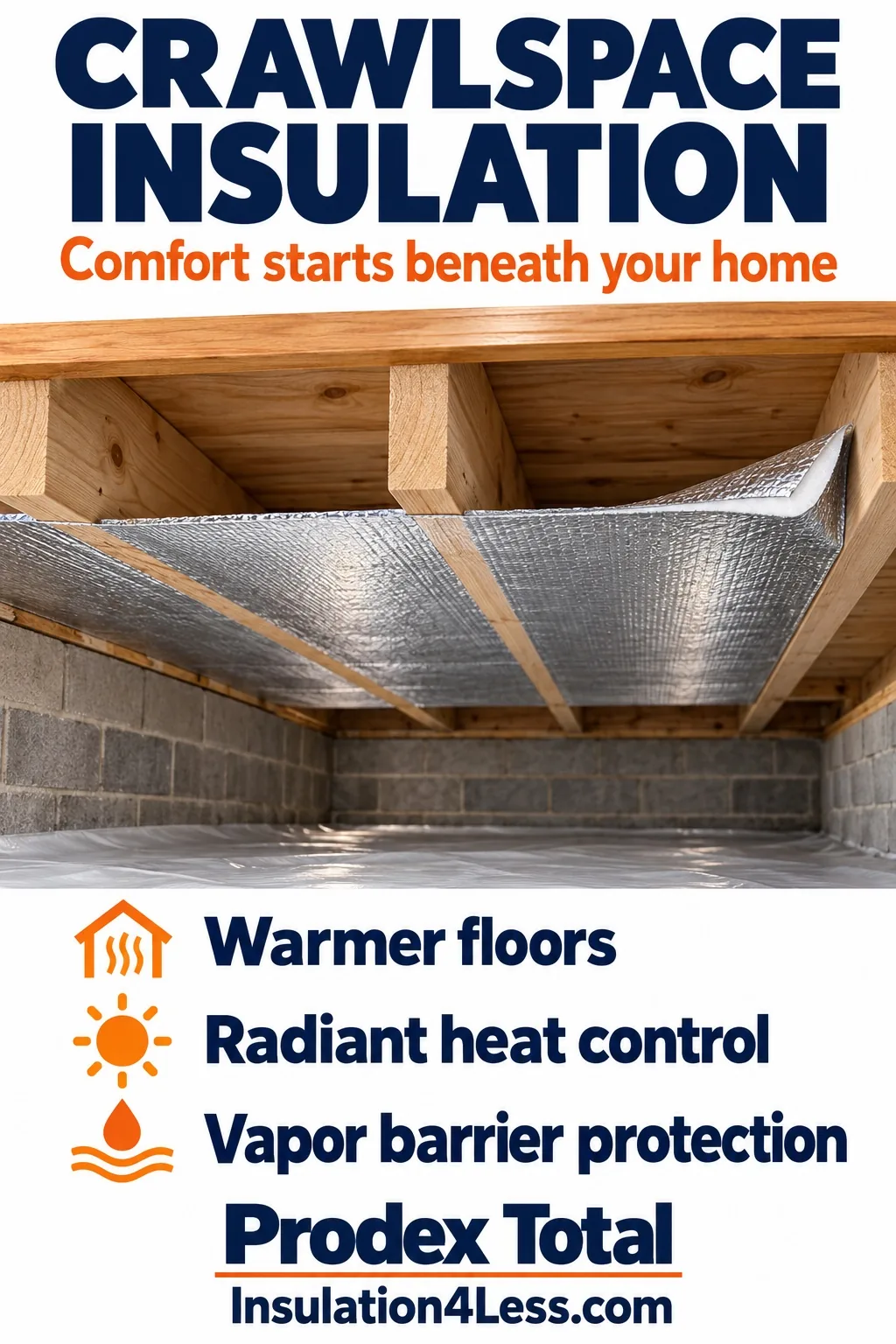
Crawlspace Insulation: Choosing the Best Insulation for Your Home
Crawlspace insulation helps reduce heat transfer beneath your home, improve floor comfort and reduce the workload on your heating and cooling system. Choosing the best crawlspace insulation starts with understanding the space beneath your house: Is it vented or conditioned? Should you insulate the floor above it or the foundation walls? Have water leaks and ground moisture been addressed?
Prodex Total combines closed-cell foam with reflective foil to provide insulation, radiant barrier protection and vapor barrier protection in one lightweight material. This guide compares crawl space insulation options and explains what to consider before selecting a system.
Prodex Total = Insulation + Radiant Barrier + Vapor Barrier — All in One Product.
Already selected your material? See our crawl space insulation installation guide for attachment methods, air gaps and seam sealing.
What Is the Best Crawlspace Insulation?
The best crawlspace insulation is the material and installation assembly that meet your home’s thermal, moisture and construction requirements.
A vented crawl space generally calls for insulation at the floor above it. A properly designed unvented or conditioned crawl space generally uses insulation at the perimeter walls.
Prodex Total is an effective option for homeowners seeking a flexible insulation layer that combines reflective performance and vapor resistance. Fiberglass, rigid foam board and spray foam are also used in crawl spaces, but each requires different installation details.
When comparing materials, consider:
- Thermal performance in the intended installation.
- Resistance to moisture absorption.
- Air sealing and vapor control.
- Available space and ease of access.
- Attachment methods and long-term support.
- Local insulation and exposed-material requirements.
Compare the complete installed system, including its air spaces and moisture-control layers—not just the material’s thickness or advertised R-value.
Crawl Space Insulation Options Compared
| Insulation Material | Common Crawl Space Applications | Important Considerations |
|---|---|---|
| Prodex Total | Reflective layers beneath or between floor joists and in wall assemblies | Combines closed-cell foam and reflective foil. Requires the specified air space for reflective performance and sealed joints for barrier continuity. |
| Fiberglass Batts | Floor joist cavities above vented crawl spaces | Requires a dry assembly, air sealing and proper support. Wet, sagging or poorly fitted batts can perform poorly. |
| Rigid Foam Board | Foundation walls and rim joists | Provides thermal resistance in limited space. Joints and edges must be sealed; check protective covering and termite inspection requirements. |
| Spray Foam | Selected floor, wall and rim joist applications | Performance depends on foam type, thickness and installation quality. Consider professional installation and required protective coverings. |
For more information about reflective assemblies, read our reflective insulation and R-value guide.
If you are also evaluating foam, our spray foam comparison for metal buildings and pole barns explains broader material differences. Crawl space applications require their own assembly design.
Should You Insulate the Crawl Space Floor or Walls?
The right location depends on whether the crawl space remains outside your home’s conditioned area or becomes part of it.
Vented Crawl Space Insulation
In a vented, unconditioned crawl space, the floor separates your living area from the space below. Insulation and air sealing at this boundary help reduce drafts and heat transfer.
Address plumbing openings, wiring penetrations, duct connections and rim joists, as well as the main floor area.
A continuous Prodex Total layer beneath the floor joists can form part of a reflective floor assembly. Between-joist methods are also available. Follow the specified air-gap and seam details, and choose an assembly that provides the required thermal resistance.
Unvented or Conditioned Crawl Space Insulation
A conditioned crawl space brings the area beneath your home inside the building’s thermal boundary. Insulation generally belongs at the perimeter walls, together with a continuous ground vapor barrier, air sealing and planned humidity control.
Simply closing foundation vents does not create a complete conditioned crawl space. The design must address water entry, ground moisture, air exchange and any combustion equipment.
Choose the thermal boundary first. Insulating the floor, walls and ground together is not automatically the most effective approach for every home.
Why Choose Prodex Total for Crawlspace Insulation?
Prodex Total combines a closed-cell foam core with reflective foil faces. Its lightweight, flexible format is useful where access is limited and continuous insulation coverage is desired.
Radiant Heat Control
When installed facing the specified air space, Prodex Total’s reflective surfaces reduce radiant heat transfer. Beneath a floor, this can help reduce radiant heat loss toward the crawl space.
Moisture-Resistant Foam Core
The closed-cell foam core resists moisture absorption. This makes moisture resistance an integral part of the product, while drainage and humidity control remain essential parts of the overall crawl space design.
Built-In Vapor Barrier Protection
Prodex Total provides vapor barrier protection. Seal seams, perimeter edges and penetrations according to the installation instructions to create a continuous barrier.
Continuous Coverage Beneath Floor Joists
Wide rolls allow installation beneath the joists, covering the framing rather than limiting insulation to individual cavities. Narrower products provide options for compatible between-joist installations.
Lightweight Material for Limited Access
Flexible rolls can be cut to fit the installation area and handled in spaces where moving large rigid panels may be difficult.
Control Crawl Space Moisture Before Installing Insulation
Insulation supports moisture management, but it does not repair drainage problems or remove existing mold.
Before installing crawl space insulation:
- Correct water entry. Inspect for plumbing leaks, standing water, foundation seepage and exterior drainage problems.
- Assess existing materials. Check for wet wood, damaged insulation, mold and signs of pest activity.
- Control ground moisture. Cover exposed soil with a suitable ground vapor barrier, sealing seams, perimeter connections and penetrations.
- Seal air leaks. Address openings along the selected thermal boundary, including rim joists and service penetrations.
- Plan humidity control. Use the ventilation, conditioning or dehumidification approach appropriate to your crawl space.
More outdoor ventilation is not always better. In humid weather, outdoor air can introduce moisture that condenses on cooler surfaces beneath the home.
Ground moisture control is also separate from insulating the floor or foundation walls. For product-specific ground-cover instructions, consult our Prodex crawl space installation guide.
Choosing Prodex Total Products for Your Crawl Space
Select the product and roll width around your framing, available access and installation method.
Prodex Total 10M Plus
10M Prodex Total Plus provides a thicker reflective foam product with heat-welded seam options.
Prodex Total 48-Inch 5M Plus
48-inch Prodex Total 5M Plus provides wide coverage beneath floor joists or within suitable wall assemblies.
Products for Between-Joist Installations
Prodex Total 16-inch and 24-inch products provide options for compatible framing layouts. Follow the installation guide for positioning, attachment and required air spaces.
Measure each area separately and allow for cuts, seams and penetrations. Our Advanced Insulation Calculator can help estimate material quantities for supported layouts. Product pages show current pricing and roll coverage.
How to Install Crawl Space Insulation
Installation details vary depending on whether you are insulating beneath floor joists, between joists, along foundation walls or over the ground.
Our step-by-step crawl space insulation installation guide covers product selection, attachment methods, air gaps and seam sealing.
For related improvements throughout your home, explore our complete house insulation guide.
Frequently Asked Questions About Crawlspace Insulation
Is crawlspace insulation the same as a vapor barrier?
No. Insulation reduces heat transfer, while a vapor barrier limits water vapor movement. Prodex Total combines these functions, but a complete crawl space still requires suitable ground moisture control, air sealing and drainage.
Can reflective insulation work beneath a floor?
Yes, when the reflective surface faces the specified air space. Follow the tested assembly and manufacturer’s installation instructions. Compressing reflective insulation between solid surfaces changes its thermal performance.
What R-value do I need for crawl space insulation?
The required insulation level depends on your climate, local requirements and whether you are insulating the floor or foundation walls. Compare the required R-value with the performance of the complete installation assembly.
For reflective insulation, distinguish the material’s thermal resistance from the tested assembly’s R-value, which includes specified air spaces and heat-flow conditions.
Should I remove wet or sagging fiberglass insulation?
First identify and correct the moisture problem. Wet, contaminated or damaged insulation should be assessed before replacement. Adding another layer over wet material can conceal the problem and restrict drying.
Does crawl space insulation prevent mold?
Insulation can help control surface temperatures and moisture movement as part of a properly designed system. Mold prevention also depends on controlling water, humidity and air leakage. Existing mold requires separate assessment and treatment.
How much does crawl space insulation cost?
Cost depends on the area, access, material, required insulation level and preparation work.
Compare material-only pricing with installed project quotes carefully. Drainage repairs, removal of damaged insulation and crawl space conditioning can add substantial costs. Check the Prodex product pages for current material pricing.
Where can I find crawl space insulation installation instructions?
Our guide to installing Prodex Total in a crawl space covers floor joists, walls and ground applications, including product selection and attachment methods.