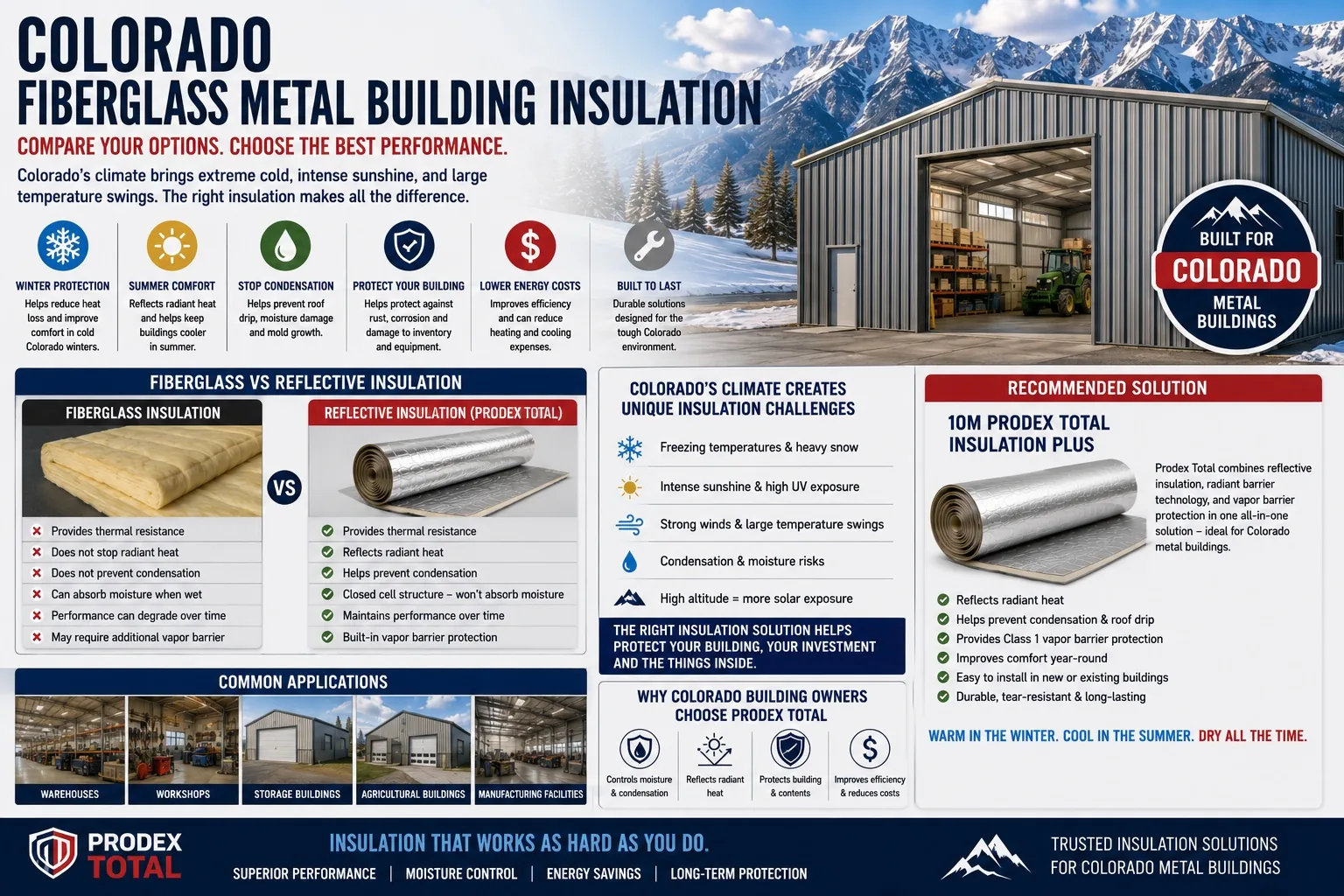
Colorado Fiberglass Metal Building Insulation
Fiberglass insulation has been used in metal buildings for decades and remains one of the most recognized insulation products in the construction industry. For Colorado metal building owners, however, insulation decisions often involve more than thermal resistance alone. Condensation, radiant heat, moisture control, and Colorado's dramatic temperature swings can all affect building performance. Understanding the strengths and limitations of fiberglass insulation can help building owners choose the right insulation system for their specific application.
Prodex Total: Warm in the Winter. Cool in the Summer. Dry All the Time.
For a broader overview of insulation solutions throughout the state, visit our Colorado Insulation Guide.
Colorado Fiberglass Metal Building Insulation
Fiberglass insulation has been used in metal buildings for decades and remains one of the most recognized insulation products in the construction industry. For Colorado metal building owners, however, insulation decisions often involve more than thermal resistance alone. Condensation, radiant heat, moisture control, and Colorado's dramatic temperature swings can all affect building performance.
Understanding the strengths and limitations of fiberglass insulation can help building owners choose the right insulation system for their specific application.
Prodex Total: Warm in the Winter. Cool in the Summer. Dry All the Time.
For a broader overview of insulation solutions throughout the state, visit our Colorado Insulation Guide.
Why Colorado Metal Buildings Present Unique Challenges
Colorado's climate creates insulation demands that differ from many other states.
Metal buildings throughout Colorado often experience:
- Freezing winter temperatures
- Heavy snow loads
- Intense summer sunshine
- High-altitude solar exposure
- Strong winds
- Large day-to-night temperature swings
- Condensation risks
These conditions can affect both comfort and energy efficiency. Learn more in our Colorado Metal Building Insulation Guide.
What Is Fiberglass Metal Building Insulation?
Fiberglass insulation is typically manufactured from fine glass fibers and is commonly supplied in blanket systems for metal buildings. Fiberglass systems are designed to provide thermal resistance and help reduce conductive heat transfer.
Fiberglass remains a popular choice because:
- It is widely available
- It is familiar to builders
- It provides thermal resistance
- It can be used in new construction and retrofit projects
For more information, see our Fiberglass Metal Building Insulation guide.
The Condensation Challenge
One of the biggest concerns for Colorado metal buildings is condensation. When warm interior air comes into contact with a cold metal roof or wall panel, moisture can form.
This can lead to:
- Roof drip
- Rust and corrosion
- Mold growth
- Wet insulation
- Damaged inventory
- Reduced insulation performance
Because Colorado frequently experiences large temperature swings, condensation is often one of the first issues metal building owners encounter.
Learn more in our How to Stop Condensation in Colorado Metal Buildings.
Fiberglass and Condensation
Fiberglass insulation can help slow heat transfer, but fiberglass alone does not stop moisture from reaching metal surfaces. If moisture reaches the metal skin, condensation may still occur under the right conditions.
In some situations:
- Fiberglass may become damp
- Moisture can reduce performance
- Mold may develop
- Insulation can become compressed over time
This is why vapor barrier performance is often an important consideration in metal building design.
Fiberglass vs Reflective Insulation
Fiberglass and reflective insulation work differently.
Fiberglass Insulation
Fiberglass primarily helps reduce conductive heat transfer.
Benefits include:
- Thermal resistance
- Familiar installation methods
- Wide industry acceptance
Reflective Insulation
Reflective insulation helps reduce radiant heat transfer while also providing vapor barrier performance.
Benefits may include:
- Condensation control
- Radiant heat reflection
- Vapor barrier protection
- Air barrier performance
- Moisture management
Colorado building owners often compare both approaches before selecting an insulation system.
For a detailed discussion, see Reflective Insulation: Measuring Its R-Value vs Fiberglass.
Why Colorado's Climate Makes Radiant Heat Important
Many building owners focus only on winter conditions. However, Colorado's elevation increases solar exposure and radiant heat gain. During summer, metal roofs can absorb significant amounts of solar energy and transfer heat into the building below. Reflective insulation helps address this form of heat transfer.
Applications for Fiberglass Metal Building Insulation
Fiberglass is commonly used in:
Warehouses
Provide thermal resistance for commercial operations.
Workshops
Help improve comfort for year-round use.
Storage Buildings
Reduce temperature fluctuations.
Agricultural Buildings
Provide thermal protection for equipment and supplies.
Manufacturing Facilities
Help improve interior conditions for workers and equipment.
Why Many Building Owners Choose Prodex Total
Many Colorado building owners want more than thermal resistance alone.
Prodex Total combines:
- Reflective insulation
- Radiant barrier protection
- Vapor barrier protection
- Condensation control
- Air barrier performance
in one all-in-one system.
This allows building owners to address multiple insulation challenges simultaneously.
Recommended Product
10M Prodex Total Insulation Plus
For Colorado metal building applications, 10M Prodex Total Insulation Plus provides excellent protection against heat transfer, moisture, and condensation.
Benefits include:
- Helps reduce roof condensation
- Reflects radiant heat
- Provides vapor barrier protection
- Improves energy efficiency
- Durable reinforced construction
- Easy installation
Warm in the Winter. Cool in the Summer. Dry All the Time.
Frequently Asked Questions
Is fiberglass insulation good for Colorado metal buildings?
Fiberglass can provide thermal resistance, but Colorado building owners should also consider condensation, moisture, and radiant heat control.
Does fiberglass stop condensation?
Fiberglass alone does not prevent moisture from reaching metal surfaces where condensation can occur.
Why is condensation common in Colorado metal buildings?
Large temperature swings and changing weather conditions frequently create condensation conditions.
Is reflective insulation effective in Colorado?
Yes. Colorado's intense sunshine and high-altitude solar exposure make radiant heat control particularly valuable.
Can Prodex Total help prevent condensation?
Yes. Prodex Total provides vapor barrier protection, thermal separation, and radiant barrier performance that help reduce condensation.