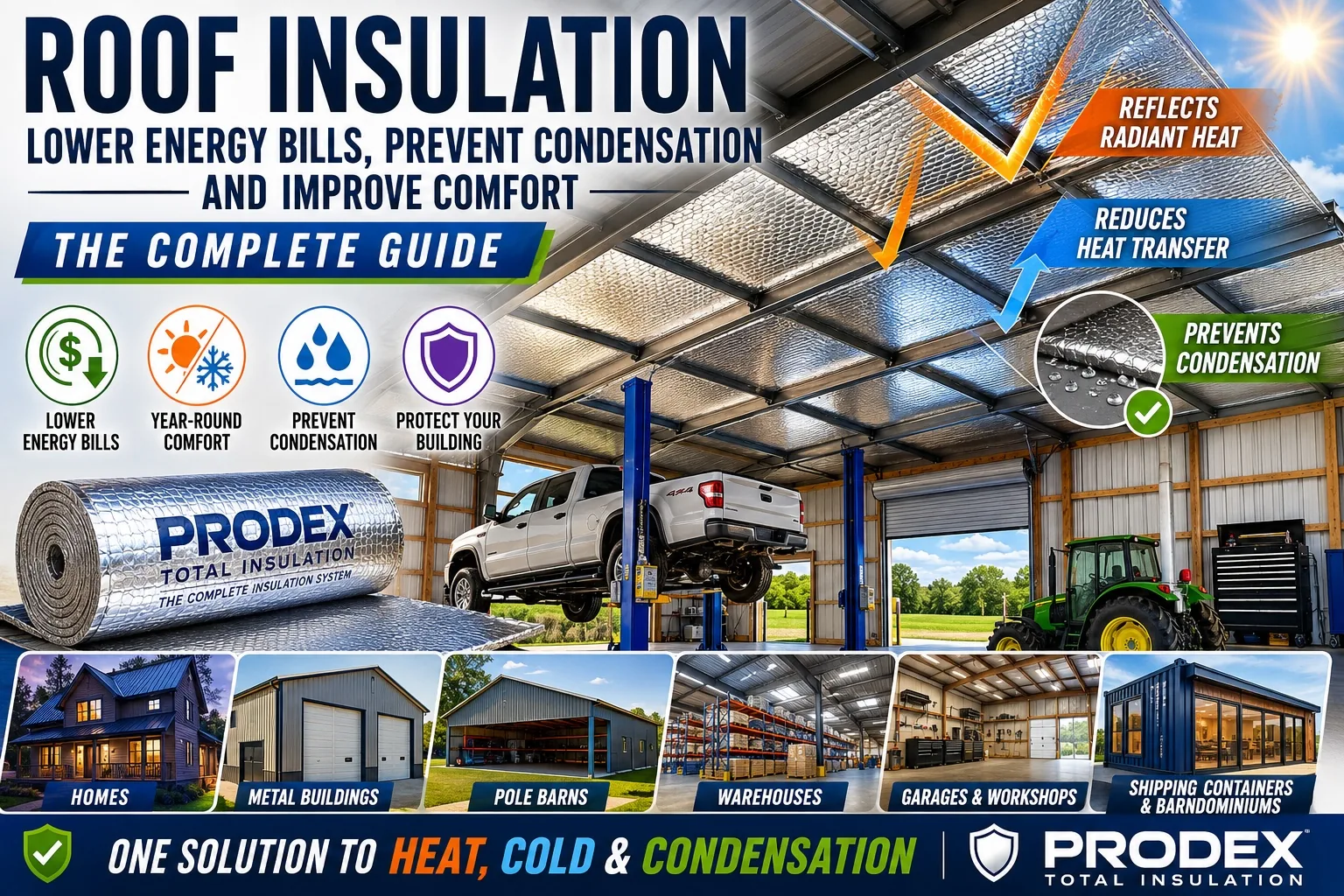
Roof Insulation: The Complete Guide to Lower Energy Bills, Prevent Condensation and Improve Comfort
Choosing the right roof insulation is one of the smartest investments you can make for your home, metal building, garage, workshop, warehouse, agricultural building, or commercial facility. A properly insulated roof helps reduce heating and cooling costs, improves year-round comfort, protects against moisture damage, and extends the life of your building.
The roof is exposed to more sunlight and weather than any other part of a structure. During summer, roofing materials absorb enormous amounts of solar energy that can quickly transfer into the occupied space below. During winter, warm indoor air naturally rises toward the roof, where valuable heat can escape if the roof is poorly insulated.
For buildings with metal roofs, insulation plays an even more important role. In addition to controlling heat transfer, the right insulation helps prevent condensation—a common cause of dripping water, rust, mold, mildew, and costly structural damage.
Whether you're building new, replacing a roof, or upgrading an existing structure, this guide explains everything you need to know about roof insulation, including:
- How roof insulation works.
- The different types of roof insulation available.
- The best insulation for houses, metal roofs, garages, pole barns, warehouses, and commercial buildings.
- How to compare fiberglass, spray foam, rigid foam board, reflective insulation, and bubble insulation.
- Roof insulation costs and what affects pricing.
- How to choose the best insulation for your specific building.
You'll also find practical comparisons, answers to frequently asked questions, and recommendations to help you select the right insulation system for long-term performance.
Jump to Recommended Roof Insulation Products
Why Roof Insulation Matters
Your roof is often the largest source of heat gain during summer and heat loss during winter. Without proper insulation, your heating and cooling system must work harder to maintain comfortable indoor temperatures, increasing energy consumption and utility costs.
Effective roof insulation provides several important benefits:
- Reduces heating and cooling costs.
- Improves year-round indoor comfort.
- Helps maintain consistent indoor temperatures.
- Reduces outside noise from rain, hail, and wind.
- Protects against condensation and moisture damage.
- Helps prevent mold and mildew.
- Extends the life of the building.
- Improves overall energy efficiency.
For buildings with metal roofing, insulation serves an additional purpose. Metal rapidly transfers heat and cold, making the roof especially vulnerable to condensation when warm, humid indoor air contacts the cooler underside of the roofing panels. Left unchecked, condensation can lead to rust, dripping water, damaged insulation, stained ceilings, mold growth, and deterioration of stored materials.
The best roof insulation doesn't simply provide a high R-value. It should also address radiant heat, air movement, moisture control, and long-term durability.
Signs Your Roof Needs Better Insulation
Many buildings already have insulation, yet still experience excessive heat, cold, or moisture problems. That's because insulation can deteriorate over time, become compressed, absorb moisture, or simply be inadequate for the building's current use. If you're experiencing any of the following issues, your roof insulation may no longer be performing effectively.
High Heating and Cooling Bills
One of the most common signs of inadequate roof insulation is unexpectedly high utility bills. If your HVAC system runs constantly but struggles to maintain comfortable temperatures, excessive heat transfer through the roof may be a contributing factor.
Rooms That Are Too Hot or Too Cold
Do certain rooms feel much warmer during summer or colder during winter than the rest of the building? Uneven temperatures often indicate that heat is entering or escaping through the roof faster than your insulation can control.
A Hot Attic or Ceiling
Attics naturally become warmer than living spaces, but if the attic feels excessively hot—or the ceiling radiates heat into occupied rooms—your roof insulation may not be effectively limiting radiant heat transfer.
Condensation Beneath a Metal Roof
Many owners of metal buildings believe they have a roof leak when water begins dripping from the ceiling. In many cases, the problem isn't rainwater—it's condensation. When warm, humid indoor air contacts the cooler underside of the metal roofing, moisture condenses into water droplets that eventually drip onto equipment, vehicles, inventory, or finished spaces.
If you own a metal building or pole barn , controlling condensation should be one of your highest priorities.
Rust, Mold, or Mildew
Persistent moisture beneath the roof can lead to rust on steel framing, mold growth, mildew, and damage to interior finishes. These problems often indicate that moisture is entering the roof assembly or becoming trapped within it.
Constant HVAC Operation
Heating and cooling systems should cycle on and off throughout the day. If your HVAC equipment seems to run continuously, poor roof insulation may be forcing the system to compensate for excessive heat gain or heat loss.
Ice Dams in Cold Climates
In northern climates, warm air escaping through the roof can melt accumulated snow. As the water reaches colder roof edges, it refreezes into ice dams that can damage shingles, gutters, and roof structures. Proper insulation helps reduce heat loss through the roof and can contribute to minimizing ice dam formation.
If any of these problems sound familiar, understanding how roof insulation works is the next step toward choosing the right solution.
How Roof Insulation Works
Roof insulation slows the movement of heat between the outside environment and the conditioned space below. During summer, it reduces unwanted heat entering the building. During winter, it helps keep valuable heated air inside. To understand why different insulation materials perform differently, it's helpful to understand the three ways heat moves.
Conduction
Conduction is heat moving directly through solid materials. When sunlight heats a metal roof, that heat conducts through the roofing panels and into the building below. During winter, the process reverses as indoor heat conducts outward through the roof assembly. Traditional insulation materials such as fiberglass, spray foam, and rigid foam board primarily reduce conductive heat transfer.
Convection
Convection is heat carried by moving air. Small gaps around roof penetrations, framing, ridge vents, skylights, and utility openings allow heated or cooled air to escape while outside air enters the building. Even high-quality insulation performs poorly if uncontrolled air movement bypasses it. Reducing air leakage is an important part of improving overall energy efficiency.
Radiant Heat
Radiant heat travels differently. Instead of moving through solid materials or air currents, radiant energy moves directly from a warmer surface to a cooler surface.
This is especially important with roofing. On sunny days, roofing materials absorb large amounts of solar energy and radiate that heat downward long before the surrounding air reaches the same temperature. Unlike traditional insulation, reflective insulation is specifically designed to reflect radiant heat away from the building, making it particularly effective beneath metal roofing and in warm climates.
Understanding these three forms of heat transfer makes it much easier to compare today's insulation products and determine which solution best fits your building.
Types of Roof Insulation
There are many types of roof insulation available, and each has advantages depending on the building, climate, and application. Rather than focusing only on R-value, it's important to consider how each insulation system performs with radiant heat, moisture, air leakage, durability, and condensation.
Fiberglass Insulation
Fiberglass remains one of the most widely used insulation materials in residential construction. Available in batts, rolls, and blown-in forms, it provides good thermal resistance at a relatively low initial cost.
Advantages
- Affordable.
- Widely available.
- Good thermal performance.
- Effective sound absorption.
Limitations
Fiberglass can lose insulating performance when it becomes wet and does not provide a built-in air barrier, radiant barrier, or vapor barrier. In many metal roof applications, additional products are required to manage moisture and condensation effectively. For a detailed comparison, see Reflective Insulation vs. Fiberglass .
Spray Foam Insulation
Spray foam expands after application, sealing cracks and reducing air leakage. It offers excellent thermal performance and air sealing but is typically one of the most expensive insulation systems and usually requires professional installation. For many projects, spray foam performs very well, particularly where irregular framing makes traditional insulation difficult to install. Learn more in Prodex Total vs. Spray Foam Insulation
If you're considering spray foam for your roof insulation project, our comprehensive Spray Foam Insulation Guide explains the differences between open-cell and closed-cell spray foam, discusses R-value, installation methods, DIY spray foam kits, costs, moisture control, and compares spray foam with fiberglass, mineral wool, cellulose, foam board, and reflective insulation to help you choose the best insulation system for your building.
Rigid Foam Board
Rigid foam board insulation is commonly used beneath roof decking and in commercial roofing systems. It provides excellent thermal resistance and high compressive strength but often requires careful seam sealing and multiple layers to achieve higher insulation levels.
Learn More About Foam Board Insulation
Rigid foam board insulation is available in several different materials, including EPS (Expanded Polystyrene), XPS (Extruded Polystyrene), and Polyiso (Polyisocyanurate). Each offers different thermal performance, moisture resistance, compressive strength, and ideal applications depending on the roof assembly.
While rigid foam board is commonly used beneath roof decking and in commercial roofing systems, it may also require additional materials to address radiant heat, air sealing, vapor control, or condensation, depending on the application.
If you're considering rigid foam for your project, our comprehensive Foam Board Insulation Guide explains the differences between EPS, XPS, and Polyiso, compares foam board with reflective insulation, fiberglass, and spray foam, and helps you determine which insulation system is best for residential, commercial, agricultural, and metal roof applications.
Bubble Insulation
Bubble insulation consists of one or more layers of polyethylene air bubbles laminated between reflective foil facings. While lightweight and economical, it contains relatively little insulating material compared to closed-cell foam insulation. Many people mistakenly assume bubble insulation and reflective foam insulation are the same product. They are not.
Learn the differences in Bubble Insulation, Bubble Wrap, Foil Radiant Barriers and Prodex Total – What's the Difference?
Reflective Insulation
Reflective insulation is designed to reduce radiant heat transfer by reflecting infrared energy away from the building. When properly installed with an adjacent air space, reflective insulation can significantly improve comfort while reducing cooling loads, especially beneath metal roofing and in sunny climates. Products that combine reflective surfaces with a closed-cell foam core also provide thermal insulation while helping control air movement, moisture, and condensation.
If you'd like to better understand how reflective insulation works, our Reflective Insulation Guide explains the science, performance, and applications in greater detail.
Best Roof Insulation by Building Type
The best roof insulation isn't the same for every building. Climate, roofing material, building use, and moisture conditions all influence which insulation system will provide the best long-term performance. A house with an asphalt shingle roof has different insulation requirements than a warehouse with a steel roof. Likewise, a pole barn storing hay has different priorities than a climate-controlled workshop or commercial building. Understanding your building's unique needs is the first step toward selecting the right insulation.
House Roof Insulation
A properly insulated roof is one of the most effective ways to improve the comfort and energy efficiency of a home. Because warm air naturally rises, the roof is responsible for a significant percentage of a home's heat loss during winter and heat gain during summer. Proper roof insulation helps stabilize indoor temperatures, reduce HVAC operating costs, and improve comfort throughout the year.
The best house roof insulation should:
- Reduce heat transfer during every season.
- Improve energy efficiency.
- Reduce drafts and temperature fluctuations.
- Help control moisture.
- Continue performing for decades.
Homes with conventional roofing systems often use fiberglass, blown-in insulation, spray foam, or rigid foam board depending on the roof design and attic configuration. For homes with metal roofing, condensation control becomes much more important. In these applications, reflective insulation systems that also provide thermal insulation, air sealing, and vapor control offer significant advantages over traditional insulation alone.
For a complete guide to insulating your entire home—including ceilings, attics, walls, crawlspaces, garages, and additions—visit our House Insulation Guide.
Metal Roof Insulation
Metal roofs are extremely durable, but they also transfer heat and cold much faster than most traditional roofing materials. During summer, the roof can become extremely hot, radiating heat into the building below. As outdoor temperatures fall, the metal cools quickly, creating ideal conditions for condensation whenever warm, humid indoor air contacts the underside of the roof.
An effective metal roof insulation system should:
- Reduce conductive heat transfer.
- Reflect radiant heat.
- Limit air leakage.
- Include an effective vapor barrier.
- Prevent condensation.
Unlike conventional residential roofs, metal roofing requires an insulation system that addresses both energy efficiency and moisture control. If you're insulating an entire steel structure, our comprehensive Metal Building Insulation Guide explains recommended insulation methods for roofs, walls, and complete building envelopes.
Pole Barn Roof Insulation
Pole barns are commonly used to protect equipment, livestock, feed, machinery, vehicles, and agricultural supplies. Many feature exposed steel roofing installed over open framing, making condensation one of the most common problems building owners face. Without proper insulation, water can form beneath the roof and drip onto valuable equipment or stored materials.
The best pole barn roof insulation should:
- Prevent condensation.
- Resist moisture.
- Reduce radiant heat.
- Improve winter comfort.
- Require minimal maintenance.
If you're planning a new agricultural building or upgrading an existing one, our complete Pole Barn Insulation Guide explains the best installation methods and insulation options.
Garage and Workshop Roof Insulation
Garages and workshops are often some of the least comfortable spaces on a property because they receive direct sunlight throughout the day while having little or no insulation. Proper roof insulation helps create a more comfortable environment for hobbies, vehicle maintenance, woodworking, storage, and home businesses.
Benefits include:
- Lower indoor temperatures during summer.
- Improved winter comfort.
- Reduced condensation beneath metal roofs.
- Better protection for tools and equipment.
- Lower energy costs if the space is heated or cooled.
For attached garages, proper roof insulation also improves comfort in adjacent living areas.
Warehouse and Commercial Roof Insulation
Commercial buildings and warehouses often have thousands of square feet of roof area exposed to direct sunlight. Without proper insulation, heat entering through the roof can dramatically increase cooling costs while creating uncomfortable working conditions.
Quality roof insulation helps:
- Improve employee comfort.
- Reduce HVAC operating costs.
- Protect inventory.
- Improve overall energy efficiency.
- Reduce condensation in steel buildings.
For buildings with metal roofing, controlling moisture is just as important as controlling temperature. Our complete guide to warehouse insulation explains how to insulate warehouse roofs and walls to help control radiant heat, condensation, heat loss, air movement, and protect stored inventory and equipment.
Agricultural Building Roof Insulation
Agricultural buildings—including equipment sheds, dairy barns, poultry houses, horse barns, and livestock facilities—present unique insulation challenges because they often contain elevated humidity levels. Condensation inside these buildings can damage equipment, reduce feed quality, contribute to mold growth, and create unhealthy conditions for livestock.
Roof insulation for agricultural buildings should emphasize:
- Condensation prevention.
- Moisture resistance.
- Durability.
- Easy installation.
- Long-term performance.
Barndominium Roof Insulation
Barndominiums combine residential living with steel building construction, making roof insulation especially important. The ideal insulation system should provide year-round comfort while preventing condensation inside the roof assembly.
Learn more in our Barndominium Insulation Guide.
Shipping Container Roof Insulation
Shipping containers are constructed entirely from steel, making them especially susceptible to rapid temperature changes and condensation. The roof is typically the largest source of solar heat gain, making proper insulation essential for maintaining comfortable interior temperatures. Our Shipping Container Insulation Guide explains the best insulation strategies for container roofs, walls, and ceilings.
Roof Insulation Cost
One of the most common questions when planning a roof insulation project is:
“How much does roof insulation cost?”
As a general guide, roof insulation costs approximately $1.50 to $7 per square foot professionally installed, depending on the insulation material, required R-value, roof size, installation method, labor rates, and complexity of the project. Fiberglass and batt insulation are generally among the lower-cost options, while spray foam and some rigid foam insulation systems tend to have higher installed costs. For example, insulating 1,500 square feet of roof area at this general range could cost approximately $2,250 to $10,500. Actual roof insulation costs can fall outside this range depending on insulation thickness, roof accessibility, removal of existing insulation, local labor rates, and additional materials required for the roof assembly.
Price is important, but it shouldn't be the only factor guiding your decision. A lower-cost insulation system that requires professional installation, multiple additional products, or future replacement may ultimately cost more over the life of the building.
Roof Insulation Cost by Type
The cost of roof insulation varies considerably by material. When comparing options, it is important to distinguish between the price of the insulation itself and the total installed cost of the complete insulation system.
| Roof Insulation Type | Relative Cost | Installation Considerations |
|---|---|---|
| Fiberglass Insulation | $–$$ | Relatively inexpensive material; may require additional air sealing or vapor-control materials depending on the roof assembly |
| Reflective Insulation | $–$$ | Often DIY-friendly; particularly useful beneath metal roofs where radiant heat and condensation are concerns |
| Rigid Foam Board | $$–$$$ | Material cost plus cutting, fitting, fastening, and sealing joints |
| Spray Foam Insulation | $$$–$$$$ | Generally among the higher installed costs because professional application is commonly required |
| Prodex Total | $$ | Combines insulation, radiant barrier, air barrier, and vapor barrier in one product and can often be installed without professional labor |
These ranges are general comparisons rather than project quotes. Actual roof insulation costs vary according to insulation thickness, R-value requirements, building location, roof configuration, labor rates, project size, and installation requirements.
What Affects Roof Insulation Cost?
Several factors determine the total roof insulation cost, including the size and design of the roof, insulation material, required thermal performance, whether the building is new or existing, and the amount of installation labor required.
Roof Size
Larger roofs require more insulation and generally more installation time. A residential garage may require only a few rolls of insulation, while a commercial warehouse or manufacturing facility may require thousands of square feet of coverage. Remember that the roof area may be greater than the building's floor area because roof pitch increases the actual surface area requiring insulation.
Type of Roof Insulation
The insulation material you select can have a major effect on the total project cost. Fiberglass is generally one of the less expensive insulation materials. Rigid foam board typically costs more and requires individual panels to be cut, fitted, fastened, and sealed. Spray foam can provide excellent thermal and air-sealing performance but typically involves professional installation, which can substantially increase the final cost.
Reflective insulation can be particularly cost-effective for metal roofs because it can address radiant heat while certain products also provide thermal insulation and moisture control.
Learn more about the different materials and their performance in our Reflective Insulation Guide.
Building Type
Different buildings require different roof insulation strategies.
For example:
Residential attics often focus primarily on thermal performance.
Metal buildings frequently require both insulation and condensation control.
Pole barns and agricultural buildings typically prioritize moisture management as well as heat and cold.
Garages and workshops may require insulation that reduces radiant heat while controlling condensation beneath metal roofing.
Commercial buildings often emphasize long-term energy savings and durability.
If you're insulating a steel structure, our Metal Building Insulation Guide explains how roof and wall insulation work together to control heat, cold, air movement, and condensation.
New Construction vs. Retrofit
Installing insulation during new construction is generally easier because the framing is exposed and the insulation can be incorporated into the roof assembly as the building is constructed. Retrofitting an existing roof can require additional labor because installers may need to work around framing, electrical wiring, HVAC systems, lighting, finished ceilings, and other obstructions.
If you're planning a retrofit, our How to Insulate a Roof guide explains common installation methods for new and existing buildings.
Roof Design
A simple roof is generally easier and less expensive to insulate than a complicated roof with numerous valleys, hips, skylights, dormers, vents, or other penetrations. More complicated roof designs require additional measuring, cutting, fitting, fastening, and sealing, which can increase both material waste and installation labor.
Material Cost vs. Installed Roof Insulation Cost
One of the biggest mistakes when comparing roof insulation costs is looking only at the purchase price per square foot. The more useful comparison is the total installed cost.
Some insulation systems may require separate products or additional work for:
Vapor control
Air sealing
Radiant heat protection
Condensation control
Fasteners and adhesives
Professional installation
Each additional product or installation step adds to the total project cost. Prodex Total is particularly cost-effective for many metal roof applications because it combines several functions in a single insulation system:
Thermal insulation
Radiant heat protection
Air barrier
Vapor barrier
Condensation control
Prodex Total is also designed for DIY installation, which can eliminate one of the largest expenses associated with many roof insulation projects: professional installation labor.
How to Estimate Your Roof Insulation Cost
To estimate your roof insulation cost, begin by determining the approximate square footage of roof area requiring insulation.
Once you know the approximate roof area, compare:
Insulation cost per square foot
Number of insulation layers required
Accessories and additional materials
Professional installation costs, if required
Vapor barrier or air-sealing costs
Removal or disposal of existing insulation
Long-term maintenance or replacement costs
For Prodex Total projects, use our Advanced Insulation Calculator to determine the approximate amount of insulation required for your building. Knowing the required quantity makes it much easier to calculate your actual roof insulation cost before ordering.
Looking Beyond the Purchase Price
The insulation with the lowest purchase price isn't necessarily the insulation with the lowest long-term cost.
Higher-quality roof insulation can potentially reduce:
Heating costs
Cooling costs
HVAC operating time
Moisture and condensation damage
Maintenance expenses
Future insulation replacement costs
These long-term considerations should be included when comparing the true cost of different roof insulation systems.
Roof Insulation Cost and Long-Term Value
A properly designed roof insulation system can provide value long after the initial installation by reducing heat transfer, improving indoor comfort, and lowering the workload placed on heating and cooling equipment.
Additional long-term benefits can include:
More comfortable indoor temperatures
Lower heating and cooling requirements
Better protection against condensation and moisture damage
Improved building durability
Protection for equipment, inventory, and interior finishes
For metal buildings, pole barns, garages, workshops, warehouses, and other structures with metal roofing, the value of insulation should also include its ability to control radiant heat and condensation.
Choosing Value Over Price
Instead of asking only:
“Which roof insulation costs the least?”
A better question is:
“Which roof insulation provides the best overall value for my building?”
The answer depends on the building, climate, roof construction, installation requirements, and performance you need. For buildings where conductive heat, radiant heat, air leakage, moisture, and condensation all need to be controlled, an insulation system that combines several functions into one installation may provide better overall value than purchasing and installing multiple separate products.
How to Choose the Best Roof Insulation
Choosing the best roof insulation isn't about finding the product with the highest advertised R-value or the lowest purchase price. The right choice depends on your building, climate, roofing material, and long-term performance goals.
Before selecting insulation, ask yourself these questions:
- Is my roof metal or conventional?
- Am I trying to reduce summer heat, winter heat loss, or both?
- Is condensation a concern?
- Is this new construction or a retrofit?
- Do I need a separate vapor barrier?
- Will the insulation be exposed to moisture?
- How important is long-term durability?
The answers will help determine which insulation system is the best fit.
Best Roof Insulation by Application
Best Roof Insulation for Homes
For traditional residential construction, fiberglass, blown-in insulation, spray foam, and rigid foam board all have applications depending on the roof design and attic configuration. Homes with metal roofing, however, benefit from insulation that also controls radiant heat and condensation.
For complete home insulation information, visit our House Insulation Guide.
Best Roof Insulation for Metal Roofs
Metal roofs require insulation that does far more than simply reduce heat transfer.
The ideal insulation system should:
- Reduce conductive heat.
- Reflect radiant heat.
- Limit air leakage.
- Control moisture.
- Prevent condensation.
This is why reflective insulation systems are commonly specified beneath metal roofing for residential, agricultural, commercial, and industrial buildings. If you're insulating an entire steel structure, our Metal Building Insulation Guide explains complete roof and wall insulation systems.
Best Roof Insulation for Pole Barns
Pole barns often experience significant condensation because warm interior air contacts cool steel roofing.
An effective insulation system should:
- Prevent condensation.
- Resist moisture.
- Reduce radiant heat.
- Improve year-round comfort.
Our Pole Barn Insulation Guide explains the best insulation methods for agricultural buildings.
Best Roof Insulation for Garages and Workshops
Garages and workshops often become extremely hot during summer because the roof receives direct sunlight throughout the day. Proper insulation creates a more comfortable workspace while helping protect tools, vehicles, and stored belongings. For buildings with steel roofing, condensation control should also be part of the insulation strategy.
Best Roof Insulation for Commercial Buildings
Commercial buildings and warehouses benefit from insulation systems that improve energy efficiency while minimizing maintenance and protecting inventory. Buildings with large metal roofs should prioritize insulation systems that also help control condensation.
Best Roof Insulation for Shipping Containers and Barndominiums
Both shipping containers and barndominiums utilize steel construction that can rapidly gain and lose heat while creating condensation problems.
Learn more in our:
Roof Insulation Comparison Chart
Every insulation product has strengths and weaknesses. Rather than comparing products solely by R-value, consider how each performs across the characteristics that matter most.
| Feature | Fiberglass | Spray Foam | Rigid Foam | Bubble Insulation | Prodex Total |
|---|---|---|---|---|---|
| Thermal Insulation | Excellent | Excellent | Excellent | Fair | Excellent |
| Reflects Radiant Heat | No | Limited | Good (Foil Faced) | Good | Excellent |
| Air Barrier | No | Yes | Limited | Limited | Yes |
| Built-in Vapor Barrier | No | Yes | Some Products | Limited | Yes |
| Condensation Control | Poor | Good | Moderate | Fair | Excellent |
| Water Resistance | Poor | Excellent | Excellent | Good | Excellent |
| Mold & Mildew Resistance | Poor When Wet | Excellent | Excellent | Good | Excellent |
| Long-Term Performance | Good if Dry | Excellent | Excellent | Fair | Excellent |
| Installation Difficulty | Moderate | High | Moderate | Easy | Easy |
| Professional Installation Required | No | Usually | Sometimes | No | No |
| Best for Retrofit Projects | Moderate | Moderate | Moderate | Good | Excellent |
| Multiple Products Required | Usually | Sometimes | Often | Usually | No |
| Ideal for Metal Roofs | Fair | Good | Good | Fair | Excellent |
No insulation product is ideal for every application. Fiberglass remains an excellent choice for many residential attics. Spray foam offers exceptional air sealing. Rigid foam performs well in many commercial roof assemblies. Reflective insulation excels in hot climates and beneath metal roofing.
For projects where insulation, radiant heat control, vapor protection, air sealing, and condensation prevention are all important, an integrated insulation system offers significant advantages.
Frequently Asked Questions
What is the best roof insulation?
There is no single answer for every building. The best roof insulation depends on your climate, roof type, building construction, and whether condensation is a concern.
How much does roof insulation cost?
Roof insulation typically costs about $1.50 to $7 per square foot professionally installed, depending on the insulation material, required R-value, roof design, project size, labor rates, and whether the project involves new construction or an existing roof. For approximately 1,500 square feet of roof area, that general range would equal about $2,250 to $10,500. Actual costs can be higher or lower depending on the project.
Fiberglass and batt insulation are generally among the lower-cost options, while spray foam and some rigid foam systems tend to have higher installed costs. Complex roofs, difficult access, removal of existing insulation, higher R-value requirements, and additional vapor or air-control materials can increase the total roof insulation cost.
When comparing prices, consider the total installed cost rather than material price alone. Some insulation systems require professional installation or separate vapor barriers, air sealing, radiant barriers, or other materials that add to the final project cost.
What is the best insulation for a metal roof?
Metal roofs benefit from insulation that controls both heat transfer and condensation. Look for products that provide thermal insulation, radiant heat protection, an air barrier, and a built-in vapor barrier.
Does roof insulation reduce energy bills?
Yes. Proper roof insulation reduces heat transfer, allowing heating and cooling systems to operate more efficiently while improving indoor comfort.
Can roof insulation stop condensation?
Properly designed insulation systems can significantly reduce or eliminate condensation by limiting temperature differences and preventing warm, humid air from contacting cold roof surfaces.
Can I insulate an existing roof?
Yes. Many roof insulation systems are suitable for retrofit projects as well as new construction. Installation methods vary depending on roof design and access. Our How to Insulate a Roof guide explains the most common installation techniques.
Does reflective insulation really work?
Yes. Reflective insulation reduces radiant heat transfer by reflecting infrared energy away from the building. It performs especially well beneath metal roofing and in warm climates. Learn more in our Reflective Insulation Guide.
Is fiberglass better than reflective insulation?
Each serves different purposes. Fiberglass primarily reduces conductive heat transfer. Reflective insulation primarily reduces radiant heat while some products also provide thermal insulation and moisture control.
Read Reflective Insulation vs. Fiberglass for a detailed comparison.
Is spray foam better than reflective insulation?
Both have advantages. Spray foam excels at air sealing. Reflective insulation excels at reducing radiant heat and is often preferred beneath metal roofing.
See Prodex Total vs. Spray Foam Insulation.
Related Roof Insulation Resources
Choosing the right roof insulation is only part of creating a comfortable, energy-efficient building. The guides below provide more detailed information on installation methods, insulation systems, building-specific recommendations, and product comparisons to help you make the best decision for your project.
How to Insulate a Roof
Follow our step-by-step installation guide for new construction and existing buildings, including best practices for proper installation, air gaps, vapor control, and condensation prevention.
Metal Building Insulation
Learn how to insulate metal buildings to reduce heat transfer, improve energy efficiency, and prevent condensation that can lead to rust, mold, and moisture damage.
Pole Barn Insulation
Discover the best insulation solutions for pole barns and post-frame buildings to keep livestock, equipment, and stored materials protected from heat, cold, and condensation.
House Insulation
Explore our complete guide to insulating homes, including roofs, ceilings, attics, walls, crawlspaces, garages, and additions for year-round comfort and lower energy bills.
Reflective Insulation Guide
Learn how reflective insulation reduces radiant heat transfer, improves energy efficiency, and differs from traditional insulation materials.
Reflective Insulation vs. Fiberglass
Compare reflective insulation and fiberglass side-by-side, including thermal performance, moisture resistance, condensation control, installation, durability, and long-term value to determine which insulation system is right for your building.
Recommended Roof Insulation Products
Choosing the right product depends on your building type, framing, climate, and performance goals.
For many roof applications, our recommendations are:
10M Prodex Total Insulation Plus
Our premium roof insulation featuring:
- 10mm closed-cell foam core
- Reinforced reflective foil
- Built-in Class 1 vapor barrier
- Air barrier
- Excellent condensation control
Ideal for:
- Houses with metal roofs
- Metal buildings
- Pole barns
- Warehouses
- Agricultural buildings
- Garages
- Workshops
- Shipping containers
- Barndominiums
Other Popular Options
Depending on your application, you may also consider:
- 5M Prodex Total Insulation Plus
- Fast Action 5M Plus
- White 5M Plus
- 72 Inch 5M Plus
Our insulation specialists can help you select the best product for your building and calculate the amount you'll need.
Final Thoughts
The right roof insulation does far more than lower energy bills. It helps create a more comfortable building, protects against moisture damage, reduces HVAC operating costs, extends the life of the roof, and improves the overall value of your property.
Whether you're insulating a house, metal building, pole barn, garage, workshop, warehouse, barndominium, or shipping container, selecting the right insulation today can provide benefits every day your building stands.
If you're looking for one insulation system that combines thermal performance, radiant heat protection, air sealing, a built-in vapor barrier, and outstanding condensation control, we recommend 10M Prodex Total Insulation Plus.
Cool in the Summer. Warm in the Winter. Dry all the Time.
One Solution to Heat, Cold and Condensation – Prodex Total.