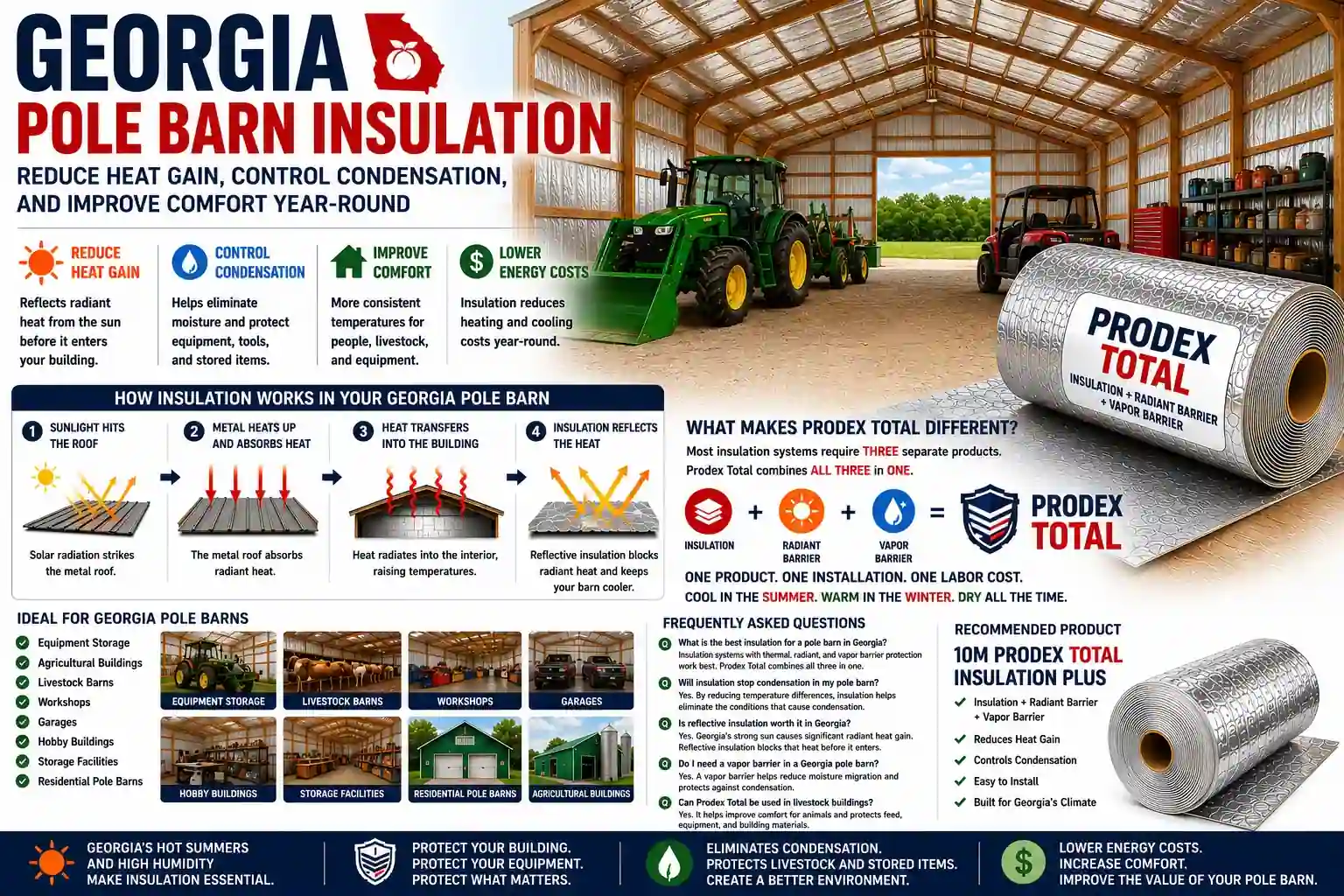
Georgia Pole Barn Insulation: Reduce Heat Gain, Control Condensation, and Improve Comfort
Pole barns are widely used throughout Georgia for equipment storage, agricultural operations, workshops, garages, livestock shelters, and residential applications.
While pole barns are durable and cost-effective, Georgia's hot summers, humidity, and changing temperatures can create significant challenges for building owners. Without proper insulation, pole barns can become extremely hot during the summer, uncomfortable during cooler weather, and vulnerable to condensation problems that can damage equipment, tools, feed, and building materials. Choosing the right insulation system can help improve comfort, reduce energy costs, and protect your investment.
Why Pole Barns Need Insulation in Georgia
Georgia's climate presents several challenges for pole barn owners.
These include:
Intense summer heat
High humidity
Rapid temperature changes
Condensation concerns
Rising energy costs
Metal roofing and siding can absorb large amounts of solar energy throughout the day, causing interior temperatures to rise significantly. Proper insulation helps reduce heat transfer while improving year-round comfort. For a broader overview of insulation options throughout the state, visit our Georgia Insulation for Metal Buildings, Pole Barns, Garages, and Homes.
How Heat Enters a Pole Barn
Many building owners assume heat enters primarily through air leaks. While air leakage can contribute to heat gain, radiant heat is often one of the largest sources of unwanted heat inside a pole barn.
Step 1: Sunlight Hits the Roof
Solar radiation strikes the roof surface.
Step 2: The Metal Heats Up
Metal roofing absorbs radiant energy and becomes hot.
Step 3: Heat Transfers Into the Building
The heated roof transfers energy toward the interior.
Step 4: Interior Temperatures Rise
Equipment, livestock, stored materials, and occupants are exposed to higher temperatures. Reflective insulation helps reduce this radiant heat transfer before it enters the building.
Condensation Problems in Georgia Pole Barns
Condensation is one of the most common issues affecting pole barns. Many owners mistake condensation for a roof leak. In reality, condensation is often caused by temperature differences.
Think about a cold can of beer sitting outside on a hot Georgia afternoon. Moisture forms on the can because the surface temperature differs from the surrounding air. The same process can occur on metal roofing and wall panels.
Morning Condensation
Metal remains cool overnight
Morning sun heats the exterior
Interior surfaces remain cooler
Temperature differences develop
Condensation forms
Evening Condensation
Interior surfaces remain warm
Exterior metal cools after sunset
Temperature differences develop
Condensation forms
Learn more in our Georgia Condensation Control for Metal Buildings.
Benefits of Insulating a Pole Barn
Reduced Heat Gain
Proper insulation helps reduce solar heat entering the building.
Improved Comfort
Buildings remain more comfortable for occupants and livestock.
Better Equipment Protection
Reduced moisture helps protect tractors, tools, machinery, and stored materials.
Lower Energy Costs
Insulated pole barns require less heating and cooling.
Condensation Control
Reducing temperature differences helps eliminate moisture formation.
Reflective Insulation for Georgia Pole Barns
Traditional insulation slows conductive heat transfer. Reflective insulation helps reduce radiant heat transfer. The combination of both can significantly improve building performance.
Learn more in our Georgia Reflective Insulation Guide.
What Makes Prodex Total Different?
Most insulation systems require building owners to purchase separate products for:
Insulation
Radiant Barrier
Vapor Barrier
This often means:
More material costs
More installation steps
More labor costs
Greater installation complexity
Prodex Total combines all three into one product.
Prodex Total = Insulation + Radiant Barrier + Vapor Barrier — All in One Product.
Instead of purchasing multiple systems, building owners can install a single solution that helps:
Reduce heat gain
Improve energy efficiency
Control condensation
Reduce moisture migration
Improve year-round comfort
One Product. One Installation. One Labor Cost.
Cool in the Summer. Warm in the Winter. Dry all the Time.
Pole Barn Applications
Prodex Total is commonly used in:
Equipment storage buildings
Agricultural structures
Livestock barns
Workshops
Garages
Hobby buildings
Storage facilities
Residential pole barn structures
Owners of steel-framed structures may also benefit from our Georgia Metal Building Insulation Guide.
Frequently Asked Questions
What is the best insulation for a pole barn in Georgia?
Many Georgia pole barn owners choose insulation systems that provide thermal insulation, radiant heat protection, and moisture control. Prodex Total combines all three in one product.
How do I keep my pole barn cooler during the summer?
Reducing radiant heat gain is one of the most effective strategies. Reflective insulation helps block solar heat before it enters the building.
Will insulation stop condensation in a pole barn?
Proper insulation can help eliminate condensation by reducing temperature differences that allow moisture to form on metal surfaces.
Is reflective insulation worth it in Georgia?
Yes. Georgia's climate produces significant radiant heat gain, making reflective insulation particularly effective.
Can condensation damage equipment stored inside a pole barn?
Yes. Condensation can contribute to rust, corrosion, mold, mildew, and damage to stored equipment and materials.
Do I need a vapor barrier in a Georgia pole barn?
A vapor barrier helps reduce moisture migration and is often recommended in Georgia's humid climate.
Is Prodex Total suitable for agricultural buildings?
Yes. Prodex Total is commonly installed in agricultural structures, equipment barns, workshops, and storage buildings.
Recommended Product
For Georgia pole barns, workshops, equipment sheds, and agricultural structures, we recommend: 10M Prodex Total Insulation Plus. It provides insulation, radiant barrier protection, vapor barrier protection, and condensation control in one integrated solution.
Looking for More Pole Barn Insulation Information?
While this guide focuses on pole barn insulation solutions for Georgia's climate, our Pole Barn Insulation Guideprovides a comprehensive overview of insulation systems, radiant heat control, condensation prevention, moisture management, installation methods, and energy-saving strategies for agricultural buildings, workshops, equipment storage, horse barns, livestock buildings, and residential pole barns.
Related Resource: Pole Barn Insulation Guide
Why Read the National Guide?
- Learn how reflective insulation reduces radiant heat gain in pole barns
- Understand how condensation forms and how to prevent it
- Compare insulation options for agricultural, residential, and commercial pole barn applications
- Explore installation methods and building assembly best practices
- Discover ways to improve comfort, reduce moisture, and lower energy costs year-round
Conclusion
Georgia pole barns face significant challenges from heat gain, humidity, and condensation. The right insulation system can improve comfort, protect equipment, reduce energy costs, and help eliminate moisture problems.
Prodex Total = Insulation + Radiant Barrier + Vapor Barrier — All in One Product.
One Product. One Installation. One Labor Cost.
Cool in the Summer. Warm in the Winter. Dry all the Time.