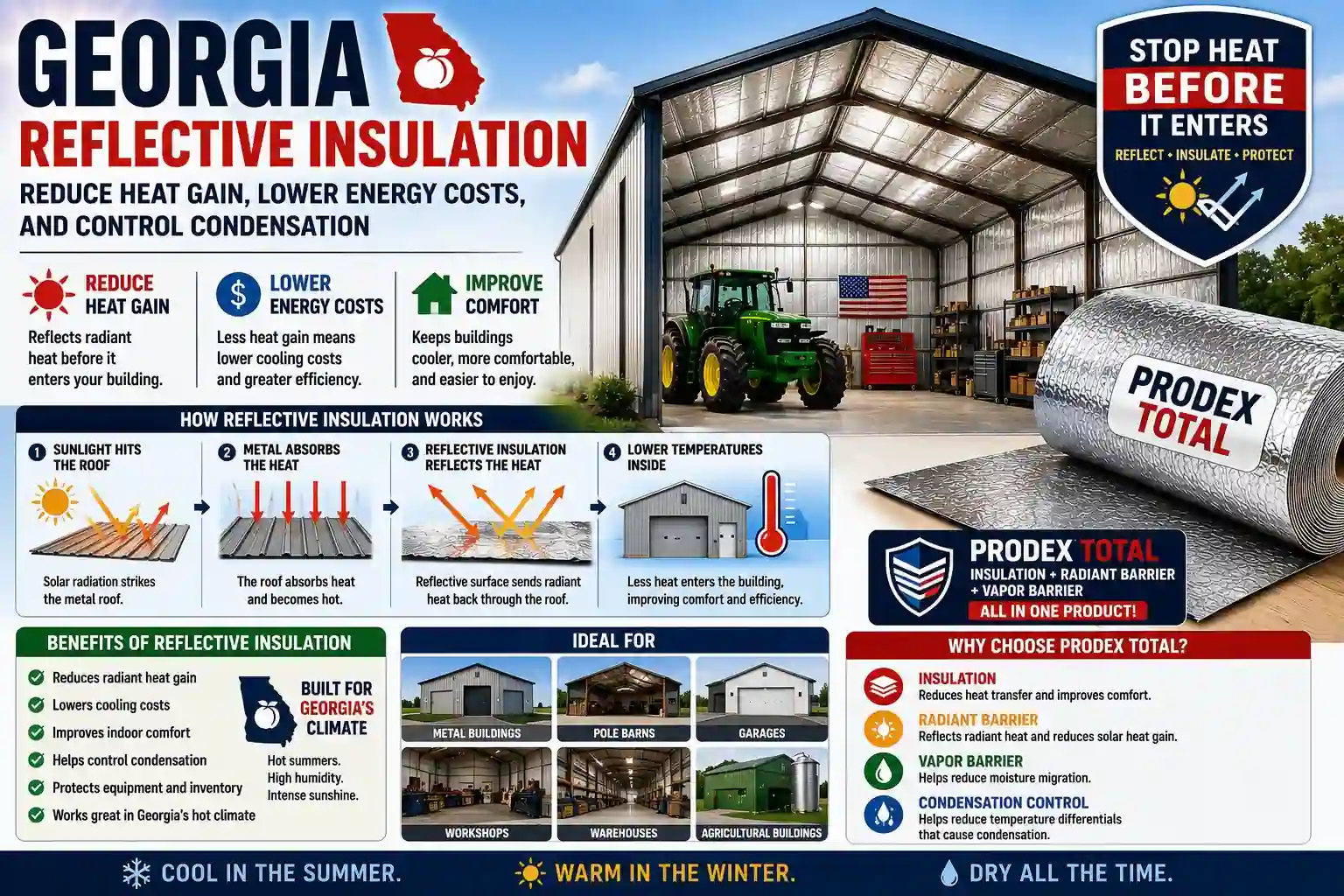
Georgia Reflective Insulation: Reduce Heat Gain, Lower Energy Costs, and Control Condensation
Georgia's hot summers, strong sunshine, and high humidity can make metal buildings, garages, workshops, warehouses, and homes uncomfortable and expensive to cool. Many property owners focus only on traditional insulation while overlooking one of the largest sources of heat entering a building: radiant heat.
Reflective insulation is specifically designed to address this problem. By helping reduce radiant heat transfer before it enters the structure, reflective insulation can improve comfort, lower cooling costs, and help control condensation.
For many Georgia building owners, Prodex Total provides a complete solution because it combines insulation, radiant barrier protection, and vapor barrier protection into one product.
Prodex Total = Insulation + Radiant Barrier + Vapor Barrier — All in One Product.
Cool in the Summer. Warm in the Winter. Dry all the Time.
What Is Reflective Insulation?
Reflective insulation is designed to reduce radiant heat transfer. Unlike traditional insulation materials that primarily slow conductive heat movement, reflective insulation helps reflect radiant energy away from the building. This distinction is important because radiant heat often accounts for a significant portion of the heat gain inside Georgia buildings. When sunlight strikes a roof, the roof absorbs solar energy and transfers that heat into the structure. Reflective insulation helps interrupt that process.
Why Reflective Insulation Matters in Georgia
Georgia's climate creates ideal conditions for radiant heat gain.
Building owners routinely deal with:
Long hot summers
High solar exposure
High humidity
Rising cooling costs
Uncomfortable interior temperatures
These conditions make radiant heat control an important part of an effective insulation strategy. Without reflective insulation, roofs and walls can absorb substantial amounts of solar energy throughout the day.
How Radiant Heat Enters a Building
Understanding how heat enters a building helps explain why reflective insulation works.
Step 1: The Sun Heats the Roof
Solar radiation strikes the roof surface.
Step 2: Metal Absorbs Heat
The roof panel absorbs radiant energy and becomes hot.
Step 3: Heat Transfers Indoors
The heated metal radiates energy toward the interior.
Step 4: Indoor Temperatures Rise
The building becomes hotter, increasing cooling demands and reducing comfort. Reflective insulation helps reduce this heat transfer before it reaches occupied space.
Reflective Insulation for Georgia Metal Buildings
Metal buildings are particularly susceptible to radiant heat gain. Metal transfers heat rapidly and can cause interior temperatures to rise dramatically during the summer.
Reflective insulation helps:
Reduce heat buildup
Improve comfort
Lower cooling costs
Protect stored equipment and materials
Improve building efficiency
Learn more in our Georgia Metal Building Insulation Guide.
Reflective Insulation and Condensation Control
Many people think reflective insulation only helps with heat. It can also play an important role in condensation control. Condensation is often caused by temperature differences between the inside and outside surfaces of metal panels. Think about a cold can of beer sitting outside on a hot Georgia afternoon. Moisture forms on the can because the can surface is colder than the surrounding air.
The same principle occurs on metal roofing.
Reflective insulation helps reduce temperature differences by reflecting radiant energy and helping maintain more consistent metal panel temperatures. When temperature differentials are reduced, condensation becomes far less likely to occur.
Learn more in our Georgia Condensation Control for Metal Buildings.
Reflective Insulation vs Traditional Insulation
Many building owners assume all insulation performs the same function.
Traditional insulation primarily slows conductive heat transfer.
Reflective insulation primarily reduces radiant heat transfer.
The best-performing systems address both.
This is one reason why many Georgia property owners choose Prodex Total.
It combines:
Insulation
Radiant Barrier Protection
Vapor Barrier Protection
into a single integrated system.
Common Georgia Applications
Reflective insulation is commonly used in:
Metal Buildings
Heat reduction and condensation control.
Pole Barns
Improved comfort and protection for agricultural equipment. Learn more in our Georgia Pole Barn Insulation Guide.
Garages
Lower temperatures and improved year-round usability.
Workshops
More comfortable working conditions.
Warehouses
Improved energy efficiency and inventory protection.
Homes
Reduced attic heat gain and improved comfort.
Save Money with One Product
Many insulation assemblies require separate products for:
Insulation
Radiant Barrier
Vapor Barrier
This often means:
More material costs
More labor
More installation complexity
Prodex Total combines all three into one system.
Prodex Total = Insulation + Radiant Barrier + Vapor Barrier — All in One Product.
One product.
One installation.
One labor cost.
Frequently Asked Questions
What is reflective insulation?
Reflective insulation is designed to reduce radiant heat transfer by reflecting heat away from a building rather than allowing it to enter occupied spaces.
Does reflective insulation work in Georgia?
Yes. Georgia's hot climate and high solar exposure make reflective insulation particularly effective for reducing summer heat gain.
Is reflective insulation the same as a radiant barrier?
Reflective insulation contains a radiant barrier component that helps reflect radiant heat energy away from the building envelope.
Can reflective insulation help reduce cooling costs?
By reducing heat gain, reflective insulation can lower cooling demands and improve energy efficiency.
Does reflective insulation help stop condensation?
Yes. By helping reduce temperature differences on metal surfaces, reflective insulation can help eliminate the conditions that cause condensation.
Is reflective insulation good for metal buildings?
Yes. Metal buildings are among the most common applications because metal readily absorbs and transfers solar heat.
Do I still need a vapor barrier?
A vapor barrier helps reduce moisture migration through the building envelope and is often recommended in Georgia's humid climate.
What is the best reflective insulation for a Georgia metal building?
Many building owners choose Prodex Total because it combines insulation, radiant barrier protection, vapor barrier protection, and condensation control in one product.
Recommended Product
For Georgia metal buildings, garages, workshops, warehouses, and agricultural structures, we recommend: 10M Prodex Total Insulation Plus
It helps reduce radiant heat gain, improve comfort, control condensation, and provide insulation, radiant barrier, and vapor barrier protection in one integrated solution.
Looking for More Reflective Insulation Information?
While this guide focuses on reflective insulation solutions for Georgia's climate, our Reflective Insulation Guideexplains how reflective insulation works, how radiant heat differs from conductive heat, why traditional R-values do not tell the complete story, and how reflective insulation can improve comfort, energy efficiency, and condensation control in homes, metal buildings, pole barns, garages, and commercial structures.
Related Resource: Reflective Insulation Guide
Why Read the National Guide?
- Learn how reflective insulation controls radiant heat
- Understand the difference between reflective insulation and fiberglass insulation
- Discover why radiant heat is responsible for significant heat gain in buildings
- Learn how reflective insulation helps reduce condensation and moisture problems
- Compare insulation performance across homes, metal buildings, pole barns, garages, and
Conclusion
Reflective insulation is one of the most effective ways to reduce radiant heat gain in Georgia buildings. When combined with insulation and vapor barrier protection, it can improve comfort, reduce cooling costs, and help control condensation.
Prodex Total = Insulation + Radiant Barrier + Vapor Barrier — All in One Product.
Cool in the Summer. Warm in the Winter. Dry all the Time.