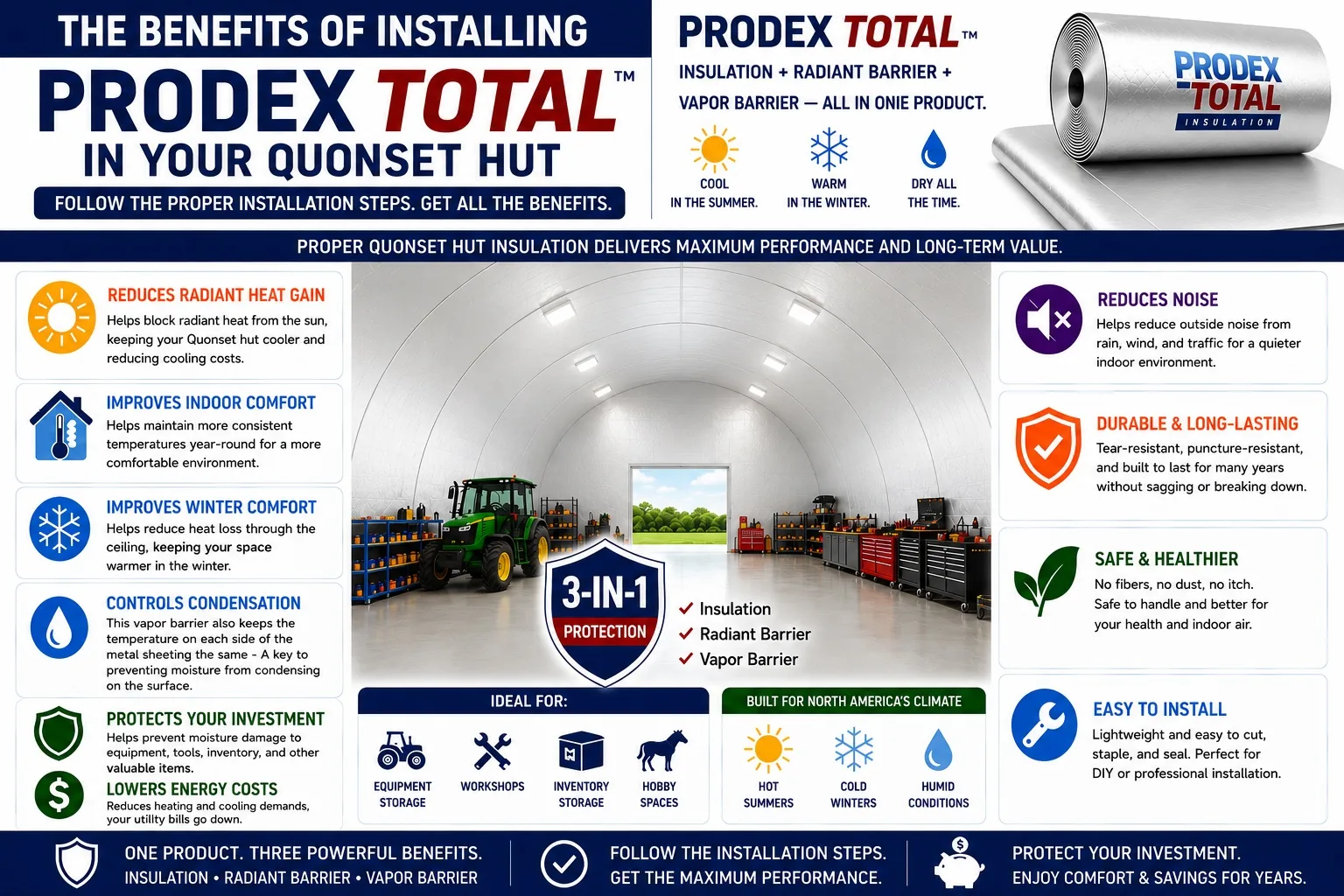
How to Install Quonset Hut Insulation
Step-by-Step Installation, Condensation Control and Energy-Saving Guide
Learn how to install Quonset hut insulation that helps reduce radiant heat, control condensation, improve energy efficiency and keep your steel building more comfortable throughout the year.
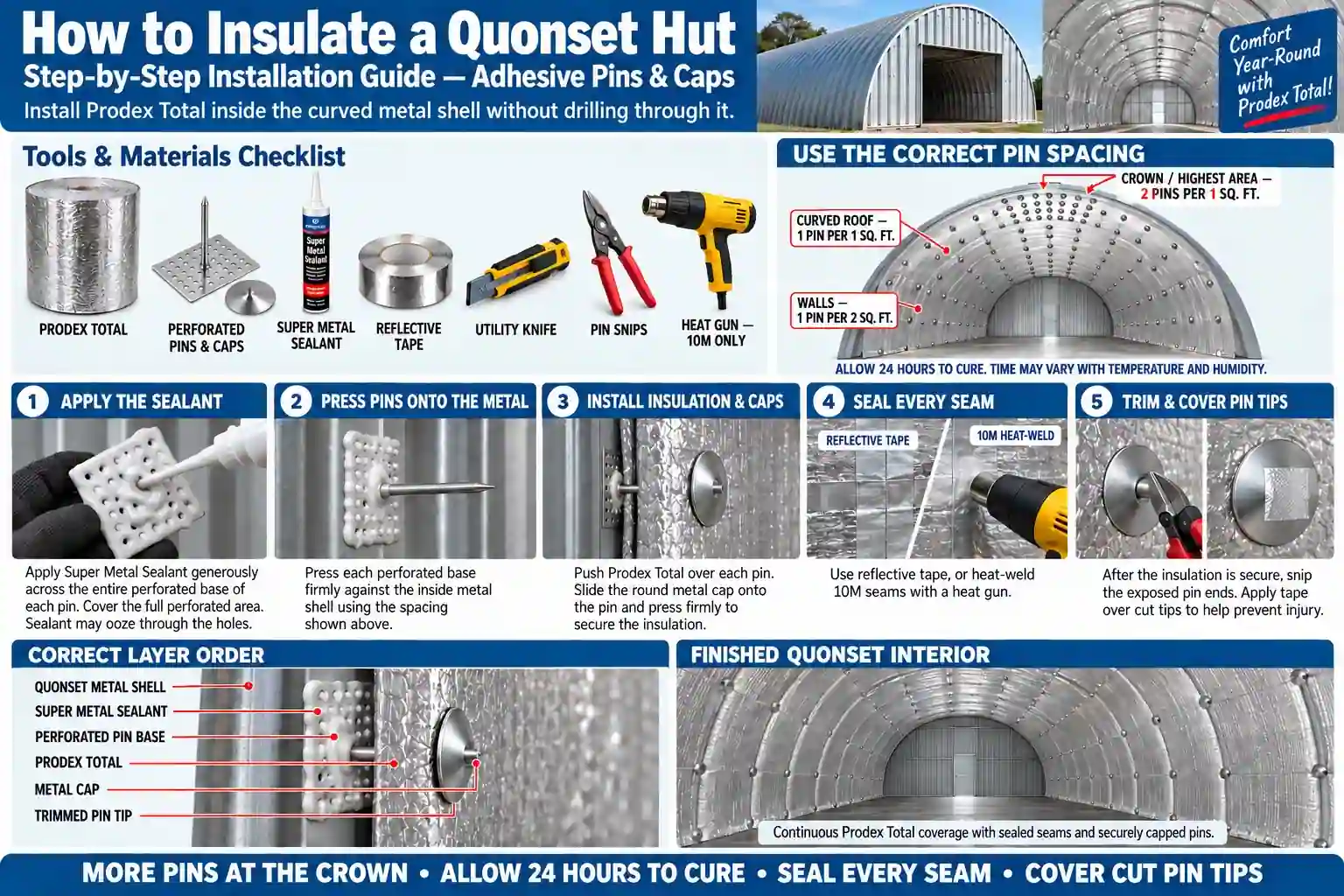
Because a Quonset hut has a continuous curved steel shell, the insulation must conform to the building’s shape while creating continuous coverage across the walls, curved roof and overhead crown. The following instructions explain how to install Prodex Total using perforated insulation pins, Super Metal Sealant and metal caps.
Recommended insulation: 10M Prodex Total Insulation
Other suitable choices include 48 Inch Prodex Total, Fast Action, 72 Inch Prodex Total, 24 Inch Prodex Total and 16 Inch Prodex Total.
Tools and Materials
Before beginning, gather:
- Super Metal Sealant
- Perforated insulation pins with caps
- Reflective tape
- Utility knife
- Snips or side-cutting pliers
- Degreaser and clean cloths
- Work gloves and safety glasses
- Heat gun when heat-welding the seams of 10M Prodex Total
How to Install Prodex Total in a Quonset Hut
Step 1 — Clean the Metal Surface
Clean the interior steel surface with a suitable degreaser. Remove dirt, dust, oil and other residue that could interfere with adhesion. Allow the metal to dry completely before installing the pins.
Step 2 — Apply the Sealant and Install the Pins
Apply Super Metal Sealant generously across the entire perforated base of each insulation pin. The sealant should cover the complete perforated area, not merely the center of the plate.
Press the pin base firmly against the steel shell. It is normal—and beneficial—for some sealant to squeeze through the perforations. This helps secure the entire base to the metal.
Use the following general pin spacing:
- Lower wall sections: Approximately one pin for every two square feet
- Curved roof sections: Approximately one pin for every square foot
- Highest overhead or crown area: Approximately two pins for every square foot
Allow the sealant to cure for at least 24 hours before placing weight on the pins. Actual curing time can vary with temperature and humidity.
Step 3 — Install the Insulation and Caps
After the sealant has cured, carefully press the Prodex Total insulation over the pins. Keep the insulation smooth while following the curve of the building.
Push a metal cap onto each pin and press it firmly against the insulation. The caps should hold the material securely without unnecessarily crushing or distorting it.
Continue across the walls, curved roof and overhead crown until the interior steel shell has continuous insulation coverage.
Step 4 — Seal the Seams
Align adjoining insulation edges carefully and seal the seams to create a continuous air and vapor barrier.
- Seal standard Prodex Total seams with reflective tape.
- Prodex Total 10M seams can be heat-welded or sealed with reflective tape.
- Fast Action rolls use an integrated adhesive seam.
Also seal openings and penetrations where practical. Unsealed gaps can allow warm, moisture-laden air to reach the colder steel shell.
Step 5 — Trim and Cover the Pins
After the insulation and caps are secure, trim the exposed ends of the pins. Cover each cut tip with tape or another suitable protective covering to reduce the risk of cuts or injuries.
Why Quonset Huts Are Different from Traditional Buildings
Quonset huts present insulation challenges that differ significantly from conventional homes, garages, and commercial buildings. Unlike traditional construction, which separates the roof from the walls, a Quonset hut is built from a continuous curved steel shell. That unique design provides exceptional structural strength while creating insulation challenges that many building owners don't anticipate.
During the summer, the curved steel shell absorbs intense solar energy throughout the day. As the steel heats up, radiant heat transfers into the building, causing interior temperatures to rise quickly. In colder weather, the same steel shell rapidly loses heat, making it more difficult to maintain comfortable indoor temperatures.
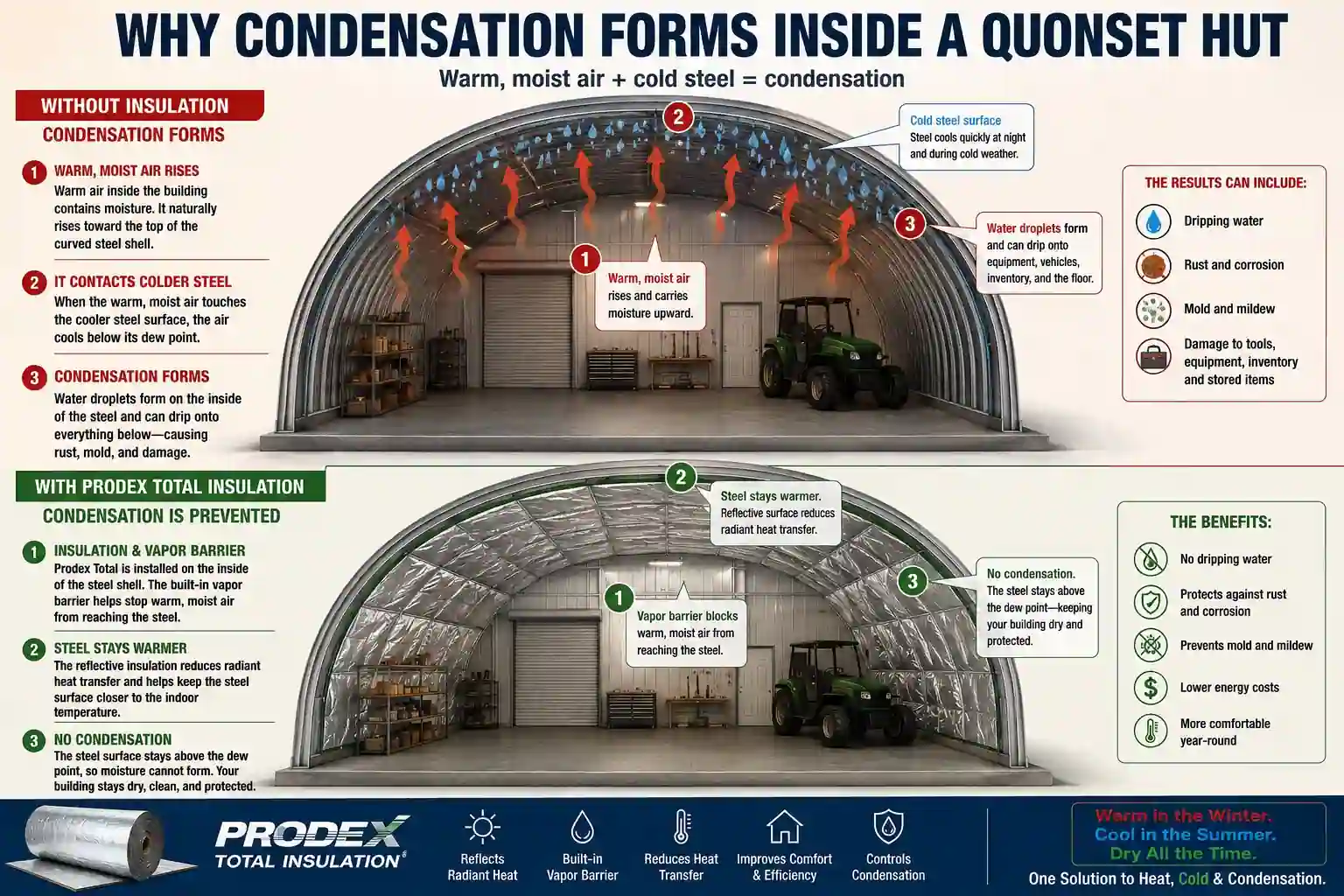
The curved design also increases the potential for condensation. As warm, moisture-laden indoor air rises and comes into contact with the cooler steel surface, water droplets can form on the inside of the building. Over time, uncontrolled condensation may contribute to rust, corrosion, mold, mildew, damaged insulation, and moisture-related damage to tools, equipment, vehicles, and stored belongings.
Because the roof and walls form one continuous structure, successful Quonset hut insulation requires more than simply increasing R-value. The insulation system should help reduce radiant heat transfer, limit conductive heat flow, control air movement, provide an effective vapor barrier, and minimize the conditions that allow condensation to develop.
Understanding how heat and moisture move through a Quonset hut is the first step toward selecting an insulation system that delivers long-term comfort, energy efficiency, and reliable year-round performance.
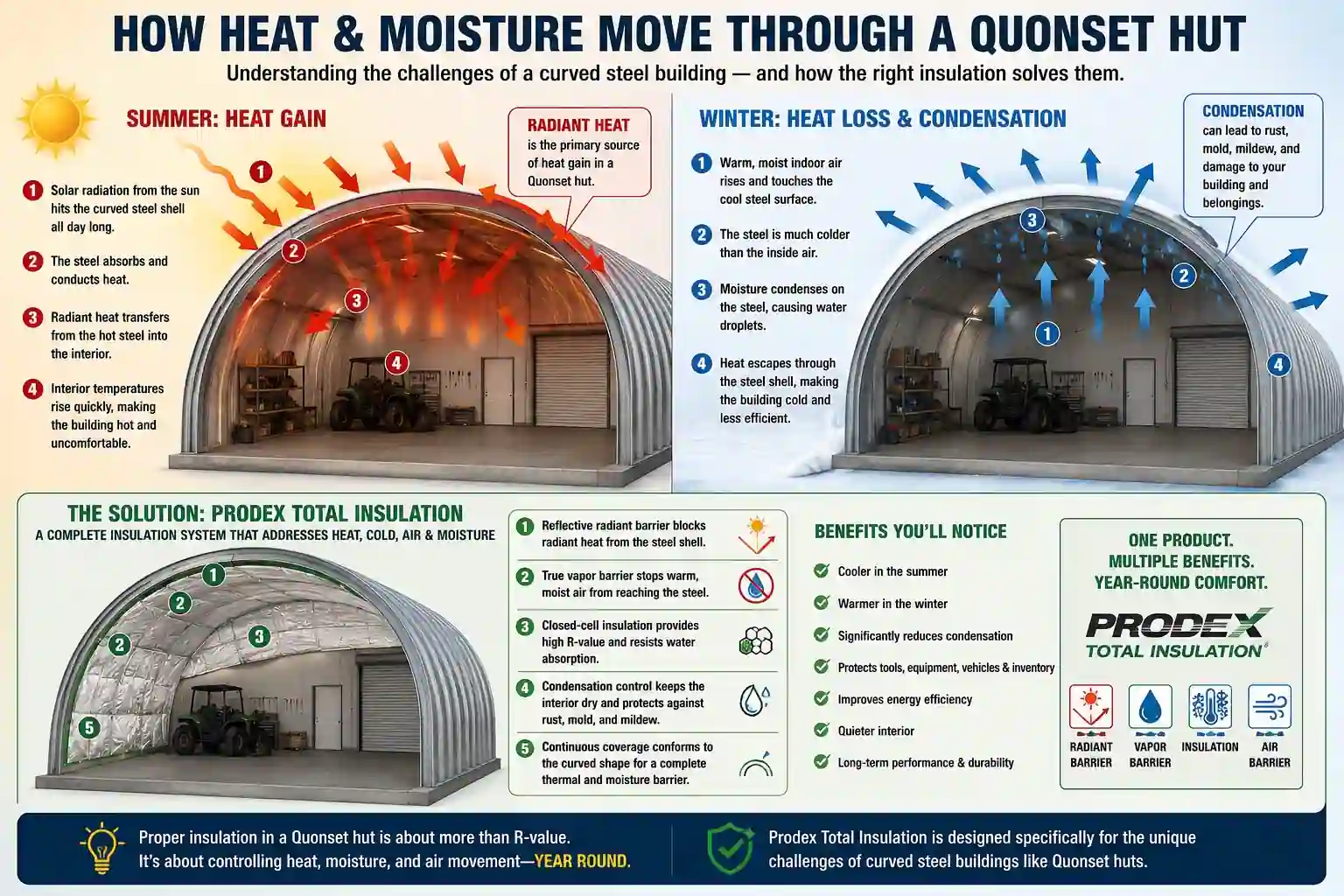
How Heat and Moisture Move Through a Quonset Hut: The continuous curved steel shell absorbs radiant heat during summer, loses interior heat during winter, and can develop condensation when warm, moist air reaches the cooler steel surface. Prodex Total creates a continuous insulation, radiant-barrier, air-barrier, and vapor-barrier system that conforms to the curved shell. Click the illustration to view a larger version.
How Heat Moves Through a Quonset Hut
Unlike traditional homes that have separate attic spaces and insulated wall cavities, a Quonset hut's curved steel shell is directly exposed to the weather. As a result, heat enters and leaves the building differently than it does in conventional construction.
Summer Heat Gain
During the summer, sunlight heats the exterior steel shell throughout the day. Because steel is an excellent conductor of heat, the curved shell quickly becomes hot and begins transferring energy toward the interior. In addition to conductive heat transfer, the heated steel radiates energy downward into the occupied space, often causing indoor temperatures to rise rapidly. Without insulation that helps reduce radiant heat transfer, Quonset huts can become extremely uncomfortable, particularly during sunny afternoons.
Winter Heat Loss
In colder weather, the process reverses. Warm indoor air naturally rises toward the upper portion of the curved shell. As that heat reaches the colder steel, energy escapes to the outside, making the building more difficult and expensive to heat. This continuous heat loss can reduce comfort while increasing heating costs throughout the winter months.
Condensation Forms Where Warm Air Meets Cold Steel
Condensation develops when warm, moisture-laden indoor air contacts the cooler steel shell and falls below its dew point. Water droplets form on the inside of the metal and may drip onto vehicles, equipment, tools, inventory, finished interiors, or stored belongings.
Because a Quonset hut is one continuous curved steel structure, condensation can develop across large portions of the building if moisture is not properly controlled.
Choosing insulation that helps reduce radiant heat transfer while limiting warm, humid air from reaching the steel shell is one of the most effective ways to improve comfort, increase energy efficiency, and keep a Quonset hut dry throughout the year.
Best Insulation for a Quonset Hut
Choosing the best insulation for a Quonset hut involves more than comparing R-values. Because Quonset huts are constructed from curved steel panels, the insulation system must address radiant heat, conductive heat transfer, air leakage, moisture, and condensation—not just one of these factors.
The right solution depends on how the building will be used, your local climate, and whether the structure will be heated or cooled. However, the most effective insulation systems are those that provide multiple layers of protection rather than relying on a single performance characteristic.
Reflective Insulation
Reflective insulation is specifically designed to reduce radiant heat transfer, making it particularly effective in steel buildings where the roof and walls are exposed to direct sunlight.
Products such as Prodex Total combine reflective insulation with thermal insulation, an air barrier, a built-in vapor barrier, and condensation control in a single lightweight product. This allows one system to help manage heat gain in summer, reduce heat loss in winter, and keep moisture from reaching the steel shell.
Fiberglass Insulation
Fiberglass insulation is commonly used in many building types and provides good thermal resistance when installed correctly.
In Quonset huts, however, fiberglass usually requires additional components such as a separate vapor barrier, air sealing, and a support system to help manage moisture. If warm, humid air reaches the steel shell behind the insulation, condensation can develop on the metal surface.
Spray Foam Insulation
Closed-cell spray foam provides excellent air sealing and thermal performance and is often selected for conditioned commercial buildings or workshops.
Because it adheres directly to the steel, spray foam is generally one of the more expensive insulation options and can make future repairs or building modifications more challenging. Professional installation is also recommended for most applications.
Comparing Your Options
The best insulation isn't simply the one with the highest R-value—it's the one that best addresses the unique challenges of a steel Quonset hut.
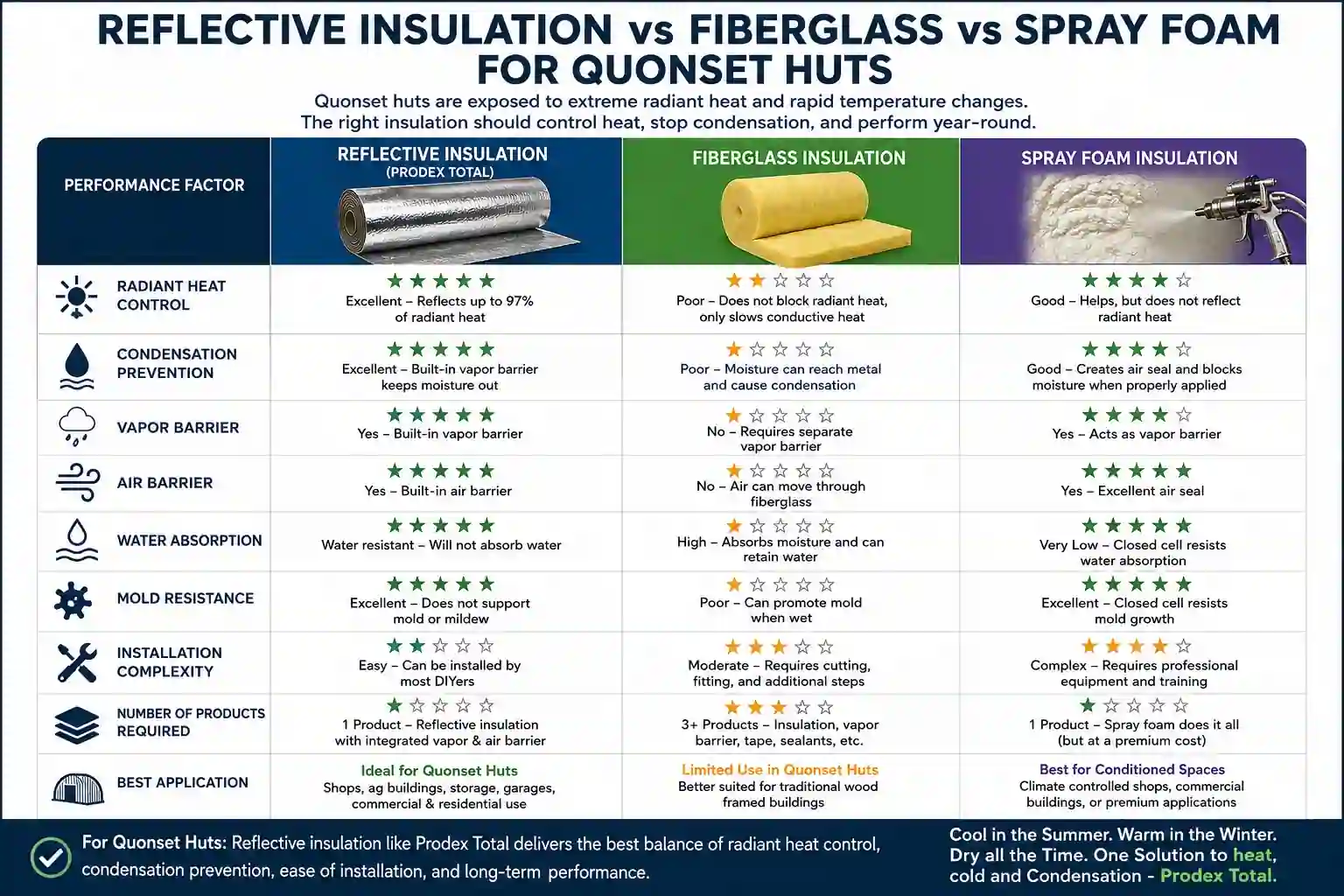
When comparing insulation systems, consider:
Radiant heat performance
Condensation prevention
Vapor barrier protection
Air sealing
Moisture resistance
Installation complexity
Long-term durability
Total system cost rather than material cost alone
For many workshops, garages, storage buildings, agricultural buildings, and commercial Quonset huts, reflective insulation with an integrated vapor barrier provides an excellent balance of energy efficiency, condensation control, installation simplicity, and long-term performance.
Cool in the Summer. Warm in the Winter. Dry all the Time. One Solution to heat, cold and Condensation – Prodex Total.
How to Choose the Right Insulation for Your Quonset Hut
No two Quonset huts are used exactly the same way. A climate-controlled workshop has very different insulation needs than a farm equipment shed or seasonal storage building. The best insulation system depends on how you use the building, your local climate, your energy-efficiency goals, and your budget.
Before choosing an insulation product, consider these key questions:
Will the building be heated, cooled, or both?
Will people work inside every day or only occasionally?
Is condensation currently a problem?
Will moisture-sensitive equipment or inventory be stored inside?
Are you finishing the interior with framing and wall panels?
Are you looking for the simplest installation or maximum thermal performance?
Understanding your priorities will help you choose an insulation system that delivers the performance you need.
Workshops and Garages
Workshops and garages are often occupied for long periods and may contain tools, vehicles, woodworking equipment, or machinery that can be damaged by excessive heat or moisture.
For these buildings, insulation should:
Reduce summer heat gain
Improve winter comfort
Help prevent condensation
Limit air infiltration
Improve energy efficiency if heating or cooling is used
Reflective insulation with an integrated vapor barrier is a popular solution because it addresses radiant heat, thermal performance, air leakage, and condensation with one product.
Storage Buildings
Storage buildings may not require full climate control, but protecting stored items from moisture is often the highest priority. Even if a building is rarely heated, daily temperature swings can create condensation on the steel shell. That moisture can damage cardboard boxes, furniture, electronics, paper products, fabrics, and other stored belongings. Choosing insulation that includes effective condensation control can help keep the interior dry throughout the year.
Agricultural Buildings
Agricultural Quonset huts are commonly used for equipment storage, feed, livestock support, workshops, and general farm operations.These buildings often experience higher humidity levels because of weather exposure, open doors, stored materials, or agricultural activities. Reducing condensation helps protect equipment from rust and corrosion while creating a more comfortable environment for workers. Durability, moisture resistance, and ease of installation are often just as important as thermal performance.
Commercial and Industrial Buildings
Commercial Quonset huts may serve as warehouses, manufacturing facilities, maintenance shops, distribution centers, or retail spaces.When employees occupy the building throughout the day, insulation can improve comfort, reduce HVAC operating costs, and help create more consistent indoor temperatures. A well-designed insulation system also helps reduce condensation that could affect inventory, equipment, or finished products.
Climate Matters
Buildings in hot, sunny climates typically benefit from insulation that reduces radiant heat entering through the steel shell. In colder climates, limiting heat loss and controlling interior moisture become increasingly important.Many areas experience both hot summers and cold winters, making year-round insulation performance essential. Rather than focusing on a single performance characteristic, choose an insulation system that addresses radiant heat, conductive heat transfer, air leakage, vapor control, and condensation management as a complete assembly.
Installation and Long-Term Value
The least expensive insulation product is not always the lowest-cost solution over the life of the building.
Consider factors such as:
Number of products required
Installation time
Long-term durability
Maintenance requirements
Moisture resistance
Energy savings
Future repair or modification needs
Systems that combine multiple functions into a single product can simplify installation while reducing the number of materials needed to complete the project.
Choosing the Right Solution
For many Quonset huts used as workshops, garages, storage buildings, agricultural facilities, and commercial spaces, reflective insulation with an integrated vapor barrier provides an excellent balance of thermal performance, radiant heat control, condensation prevention, and installation simplicity. By selecting insulation that addresses heat, cold, air movement, and moisture together, you can create a more comfortable, energy-efficient building that stays dry and performs well throughout the year.
Cool in the Summer. Warm in the Winter. Dry all the Time. One Solution to heat, cold and Condensation - Prodex Total.
Why Reflective Insulation Works So Well
Unlike fiberglass, which primarily resists conductive heat flow, reflective insulation is designed to reduce radiant heat transfer before it enters the building. Because radiant heat is the dominant source of summer heat gain in steel buildings, blocking it at the roof and walls can dramatically improve interior comfort.
Prodex Total combines several important functions into one product:
Reflective insulation that blocks radiant heat
Built-in vapor barrier
Air barrier
Condensation control layer
Thermal insulation
Instead of installing multiple materials, one product helps manage heat, cold, moisture, and air infiltration.
Cool in the Summer. Warm in the Winter. Dry all the Time. One Solution to heat, cold and Condensation - Prodex Total.
Why Fiberglass Alone Can Be Problematic
Fiberglass insulation performs well when kept dry inside a traditional framed wall, but Quonset huts present different conditions. If humid air reaches the steel shell behind fiberglass insulation, condensation can develop on the metal surface. Over time this trapped moisture may reduce insulation performance and contribute to mold, mildew, corrosion, or water damage.
Because fiberglass is air permeable, it typically requires additional components such as:
A separate vapor barrier
Air sealing
Moisture management
Careful detailing to minimize condensation risk
In many steel buildings, using multiple products increases installation complexity and leaves more opportunities for moisture-related issues if any layer is compromised.
Spray Foam vs Reflective Insulation
Spray foam creates an excellent air seal and provides high R-values, making it a popular choice for some steel structures. However, it is generally one of the most expensive insulation options and is permanently bonded to the steel shell, making future repairs or modifications more difficult.
Reflective insulation offers a different approach by reducing radiant heat gain while also providing an integrated vapor barrier and condensation control layer. For many Quonset hut owners, this combination delivers excellent year-round performance with a faster and more economical installation.
Which Insulation Is Best?
The best insulation depends on how the building will be used, your climate, and your performance goals.
If your priorities include:
Preventing condensation
Lowering summer heat gain
Improving winter comfort
Reducing air infiltration
Installing one product instead of multiple layers
then reflective insulation with an integrated vapor barrier is often one of the most effective solutions for Quonset huts.
For conditioned buildings, workshops, garages, agricultural buildings, storage facilities, and commercial applications, many owners choose Prodex Total because it addresses the unique heat and moisture challenges created by curved steel construction.
Quonset Hut Insulation FAQs
What is the best insulation for a Quonset hut?
The best insulation should address radiant heat, conductive heat transfer, air movement, moisture, and condensation.
Reflective insulation with an integrated vapor barrier is well suited to the curved steel shell of a Quonset hut because it can perform several functions with one product. Prodex Total provides reflective insulation, thermal insulation, an air barrier, a vapor barrier, and condensation control.
For a broader explanation of insulation performance in steel structures, see Metal Building Insulation: Stop Condensation, Heat, Cold and Air.
How do you stop condensation inside a Quonset hut?
Condensation is controlled by preventing warm, humid interior air from reaching the colder steel shell. The insulation system should provide continuous coverage, control air movement, include an effective vapor barrier, and be sealed around seams, edges, fasteners, and penetrations. Learn more about the underlying moisture problem in Condensation in Metal Buildings: Causes, Damage and How to Stop It.
Do Quonset huts need a vapor barrier?
Most enclosed Quonset huts benefit from a continuous vapor barrier. Steel does not absorb moisture. When humid air reaches cold metal, water can form directly on the interior surface. A properly installed vapor barrier helps keep moisture-filled air away from the steel shell. Seams, overlaps, openings, and penetrations must be sealed so the vapor-control layer remains continuous.
Does reflective insulation work in a Quonset hut?
Yes. Reflective insulation is especially useful in Quonset huts because the curved steel shell can absorb intense solar radiation. A properly installed reflective surface reduces radiant heat transfer into the building. This can improve summer comfort and reduce the load on cooling equipment. For a more detailed explanation, read the Reflective Insulation Guide.
Is bubble insulation the same as Prodex Total?
No. Basic single-bubble and double-bubble products should not automatically be treated as equivalent to Prodex Total. Products can differ in thickness, construction, thermal performance, strength, condensation control, and intended application. Compare their differences in Bubble Insulation vs. Prodex Total.
Can fiberglass insulation be used in a Quonset hut?
Fiberglass can be used in some Quonset hut assemblies, but it does not provide a built-in air barrier or vapor barrier. If humid air moves through fiberglass and reaches cold steel, condensation can form behind the insulation. A fiberglass system may therefore require separate air-sealing, vapor-control, support, and interior-liner materials.
Is spray foam good for insulating a Quonset hut?
Closed-cell spray foam can provide thermal resistance and a strong air seal when correctly applied. However, it is generally more expensive, usually requires professional installation, and bonds directly to the steel shell. This can make future panel repairs, wiring changes, inspections, and building modifications more difficult. The best choice depends on the building's use, budget, climate, and long-term plans.
What part of a Quonset hut is most important to insulate?
The upper portion of the curved shell is the most critical area because it functions as the roof. It receives the greatest radiant heat load during sunny weather and is also a major location for condensation because warm interior air rises toward the colder steel overhead. For consistent performance, the insulation should normally continue across the entire curved shell rather than stopping at an arbitrary roofline.
Can I install Quonset hut insulation myself?
Many owners can install lightweight reflective insulation themselves using common tools, suitable access equipment, and proper safety precautions. DIY installation is most successful when roll direction, attachment points, overlaps, penetrations, and seam locations are planned before work begins. Follow the detailed installation instructions on this page for the recommended sequence. Spray foam generally requires specialized equipment, protective clothing, ventilation, and professional application experience.
Which Prodex Total product is recommended for a Quonset hut?
For many Quonset hut, steel-building, workshop, garage, agricultural, and storage applications, consider 10M Prodex Total Insulation Plus. It combines reflective insulation, thermal insulation, an air barrier, a vapor barrier, and condensation control in one lightweight product.
How much insulation do I need for a Quonset hut?
Find the insulation calculator (on every page of the website toward the top right). For your wall height, you'll need to estimate what would be the height if you had a straight-wall building. The calculator will help determine the number of insulation rolls required based on your building dimensions. Insulation quantity must be calculated from the surface area of the curved steel shell rather than the floor area alone.
Measurements should account for:
- Building length
- Curved-shell dimensions
- End walls
- Overlaps
- Doors and windows
- Trimming
- Penetrations
- Installation waste
A modest waste allowance helps prevent shortages during cutting and fitting.
Cool in the Summer. Warm in the Winter. Dry all the Time. One Solution to heat, cold and Condensation - Prodex Total.
Buy Quonset Building Insulation With Confidence
Independent Reviews at Site Jabber. Site Jabber is the leading destination for customer reviews of businesses. We include their link (bottom right of every page) because they only allow customer reviews.
BBB report. For over 100 years, BBB has set the standard for ethical business behavior. We're proud to maintain an "A to A+" rating. This rating takes into account a company's size in its relation to complaints.
ICC-ES Recognized - ICC-ES is an evaluation service that takes independent test data for a variety of products and analyses it against a uniform Acceptance Criteria that is recognized internationally.
Prodex adds an extra layer of credibly by submitting these rolls to the ASTM Rima International verification program. By having a third party verification, Prodex assures its clients that the insulation complies with industry standards, and is suitable for any construction system.
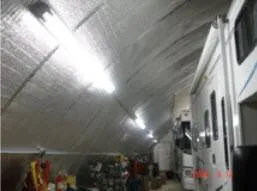
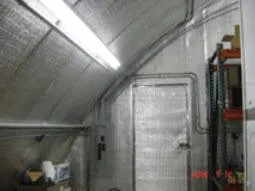
Ready to choose the right reflective insulation? Browse our complete selection of Buy Reflective Insulation.
Featured Quonset Hut Insulation For Sale
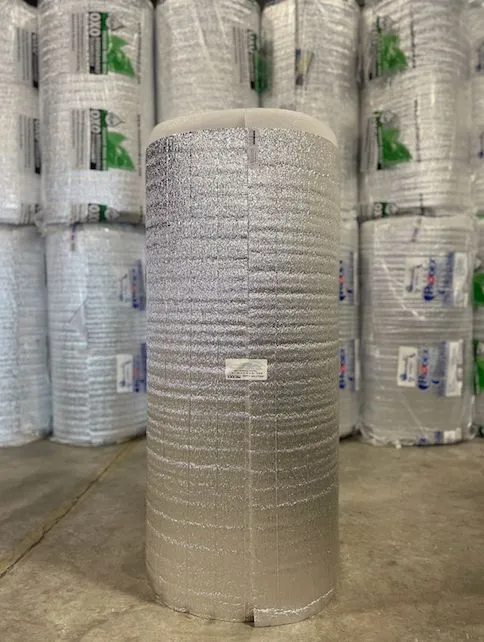
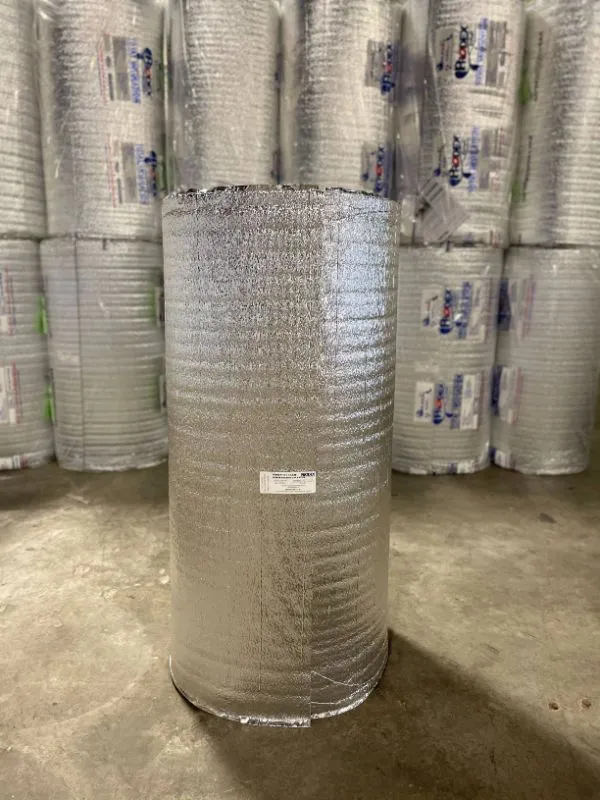
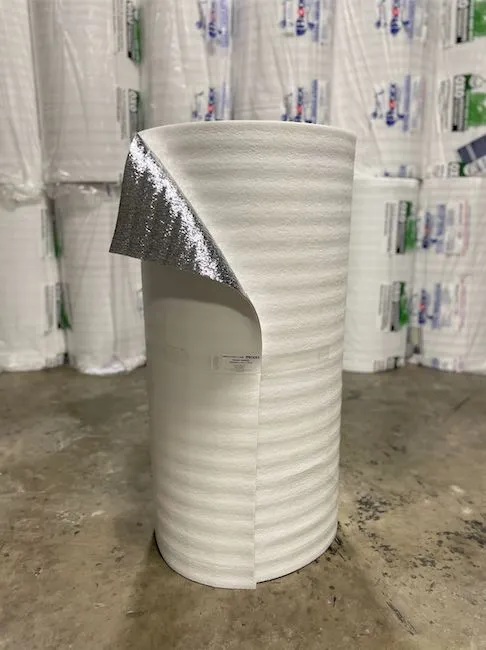
WHITE 5M Plus: R15.3
Thickness: 5mm (0.2") closed cell polyethylene foam with reflective reinforced foil on one side and plastic white finish film on the other side. Ideal where white finish is preferred.