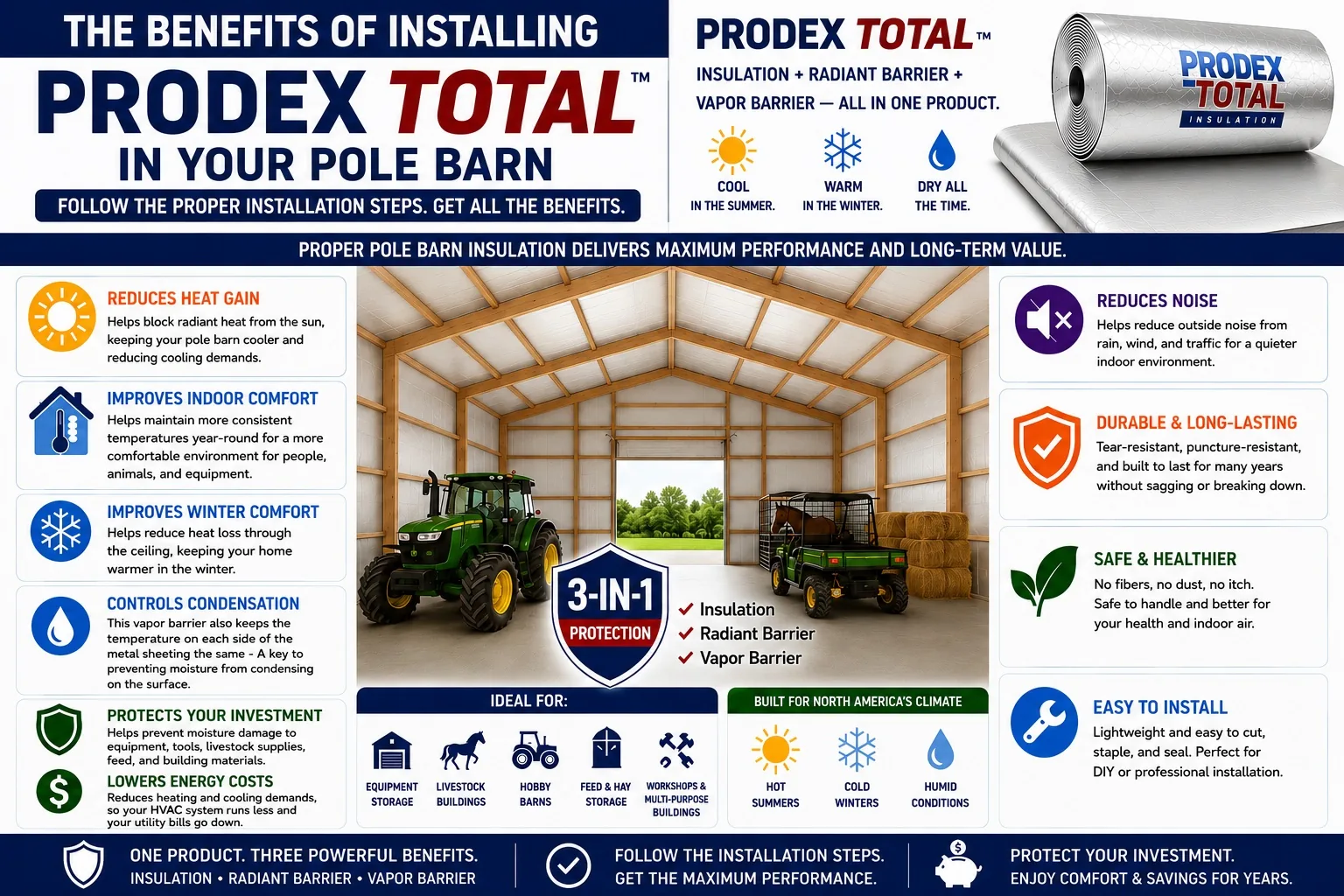
Prodex Total insulation benefits for pole barns – 3-in-1 radiant barrier, vapor barrier, and insulation in one product

How to Insulate a Pole Barn: Insulation Options and Installation Guide


Insulating a pole barn or post-frame barndominium means controlling summer heat, winter heat loss, air leaks and condensation beneath metal roofing and siding. Prodex Total combines insulation, a radiant barrier and a vapor barrier in lightweight rolls for new construction and existing buildings.


Building a barndominium? The attachment methods below also apply to many post-frame barndominiums. For living spaces, plan the complete insulation assembly around residential thermal, moisture-control and interior-finish requirements. See our barndominium insulation guide for more information.


Choose your installation method below, compare insulation options, or go directly to rolls and pricing.


Go directly to what you need:

New Construction | Existing Pole Barn | Compare Insulation | Choose Your Rolls

Listen to this article


Prodex Total = Insulation + Radiant Barrier + Vapor Barrier — All in One Product.

Cool in the Summer. Warm in the Winter. Dry all the Time.


Calculate How Many Rolls You Need | Shop Pole Barn Insulation Rolls


Considering other insulation? Compare Prodex Total to: Fiberglass · Spray Foam · Bubble Insulation


Why Choose Prodex Total for Your Pole Barn?


Metal roofing and siding expose pole barns to intense summer heat, winter heat loss and condensation. Prodex Total combines insulation, a radiant barrier and a vapor barrier in one lightweight roll, with installation methods for new construction and existing post-frame buildings.


Prodex Total benefitWhat it means for your pole barn
Radiant heat controlReflective foil reduces radiant heat transfer when facing an air space, helping limit heat gain from sun-heated roofing and siding.
Added thermal resistanceThe closed-cell foam core adds insulation. Choose your roll and installation arrangement using the applicable tested assembly values.
Condensation controlProperly sealed seams, edges and penetrations help prevent moist indoor air from reaching cold metal panels.
Continuous coverage across framingInstall across wood purlins and girts to create a continuous layer rather than fitting separate pieces into every opening.
Practical installationCut and fasten rolls using the method suitable for your framing—before attaching the metal panels or from inside an accessible existing building.
Works with fiberglassAdd insulation, radiant heat and vapor control to a suitable fiberglass assembly, helping protect its insulating performance.
Interior finish choicesChoose reflective foil or explore white, black and rustic finishes to suit a workshop, storage building or other interior space.


Prodex Total = Insulation + Radiant Barrier + Vapor Barrier — All in One Product.


For heated workshops and post-frame barndominiums, select the complete roof and wall assembly to meet the building’s thermal, moisture-control and interior-finish requirements.


Calculate Your Roll Quantity | Shop Pole Barn Insulation Rolls


Tools and Materials


Most installations use a few basic tools and fasteners:


  • Prodex Total insulation rolls — Select the thickness, width, finish and seam option for your project.

  • Reflective tape — Seals standard roll seams and appropriate cut joints.

  • Suitable fasteners — Roofing cap nails, screws with locking washers, or staples suitable for the wood framing and installation.

  • Utility knife and measuring tape — For measuring and cutting rolls.

  • Stapler or screw gun — Depending on your fastening method.

  • Heat gun for 10M — For heat-welding compatible seams according to the product instructions.

  • Furring or additional supports — Where needed to secure edges or maintain the intended air space.

Seam options: Standard rolls use reflective tape. Compatible 10M seams can be heat-welded, and Fast Action rolls include an adhesive seam strip. Cut joints, perimeter edges and penetrations still need appropriate sealing.


How to Insulate a New Pole Barn


One Layer: Install Over the Roof Purlins and Wall Girts


Before the metal panels are installed, run Prodex continuously across the exterior face of the framing. This covers the framing rather than insulating only the spaces between members.
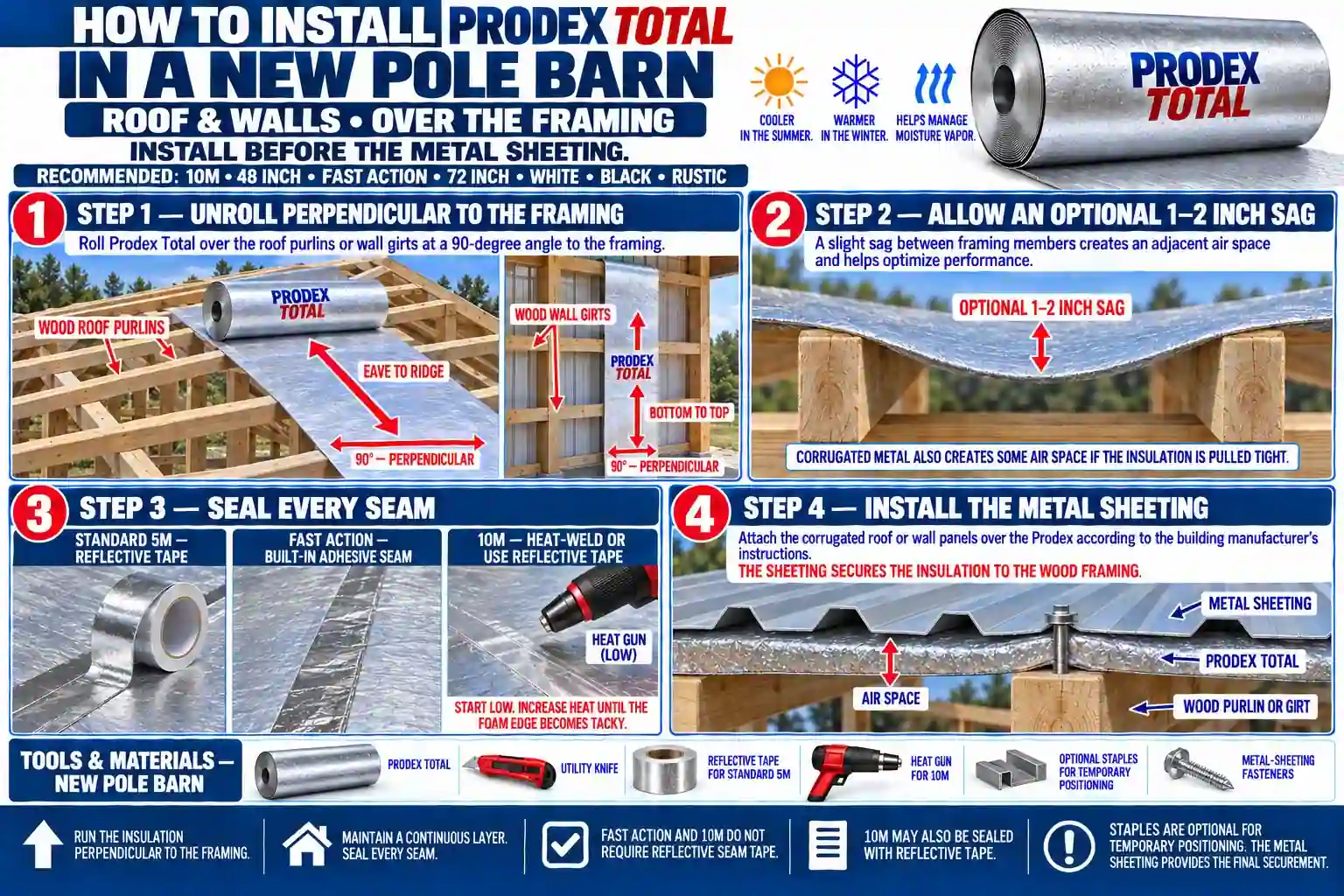


How to install Prodex Total insulation in a New Pole Barn
  1. Position the roll. Run the insulation perpendicular to the purlins or girts, keeping adjacent rolls aligned for sealing.

  2. Create the intended air space. On the roof, allow a slight 1–2-inch sag between supports where appropriate. On walls, use the installation arrangement needed to maintain the specified air space. Corrugations create some separation, but they should not be assumed to reproduce the air space used in a tested assembly.

  3. Secure temporarily as needed. Hold the insulation in position while completing the seams and preparing to attach the panels.

  4. Seal the seams. Use reflective tape for standard rolls, heat-weld compatible 10M seams, or close the factory adhesive strip on Fast Action rolls.

  5. Attach the metal sheeting. Use fasteners suitable for the panel and framing system. Prodex compresses where the panels are fastened to the framing.

  6. Seal the remaining details. Complete edges, corners, openings and penetrations to maintain a continuous insulation layer.


Why choose this method? Installing before the sheeting goes on provides convenient access and continuous coverage across the roof and wall framing.


View Prodex Total 10M Plus | View Fast Action Rolls


Two Layers: Add an Interior Layer Across the Framing


Many customers use one layer of Prodex. A second layer is an option when the planned assembly calls for additional insulation and a continuous interior surface. 


Many customers use one layer of Prodex. A second layer is an option when the planned assembly calls for additional insulation and a continuous interior surface.
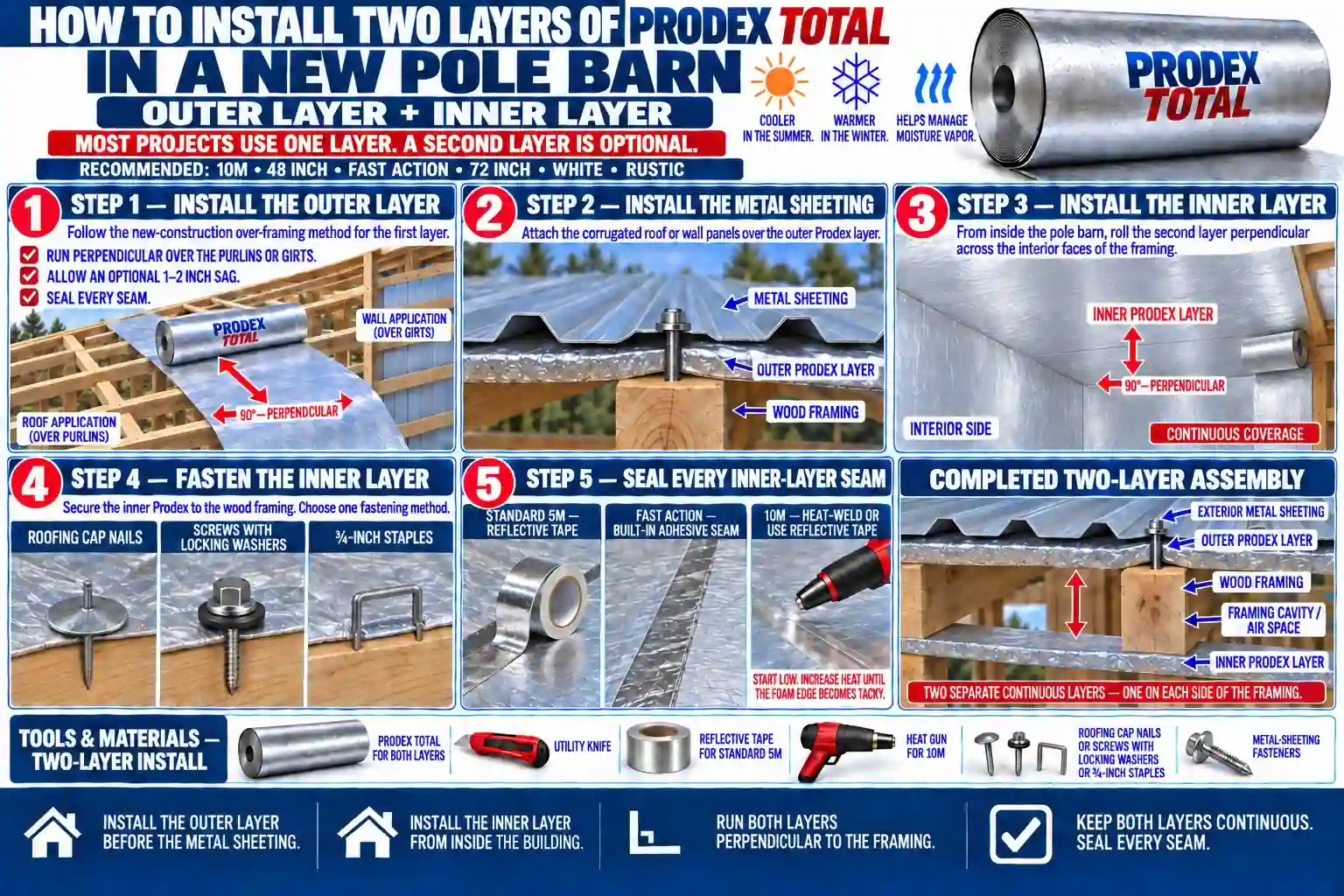
How to install two layers of Prodex total insulation a new new pole barn

  1. Install the outer layer using the method above, then attach the metal panels.

  2. Run the second layer across the inside face of the framing, perpendicular to the members.

  3. Fasten to suitable wood framing using roofing cap nails, screws with locking washers, or appropriate staples. The illustrated methods use ¾-inch staples where suitable.

  4. Seal the interior seams, edges and penetrations.

  5. Maintain the intended spaces between layers without pushing the outer layer against the metal panels.

Plan the complete assembly before adding a second vapor-resistant layer. Keep enclosed materials dry, account for drying potential, and use the applicable tested assembly when evaluating thermal performance. Two layers do not automatically double the published R-value.


How to Insulate an Existing Pole Barn

You can often insulate an existing pole barn from the inside without removing its roofing or siding. Choose continuous coverage across the framing or an installation between accessible members.


Retrofit Roof and Walls: Install Across the Inside of the Framing


This method creates a continuous interior insulation layer and leaves space between Prodex and the metal panels.


  1. Prepare the building. Repair roof and wall leaks and allow wet materials to dry before covering them.

  2. Run Prodex perpendicular to the framing. Unroll across the room-facing side of the roof purlins or wall girts.

  3. Fasten securely. Use roofing cap nails, screws with locking washers, or staples suitable for the wood framing and installed material. Provide additional support where needed, especially overhead.

  4. Maintain the air space. The framing depth and insulation position establish separation from the metal panels. Avoid pushing the insulation into contact with the sheeting across the field of the installation.

  5. Seal the insulation layer. Seal seams, perimeter edges, openings and penetrations using the appropriate materials for your roll.


Why choose this method? It covers the framing continuously and reduces the number of individual pieces and perimeter joints compared with fitting insulation into every opening.

Compare Prodex Rolls and Finishes
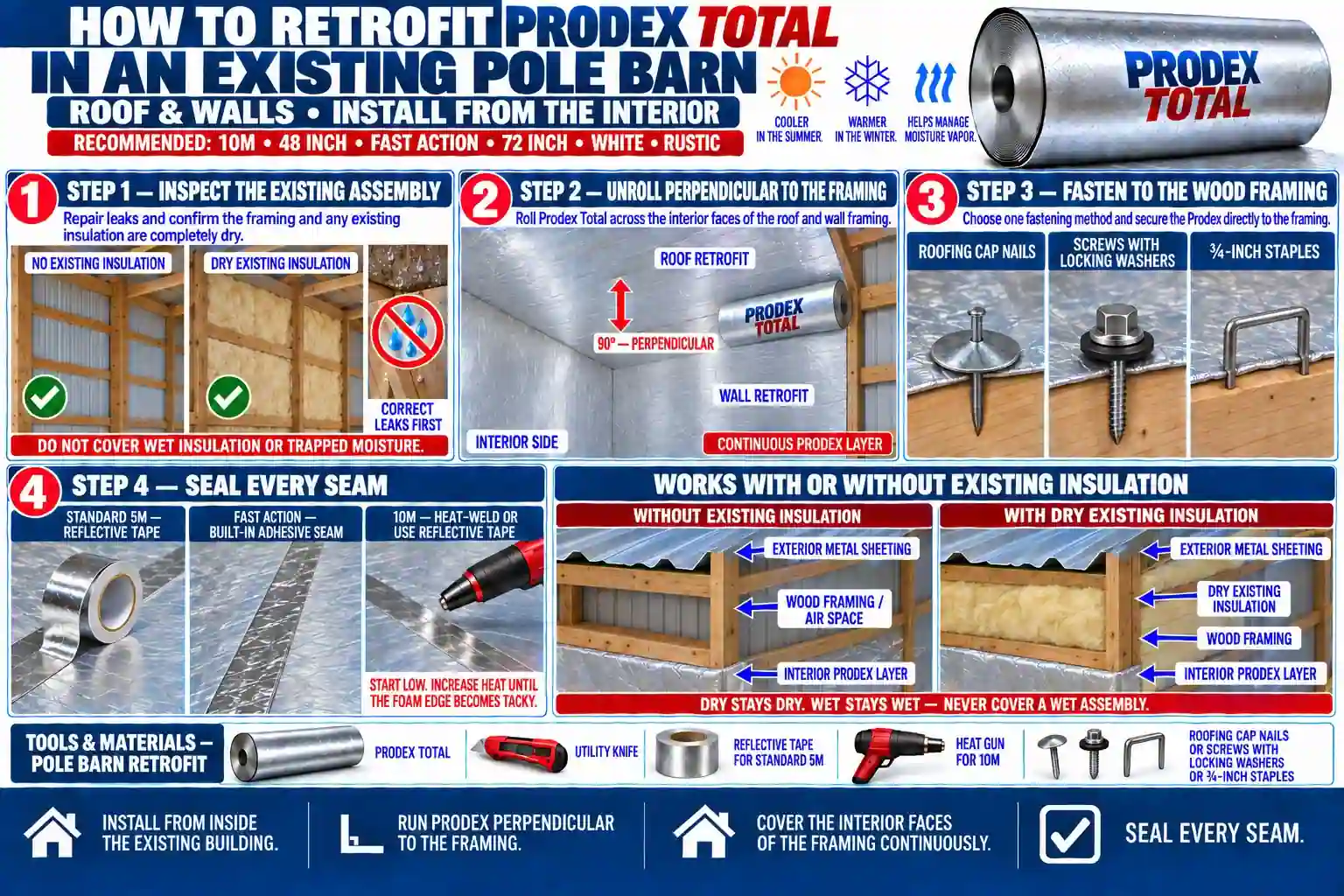

How to retrofit Prodex Total Insulation in an exisiting pole barn


Retrofit Between Girts or Purlins


Installing between framing members can be useful where you want to leave the framing exposed or where interior access makes continuous coverage impractical.


  1. Measure each opening. Choose a suitable roll width or cut the insulation to fit, allowing enough material for secure attachment and sealed edges.

  2. Establish the air space. Leave at least 1 inch between the reflective surface and metal sheeting to help optimize performance, following the conditions for your intended assembly.

  3. Attach to suitable wood surfaces. Use appropriate cap nails, screws with locking washers, or staples. Add fastening surfaces where necessary rather than leaving unsupported edges.

  4. Seal around each section. Seal seams and connections to the surrounding framing so moist air cannot readily bypass the insulation.

  5. Check corners and transitions. Complete the insulation around posts, openings, roof-to-wall junctions and other interruptions.


Optional second layer: Add a continuous layer across the inside face of the framing when the assembly calls for it. Secure and seal that layer using the continuous retrofit method above.


The 16-inch and 24-inch rolls can be convenient for suitable framing layouts. Measure the actual openings before choosing your width.
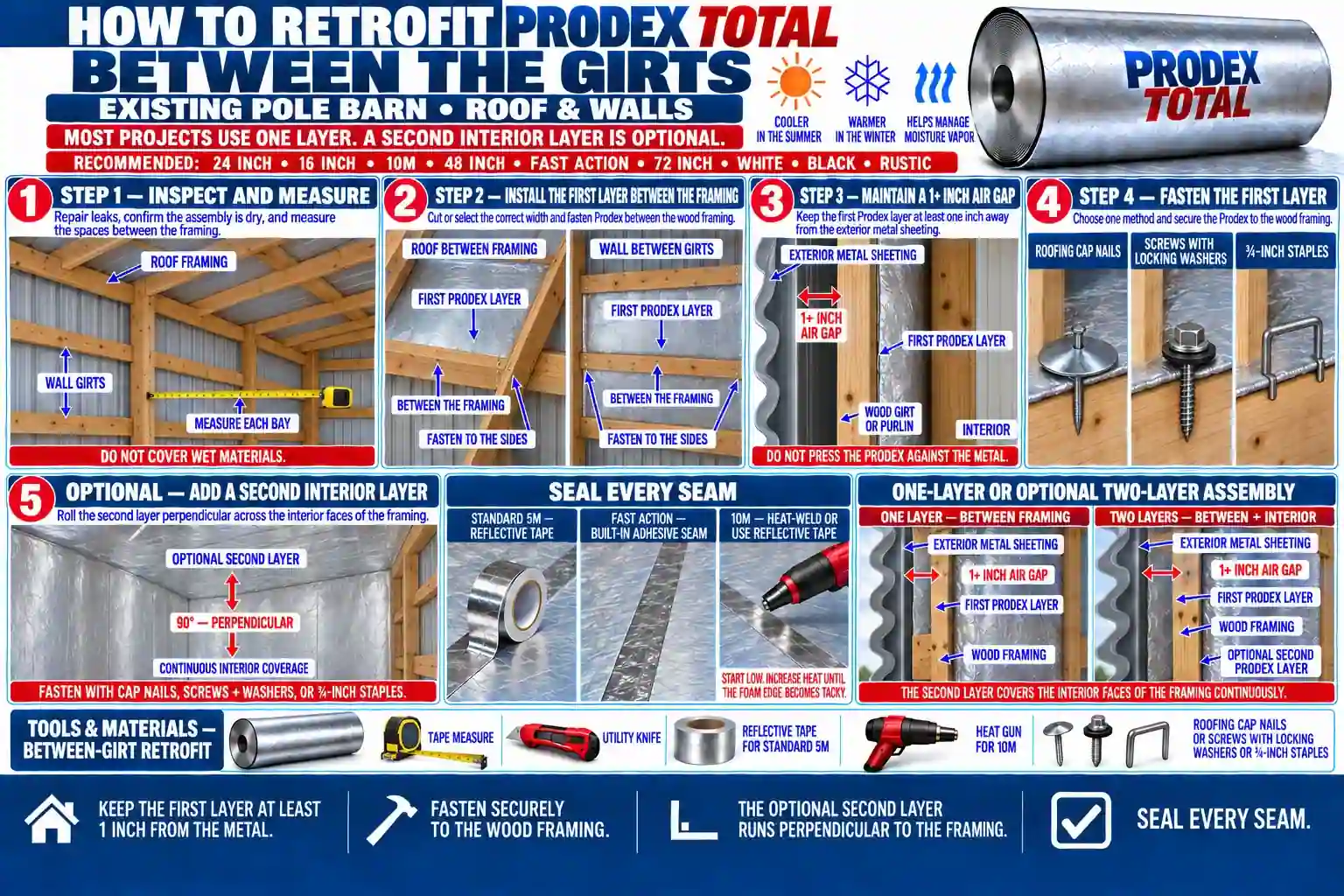

How to retrofit Prodex Total BETWEEN the girts

Compare Pole Barn Insulation Options


What Is the Best Insulation for a Pole Barn?


The best pole barn insulation depends on how you use the building. An equipment-storage barn, an intermittently heated workshop and a continuously conditioned barndominium can require different insulation assemblies.


Choose Prodex Total when you want insulation, radiant heat control and a sealed vapor barrier in a manageable roll. You can install it continuously across post-frame purlins and girts, fit it between suitable framing members, or combine it with fiberglass when additional thermal resistance is required.


Compare the complete installed system—including insulation, air spaces, air sealing, vapor control, fastening and labor.


FeatureProdex TotalFiberglassSpray FoamMineral WoolReflective Bubble
Insulation materialClosed-cell polyethylene foam with reinforced facingsFibrous batts or blanketsSite-applied expanding foamMineral-fiber batts or boardsAir-bubble core with reflective facing
Thermal resistanceDepends on the product and tested assembly, including air spacesDepends on thickness, density and compressionDepends on foam type and installed thicknessDepends on thickness and densityDepends on the product and tested assembly, including air spaces
Reflective radiant barrierYes, where reflective foil faces an air spaceRequires a suitable reflective facing or separate layerRequires a separate reflective layerRequires a suitable reflective facing or separate layerYes, where reflective foil faces an air space
Air controlContinuous installation with sealed seams, edges and penetrationsRequires a separate air-control layer or suitable sealed facing systemCan provide air control at the specified thickness and with complete coverageRequires a separate air-control layerDepends on product suitability and sealed installation
Vapor controlNonperforated vapor-barrier products provide control when properly sealedDepends on facing and sealed installationDepends on foam type and thicknessUnfaced material requires a separate layer where specifiedDepends on the product and sealed installation
Post-frame installationFasten rolls across or between suitable framing; seal jointsFit and support blankets or batts; detail facing jointsPrepare surfaces, spray and cureFit and support batts or attach boardsFasten rolls and seal compatible joints
Why consider Prodex?Combines insulation, reflective and vapor-control functionsAdds a continuous reflective layer and can complement fiberglassOffers roll installation without bonding sprayed foam directly to the panelsAdds reflective and sealed control-layer functions alongside insulationUses a closed-cell foam core rather than air bubbles


Compare equivalent assemblies. Evaluate published R-values using the specified installation conditions and air spaces. Fire performance, interior coverings and moisture requirements depend on the selected product and complete building assembly.


Why Buy Prodex Instead of—or Alongside—Another Insulation?


Considering fiberglass? Fiberglass supplies thermal resistance, but the complete system also needs appropriate air and moisture control. Prodex adds a continuous reflective layer and sealed air and vapor control. The materials can also work together in a suitable assembly. See Prodex Total versus fiberglass insulation for pole barns.


Considering spray foam? Prodex offers a roll installation using basic cutting and fastening tools rather than spraying foam onto the roofing or siding. Its reflective surface controls radiant transfer when facing an air space. Compare Prodex Total versus spray foam for pole barns, or explore our broader spray foam insulation guide for metal buildings and pole barns.


Considering mineral wool? Mineral wool offers thermal resistance, sound absorption and noncombustibility. Prodex provides a different combination of functions: reflective insulation plus air and vapor control when properly sealed. For a post-frame workshop or barndominium, select the assembly around the required thermal, fire, sound and moisture performance.


Considering bubble insulation? Both products can provide reflective surfaces, but the cores differ. Prodex uses closed-cell foam; bubble insulation uses enclosed air bubbles. Compare product construction, tested assemblies and installation requirements before choosing. See single and double bubble insulation versus Prodex Total.


Compare the Installed Job, Not Just the Roll Price


Before purchasing insulation for your pole barn, consider what is needed to complete the roof and walls: insulation, supports, seam materials, air and vapor control layers, tools and labor.


Prodex combines several functions in one roll and offers methods for installation before the metal panels go on or from inside an accessible existing building. 10M Plus provides our thickest reflective insulation roll and heat-weldable seams. The 5M Plus range offers more widths, finishes and Fast Action seam options.


Compare Prodex Rolls and Prices | Calculate How Many Rolls You Need


Can You Combine Prodex with Fiberglass?


Yes. Fiberglass can supply additional thermal resistance while Prodex provides a reflective layer and properly detailed air and vapor control.


For new construction, a suitable arrangement can place Prodex between the metal sheeting and fiberglass, with an air space facing the reflective surface. Fiberglass can contact the opposite side of Prodex without eliminating the air space above it.


For existing buildings, select the arrangement based on access, existing facings and the assembly’s moisture conditions. Adding Prodex does not repair wet or damaged fiberglass.


Learn About Prodex and Fiberglass Together


Choose Your Pole Barn Insulation Rolls


10M Plus: Our Most Popular and Thickest Reflective Insulation Roll


Prodex Total 10M Plus has a 10 mm closed-cell foam core with reinforced reflective foil on both sides. Compatible seams can be heat-welded for a continuous seal without seam tape. Each 4-foot-wide roll covers 341 square feet.


See 10M Plus Specifications, Pricing and Ordering


5M Plus: More Widths, Finishes and Seam Options


Prodex Total 5M Plus offers a 5 mm core with several roll widths and finish choices. Choose reflective foil on both sides or a white, black or rustic finish on one side with reflective foil on the other.


The standard 48-inch roll covers 700 square feet. Fast Action versions include an adhesive seam strip for compatible roll joints.


Choose the width that fits your installation layout, rather than assuming it must match framing spacing when you are installing continuously across the framing.


Review product documentation for tested R-values, required air spaces and installation conditions. For a heated or cooled pole barn, select the complete assembly to meet your project’s thermal requirements.


Compare Pole Barn Insulation Rolls | Calculate Your Roll Quantity


Pole Barn and Barndominium Insulation


Post-frame barndominiums can use attachment methods similar to those shown here for pole barns. However, residential occupancy changes the requirements for the complete roof and wall assembly.


Plan insulation levels, air sealing, moisture control, ventilation and interior finishes for the intended living space. A method suitable for a storage barn does not automatically provide the complete insulation system needed for a home.


See our barndominium insulation guide for residential planning considerations.


Pole Barn Insulation FAQs


What Is the Best Way to Insulate a Pole Barn?


During new construction, installing Prodex continuously over the framing before attaching the metal panels offers convenient access. For an existing building, fastening across the inside face of the framing creates continuous coverage without removing the panels where access allows.


Choose the complete assembly based on your building’s use, climate and heating or cooling requirements.


Should I Insulate the Roof, Walls or Both?


Insulating both provides more complete coverage for an enclosed building. Roof insulation addresses heat transfer and condensation exposure beneath the roofing, while wall insulation helps control heat transfer and air leakage around the perimeter.


Roof-only insulation can serve a more limited purpose in an open or unconditioned structure. It will not provide the same enclosure performance as an insulated roof-and-wall system.


Does Prodex Need an Air Gap?


The reflective surface must face an air space to provide its radiant barrier benefit. The methods above use a slight roof sag or separation created by the framing to establish that space. Follow the installation conditions associated with your selected product and intended assembly.


How Do I Reduce Pole Barn Condensation?


Limit moist air from reaching cold metal surfaces by installing a continuous, properly sealed insulation system. Seal seams, edges and penetrations, repair leaks, and manage indoor moisture.


Livestock, damp soil, wet equipment and unvented heaters can add substantial moisture. Insulation should be part of the building’s overall moisture-control plan.


Do I Need Two Layers of Prodex?


Many customers use one layer. A second layer is an option when the planned assembly calls for it. Consider the required thermal performance, spacing, existing facings and drying potential before adding another layer.


Are Pole Barn Insulation Blankets the Same as Prodex Rolls?


“Pole barn insulation blankets” commonly refers to fiberglass blanket insulation. Prodex is a thinner, foil-faced, closed-cell foam insulation roll. The materials have different installation and performance characteristics and can also be combined in a suitable assembly.


Can I Install Prodex Myself?


Many customers install Prodex themselves using basic measuring, cutting and fastening tools. The appropriate method depends on access, framing and the work involved. Arrange suitable access equipment and support for roof and overhead work.


How Many Rolls Should I Order?


Use the Advanced Insulation Calculator to estimate quantities for your roof and walls. Enter numerals only, then review your layout, cuts and seam details before ordering.


For an explanation of reflective surfaces and tested assemblies, read our reflective insulation guide.


Ready to Insulate Your Pole Barn?


Choose your installation method, estimate your quantity and select the Prodex roll that fits your project.


10M Plus offers our thickest roll and heat-weldable seams. The 5M Plus range provides more widths, finish choices and Fast Action seam options.


Calculate How Much You Need | Shop Pole Barn Insulation Rolls 


Need help choosing a product?
circle

Shopping Cart

We use cookies

We use necessary cookies to make our site work and optional cookies to improve your experience. See our Privacy Policy.