Prodex Total vs. Mineral Wool for Metal Buildings
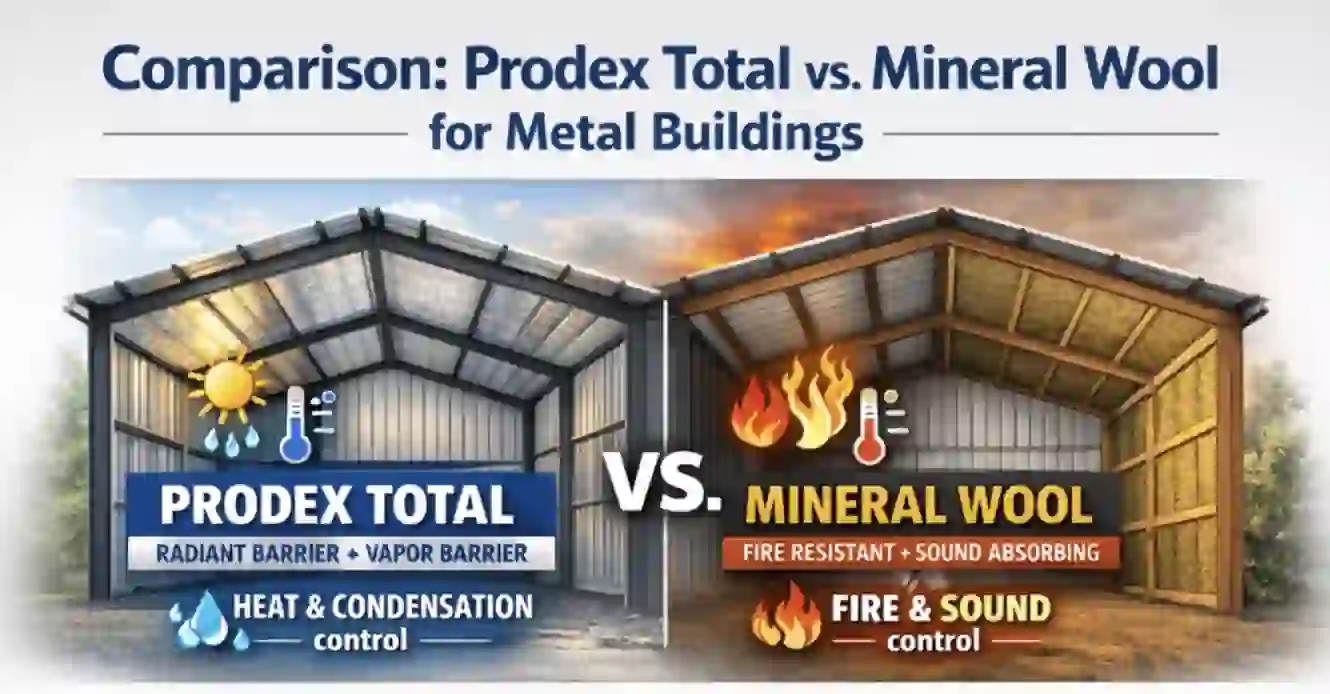
When insulating metal buildings — whether it’s a steel shop, garage, pole barn, or a metal-roofed structure — choosing insulation isn’t just about R-value. Metal buildings have unique performance challenges because steel heats up fast, cools down fast, and creates condensation when warm, humid air contacts cold metal panels.
In this article, we compare Prodex Total Insulation and Mineral Wool Insulation (Rockwool / Stone Wool) for metal buildings, including where each performs best, where problems occur, and what contractors commonly do to get the best performance.
If you're comparing insulation options for steel buildings, you may also like our related comparison guides, including Prodex Total vs. fiberglass Insulation for metal buildings and Prodex Total vs. spray foam insulation for metal buildings.
Why Insulation Matters in Metal Buildings
Metal roofing and siding are excellent conductors of heat. That means:
High radiant heat gain in summer
Rapid heat loss in winter
A much higher likelihood of condensation on the underside of metal panels
Condensation is one of the biggest problems in metal buildings. If water forms repeatedly on interior metal surfaces, it can lead to:
Rust and corrosion
Mold issues
Wet insulation
Reduced energy performance
Damage to interior finishes
That’s why the best insulation system for a metal building must address radiant heat, condensation, and air movement, not just conductive heat transfer. Metal building performance depends heavily on proper radiant, air, and vapor control -- which is why our guide on how to insulate a metal building breaks down the most common assembly types contractors use.
For a deeper breakdown of condensation, comfort, and performance, read our metal building guide to stop condensation, heat, cold and air.
What Is Prodex Total Insulation?
Prodex Total Insulation is a foil-faced insulation designed specifically for metal buildings, pole barns, and steel structures. It uses a closed-cell foam core laminated between reflective foil surfaces.
Prodex Total is engineered to help solve the real-world challenges that cause problems in metal buildings by providing:
A radiant barrier to reduce radiant heat transfer
A vapor barrier to prevent moisture migration
An air barrier to reduce air infiltration and leakage
Lightweight and fast installation under metal panels
Because Prodex Total combines multiple functions in one product, it helps reduce the root cause of condensation by limiting humid indoor air from reaching cold metal surfaces.
What Is Mineral Wool Insulation?
Mineral wool insulation (also called rock wool or stone wool) is made from spun mineral fibers. It’s known for fire resistance, sound absorption, and solid thermal performance.
Mineral wool is commonly installed as:
Batts (for stud cavities and framed assemblies)
Rigid boards (for exterior continuous insulation and commercial wall systems)
Mineral wool is popular because it offers:
Excellent fire resistance (noncombustible)
Excellent sound control (high density helps absorb sound)
Strong thermal performance when installed in cavities
Moisture resistance (it does not easily absorb water like some other materials)
Side-by-Side Comparison: Prodex Total vs. Mineral Wool
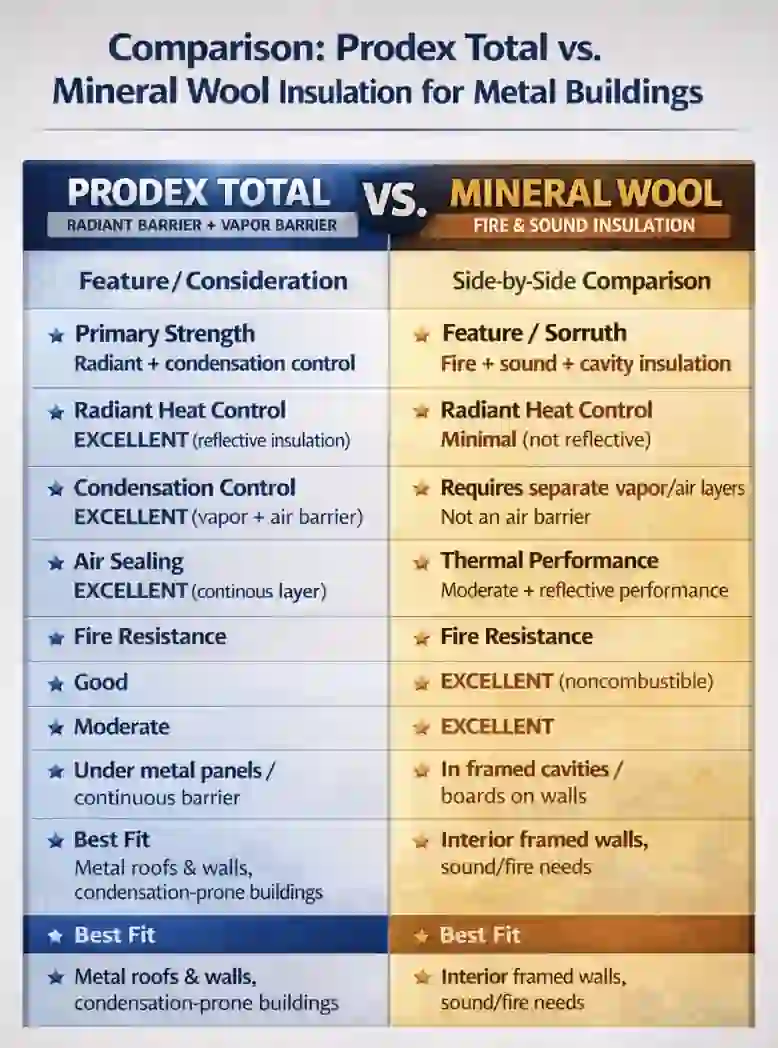
| Feature / Consideration | Prodex Total Insulation | Mineral Wool Insulation |
|---|---|---|
| Primary Strength | Radiant + condensation control | Fire + sound + cavity insulation |
| Radiant Heat Control | Excellent (reflective insulation) | Minimal (not reflective) |
| Condensation Control | Excellent (vapor + air barrier) | Requires separate vapor/air layers |
| Air Sealing | Excellent (continuous layer) | Not an air barrier |
| Thermal Performance | Moderate + reflective performance | Strong with thickness in cavities |
| Fire Resistance | Good | Excellent (noncombustible) |
| Sound Control | Moderate | Excellent |
| Typical Installation | Under metal panels / continuous barrier | In framed cavities / boards on walls |
| Best Fit | Metal roofs & walls, condensation-prone buildings | Interior framed walls, sound/fire needs |
The Key Difference: Condensation Control
Mineral wool is a great insulation, but it’s important to understand this:
Mineral Wool Is Not a Vapor Barrier or Air Barrier
Mineral wool is permeable and allows air and vapor movement through it unless you add additional control layers.
In metal buildings, condensation forms when warm, moist air reaches cold metal. If mineral wool is installed without a properly sealed vapor barrier and air barrier:
Moist air can travel through the insulation
Condensation can still form on the interior metal skin
Water can drip into the wall/roof assembly
Performance can drop and corrosion can accelerate
To understand why condensation happens under metal roofing and how to prevent it long-term, see our metal building guide to stop condensation, heat, cold and air.
Prodex Total Is Designed to Stop This Failure Mode
Prodex Total works differently because it is a continuous radiant barrier + vapor barrier + air barrier, which is exactly what metal buildings need in many climates and applications.
When Mineral Wool Makes Sense in Metal Buildings
Mineral wool is often the best choice inside a metal building when you’re framing out interior walls or ceilings.
Mineral wool is a great fit for:
Interior partitions and framed rooms
Office build-outs inside steel shops
Garage conversions or ADUs inside metal shells
Sound control between rooms
Fire-focused projects where noncombustible materials are required
If your metal building includes interior framing, mineral wool batts are excellent in those cavities.
The Best Practice: Using Mineral Wool and Prodex Total Together
In many real-world contractor installations, the best-performing approach is a hybrid system:
Step 1: Install Prodex Total under the metal panels
Under roof panels
Under wall panels (as needed)
This provides the radiant barrier + vapor barrier + air barrier, which reduces condensation risk.
Step 2: Install mineral wool batts inside framed interior walls or ceilings
Adds cavity R-value
Adds sound control
Adds fire performance benefits
Why this combination works:
Prodex Total protects the metal skin and controls condensation
Mineral wool improves comfort and sound control in finished spaces
The overall system performs better than either product alone
Which Is Better for Your Metal Building?
Choose Prodex Total if you want:
The simplest method to reduce condensation
Radiant heat control under metal roofs/walls
A built-in vapor barrier and air barrier
Fast installation with fewer layers and materials
Choose Mineral Wool if you want:
Excellent sound control inside framed cavities
A noncombustible insulation in interior assemblies
Traditional cavity insulation for finished interior spaces
A system where you will add separate air and vapor layers
Choose Both if:
You want the best overall performance
Your metal building includes interior rooms or conditioned spaces
You want condensation control at the metal + comfort inside
Common Contractor Mistake (And How to Avoid It)
A common mistake is installing cavity insulation (including mineral wool) without controlling condensation at the metal skin. If condensation forms on the underside of a metal roof or wall panel, it doesn’t matter how much insulation is installed inside the cavity — moisture will still enter the system. That’s why many contractors install Prodex Total under the metal even if they plan to use a second layer of insulation inside.
Choosing the best insulation for a metal building involves more than R-value alone. Learn how condensation prevention, moisture resistance, radiant heat reflection, and vapor barrier performance affect long-term building performance in our Metal Building Insulation Guide.
Need Help Choosing the Right System?
Frequently Asked Questions
Is mineral wool good for metal buildings?
Yes. Mineral wool is excellent for framed interior walls and ceilings inside metal buildings because it provides strong thermal performance, great sound absorption, and is noncombustible. However, it does not act as a vapor barrier or air barrier, so condensation control at the metal panels requires an additional layer.
What insulation is best to stop condensation in a metal building?
The best insulation system is one that prevents warm, humid air from reaching cold metal surfaces. A continuous vapor/air barrier system installed under metal panels is commonly used to reduce condensation. Prodex Total performs well in this role because it combines radiant barrier, vapor barrier, and air barrier in one layer.
Can I use Prodex Total and mineral wool together?
Yes — and in many cases it’s the best-performing approach. Prodex Total can be installed under the metal roof/wall panels to control radiant heat and condensation, while mineral wool batts can be installed in framed interior walls or ceilings for added R-value, sound control, and fire performance.
Does mineral wool prevent condensation?
Mineral wool resists moisture but does not prevent condensation by itself because air and vapor can still move through it. Condensation occurs when warm, humid air contacts cold metal. Preventing condensation typically requires an air barrier and vapor control layer at the metal skin.
Does Prodex Total add R-value?
Prodex Total provides thermal performance and helps reduce heat transfer in metal buildings by combining insulation with radiant reflectivity, air sealing, and vapor control. It is commonly used under metal panels where radiant heat and condensation are the main concerns.