Pennsylvania Fiberglass Metal Building Insulation
Fiberglass insulation has been used in metal buildings for decades, but today's Pennsylvania building owners often expect more than simply slowing heat transfer.
Modern steel buildings require insulation that not only helps regulate temperature but also addresses condensation, moisture control, radiant heat, and long-term durability.
Pennsylvania experiences cold winters, warm humid summers, frequent rain, and seasonal temperature swings. These changing conditions can create significant condensation inside steel buildings if the insulation system does not properly control moisture.
Prodex Total Insulation Plus was designed specifically for these challenges by combining reflective insulation, radiant barrier protection, Class 1 vapor barrier protection, and condensation control into one easy-to-install insulation system.
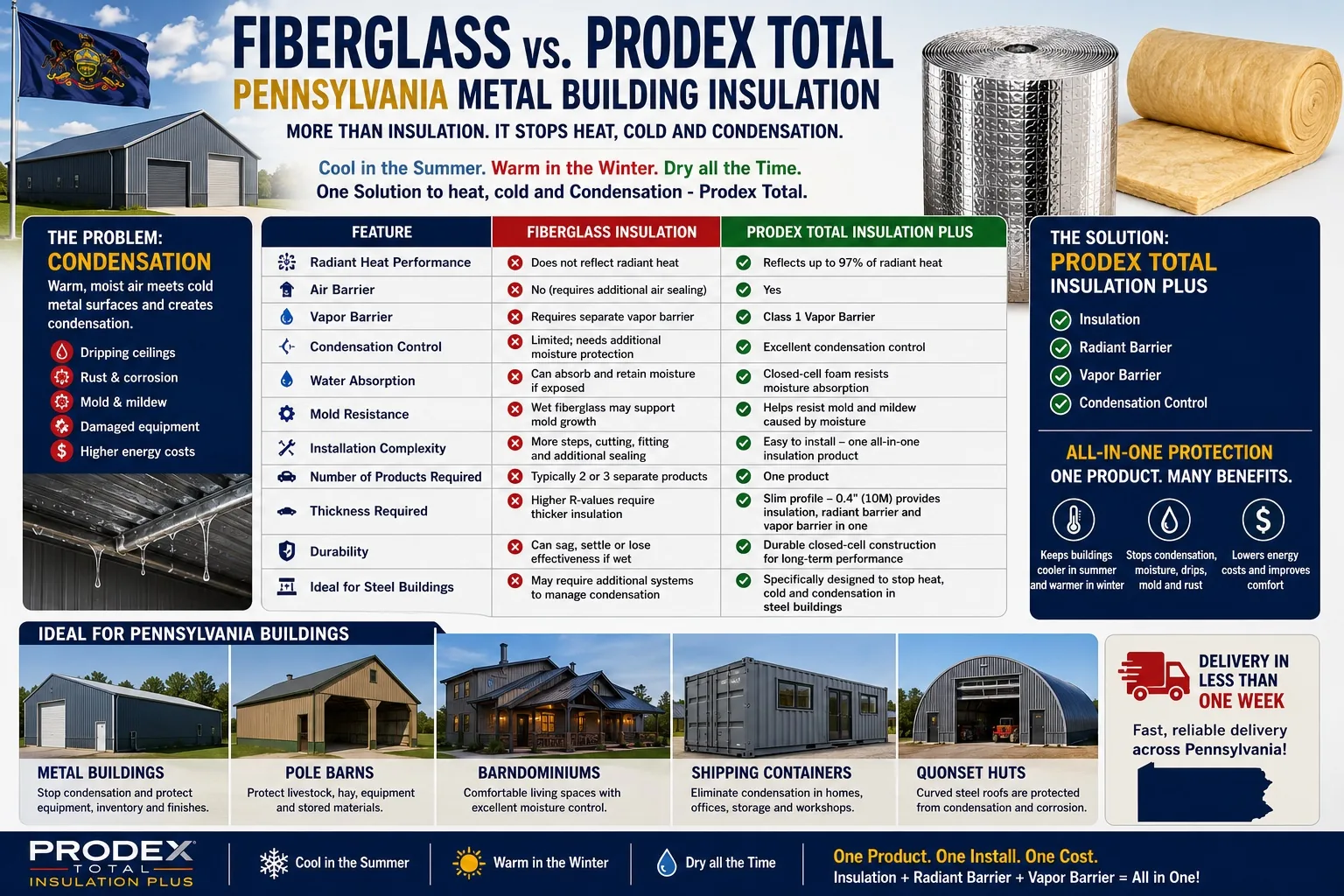
Cool in the Summer. Warm in the Winter. Dry all the Time. One Solution to heat, cold and Condensation - Prodex Total.
Fiberglass Primarily Slows Conductive Heat
Fiberglass insulation works by trapping pockets of air that slow conductive heat transfer.
While this can help reduce heat loss, fiberglass alone does not provide:
- Reflective insulation
- Radiant barrier protection
- Vapor barrier protection
- Condensation control
To improve moisture performance, fiberglass systems typically require additional vapor retarders, facing materials, or separate installation methods.
If these components are damaged, improperly sealed, or installed incorrectly, moisture can enter the insulation system and reduce its effectiveness.
Pennsylvania's Climate Demands Moisture Control
Pennsylvania's changing weather creates ideal conditions for condensation inside steel buildings.
Warm interior air naturally contains moisture. When that air contacts cooler steel roofing or wall panels, water droplets can form.
This often leads to:
- Dripping ceilings
- Rust and corrosion
- Wet insulation
- Mold and mildew
- Damaged equipment
- Reduced energy efficiency
Because of these conditions, controlling condensation is just as important as controlling temperature.
Reflective Insulation Performs Differently
Unlike fiberglass, Prodex Total Insulation Plus reflects up to 97% of radiant heat while also providing a continuous Class 1 vapor barrier.
Its closed-cell foam core does not rely on loose fibers and helps maintain consistent performance while controlling both radiant heat transfer and moisture.
For Pennsylvania steel buildings, this combination helps improve comfort throughout the year while reducing many of the moisture issues commonly associated with traditional insulation systems.
Condensation forms whenever warm, humid air contacts a cooler surface and reaches its dew point.
Steel buildings are particularly susceptible because metal rapidly transfers heat and cold. During cooler weather, the interior surface of the steel may become cold enough for water vapor to condense into liquid droplets.
This often results in:
- Dripping ceilings
- Wet insulation
- Rust and corrosion
- Mold and mildew
- Damaged equipment
- Moisture damage
- Reduced energy efficiency
Simply adding insulation without proper vapor barrier protection may not solve the problem. Effective condensation control requires managing both heat transfer and moisture movement.
Fiberglass Can Lose Performance When Moisture Is Present
Fiberglass insulation depends on trapped air to achieve its thermal performance. When moisture enters the insulation system, that trapped air can be displaced, reducing effectiveness and potentially contributing to long-term moisture problems.
Steel buildings are particularly vulnerable because condensation often forms on the underside of the roof panels before it becomes visible.
By helping prevent moisture from reaching the steel surface, Prodex Total Insulation Plus helps maintain a drier building envelope while reducing the likelihood of wet insulation, rust, mold, and mildew.
Roof Insulation Is the Most Important Area
The roof is the largest source of radiant heat gain during Pennsylvania summers and one of the first places condensation develops during cooler weather.
Warm, moisture-laden air naturally rises and contacts the cooler roof panels, creating the ideal conditions for water droplets to form.
Proper roof insulation helps:
- Reflect up to 97% of radiant heat
- Reduce unwanted heat gain
- Help prevent condensation
- Lower heating and cooling costs
- Improve year-round comfort
- Protect equipment, inventory, and building finishes
For additional guidance, visit:
Pennsylvania Roof & Ceiling Insulation
You can also learn more on our national residential guide:
Metal Buildings
For Pennsylvania commercial buildings, workshops, garages, warehouses, and agricultural facilities, condensation control is often just as important as thermal insulation.
Learn more:
Pennsylvania Metal Building Insulation
National Guide:
Pole Barns and Agricultural Buildings
Pole barns frequently house livestock, hay, feed, machinery, and valuable equipment that can be damaged by condensation dripping from the roof.
Prodex Total Insulation Plus helps reduce radiant heat while providing continuous vapor barrier protection to help control moisture.
Learn more:
Pennsylvania Pole Barn Insulation
National Guide:
Barndominiums
Modern Pennsylvania barndominiums combine residential comfort with steel construction, making moisture management essential.
Prodex Total Insulation Plus helps improve comfort while helping protect finished interiors from condensation.
Learn more:
Pennsylvania Barndominium Insulation
National Guide:
Shipping Containers
Many shipping containers are converted into homes, offices, workshops, and storage buildings throughout Pennsylvania.
Because they're constructed entirely from steel, controlling condensation is one of the most important parts of the insulation system.
Learn more:
Pennsylvania Shipping Container Insulation
National Guide:
Fiberglass vs. Prodex Total at a Glance
| Feature | Fiberglass | Prodex Total Insulation Plus |
|---|---|---|
| Reflective insulation | No | ✓ |
| Reflects up to 97% of radiant heat | No | ✓ |
| Built-in vapor barrier | Requires additional materials | ✓ |
| Condensation control | Limited | ✓ |
| Closed-cell foam core | No | ✓ |
| Lightweight installation | Moderate | ✓ |
| Helps reduce heating & cooling costs | ✓ | ✓ |
| Designed specifically for steel buildings | Limited | ✓ |
Fiberglass vs. Prodex Total Insulation Plus
| Feature | Fiberglass Insulation | Prodex Total Insulation Plus |
|---|---|---|
| Reflective Insulation | No | ✓ Yes |
| Radiant Heat Performance | Does not reflect radiant heat | Reflects up to 97% of radiant heat |
| Thermal Insulation | Yes | Yes |
| Air Barrier | No (requires additional air sealing) | ✓ Yes |
| Built-in Vapor Barrier | Requires separate facing or vapor barrier | ✓ Class 1 Vapor Barrier |
| Condensation Control | Limited; requires additional moisture protection | ✓ Excellent |
| Water Absorption | Can absorb and retain moisture if exposed | Closed-cell foam resists moisture absorption |
| Mold & Mildew Resistance | Wet fiberglass may support mold growth on surrounding materials | Closed-cell foam helps resist moisture-related mold and mildew issues |
| Energy Efficiency | Helps reduce conductive heat transfer | Helps reduce conductive heat transfer while reflecting radiant heat |
| Installation Complexity | Often requires fiberglass, vapor barrier, tape, and additional sealing | One all-in-one insulation product |
| Number of Products Required | Typically two or three separate products | One product |
| Thickness Required | Higher R-values generally require thicker insulation | Slim 0.4-inch profile (10M) with insulation, radiant barrier, and vapor barrier in one product |
| Weight | Heavier | Lightweight and easy to handle |
| Durability | Can sag, compress, or become less effective if wet | Durable closed-cell construction designed for long-term performance |
| Ideal for Steel Buildings | May require additional systems to manage condensation | Specifically designed to help control heat, cold, and condensation in steel buildings |
Why Pennsylvania Builders Choose Prodex Total
Pennsylvania builders often need more than traditional insulation. Steel buildings, pole barns, barndominiums, shipping containers, and Quonset huts require protection against radiant heat, condensation, and moisture—not just conductive heat transfer.
Prodex Total Insulation Plus combines insulation, a radiant barrier, and a Class 1 vapor barrier into one lightweight product, helping simplify installation while improving year-round comfort and energy efficiency.
Cool in the Summer. Warm in the Winter. Dry all the Time. One Solution to heat, cold and Condensation - Prodex Total.
Most Popular Product
For most Pennsylvania metal building projects, we recommend:
10M Prodex Total Insulation Plus
Features include:
- 0.4-inch closed-cell foam core
- Reflective insulation
- Reflects up to 97% of radiant heat
- Class 1 vapor barrier protection
- Condensation control
- Durable, lightweight construction
- Easy installation
Delivery in less than one week helps Pennsylvania contractors and property owners keep projects on schedule.
Why More Pennsylvania Builders Choose Prodex Total
Rather than combining fiberglass, separate vapor barriers, and additional radiant barrier products, Prodex Total Insulation Plus integrates all three functions into one easy-to-install system.
Benefits include:
- Helps stop condensation
- Reflects up to 97% of radiant heat
- Helps reduce heating and cooling costs
- Improves year-round comfort
- Helps protect against mold and mildew
- Lightweight and durable
- Ideal for metal buildings, pole barns, barndominiums, shipping containers, and many other steel structures
Cool in the Summer. Warm in the Winter. Dry all the Time. One Solution to heat, cold and Condensation - Prodex Total.