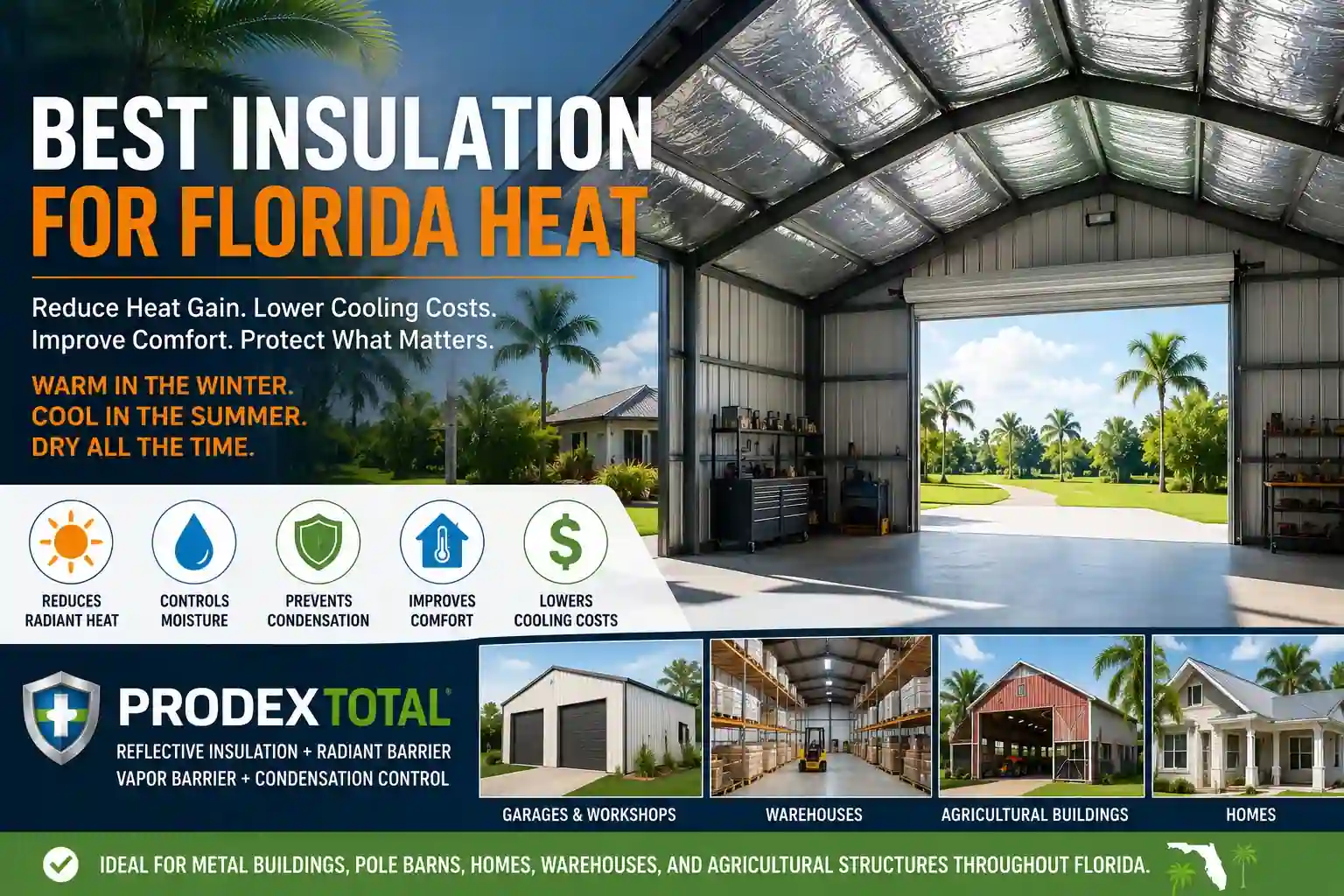
Best Insulation for Florida Heat
Florida's climate presents unique insulation challenges. Long summers, intense sunshine, high humidity, and year-round cooling demands can make homes, metal buildings, garages, workshops, warehouses, and agricultural structures difficult and expensive to keep comfortable.
Choosing the best insulation for Florida heat requires understanding how heat enters buildings and how different insulation systems perform in Florida's hot and humid environment.
For a broader overview of insulation solutions throughout the state, visit our guide to Florida Insulation for Metal Buildings, Pole Barns, and Houses.
Warm in the Winter. Cool in the Summer. Dry All the Time.
Why Florida Buildings Get So Hot
Florida receives intense sunlight throughout most of the year. Roofs, walls, and other exterior surfaces absorb solar energy and transfer heat into the building below.
Common Florida heat-related problems include:
Excessive indoor temperatures
High cooling costs
Uneven room temperatures
Hot garages and workshops
Increased HVAC workload
Reduced comfort
Without proper insulation, buildings can become significantly hotter than outdoor temperatures.
Understanding Heat Transfer
Heat enters buildings through three primary mechanisms:
Radiant Heat
Radiant heat comes directly from the sun and is often the largest source of heat gain in Florida buildings.
Conductive Heat
Conductive heat moves through building materials such as metal roofing, framing, and wall systems.
Convective Heat
Convective heat occurs when warm air moves through a structure and transfers heat between spaces.
The most effective insulation systems help address multiple forms of heat transfer.
Why Traditional Insulation Is Not Always Enough
Many insulation products focus primarily on slowing conductive heat transfer.
While this is important, Florida's intense sunlight often makes radiant heat control equally important.
Property owners should also consider:
Humidity
Moisture resistance
Condensation control
Mold prevention
Long-term durability
The best insulation for Florida heat addresses both thermal performance and moisture management.
Best Insulation for Florida Metal Buildings
Metal buildings face some of the toughest heat challenges in Florida.
Metal roofing absorbs solar energy quickly and can transfer substantial heat into the interior space. This can make workshops, garages, warehouses, and storage buildings uncomfortable while increasing cooling expenses.
Proper insulation helps:
Reduce heat gain
Improve comfort
Lower cooling costs
Control condensation
Protect equipment and stored materials
For a detailed discussion of insulation options, installation considerations, and moisture control, see our Florida Metal Building Insulation Guide.
Reflective Insulation and Florida Heat
Reflective insulation helps reduce radiant heat transfer before it enters the occupied space.
Because Florida experiences intense solar exposure throughout the year, reflective insulation can play an important role in reducing heat.
To better understand how reflective insulation works, how it compares with fiberglass, spray foam, mineral wool, and cellulose, and why it is so effective at reducing heat in hot climates, read our complete Reflective Insulation Guide. It explains the science of radiant heat transfer, R-value, condensation control, vapor barriers, and how to choose the best reflective insulation system to help keep buildings Warm in the Winter. Cool in the Summer. Dry All the Time.
Reflective insulation is commonly used in:
Metal buildings
Pole barns
Garages
Workshops
Warehouses
Agricultural buildings
Reducing radiant heat can improve comfort while helping lower cooling demands.
Owners of large storage and distribution facilities should also review our Florida Warehouse Insulation Guide.
Why Many Florida Building Owners Choose Prodex Total
Prodex Total combines several important benefits into a single insulation system:
Reflective insulation
Radiant barrier protection
Vapor barrier protection
Condensation control
Thermal performance
Unlike fiberglass, Prodex Total does not absorb water and does not support mold growth.
This makes it particularly well suited for Florida's hot, humid climate.
Our most popular insulation for Florida heat is 10M Prodex Total Insulation Plus
Warm in the Winter. Cool in the Summer. Dry All the Time.
Moisture Matters in Florida
Heat is only part of the challenge.
Florida's humidity can contribute to:
Mold growth
Mildew
Corrosion
Condensation
Reduced insulation effectiveness
Florida building owners often focus on heat reduction, but humidity can be equally damaging. High moisture levels can lead to condensation, rust, mold, and mildew inside metal structures. Learn more in our Stop Condensation in Florida Metal Buildings guide.
Choosing insulation that helps resist moisture can provide long-term performance advantages and help protect the building structure.
Frequently Asked Questions
What is the best insulation for Florida heat?
The best insulation depends on the building type, but many Florida property owners choose systems that provide radiant heat protection, moisture resistance, and condensation control.
Is reflective insulation effective in Florida?
Yes. Reflective insulation can help reduce radiant heat transfer from the sun, which is often one of the largest contributors to heat gain in Florida buildings.
Does insulation lower cooling costs?
Proper insulation can help reduce heat gain and decrease cooling demands, improving overall energy efficiency.
What insulation works best for Florida metal buildings?
Many Florida metal building owners choose insulation systems that combine radiant barrier protection, moisture resistance, and condensation control.
Does Florida humidity affect insulation performance?
Yes. Moisture can reduce the effectiveness of some insulation products, making moisture resistance an important consideration in Florida.
Warm in the Winter. Cool in the Summer. Dry All the Time.