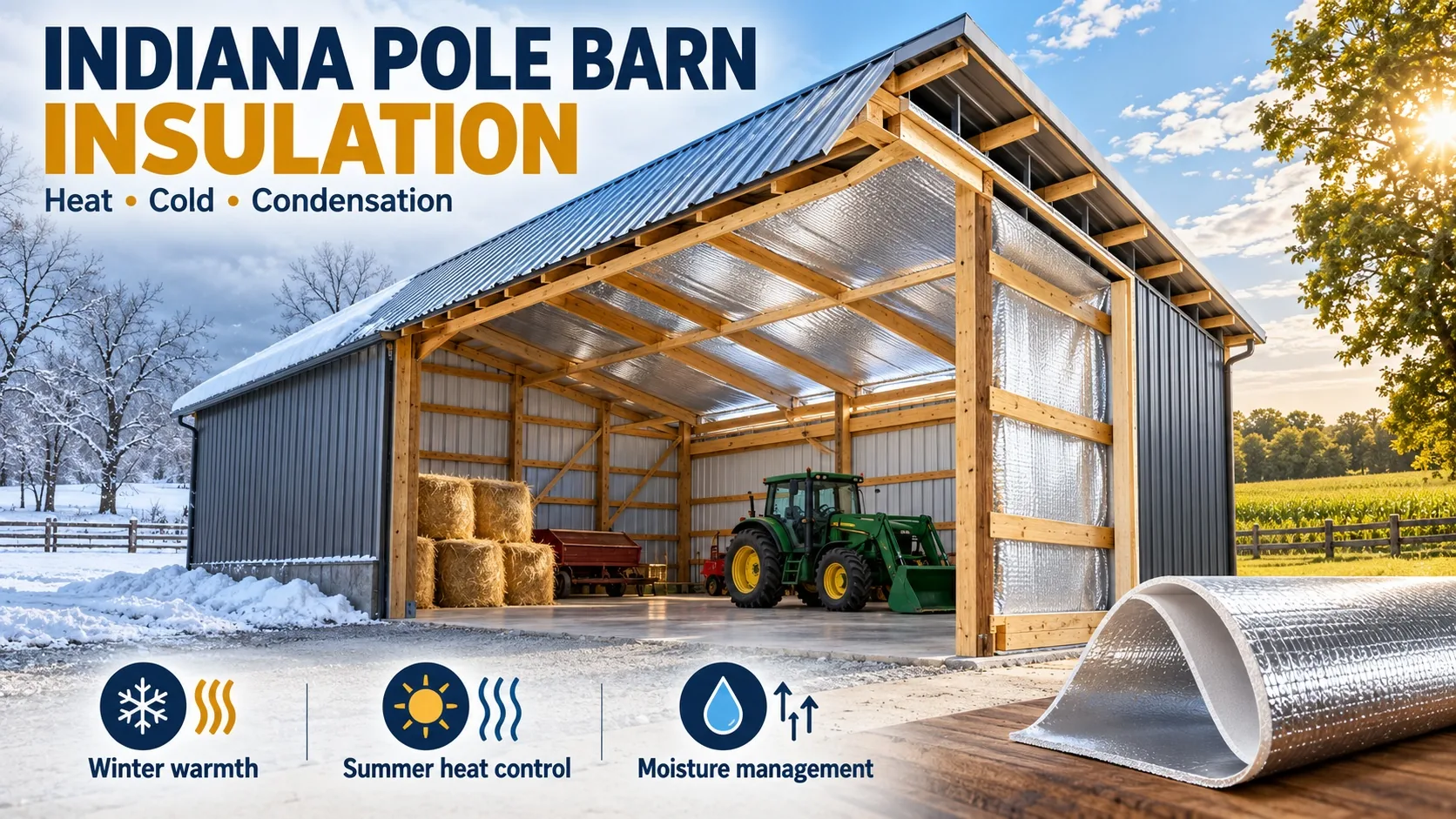
Pole Barn Insulation in Indiana: Keep Heat, Cold & Condensation Under Control
Indiana pole barns serve many purposes. One may shelter tractors and equipment; another may be a heated repair shop. A building used for livestock has different moisture and ventilation needs from either of them. The best insulation plan begins with how the barn is used, then considers its roof, walls, framing and climate.
Across Indiana, metal roofing can collect summer heat and become cold enough for condensation during winter. Heated workshops also need to limit heat loss and air leakage. An unheated storage barn may have a narrower goal: reducing roof heat and protecting stored items from drips.
This guide focuses on post-frame buildings. For other building types, visit our Indiana Insulation Guide. Our national pole barn insulation guide provides a broader comparison of materials and assemblies.
Indiana’s Climate and Your Pole Barn
Indiana includes both climate zone 5A across much of its central and northern area and 4A in parts of the south. A barn near South Bend will generally face more winter heating demand than one near Evansville. Both can experience warm summers, humidity and changing temperatures.
Those conditions matter differently depending on the building:
- Equipment storage: Protecting machinery and supplies from roof condensation may be a higher priority than maintaining a set indoor temperature.
- Heated farm shop: Roof and wall insulation, air sealing, doors and the slab all affect comfort and heating needs.
- Livestock building: Animals and related operations add moisture. Insulation must be planned alongside ventilation rather than used as a substitute for it.
- Finished post-frame space: An office, business space or living area may need a substantially different assembly and must meet the requirements that apply to its use.
Why Pole Barn Roofs and Walls Need Different Attention
Metal roof heat and winter condensation
A broad metal roof receives direct summer sun. In winter, warm indoor air carrying moisture can contact a cold roof surface and form condensation. If you see drips, determine whether they come from condensation, a roof leak or both before covering the area.
Reflective insulation can help control radiant heat when its reflective surface faces the adjacent air space required by the installation. A continuous, properly sealed layer can also help limit air movement toward cold metal. Roof details must still account for ventilation, openings and the building’s moisture sources.
Post-frame walls and girts
Pole barn walls are commonly framed with posts and horizontal girts. That layout gives installers choices: place insulation between framing members, cover the framing with a continuous layer, or use a designed combination.
A layer installed only between girts can leave framing and joints exposed. Covering the framing can create a more continuous interior surface. The right approach depends on how the siding is attached, whether the walls are already finished and whether an interior liner will be added.
Comparing Insulation for Indiana Pole Barns
Prodex Total
Prodex Total is a thin, flexible roll with a closed-cell polyethylene foam core and reinforced reflective surfaces. In an appropriate roof or wall assembly, it can provide insulation, radiant heat control, an air barrier and vapor control.
Prodex Total = Insulation + Radiant Barrier + Vapor Barrier — All in One Product.
For applications that rely on reflective performance, maintain the adjacent air space called for by the installation method. Seams, edges and penetrations also need attention if the installed layer is intended to control air and vapor movement.
Compare 10M Prodex Total Plus with 48-inch 5M Prodex Total Plus when selecting thickness and roll coverage.
Fiberglass
Fiberglass is a familiar choice for buildings that need substantial thermal resistance. It performs best when it fits the available space without gaps or compression. Fiberglass itself is not a radiant barrier or air barrier, and the assembly needs suitable air and vapor control.
Prodex Total and fiberglass can also be used together in a properly designed assembly. Placement matters: the goal is to manage condensation at the metal shell without enclosing material that is already wet. See available fiberglass insulation for pole barns and metal buildings.
Spray foam and foam board
Spray foam can insulate irregular surfaces, though the type of foam, thickness, substrate condition and installer’s work affect the result. Read our spray foam insulation guide when comparing it with other pole barn systems.
Foam board insulation provides thermal resistance in rigid panels. Fitting and sealing panels around posts, girts and openings require careful work. As with any material, judge the completed assembly rather than the product alone.
Insulating a New Indiana Pole Barn
New construction offers access to framing before roofing, siding and interior finishes complicate the work. Decide early whether the barn will remain storage space or may later become a heated shop. That choice can affect insulation placement, planned ventilation and interior finishing.
For a reflective roof installation, follow the product’s fastening and seam instructions, and preserve the specified adjacent air space. Plan how the roof layer meets the wall layer and how openings and penetrations will be treated. On the walls, decide whether a continuous layer across framing or a designed cavity assembly better serves the building.
A livestock or other high-moisture building needs a ventilation design suited to its use. Do not block planned air inlets or exhaust paths while adding insulation.
The step-by-step pole barn installation guide covers methods for roof and wall construction in more detail.
Retrofitting an Existing Pole Barn
Start by inspecting the building. Look for roof leaks, condensation marks, wet framing, rusted metal, damaged siding and existing insulation. Correct water entry and investigate moisture sources before concealing them.
For a roof or wall retrofit, the available framing determines where a roll can be securely supported and how much adjacent air space is available. Covering the framing with a continuous layer is one option. In some buildings, insulation can be installed between girts with the appropriate air space and, if the design calls for it, a second layer over the framing.
Fasteners, washers, pins or other attachment methods should be selected for the actual framing and surface. Treat seams according to the chosen product’s instructions. The pole barn installation guide shows the methods; inspect your own building before choosing one.
A Heated Shop Needs a Whole-Building Plan
For a workshop, the roof and walls are only part of the comfort equation. Large doors, gaps around openings and an uninsulated slab may also affect heating needs. Decide whether the space will be heated every day or only during projects.
If you are pouring a new slab for a heated shop, consider the floor assembly before construction begins. Our under-slab insulation guide covers that separate application. Insulation beneath concrete follows different installation rules from reflective insulation in a roof or wall.
How Much Pole Barn Insulation Should You Order?
Measure the actual roof and wall areas, including roof slope. Note the framing layout, openings and the roll width that suits the installation method. Floor dimensions alone do not equal the area of roof and wall insulation needed.
Use the Advanced Insulation Calculator for an initial roll estimate. Confirm your measurements and installation layout before ordering.
Building requirements depend on location, occupancy, building type and assembly. When a specific code-required R-value or assembly is necessary, verify it with the appropriate local building official, architect, engineer or other qualified professional. This is especially important when a storage barn is being converted to a regularly occupied or conditioned space.
Indiana Pole Barn Insulation FAQs
Should I insulate an unheated equipment barn?
It may make sense if roof heat, condensation or protection of stored equipment is a concern. The goal and assembly may differ from those of a fully heated shop. First identify any roof leaks or ventilation problems.
Will insulation alone stop condensation in a livestock barn?
No. Insulation can help manage cold surfaces, but livestock buildings also need ventilation suited to the animals, moisture production and season. Keeping all ventilation closed in winter can allow indoor moisture to build up.
Is Prodex Total suitable for an existing pole barn?
It can be used in many retrofits, but the method depends on the framing, existing finishes, available air space and attachment points. Repair leaks and wet areas first, then select the appropriate roof and wall method.
Can I combine fiberglass and Prodex Total?
Yes, if the combined assembly is designed for the building’s climate and use. Confirm the placement of the layers and any existing facing so the finished assembly manages air and moisture as intended.
Should insulation go between the girts or over them?
Both approaches are possible. A continuous layer over framing can reduce uncovered joints and framing areas; between-girt installation may suit a different construction or finishing plan. Follow the installation instructions and preserve an adjacent air space wherever reflective performance is intended.
Related Indiana Insulation Guides
Return to the Indiana Insulation Guide to choose another application. If your structure has steel framing rather than post-frame construction, read Metal Building Insulation in Indiana. For detailed fastening and seam guidance, use How to Insulate a Pole Barn.
Cool in the Summer. Warm in the Winter. Dry all the Time.