Foam Board Insulation: Pros, Cons, Applications & Better Alternatives
Foam board insulation has become one of the most widely used insulation materials in residential and commercial construction. Also known as rigid foam insulation, rigid insulation board, or foam insulation board, it offers relatively high R-values in a relatively thin panel and is commonly used in walls, basements, crawl spaces, foundations, roofs, garages, workshops, and remodeling projects.
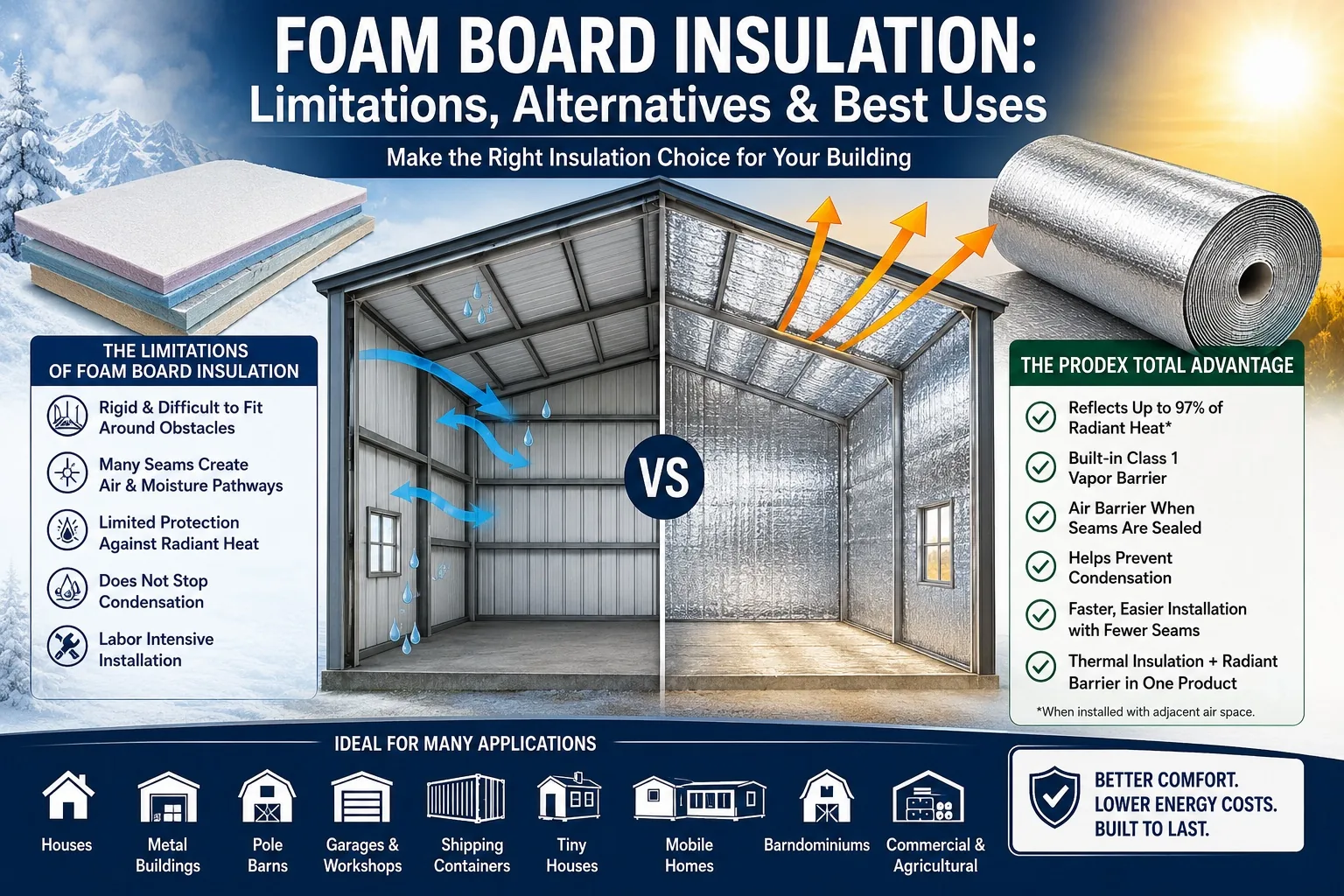
While foam board insulation performs well in many applications, it also has limitations that homeowners and builders often discover during installation. Gaps around framing, labor-intensive cutting, limited radiant heat protection, and condensation concerns can all affect the overall performance of the building envelope.
Fortunately, there are alternatives that address many of these challenges. One of the most effective is Prodex Total Insulation, an all-in-one insulation system that combines thermal insulation, a radiant barrier, an air barrier, and a Class 1 vapor barrier into a single product.
If you're also evaluating spray foam insulation, our comprehensive Spray Foam Insulation Guide explains how open-cell and closed-cell spray foam work, compares spray foam with foam board, fiberglass, mineral wool, cellulose, and reflective insulation, and covers R-value, installation methods, DIY spray foam kits, costs, moisture control, and long-term performance to help you choose the best insulation system for your project.
In this guide you'll learn:
- What foam board insulation is
- The different types of rigid foam insulation
- Where foam board insulation is commonly used
- The advantages and disadvantages of foam board insulation
- Applications where Prodex Total offers significant advantages
- How to choose the best insulation for your project
Whether you're insulating a house, garage, workshop, pole barn, metal building, shipping container, tiny house, mobile home, or barndominium, understanding how these insulation systems differ will help you make a more informed decision.
For a complete overview of residential insulation options, visit our Ultimate Guide to House Insulation.
What Is Foam Board Insulation?
Foam board insulation is a rigid panel manufactured from closed-cell plastic foam. Unlike fiberglass batts or roll insulation, foam board comes in flat sheets that are cut to fit between framing members or installed as continuous insulation over walls and roofs.
Because foam board provides relatively high thermal resistance for its thickness, it is commonly used where builders want to improve energy efficiency without significantly increasing wall thickness.
Foam board insulation is also known as:
- Foam insulation board
- Rigid foam insulation
- Rigid insulation board
- Foam sheathing
- Continuous insulation
Rigid foam boards are available in multiple thicknesses and are typically installed using construction adhesive, mechanical fasteners, or both. To improve air sealing, installers often tape seams or fill gaps with spray foam.
While foam board is excellent at reducing conductive heat transfer, it performs differently than reflective insulation when exposed to radiant heat. Understanding these differences can help you choose the right insulation system for your project.
If you're comparing insulation systems, our Reflective Insulation Guide explains how reflective insulation works, how it differs from traditional insulation materials, and where each performs best.
Types of Foam Board Insulation
Not all foam board insulation is the same. The three most common products are Expanded Polystyrene (EPS), Extruded Polystyrene (XPS), and Polyisocyanurate (Polyiso). Each offers different performance characteristics and is designed for different applications.
Expanded Polystyrene (EPS)
EPS is the most economical type of rigid foam insulation. It is manufactured by expanding small polystyrene beads into lightweight rigid panels.
Advantages
- Economical
- Lightweight
- Easy to cut and handle
- Available in multiple thicknesses
- Good thermal insulation
Limitations
- Lower R-value per inch than other foam boards
- Can be damaged more easily during installation
- Requires careful sealing around joints
- Provides little radiant heat protection
EPS is commonly used in residential wall systems and selected foundation applications where cost is an important consideration.
Extruded Polystyrene (XPS)
XPS is manufactured as a dense, closed-cell foam board recognized by its smooth surface and excellent compressive strength.
Advantages
- Higher compressive strength
- Better moisture resistance than EPS
- Higher R-value per inch
- Durable and easy to machine
Limitations
- Higher cost than EPS
- Requires careful cutting and sealing
- Does not reflect radiant heat
- Multiple seams can reduce overall system performance
XPS is frequently selected for basement walls, crawl spaces, foundation insulation, and exterior continuous insulation.
Polyisocyanurate (Polyiso)
Polyiso generally provides the highest R-value per inch among the three major rigid foam insulation products. Most panels are manufactured with foil or fiberglass facers.
Advantages
- Excellent R-value
- Lightweight
- Widely used in commercial roofing
- Readily available
Limitations
- More expensive than EPS
- Thermal performance can decrease in very cold temperatures
- Requires careful installation around joints
- Cannot conform to irregular surfaces
Polyiso is commonly specified for commercial roofing systems and continuous exterior insulation where maximum thermal resistance is desired.
Where Foam Board Insulation Is Commonly Used
Foam board insulation can be an effective solution in many building assemblies. The best application depends on the building design, climate, moisture conditions, and the type of heat transfer the insulation is expected to control.
Exterior Walls
Foam board is frequently installed over exterior wall framing to reduce thermal bridging and improve the overall thermal performance of the wall assembly.
Interior Walls
Rigid foam is sometimes installed on interior foundation walls or in remodeling projects where additional insulation is desired without sacrificing much interior space.
Basement Walls
Basement walls are one of the most common applications for foam board because its closed-cell construction resists moisture while providing continuous insulation across concrete surfaces.
Properly sealing seams is important to help reduce air leakage and moisture migration.
Crawl Spaces
Foam board is often installed on crawl space foundation walls where moisture resistance is important.
Installation quality is critical because even small gaps can allow humid air to reach cooler surfaces, increasing the potential for condensation.
Garages & Workshops
Rigid foam can be installed in garage walls and ceilings, although cutting panels around framing, wiring, windows, and doors often requires considerable time.
Many homeowners looking for faster installation and improved radiant heat performance choose Garage & Workshop Insulation instead.
Metal Buildings
Although foam board can improve conductive insulation in metal buildings, rigid panels can be difficult to install around steel framing and roof systems.
Metal buildings are especially vulnerable to radiant heat gain during summer and condensation during cooler weather. Learn why many builders choose Metal Building Insulation Guide for these applications.
Pole Barns
Pole barns experience many of the same insulation challenges as metal buildings. Large roof areas absorb intense solar heat, while seasonal temperature swings often create condensation beneath metal roofing.
Our Pole Barn Insulation Guide explains how to control heat, cold, and condensation in pole barn construction.
Shipping Containers
Shipping containers present unique insulation challenges because steel rapidly transfers heat and cold.
While foam board increases conductive insulation, managing radiant heat and condensation is equally important. Learn more in our Shipping Container Insulation Guide.
Tiny Houses
Tiny houses require insulation systems that maximize performance while preserving valuable interior living space.
Although foam board offers excellent R-value per inch, installation around framing, plumbing, and electrical systems often requires extensive cutting and fitting. Many builders instead choose insulation systems that combine thermal insulation, radiant heat protection, air sealing, and vapor barrier protection in one product.
Learn more in our Tiny House Insulation Guide.
Mobile Homes
Mobile homes often have limited wall and ceiling cavity depth, making insulation selection especially important for comfort and energy efficiency.
Our Mobile Home Insulation Guide explains the best insulation options for roofs, walls, floors, and crawl spaces.
Barndominiums
Barndominiums combine residential living with steel construction, making insulation especially important for controlling radiant heat, condensation, and energy efficiency.
While rigid foam insulation is used in some wall assemblies, many builders choose insulation systems that provide multiple building envelope functions in a single installation.
Learn more in our Metal Barndominium Insulation Guide.
Advantages of Foam Board Insulation
Foam board insulation remains popular because it offers several important benefits when installed correctly and used in the appropriate application.
High R-Value Per Inch
Rigid foam provides excellent thermal resistance relative to its thickness, making it a popular choice where wall or roof space is limited.
Lightweight
Foam boards are easy to transport, handle, and position during installation.
Moisture Resistance
Closed-cell foam board does not readily absorb water, making it suitable for many below-grade and foundation applications.
Good Compressive Strength
Products such as XPS provide excellent compressive strength, making them suitable for applications where insulation must withstand significant loads.
Long Service Life
When properly installed and protected from prolonged UV exposure and physical damage, foam board insulation can provide decades of reliable thermal performance.
The Limitations of Foam Board Insulation
Foam board insulation has earned its place in modern construction because it provides good thermal resistance, is lightweight, and performs well in many wall, foundation, and roof assemblies.
However, like every insulation material, it has limitations.
The best insulation depends on the type of building, climate, moisture conditions, and how heat moves through the structure. Foam board primarily slows conductive heat transfer, but buildings also gain and lose heat through radiant heat and air movement. Understanding these differences helps explain why foam board performs exceptionally well in some applications while other insulation systems may be a better choice in others.
The following are some of the most common challenges builders and homeowners encounter when using rigid foam insulation.
Foam Board Doesn't Easily Conform to Irregular Surfaces
Foam board insulation is manufactured in rigid panels. While that rigidity provides strength, it can also make installation more challenging.
Few buildings are perfectly square or perfectly flat. Walls and roofs often contain:
- Electrical wiring
- Plumbing
- Electrical boxes
- Window openings
- Door openings
- Structural bracing
- Steel framing
- Crowned or warped lumber
Each obstacle requires additional measuring, cutting, and fitting. Even experienced installers may spend considerable time trimming individual panels to achieve a proper fit.
Why This Matters
Every cut creates another opportunity for air movement or moisture intrusion.
Poorly fitted panels can contribute to:
- Air leakage
- Reduced energy efficiency
- Moisture infiltration
- Lower overall insulation performance
A Different Approach
Unlike rigid foam panels, Prodex Total Insulation is manufactured in continuous rolls that easily conform to framing and irregular surfaces.
Instead of cutting dozens—or even hundreds—of individual panels, installers can cover large sections at one time, creating a more continuous insulation system with fewer interruptions.
Foam Board Installations Create Many Seams
A typical foam board installation consists of numerous individual panels.
Every panel creates additional joints that should be carefully sealed to maximize performance.
Depending on the installation, seams may require:
- Foil tape
- Compatible sealants
- Spray foam
- Careful alignment
As buildings become larger, the number of seams increases significantly.
Each seam represents another potential pathway for unwanted air movement or moisture if it is not properly sealed.
Why Fewer Seams Matter
Large continuous insulation systems generally provide more consistent coverage with fewer interruptions.
Because Prodex Total is supplied in long rolls, significantly fewer seams are required, particularly on roofs and long wall sections.
This can result in:
- Faster installation
- Less material waste
- Reduced labor
- More continuous insulation coverage
Foam Board Provides Limited Protection Against Radiant Heat
One of the biggest differences between rigid foam insulation and reflective insulation is how they manage heat.
Foam board is designed primarily to reduce conductive heat transfer.
Buildings, however, also gain heat through radiant energy.
Why Radiant Heat Matters
Radiant heat behaves differently than conductive heat.
When sunlight strikes a roof, the roofing material absorbs solar energy and becomes extremely hot. That heat is then radiated downward into the building.
This effect is especially noticeable in buildings with:
- Metal roofs
- Dark-colored roofing
- Minimal attic ventilation
- Large roof areas
- Direct sun exposure
Simply increasing conductive insulation does not stop radiant heat from entering the building.
Why the Roof Is Usually the Most Important Area to Insulate
The roof receives more direct solar exposure than any other part of most buildings.
As a result, it is often responsible for the greatest amount of unwanted summer heat entering the structure.
This is particularly true for:
- Metal buildings
- Pole barns
- Garages and workshops
- Shipping containers
- Tiny houses
- Barndominiums
Reducing radiant heat at the roof often produces greater improvements in indoor comfort than adding additional insulation elsewhere.
Learn more about insulating roof systems in our Roof Insulation Guide.
How Prodex Total Helps Reduce Radiant Heat
Unlike conventional rigid foam insulation, Prodex Total incorporates highly reflective reinforced foil surfaces that can reflect up to 97% of radiant heat when installed with the required adjacent air space.
At the same time, it also provides:
- Thermal insulation
- An air barrier
- A built-in Class 1 vapor barrier
- Condensation control
This allows one product to perform several important building envelope functions simultaneously.
Air Leakage Can Reduce Overall Insulation Performance
Even insulation with an excellent laboratory R-value cannot perform at its full potential if uncontrolled air movement bypasses the insulation.
Air leakage commonly occurs around:
- Panel joints
- Corners
- Windows
- Doors
- Electrical penetrations
- Plumbing penetrations
- Framing intersections
When conditioned indoor air escapes—or outdoor air enters—the heating and cooling system must work harder to maintain comfortable indoor temperatures.
Why Air Sealing Matters
An effective building envelope should not only provide thermal resistance but also help limit uncontrolled air movement.
Because Prodex Total is installed in large continuous sections with sealed seams, it also functions as an effective air barrier.
Condensation Can Become a Major Concern
Condensation occurs whenever warm, moisture-laden air contacts a surface that is below the dew point.
This is particularly common in:
- Metal buildings
- Pole barns
- Garages and workshops
- Shipping containers
- Agricultural buildings
Water forming on the underside of metal roofing can eventually contribute to:
- Rust and corrosion
- Mold and mildew
- Interior water damage
- Reduced insulation performance
Foam board itself does not eliminate condensation.
Proper moisture control depends on the complete wall or roof assembly, including air sealing, vapor control, ventilation, and installation quality.
If condensation is one of your primary concerns, our Metal Building Insulation Guide explains why controlling moisture at the roof is critical.
How Prodex Total Helps Control Condensation
Prodex Total combines reflective insulation with a built-in Class 1 vapor barrier, helping reduce moisture migration while minimizing the conditions that allow condensation to form.
Foam Board Installation Can Be Labor Intensive
Rigid foam insulation is not difficult to install, but it is often more time-consuming than many people expect.
Each panel typically requires:
- Measuring
- Marking
- Cutting
- Test fitting
- Fastening
- Sealing the seams
As the number of panels increases, so does the installation time.
Projects containing numerous windows, doors, beams, pipes, and electrical penetrations require even more cutting and fitting.
Continuous Rolls Can Simplify Installation
Because Prodex Total is supplied in long rolls, installers can often cover large wall and roof sections much more quickly.
That means:
- Fewer cuts
- Fewer seams
- Less material waste
- Faster installation
- A cleaner finished appearance
Foam Board Insulation vs. Prodex Total Insulation
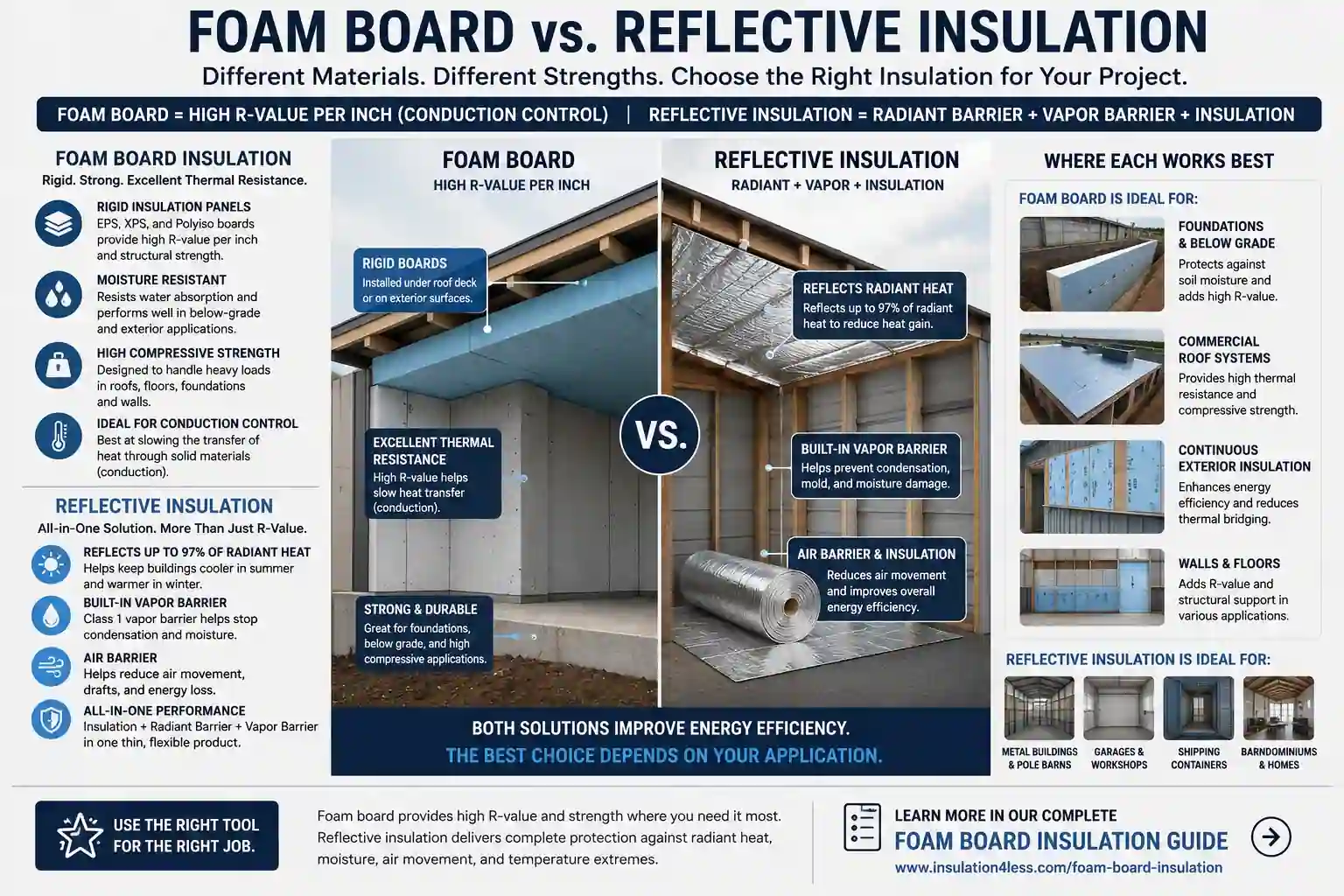
The following comparison highlights some of the key differences between rigid foam board insulation and Prodex Total. The best choice depends on your building type, installation method, and performance goals.
| Feature | Foam Board Insulation | Prodex Total Insulation |
|---|---|---|
| Installation | Individual rigid panels | Continuous rolls |
| Flexibility | Rigid panels | Flexible and conforms to irregular surfaces |
| Number of Seams | Many | Significantly fewer |
| Air Barrier | Requires careful sealing | Built into the system when seams are sealed |
| Vapor Barrier | Depends on product and installation | Built-in Class 1 vapor barrier |
| Radiant Heat Protection | Limited | Reflects up to 97% of radiant heat* |
| Condensation Control | Depends on the building assembly | Excellent for condensation-prone applications |
| Installation Labor | Higher due to measuring, cutting, and fitting | Faster roll-out installation |
| Metal Buildings | Can be challenging | Excellent choice |
| Pole Barns | Can be challenging | Excellent choice |
| Shipping Containers | Can be challenging | Excellent choice |
| Garages & Workshops | Good | Excellent choice |
| Roof Applications | Depends on the assembly | Excellent where radiant heat is a concern |
*Reflective performance requires an adjacent air space.
Which Insulation Is Best for Your Project?
No single insulation product is the best choice for every application.
The ideal insulation depends on the type of building, climate, framing, moisture conditions, installation method, and the primary challenges you're trying to solve.
For some projects, foam board insulation is an excellent choice. For others, an all-in-one insulation system like Prodex Total Insulation offers additional advantages by combining thermal insulation, radiant heat protection, an air barrier, a Class 1 vapor barrier, and condensation control into a single product.
The following recommendations can help you determine which insulation system is best suited for your project.
Houses
Both foam board insulation and Prodex Total can be effective in residential construction, depending on the wall or roof assembly.
Foam board is commonly used as continuous exterior insulation or in specialized wall systems where increasing conductive insulation is the primary objective.
Prodex Total is often selected by homeowners and builders who also want to reduce radiant heat gain, improve energy efficiency, simplify installation, and provide built-in vapor barrier protection.
If you're planning to insulate an entire home, our Ultimate Guide to House Insulation explains the best insulation options for roofs, walls, basements, crawl spaces, garages, and more.
Metal Buildings
Metal buildings present insulation challenges that differ significantly from traditional wood-frame construction.
Steel rapidly transfers heat and cold while creating ideal conditions for condensation. Although rigid foam insulation can improve conductive insulation, it provides limited protection against radiant heat entering through the roof.
Because Prodex Total combines thermal insulation, radiant heat reflection, an air barrier, and a built-in Class 1 vapor barrier, it has become one of the most popular insulation choices for metal buildings.
Learn more in our /installing-insulation/how-to-insulate-a-metal-building .
Warehouses
Warehouses often have expansive metal roof and wall surfaces that can experience substantial radiant heat gain during summer, heat loss during colder weather, and condensation when warm, moisture-laden interior air contacts cooler metal surfaces.
Foam board can provide good conductive thermal resistance, but large warehouse installations may require extensive cutting, fitting, fastening, and seam sealing. The complete insulation system should also account for radiant heat, air movement, moisture, and condensation.
See our complete Warehouse Insulation Guide for information about insulating warehouse roofs and walls, comparing insulation options, controlling condensation, and improving year-round energy efficiency.
Pole Barns
Pole barns experience many of the same challenges as metal buildings.
Large roof surfaces absorb intense summer heat while seasonal temperature swings often create condensation beneath metal roofing.
Many pole barn owners choose Prodex Total because one product helps control:
- Summer heat gain
- Winter heat loss
- Condensation
- Moisture migration
- Air leakage
See our complete Pole Barn Insulation Guide .
Garages & Workshops
Garages and workshops often become some of the hottest spaces on a property because large roof surfaces absorb significant amounts of solar energy.
While foam board provides good conductive insulation, reducing radiant heat entering through the roof frequently has an even greater impact on indoor comfort.
Prodex Total helps reduce radiant heat while also providing thermal insulation, air sealing, and moisture control.
Learn more in our Garage & Workshop Insulation Guide .
Shipping Containers
Shipping containers are constructed almost entirely from steel.
Steel transfers heat rapidly and is highly susceptible to condensation when interior and exterior temperatures differ.
While foam board can improve conductive insulation, controlling radiant heat and condensation is equally important.
Because Prodex Total addresses all three challenges in one product, it has become a popular insulation choice for shipping container homes, storage containers, workshops, and commercial container projects.
Visit our Shipping Container Insulation Guide to learn more.
Tiny Houses
Tiny houses require insulation systems that maximize thermal performance while preserving valuable interior living space.
Although foam board provides excellent R-value per inch, installation around framing, plumbing, and electrical systems often requires extensive cutting and fitting.
Many tiny home builders choose Prodex Total because one thin insulation system provides thermal insulation, radiant heat protection, air sealing, and vapor barrier protection while helping maximize usable interior space.
Learn more in our Tiny House Insulation Guide.
Mobile Homes
Mobile homes often have limited wall and ceiling cavity depth, making insulation selection especially important for comfort and energy efficiency.
Prodex Total helps reduce radiant heat transfer while also functioning as an air barrier and built-in vapor barrier, making it an excellent choice for many mobile home applications.
Our Mobile Home Insulation Guide explains the best insulation options for roofs, walls, floors, and crawl spaces.
Barndominiums
Barndominiums combine residential comfort with steel construction, making insulation especially important for controlling radiant heat, condensation, and overall energy efficiency.
While foam board insulation may be used in certain wall assemblies, many builders choose Prodex Total because it combines multiple building envelope functions into one easy-to-install product.
Learn more in our Metal Barndominium Insulation Guide.
When Foam Board Insulation Is an Excellent Choice
Foam board insulation remains an excellent solution for many building applications.
It is commonly selected when:
- High R-value per inch is the primary objective.
- Continuous exterior insulation is desired.
- Flat, accessible surfaces simplify installation.
- The wall or roof assembly already includes separate air barrier and vapor control systems.
- Additional compressive strength is required.
When properly installed in the appropriate application, rigid foam insulation can provide decades of reliable thermal performance.
When Prodex Total Is the Better Alternative
Prodex Total is often the preferred choice when a project requires more than conductive insulation alone.
It is especially beneficial when you want to:
- Reduce radiant heat entering through the roof.
- Control condensation on metal surfaces.
- Install insulation quickly with fewer seams.
- Combine thermal insulation, a radiant barrier, an air barrier, and a built-in Class 1 vapor barrier into one product.
- Improve comfort while reducing heating and cooling costs.
- Simplify installation by eliminating multiple insulation products.
These advantages have made Prodex Total a trusted insulation solution for contractors, builders, business owners, farmers, and homeowners throughout North America.
Choosing the Right Insulation
Choosing the right insulation isn't about finding one product that's best for every project—it's about selecting the product that best matches your building, climate, and performance goals.
Foam board insulation remains an excellent choice for many applications and has earned its place in modern construction. However, when radiant heat control, condensation prevention, air sealing, and simplified installation are important priorities, many builders choose Prodex Total Insulation because it combines multiple building envelope functions into one high-performance insulation system.
By providing thermal insulation, radiant heat reflection, an air barrier, and a built-in Class 1 vapor barrier, Prodex Total helps simplify installation while delivering year-round comfort and energy efficiency in residential, agricultural, commercial, and industrial buildings.
Which Prodex Total Product Should You Choose?
Once you've determined that reflective insulation is the right solution for your project, the next step is selecting the Prodex Total product that best matches your building and performance goals.
Best Overall Performance
10M Prodex Total Insulation Plus
10M Prodex Total Insulation Plus is our highest-performing reflective insulation. Its thicker closed-cell polyethylene core provides increased thermal performance, greater strength during installation, and outstanding condensation control.
Ideal applications include:
- Metal buildings
- Pole barns
- Barndominiums
- Commercial buildings
- Agricultural buildings
- Warehouses
- Roof systems where maximum thermal performance is desired
Best Finished White Interior
WHITE Prodex Total Insulation 5M Plus
WHITE Prodex Total Insulation 5M Plus combines the performance of reflective insulation with an attractive finished white interior surface.
Popular applications include:
- Garages
- Workshops
- Finished basements
- Utility buildings
- Residential ceilings and walls
- Commercial interiors where a bright, finished appearance is desired
Most Versatile for New Construction & Retrofit Projects
48 INCH Prodex Total Insulation 5M Plus
48 INCH Prodex Total Insulation 5M Plus is one of the most versatile products in the Prodex Total family.
It is an excellent choice for:
- Houses
- Walls
- Roofs
- Remodeling projects
- DIY installations
- Residential buildings
- Commercial buildings
- Garages
- Workshops
- Agricultural buildings
- Warehouses
- Many other new construction and retrofit applications
Frequently Asked Questions About Foam Board Insulation
Choosing the right insulation often raises questions about performance, installation, moisture control, and cost. Below are answers to some of the most common questions homeowners, contractors, and builders ask when comparing foam board insulation with other insulation systems.
What is foam board insulation?
Foam board insulation is a rigid insulation panel manufactured from closed-cell plastic foam. It is commonly used in walls, roofs, foundations, basements, crawl spaces, and other building assemblies to reduce conductive heat transfer and improve energy efficiency.
The three primary types are Expanded Polystyrene (EPS), Extruded Polystyrene (XPS), and Polyisocyanurate (Polyiso).
What is the difference between foam board insulation and rigid foam insulation?
There is no difference.
The terms foam board insulation, foam insulation board, rigid foam insulation, and rigid insulation board are commonly used interchangeably to describe the same category of insulation products.
What is the best foam board insulation?
The answer depends on your application.
- EPS is often the most economical choice.
- XPS provides excellent moisture resistance and compressive strength.
- Polyiso generally offers the highest R-value per inch.
The best product depends on your climate, wall assembly, budget, and performance goals.
Is foam board insulation waterproof?
Most rigid foam insulation resists water absorption, but it is not a waterproof building system.
Water can still penetrate around seams, fastener penetrations, windows, doors, and other openings if they are not properly sealed.
Can foam board insulation be used on walls?
Yes.
Foam board insulation is commonly installed on both interior and exterior walls.
Many builders use it as continuous exterior insulation to reduce thermal bridging while improving overall wall performance.
Can foam board insulation be used on roofs?
Yes.
Rigid foam insulation is widely used in residential and commercial roof assemblies.
However, roof systems are also exposed to intense radiant heat, making radiant heat control an important consideration—especially beneath metal roofing.
Learn more about roof applications in our Roof Insulation Guide .
Can foam board insulation be installed in metal buildings?
Yes, although installation can be more challenging because rigid panels must be cut around steel framing and roof members.
Many builders choose reflective insulation instead because it combines thermal insulation, radiant heat protection, air sealing, vapor barrier protection, and condensation control into one product.
Our Metal Building Insulation Guide explains these differences in greater detail.
Does foam board insulation stop condensation?
Foam board insulation by itself does not eliminate condensation.
Condensation depends on the complete building assembly, including air sealing, vapor control, ventilation, humidity levels, and temperature differences.
Buildings with metal roofs or walls often require additional condensation management strategies.
Does foam board insulation provide a vapor barrier?
Some rigid foam products can function as vapor retarders or vapor barriers depending on the material, thickness, facing, and installation method.
However, the complete wall or roof assembly determines overall moisture performance.
Does foam board insulation stop radiant heat?
Foam board insulation is designed primarily to reduce conductive heat transfer.
While some products include reflective facers, foam board is generally not intended to function as a radiant barrier in the same way as reflective insulation systems installed with the required adjacent air space.
What is the R-value of foam board insulation?
R-value varies by product type and thickness.
In general:
- EPS provides approximately R-3.6 to R-4.2 per inch.
- XPS provides approximately R-5 per inch.
- Polyiso typically provides R-6 to R-6.5 per inch under standard testing conditions.
Always consult the manufacturer's published specifications for the product you are considering.
Is foam board insulation better than fiberglass?
Neither insulation is universally better.
Foam board generally offers higher R-value per inch and better moisture resistance than fiberglass.
Fiberglass is often less expensive and can be easier to install in conventional wood-frame wall cavities.
The best choice depends on your building design and insulation objectives.
Is foam board insulation better than Prodex Total?
Each product is designed for different applications.
Foam board excels where high conductive R-value per inch and rigid structural panels are desired.
Prodex Total is often preferred for buildings where controlling radiant heat, condensation, air leakage, and moisture is equally important.
The best insulation is the one that matches your building's construction and performance requirements.
Ready to Choose the Right Insulation?
Foam board insulation continues to be an excellent choice for many residential and commercial applications, particularly where high R-value per inch and rigid continuous insulation are priorities.
However, if your project involves a metal building, pole barn, garage, workshop, shipping container, tiny house, barndominium, or other structure where radiant heat and condensation are major concerns, an all-in-one insulation system may provide greater overall performance.
Prodex Total Insulation combines:
- Thermal insulation
- Reflective radiant barrier protection
- Built-in Class 1 vapor barrier
- Air barrier
- Condensation control
—all in a single easy-to-install product.
Whether you're building new, remodeling, or upgrading an existing structure, choosing the right insulation today can improve comfort, reduce energy costs, and help protect your building for years to come.
Once you've selected the right insulation for your project, the next step is determining how much material you'll need. Our How Much Insulation Do I Need? guide explains how to calculate insulation requirements for roofs, walls, ceilings, metal buildings, pole barns, homes, and other structures.
Browse our complete selection of Prodex Total Insulation to compare products, calculate material requirements, and find the best solution for your next project.
Related Insulation Resources
Whether you're insulating a home, commercial building, agricultural structure, or specialty project, learning how different insulation systems perform can help you make the right choice. Explore these in-depth guides to compare insulation options, installation methods, and best practices for your specific application.
Building-Specific Insulation Guides
- House Insulation Guide – Learn how to insulate roofs, walls, crawl spaces, basements, garages, and additions for year-round comfort and energy efficiency.
- Metal Building Insulation Guide – Discover why controlling radiant heat and condensation is essential for metal buildings and how to achieve long-lasting performance.
- Pole Barn Insulation Guide – Learn how to keep pole barns cool in summer, warm in winter, and dry all year while preventing condensation.
- Garage & Workshop Insulation Guide – Compare insulation options for garages and workshops while improving comfort and reducing energy costs.
- Shipping Container Insulation Guide – Understand how to control heat transfer and condensation inside shipping containers using high-performance insulation systems.
- Tiny House Insulation Guide – Maximize comfort and energy efficiency while preserving valuable interior living space.
- Mobile Home Insulation Guide – Learn the best insulation solutions for mobile home roofs, walls, floors, and crawl spaces.
- Metal Barndominium Insulation Guide – Discover how to insulate steel-framed barndominiums for superior comfort, moisture control, and energy efficiency.
Learn More About Reflective Insulation
Want to better understand how reflective insulation works and when it offers advantages over traditional insulation materials?
Our Reflective Insulation Guide explains:
- How radiant heat differs from conductive heat
- Why reflective insulation performs differently than foam board and fiberglass
- How radiant barriers work
- The importance of adjacent air spaces
- Which building types benefit most from reflective insulation
Shop Prodex Total Insulation
If you've determined that reflective insulation is the best solution for your project, browse our complete selection of Prodex Total Insulation .
Prodex Total combines multiple building envelope functions into one easy-to-install insulation system, including:
- Thermal insulation
- Reflective radiant barrier protection
- Built-in Class 1 vapor barrier
- Air barrier
- Condensation control
Available in multiple thicknesses and widths, Prodex Total is used in homes, metal buildings, pole barns, garages, workshops, shipping containers, barndominiums, agricultural buildings, warehouses, and many other residential and commercial applications.
Why Buy from Insulation4Less?
Insulation4Less is the authorized U.S. distributor of Prodex Total Insulation. Every roll shipped within the United States is distributed from our Houston, Texas warehouse, allowing most orders to ship by the next business day.
Customers choose Insulation4Less for:
- Complete selection of Prodex Total products
- Competitive factory-direct pricing
- Expert installation guidance
- Fast nationwide shipping
- Decades of insulation experience
- Trusted by homeowners, contractors, farmers, and commercial builders
Use our online insulation calculator to estimate material requirements, compare products, and order with confidence.