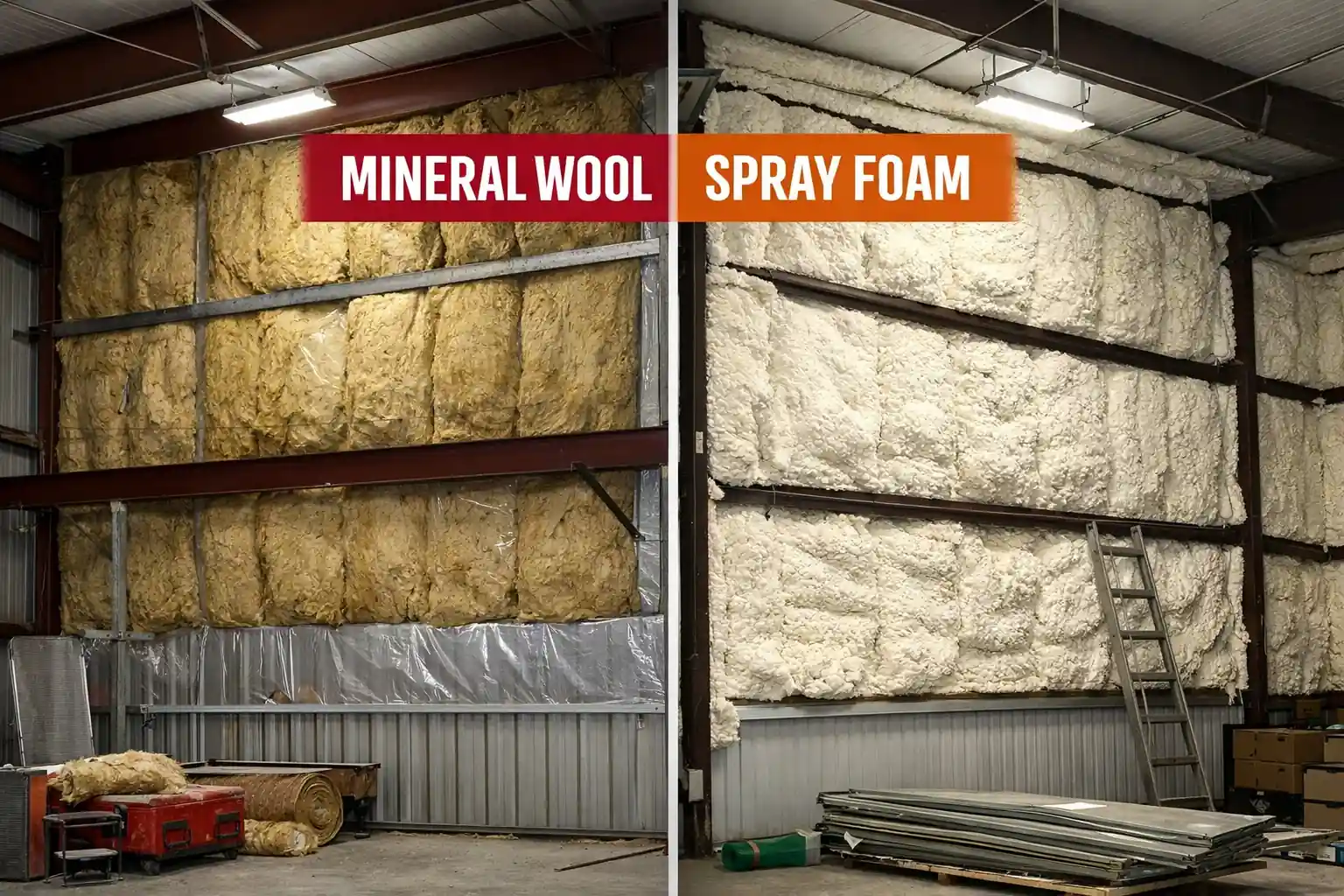
Understanding the Unique Challenges of Metal Buildings
Before comparing insulation types, it’s important to understand what makes metal buildings different:
1. Condensation Is the #1 Problem
Metal sweats. When warm, moist interior air contacts cold metal panels, condensation forms. Over time, this leads to:
Rust and corrosion
Mold growth
Dripping ceilings
Damaged inventory and equipment
2. Thermal Bridging Is Severe
Steel transfers heat rapidly. Traditional insulation that only slows conductive heat flow may not solve radiant heat gain.
3. Air Gaps & Compression Reduce Performance
Many bulk insulation products lose effectiveness if compressed or installed with gaps — common issues in metal structures.
Because of these factors, the “highest R-value” material isn’t always the best real-world solution.
Mineral Wool for Metal Buildings
Mineral wool (also called rock wool or stone wool) is made from molten rock spun into dense fibers. It’s often promoted for fire resistance and sound control.
Pros of Mineral Wool
Fire Resistant
Mineral wool is non-combustible and can withstand extremely high temperatures.
Moisture Resistant (To a Point)
It does not absorb water as readily as fiberglass.
Good Sound Dampening
Its density helps reduce noise transmission.
Cons of Mineral Wool in Metal Buildings
Still Requires a Vapor Barrier
Mineral wool alone does not stop condensation. Without a proper vapor barrier, moisture can accumulate.
Difficult Installation
It is heavy, rigid, and labor-intensive compared to roll insulation.
Can Sag Over Time
In metal buildings with large spans, sagging may occur if not properly supported.
Higher Material & Labor Cost
Mineral wool typically costs more than fiberglass and requires more time to install.
For a deeper comparison, see our full analysis here:
Mineral Wool for Metal Buildings vs. Prodex Total
Spray Foam Insulation for Metal Buildings
Spray polyurethane foam (SPF) is sprayed directly onto the metal surface, where it expands and hardens.
There are two main types:
Open-cell foam
Closed-cell foam (more common for metal buildings)
Pros of Spray Foam
Air Sealing
Spray foam seals cracks and penetrations effectively.
High R-Value per Inch
Closed-cell foam provides strong thermal resistance in thinner applications.
Adheres Directly to Metal
This reduces air gaps if installed properly.
Cons of Spray Foam in Metal Buildings
Expensive
Spray foam is one of the most costly insulation methods — both in materials and professional installation.
Permanent & Difficult to Remove
Once applied, removal is extremely difficult and costly.
Can Trap Moisture Against Metal
Improper installation may trap moisture between foam and metal, potentially accelerating corrosion.
UV Degradation
If exposed, foam must be coated to prevent breakdown.
Application Sensitivity
Installation requires ideal temperature and humidity conditions. Poor application can lead to voids, cracking, or off-ratio foam.
The Hidden Problem: Bulk Insulation Alone Doesn’t Stop Radiant Heat
Both mineral wool and spray foam primarily address conductive heat flow.
However, metal buildings are heavily impacted by radiant heat transfer — especially from sun exposure on roofs and walls.
If radiant heat isn’t addressed:
Summer interiors become extremely hot
HVAC systems work harder
Energy costs rise
This is where reflective insulation technology becomes critical.
A Smarter Solution: Prodex Total
Instead of choosing between heavy mineral wool or expensive spray foam, many building owners choose Prodex Total, a reflective insulation system specifically engineered for metal buildings.
Learn more about how it works here:
Metal Building Insulation – Stop Condensation, Heat, Cold & Air
What Makes Prodex Total Different?
1. Built-In Vapor Barrier
Prodex Total stops condensation at the source by preventing warm, moist air from reaching cold metal panels.
2. Reflective Radiant Barrier Technology
It reflects up to 97% of radiant heat, dramatically reducing summer heat gain.
3. Continuous Insulation System
Unlike batts that leave gaps and seams, Prodex creates a continuous insulation layer.
4. Lightweight & Easy to Install
No special equipment. No messy spray rigs. No heavy panels.
5. No Sagging or Settling
It will not collapse, compress, or lose thickness over time.
6. Cleaner Installation
No fibers. No itchy handling. No airborne particles.
Mineral Wool vs. Spray Foam vs. Prodex Total
Condensation Control
Mineral Wool: Requires separate vapor barrier
Spray Foam: Can seal air, but installation must be perfect
Prodex Total: Integrated vapor barrier system
Radiant Heat Protection
Mineral Wool: Minimal
Spray Foam: Minimal
Prodex Total: Reflects radiant heat effectively
Installation Cost
Mineral Wool: Moderate to high
Spray Foam: High
Prodex Total: Cost-effective
Long-Term Maintenance
Mineral Wool: May sag
Spray Foam: Difficult to repair or modify
Prodex Total: Durable and stable
When Is Mineral Wool or Spray Foam the Right Choice?
Mineral wool may make sense when:
Fire rating is the top priority
Acoustic performance is critical
Spray foam may make sense when:
You need maximum R-value in limited space
Budget is not a major concern
However, for most metal building owners concerned with:
Condensation
Heat gain
Energy efficiency
Cost control
Ease of installation
Prodex Total consistently delivers a better overall value.
Final Verdict: What’s the Best Insulation for Metal Buildings?
Mineral wool and spray foam both offer benefits — but they don’t fully address the unique challenges of metal structures without additional components and cost.
Metal buildings require:
Condensation control
Radiant heat reflection
Continuous coverage
Long-term durability
That’s why many builders and property owners choose Prodex Total as a complete insulation system — not just a material.
If you're evaluating options, we recommend reviewing:
Mineral Wool vs. Fiberglass for Metal Buildings – Pros, Cons & Best Option
Metal Building Insulation – Stop Condensation, Heat, Cold & Air
Choosing the right insulation the first time can prevent years of moisture problems, high energy bills, and costly retrofits.
Before choosing between mineral wool and spray foam, it's important to understand how all major metal building insulation systems compare. Our comprehensive Metal Building Insulation Guide explains condensation control, radiant heat reduction, vapor barriers, installation methods, and how different products perform in steel buildings.
If you want insulation engineered specifically for metal buildings — not adapted from residential construction — Prodex Total is the smarter investment.