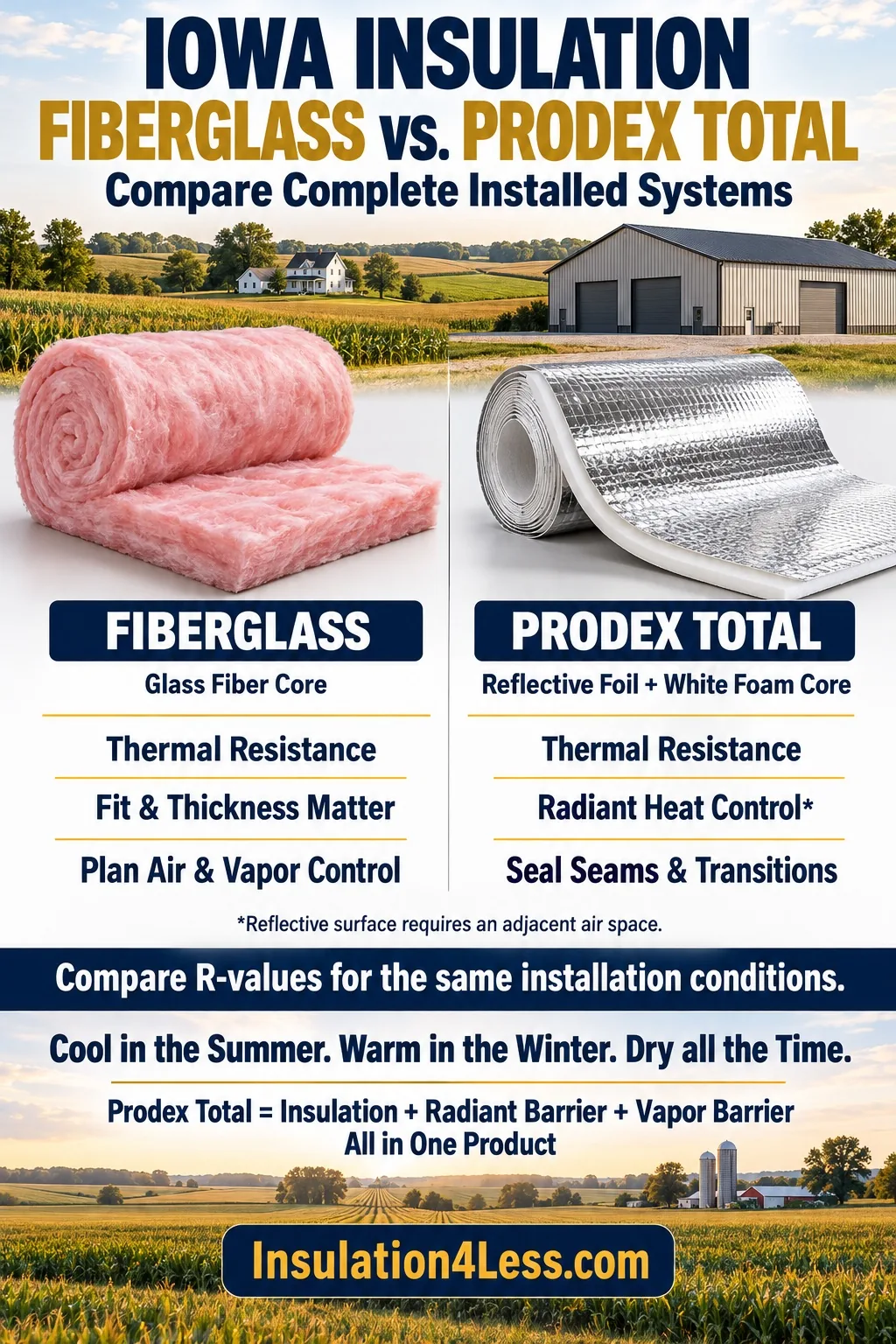
Iowa Fiberglass vs. Prodex Total: Compare Heat, Cold and Moisture Control
Choosing insulation for an Iowa building involves more than comparing thickness or a number on a package. Cold winters, summer heat and indoor moisture place different demands on roofs, walls and floors.
Fiberglass and Prodex Total address heat transfer through different product constructions. Fiberglass uses fine glass fibers to create a layer that resists heat flow. Prodex Total combines a closed-cell polyethylene foam core with reinforced reflective foil.
The useful comparison is between complete installed systems: their thermal performance, air sealing, vapor control, installation requirements and suitability for the building.
Cool in the Summer. Warm in the Winter. Dry all the Time.
Prodex Total = Insulation + Radiant Barrier + Vapor Barrier — All in One Product.
For broader guidance, explore our reflective insulation guide. Visit the Iowa Insulation Guide for building-specific articles.
The Main Difference: Fibrous Insulation vs. Reflective Foam Insulation
How Fiberglass Works
Fiberglass insulation creates thermal resistance through a network of fine glass fibers and the air held within that structure. Products include batts, blankets and loose-fill insulation.
Performance depends on the specified product, installed thickness and workmanship. Gaps, compression and displacement can reduce the performance expected from the intended assembly.
Fiberglass itself is not a continuous air barrier. Vapor-control properties depend on the facing and other materials used in the assembly.
How Prodex Total Works
Prodex Total uses a white closed-cell polyethylene foam core with reinforced reflective foil surfaces. The foam contributes thermal resistance, while a reflective face reduces radiant heat transfer when it faces an appropriate air space.
Properly sealed seams, edges and penetrations allow the installed layer to support air and vapor control. These functions depend on continuity throughout the assembly.
Prodex Total is also different from bubble insulation, which uses encapsulated air bubbles instead of a foam core.
Compare Fiberglass and Prodex Total by Function
| Consideration | Fiberglass | Prodex Total |
|---|---|---|
| Core construction | Fine glass fibers | Closed-cell polyethylene foam |
| Thermal performance | Depends on product, thickness and installation | Depends on product and installed configuration, including specified air spaces |
| Radiant heat control | Unfaced fiberglass does not provide a low-emissivity reflective surface | Reflective foil provides radiant-barrier performance when facing an appropriate air space |
| Air control | Requires a continuous air-control layer | Can support air control when seams, edges and penetrations are properly sealed |
| Vapor control | Depends on facing and assembly layers | Nonperforated products provide a vapor-resistant layer; placement requires planning |
| Installation priorities | Correct fit, thickness, support and continuity | Correct air spaces, attachments, seam closure and continuity |
A foil-faced fiberglass product may combine functions differently from unfaced fiberglass. Compare the actual products and assembly details rather than assuming every fiberglass system is the same.
R-Values: Compare Equivalent Conditions
A material R-value and an assembly R-value describe different things.
Fiberglass product ratings apply to a specified product and thickness under defined test conditions. Reflective insulation system values may include air spaces whose dimensions and orientation affect performance.
Before comparing numbers, ask:
- Does the value describe the material alone or a complete system?
- What air spaces and other layers are included?
- What is the direction of heat flow?
- Does the tested configuration match the proposed installation?
- How does framing affect the completed assembly?
Do not assume a thin reflective product replaces any thickness of fiberglass in every application. Select an assembly that achieves the project’s required thermal performance.
Iowa Winter Performance
Heated Iowa buildings need insulation that slows heat loss and an air-control layer that limits unintended air movement.
Fiberglass in Heated Buildings
Fiberglass can provide substantial thermal resistance when installed at the specified thickness without gaps or excessive compression. Its performance benefits from a separate, continuous air-control system.
In metal buildings, framing and attachment details can create compressed areas or conductive pathways. Review the complete roof and wall design when choosing a blanket system.
Explore fiberglass insulation for metal buildings for the available product category.
Prodex Total in Heated Buildings
Prodex Total can contribute thermal resistance, reflective performance and air and vapor control within an appropriate assembly. Continuous coverage across framing can help reduce exposed conductive pathways where the installation permits.
A continuously heated shop or residence may require additional insulation. Confirm the complete assembly’s performance before selecting materials.
Summer Radiant Heat Beneath Iowa Roofs
Sun-warmed roofing can transfer radiant heat toward cooler surfaces inside a building.
Prodex Total’s reflective face helps reduce this transfer when it faces the required air space. Unfaced fiberglass does not provide that reflective surface, although it still resists heat flow through its thickness.
This makes radiant heat control a useful consideration for farm shops, metal workshops and roof assemblies exposed to summer sun.
Our Iowa roof and ceiling insulation guide explains how roofline and ceiling approaches affect the overall design.
Condensation, Air Leakage and Moisture
Neither material should be evaluated without considering the building’s moisture conditions.
Control Moist Air Reaching Cold Surfaces
Condensation forms when moist air encounters a surface below its dew point. Cold roof panels, framing or sheathing can become collection points.
A continuous air-control layer helps limit moist indoor air reaching those surfaces. Sealed transitions around doors, roof edges and penetrations matter as much as the open field of the insulation.
Understand Facings and Vapor Barriers
Faced fiberglass systems may include a vapor-resistant facing. Prodex Total’s nonperforated reflective facings also create a vapor-resistant layer.
Placement must account for the climate, indoor conditions and existing construction. Adding another vapor-resistant layer without examining the assembly can restrict drying.
Perforated products have different vapor-control characteristics and should not be treated as equivalent to nonperforated products.
Correct Water Problems Before Insulating
Repair roof leaks, plumbing leaks and drainage problems first. Inspect existing insulation and framing for moisture damage before covering them.
Wet insulation does not necessarily remain wet forever; drying depends on the assembly and conditions. The practical priority is to identify the moisture source and establish a suitable repair and drying plan.
Which System Fits Your Iowa Building?
Metal Buildings and Workshops
Compare thermal resistance, radiant heat, framing coverage and condensation details together. The heating schedule also matters: an occasionally heated workshop differs from a continuously conditioned commercial space.
Start with our Iowa metal building insulation guide.
Pole Barns and Agricultural Buildings
An equipment shelter, heated farm shop and livestock building have different moisture and comfort requirements.
Fiberglass, Prodex Total or a combination may suit the project, depending on the complete design. Livestock moisture and wet machinery also require ventilation and moisture-source management.
Explore Iowa pole barn insulation for these applications.
Houses and Residential Renovations
Homes need coordinated roof, wall, floor and foundation assemblies. Select insulation around the thermal boundary and consider the existing air and vapor-control layers.
Our Iowa house insulation guide explains this whole-home approach.
Can Fiberglass and Prodex Total Be Used Together?
They can be combined in suitable assemblies. Fiberglass can provide cavity thermal resistance, while Prodex Total can contribute reflective performance and a continuous control layer.
The combination needs deliberate design. Maintain the air space required for reflective performance, avoid unintended compression and evaluate the placement of vapor-resistant layers.
Adding products together does not automatically produce a better assembly. Their functions and installation details must support the same plan.
Compare Other Insulation Options
If your project requires a broader material comparison, review our spray foam insulation guide and foam board insulation guide.
For reflective products with an air-bubble core, explore the national bubble insulation guide. Product specifications for single bubble insulation should be evaluated separately from Prodex Total’s foam-core construction.
Plan Installation and Materials Before Ordering
Select the assembly and installation method before calculating quantities. Include insulation, seam closures, attachments, supports and any required interior finishes.
Use the Advanced Insulation Calculator where its configurations match your project. Then check the estimate against the installation layout.
Review the applicable insulation installation instructions, especially for air spaces, attachment and product-specific seam closure.
Frequently Asked Questions About Fiberglass vs. Prodex Total
Is Prodex Total the same as fiberglass?
No. Fiberglass uses fine glass fibers. Prodex Total uses a closed-cell polyethylene foam core with reinforced reflective foil.
Does fiberglass stop radiant heat?
Fiberglass resists heat flow, but unfaced fiberglass does not provide a low-emissivity reflective surface. Some fiberglass systems include reflective facings, so compare the actual products.
Is Prodex Total’s published system R-value its material-only R-value?
No. System values include the specified installation conditions and may incorporate air spaces. Use the value that matches the proposed assembly.
Can either system help control condensation?
A properly designed system can help manage surface temperatures and moisture movement. Air sealing, vapor-control placement, ventilation and moisture sources all influence the result.
Do I need to remove existing fiberglass before installing Prodex Total?
Inspect the existing assembly first. Removal depends on its condition, the proposed installation and moisture considerations. Wet, damaged or poorly supported material needs attention before it is covered.
Which should I choose for an Iowa building?
Compare complete assemblies against the building’s use, thermal requirements, radiant heat exposure and moisture conditions. Choose the system whose tested configuration and installation details fit the project.