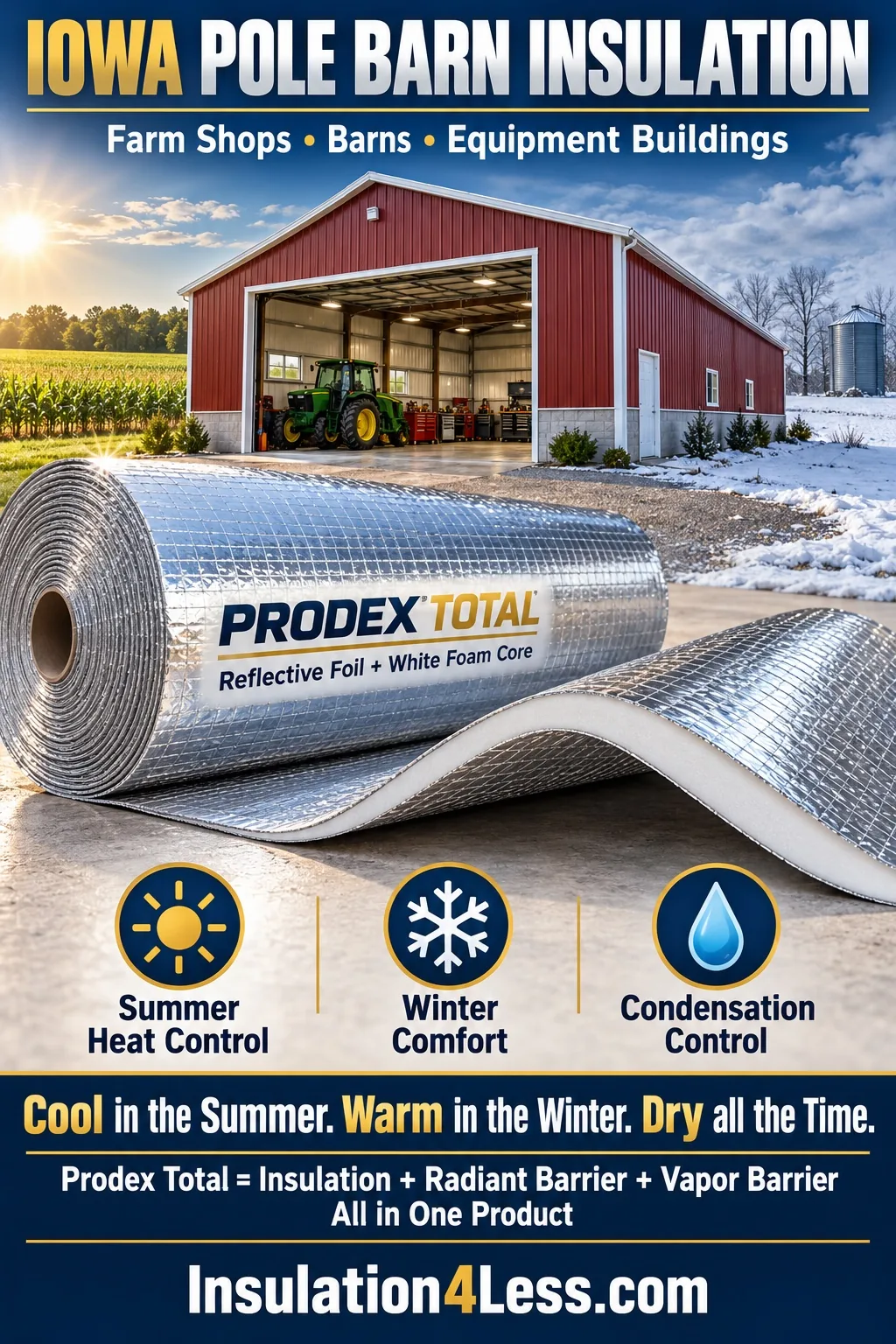
Iowa Pole Barn Insulation: Comfort and Condensation Control for Agricultural Buildings
An Iowa pole barn can serve many purposes: protecting machinery, housing livestock, storing supplies or providing a heated space for repairs. Each use creates different insulation needs. An open equipment shelter does not need the same enclosure as a farm shop used throughout the winter.
Effective Iowa pole barn insulation starts with deciding how the building will operate. Consider heating and cooling, indoor moisture, ventilation, overhead doors and whether the project involves new construction or an existing structure.
Prodex Total combines reinforced reflective foil with a closed-cell polyethylene foam core. When incorporated into a properly designed assembly, it provides insulation, radiant heat control and vapor-barrier functionality.
Cool in the Summer. Warm in the Winter. Dry all the Time.
Prodex Total = Insulation + Radiant Barrier + Vapor Barrier — All in One Product.
For a complete national overview, explore our pole barn insulation guide. For other building applications, visit the Iowa Insulation Guide.
Start With How You Use Your Iowa Pole Barn
Post-frame buildings share a construction approach, but their operating conditions can differ considerably. Choosing insulation around the actual use helps establish sensible priorities.
Heated Farm Shops and Repair Buildings
A farm shop used daily in winter needs an enclosure that retains heat and limits uncontrolled air leakage. Roofs, walls, doors and foundation details all contribute to that performance.
Plan the insulation before selecting heating equipment. A well-detailed enclosure can reduce the heating load, while gaps around large doors and wall transitions can undermine the benefits of insulation.
Occasionally heated shops also need attention. Bringing cold machinery into a warm building—or rapidly heating a cold interior—can create conditions where condensation develops on cold surfaces.
Machinery and Equipment Storage
An unheated equipment building may prioritize reducing summer radiant heat and managing condensation beneath the roof. Insulation can help moderate conditions, but it does not maintain a selected indoor temperature without heating or cooling.
Consider how wet machinery, melting snow and moisture from the ground affect the interior. These sources need attention alongside the insulation system.
Livestock and Agricultural Buildings
Animals, drinking water, wet bedding and cleaning activities can add substantial moisture to a building. Insulation should support a ventilation and humidity-management plan suited to the operation.
Interior durability also matters. Where animals, equipment or frequent washing could damage exposed insulation, select an appropriate protective finish. Review material suitability for the building’s actual exposure conditions.
Why Condensation Matters in Iowa Pole Barns
Condensation occurs when moist air reaches a surface below its dew point. Metal roofing and siding can become cold enough for water droplets to form, particularly when indoor moisture is elevated.
Dripping beneath the roof can wet tools, stored materials and building components. Dampness hidden within an assembly can be harder to identify.
Manage Moisture at Its Source
Repair roof leaks and drainage problems before insulating. Account for moisture entering from exposed soil, newly placed concrete, wet vehicles and agricultural activities.
A ground vapor-control layer, suitable slab details and ventilation may all contribute to moisture management, depending on the building.
Create Continuous Coverage
An insulation system performs more consistently when seams, edges and transitions are properly detailed. Open joints can allow moist indoor air to reach cold exterior surfaces.
Plan the connections between roof and wall insulation, around posts and at doors. Follow the selected installation method for sealing penetrations and supporting the material.
Plan for Drying
Existing buildings may already contain vapor-resistant layers. Adding another layer requires understanding where moisture could accumulate and how the assembly can dry.
Do not enclose wet insulation or damaged building materials. Correct the underlying problem before covering the area.
How Prodex Total Fits Into a Pole Barn Insulation System
Prodex Total has a white closed-cell polyethylene foam core with reinforced reflective foil surfaces. Its construction differs from bubble insulation and from fibrous cavity insulation.
The reflective surface helps reduce radiant heat transfer when facing an appropriate air space. The foam core contributes thermal resistance and provides a thermal break. Properly sealed seams and transitions allow the installed layer to support air and vapor control.
For Iowa pole barns, evaluate these functions within the complete roof or wall assembly. A regularly heated building may need additional insulation to achieve the required overall thermal performance.
Our reflective insulation guide explains why air-space dimensions, heat-flow direction and assembly configuration matter when comparing published R-values.
Roofline or Ceiling: Where Should Pole Barn Insulation Go?
The location of the insulation determines which space is inside the building’s thermal enclosure.
Insulation Along the Roofline
A roofline approach follows the roof slope. It can suit buildings where the full interior height is needed for equipment, storage or work.
The design must account for the roof assembly’s ventilation or unvented configuration, air sealing and moisture control. Maintain the air spaces specified for the selected reflective insulation installation.
Insulation at a Flat Ceiling
A ceiling approach separates the occupied space below from the attic above. This can reduce the volume of space that needs heating or cooling.
Ceiling insulation requires suitable support, continuous air sealing and an attic ventilation strategy where applicable. Have the building designer confirm that the structure can support the proposed ceiling and insulation loads.
Explore our Iowa roof and ceiling insulation guide and national roof insulation guide when comparing these layouts.
New Construction and Retrofit Installation
Insulating a New Iowa Pole Barn
Planning before roofing and siding installation makes it easier to coordinate insulation placement, attachments and transitions.
For applicable Prodex Total methods, rolls run perpendicular to the supporting framing, with the specified sag or spacing to establish the required air gap. Follow the instructions for the particular roof or wall configuration rather than applying one detail to every surface.
Choose the seam-closure method that matches the product. Prodex Total 10M Plus uses heat-welded seams; other products have their own specified seam details.
Insulating an Existing Pole Barn
Begin with an inspection. Look for leaks, damp materials, damaged electrical wiring and areas where access will be restricted after insulation is installed.
Depending on the method, insulation may extend continuously across the interior framing or be fitted within framing bays. Continuous coverage can help reduce exposed framing and simplify some transitions, while installation between members requires careful edge detailing.
Use attachments suitable for the structure and provide lasting support. Consult our pole barn insulation installation instructions for the applicable methods.
Compare Iowa Pole Barn Insulation Materials
Fiberglass
Fiberglass provides thermal resistance through its fibrous structure. Installed thickness, compression, gaps and moisture exposure affect the finished assembly.
Air sealing and vapor control depend on facings and other system components. Review fiberglass insulation for metal buildings and pole barns when evaluating this option.
Bubble Insulation
Bubble wrap insulation uses encapsulated air bubbles with reflective facings. Prodex Total uses a closed-cell polyethylene foam core instead.
For a bubble-core product, review the specifications for reflective bubble insulation. Compare complete installed systems, including their required air spaces, rather than treating all reflective products as interchangeable.
Our Iowa bubble insulation guide examines these options in more detail.
Spray Foam
Spray foam can provide insulation and air sealing, depending on the type, thickness and application. Consider the condition of the substrate, protective coverings and future access to roofing or siding.
Read our spray foam insulation guide before selecting an approach.
Foam Board
Rigid foam panels can provide continuous insulation where the building design accommodates them. Panel joints, edges, attachments and interior protection need proper detailing.
Our foam board insulation guide explains the main types and application considerations.
Estimate Materials for Your Iowa Pole Barn
Measure the roof slope, building length, wall heights and areas to be insulated. Decide whether the thermal boundary follows the roofline or a ceiling before calculating quantities.
Use the Advanced Insulation Calculator to estimate material needs. Review roll direction, overlaps, cuts and transitions before ordering, and include the specified seam closures and attachment accessories.
For steel-framed structures, see our Iowa metal building insulation guide. For smaller workspaces, explore Iowa metal garage and workshop insulation.
Frequently Asked Questions About Iowa Pole Barn Insulation
What is the best insulation for an Iowa pole barn?
The best system depends on the building’s use, heating schedule, moisture load and required thermal performance. Evaluate insulation, air sealing, radiant heat control and vapor management together.
Should I insulate an unheated pole barn?
Insulation may help reduce radiant heat transfer and manage condensation conditions. It will not keep an unheated building at a chosen temperature. Start by identifying the problem you want to solve.
Can Prodex Total be used in a heated farm shop?
Yes. Evaluate it within the complete roof and wall design, including the specified air spaces, sealed transitions and any additional insulation needed for the building’s thermal requirements.
Is pole barn insulation enough to control livestock moisture?
Livestock buildings also need ventilation and moisture-source management. Insulation is one part of that plan; it does not remove moisture from the indoor air.
Should I insulate the roof or install an insulated ceiling?
Choose according to the space you need, the building design and the ventilation strategy. A roofline approach retains the full interior volume, while a ceiling can separate an attic from the conditioned workspace.
Can I install insulation over existing material?
Inspect the existing assembly first. Wet, damaged or poorly supported material needs attention before it is covered. Confirm that the proposed layers provide suitable moisture control and drying potential.