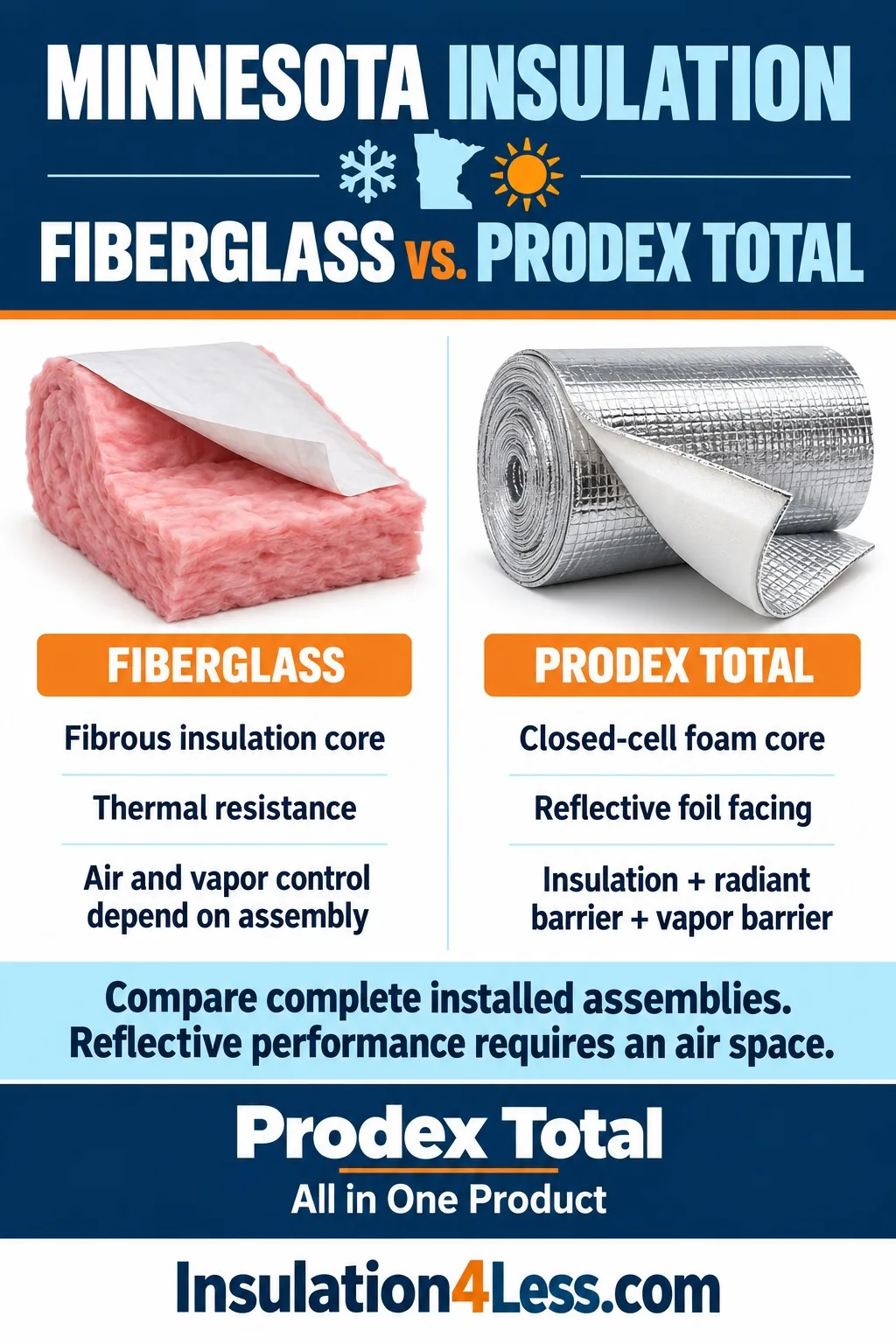
Minnesota Insulation: Fiberglass vs. Prodex Total
Choosing between fiberglass and Prodex Total insulation in Minnesota starts with understanding how each product works. Both can contribute to thermal performance, but they differ in construction, installation and the functions they provide within a building assembly.
Fiberglass primarily resists conductive heat flow through a fibrous insulation layer. Prodex Total combines a closed-cell polyethylene foam core with reflective facing, providing insulation, radiant barrier and vapor barrier functions when installed appropriately.
For a heated Minnesota workshop, agricultural pole barn or metal storage building, the comparison should include winter heat loss, summer radiant heat, air leakage and moisture management. The most useful question is how each complete installation will perform in your building.
For other building applications, visit the Minnesota Insulation Guide.
Cool in the Summer. Warm in the Winter. Dry all the Time.
How Fiberglass Insulation Works
Fiberglass uses a network of fine glass fibers that holds air within the insulation layer. Available products include batts, rolls and loose-fill insulation, with different applications and installation methods.
Its thermal performance depends on the product, installed thickness and condition. Gaps, unintended compression and poor fit can reduce the effectiveness of the installation.
Fiberglass in Metal Buildings and Pole Barns
Fiberglass systems for these buildings may include a facing and a support arrangement. Those components matter when evaluating vapor control, durability and the finished interior.
A fiberglass core alone should not be assumed to provide an air barrier or vapor barrier. Those functions depend on the facing and other assembly components, including their seams and connections.
Review our fiberglass insulation for metal buildings and pole barns when comparing available systems.
How Prodex Total Works
Prodex Total uses a closed-cell polyethylene foam core with reflective facing. Its functions depend on how the product is placed, supported and joined within the assembly.
Prodex Total = Insulation + Radiant Barrier + Vapor Barrier — All in One Product.
The foam core contributes thermal resistance, while a reflective surface facing an appropriate air space helps reduce radiant heat transfer. Properly detailed seams, edges and penetrations support the intended air and vapor control functions.
The Role of the Air Space
The reflective surface needs an appropriate adjacent air space for its radiant barrier function. Pressing that surface directly between solid materials changes the thermal conditions.
Our reflective insulation guide explains why installation details are essential when evaluating reflective products.
Comparing R-Values Correctly
R-value comparisons are useful only when the numbers describe comparable conditions. A material-only R-value and a complete assembly R-value describe different things.
Fiberglass R-Values
Fiberglass products have thermal ratings associated with their specified installed conditions. The selected thickness must fit the assembly, and installation should avoid gaps or unintended compression.
If the available cavity cannot accommodate the selected product properly, choose a suitable assembly rather than forcing a thicker product into a smaller space.
Reflective Insulation Assembly R-Values
Published reflective insulation performance may include contributions from specified air spaces. Heat-flow direction and other test conditions can also affect the reported assembly performance.
Do not treat an assembly R-value as the material-only R-value of a thin insulation layer. Compare the complete roof or wall systems under the conditions relevant to your project.
Winter Performance in Minnesota
A heated building needs sufficient thermal resistance around the conditioned space. Select the complete assembly for the intended indoor temperature, building use and project requirements.
Where additional insulation is needed, plan the layers together. Their placement affects attachment, air sealing and moisture behavior.
Summer Heat: Fiberglass vs. Reflective Insulation
Sunlight can heat metal roofing and siding, increasing heat transfer toward the interior. Fiberglass and reflective insulation address that transfer differently.
Fiberglass and Conductive Heat Flow
Fiberglass provides resistance to heat flow through its installed layer. Its performance depends on appropriate thickness and coverage.
The presence of fiberglass does not automatically create a low-emittance surface facing an air space. If the system includes a reflective facing, evaluate that facing and its placement separately.
Prodex Total and Radiant Heat
Prodex Total’s reflective surface can help reduce radiant heat transfer when it faces an appropriate air space. That function is relevant beneath sun-heated roofing in workshops, barns and other buildings.
For a broader comparison of steel-building assemblies, read our national metal building insulation guide.
Condensation and Moisture Control
Condensation can occur when moist air reaches a surface below its dew point. Cold metal roof and wall panels are potential condensation surfaces during Minnesota winters.
The insulation system should limit unwanted air movement and manage vapor appropriately. Indoor humidity, ventilation and roof condition remain part of the solution.
Fiberglass Systems Need Appropriate Moisture Detailing
Fiberglass does not make an assembly immune to condensation. Facing, seam treatment, air sealing and placement determine how the system manages moisture.
Wet insulation or damaged facing should be investigated before adding another layer. Identify and correct the moisture source rather than simply covering the affected area.
Prodex Total Needs Complete Connections
Prodex Total’s vapor-resistant facing must be joined and connected appropriately for its intended function. Open seams or unfinished edges can allow moisture-bearing air to bypass the layer.
The product does not remove indoor humidity or repair a roof leak. Moisture sources and water entry must also be addressed.
Plan Drying Before Combining Materials
Adding a vapor-resistant layer changes how an existing assembly dries. Inspect existing materials and consider the placement of other vapor-resistant surfaces before combining insulation products.
Installation in New Minnesota Buildings
New construction allows insulation to be coordinated with framing and roof or wall panel installation.
Installing Fiberglass
Plan for the specified thickness, support system and facing. Coordinate adjoining sections and penetrations so the finished installation provides consistent coverage.
Include supporting components and facing repairs in the material and labor estimate.
Installing Prodex Total
Choose roll widths, orientation, attachment and seam locations before installation. Preserve the air space required by the selected method.
Standard 5M Plus uses the specified seam tape. Prodex Total 10M Plus offers heat-welded seams, while Fast Action products incorporate an adhesive joining feature. Follow the instructions for the particular product.
Retrofitting Existing Buildings
An existing building presents different access and attachment conditions from new construction. Inspect the roof, walls and existing insulation before deciding on the approach.
Replacing Damaged Insulation
Find the cause of wet, displaced or damaged insulation first. Roof leaks, condensation and failed attachment require different repairs.
Determine which materials can remain and which require removal before enclosing the assembly.
Adding an Interior Insulation Layer
A continuous interior layer may be an option where the selected installation method allows it. Plan permanent support, perimeter connections and transitions around openings.
For application-specific guidance, use our insulation installation guides.
Compare Total Installed Cost
The price of a roll does not represent the entire project cost. Compare systems covering the same surfaces and delivering the intended performance.
For fiberglass, include the specified thickness, facing, supports and installation labor. For Prodex Total, include seam materials, attachment accessories and the space needed for the chosen assembly.
Access, preparation, existing insulation removal and interior finishes can also affect the total. Use the Advanced Insulation Calculator to help estimate quantities where its configurations match your project.
What About Spray Foam and Foam Board?
Fiberglass and Prodex Total are two options within a broader material comparison.
Spray foam can provide thermal insulation and air sealing, with differences between open-cell and closed-cell products. Our spray foam insulation guide explains those choices.
Rigid boards may suit assemblies designed for continuous board insulation. Read our foam board insulation guide when evaluating board types, attachment and joint treatment.
Choosing for Your Minnesota Building
A heated repair shop, an unheated equipment barn and an occupied home require different insulation plans. Start with the building application, then compare appropriate assemblies.
For local planning guidance, see our articles on Minnesota metal building insulation, Minnesota pole barn insulation and Minnesota house insulation.
The right choice should provide the required thermal performance while fitting the building’s moisture conditions, installation access and budget.
Minnesota Fiberglass vs. Prodex Total FAQs
Is Prodex Total the Same as Fiberglass?
No. Fiberglass uses a fibrous insulation layer, while Prodex Total uses a closed-cell foam core with reflective facing. Their installation requirements and functions differ.
Can I Compare Their Advertised R-Values Directly?
Only when the ratings describe comparable conditions. Check whether each number represents material-only performance or a complete assembly that includes air spaces.
Does Fiberglass Prevent Condensation?
Fiberglass alone does not guarantee condensation control. The complete system needs appropriate air sealing, vapor control and moisture management.
Does Prodex Total Require an Air Space?
An appropriate adjacent air space is required for the reflective surface’s radiant barrier function. Follow the specified installation method.
Can Fiberglass and Prodex Total Be Used Together?
They can be components of a deliberately designed assembly. Their placement should account for thermal performance, support, air spaces, vapor control and drying.
Which Is Better for a Heated Minnesota Pole Barn?
Choose the complete assembly that meets the building’s thermal and moisture requirements. Compare installed performance, attachment, durability and total cost for the same intended use.