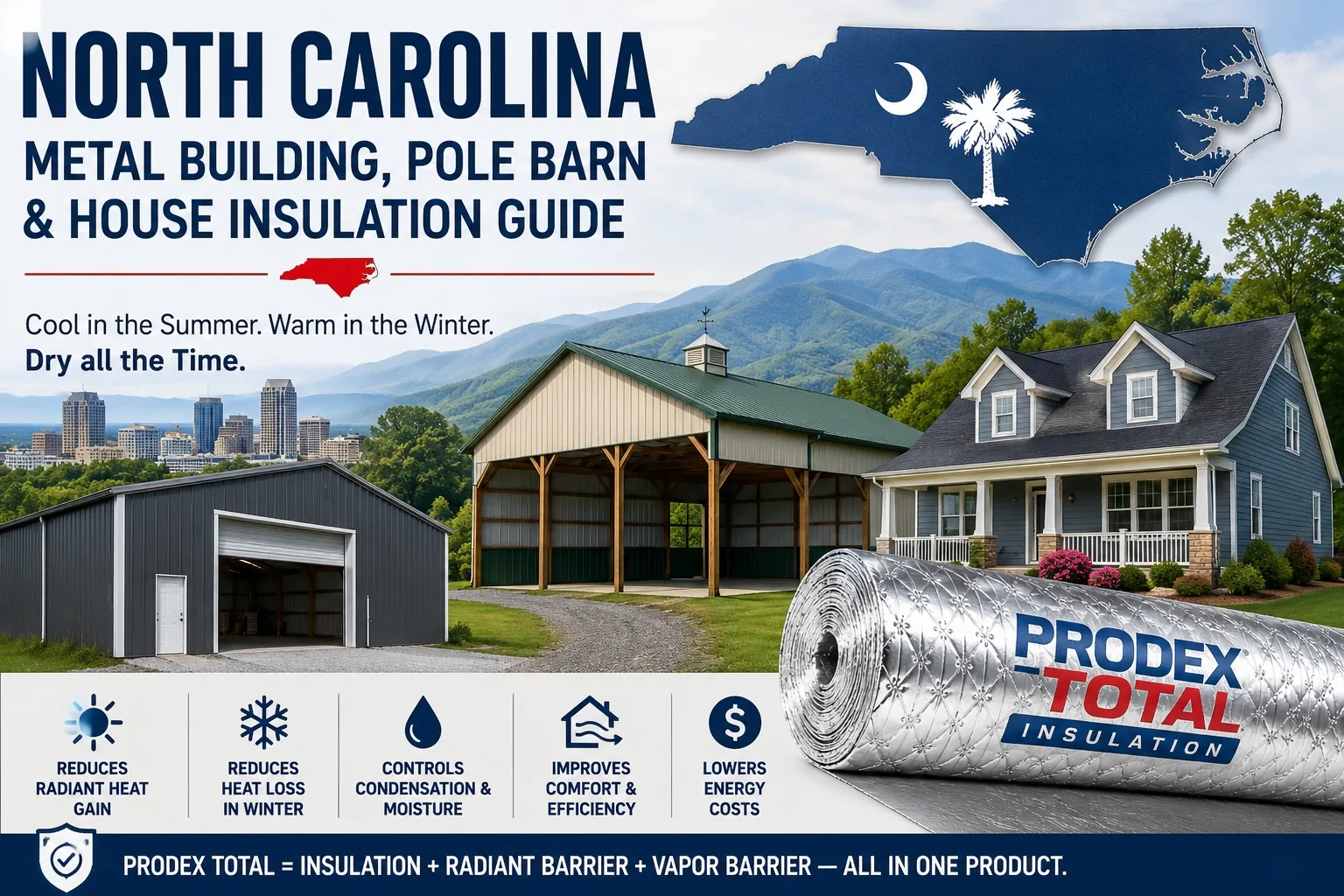
North Carolina Metal Building, Pole Barn & House Insulation Guide
North Carolina property owners face a unique combination of heat, humidity, moisture, and seasonal temperature swings. From the humid Atlantic coastline to the rolling Piedmont and cooler Appalachian Mountains, buildings throughout the state require insulation systems that can help control heat gain, reduce energy costs, and prevent damaging condensation.
Whether you're insulating a metal building, pole barn, garage, workshop, agricultural facility, warehouse, or home, choosing the right insulation can significantly improve comfort and building performance.
Prodex Total provides multiple benefits in a single product.
Prodex Total = Insulation + Radiant Barrier + Vapor Barrier — All in One Product.
It helps buildings stay:
Cool in the Summer. Warm in the Winter. Dry all the Time.
Why North Carolina Buildings Need Insulation
North Carolina experiences:
Hot, humid summers
Significant solar heat gain
Seasonal winter cold
Coastal moisture
Hurricane-related humidity
Condensation risks in metal structures
Without proper insulation, buildings can experience:
Excessive indoor heat
High utility bills
Condensation dripping from ceilings
Moisture damage
Mold and mildew concerns
Uncomfortable temperature swings
A properly insulated building helps address all of these challenges while improving energy efficiency and long-term building durability.
North Carolina's Three Climate Regions
Coastal North Carolina
The coastal region includes:
Wilmington
Morehead City
Jacksonville
New Bern
The Outer Banks
The biggest challenge along the coast is humidity. Warm, moisture-laden air frequently creates condensation issues in homes, garages, pole barns, and metal buildings. Buildings near the coast often benefit from insulation systems that help manage both heat and moisture.
The Piedmont Region
The Piedmont includes:
Charlotte
Raleigh
Durham
Greensboro
Winston-Salem
This region experiences hot summers, mild winters, and year-round humidity. Property owners often need insulation that performs well during both cooling and heating seasons.
Western North Carolina Mountains
Mountain communities such as:
Asheville
Boone
Banner Elk
Hendersonville
Experience cooler temperatures and greater heating demands. Proper insulation helps reduce heat loss while maintaining indoor comfort throughout the year.
The Hidden Problem: Condensation
Many building owners focus only on temperature control. However, condensation often causes more damage than heat loss. Condensation forms when warm, humid air contacts a cooler surface. Think of a cold can of beer sitting outside on a hot day. Water forms on the outside because of the temperature difference. The same thing happens inside metal buildings, garages, workshops, and pole barns.
Common results include:
Dripping ceilings
Wet equipment
Rust and corrosion
Mold growth
Damaged inventory
Structural deterioration
The best solution is preventing condensation from forming in the first place.
What Makes Prodex Total Different?
Many insulation systems require separate products for:
Insulation
Radiant Barrier
Vapor Barrier
This often means:
More materials
More labor
More installation time
More opportunities for installation mistakes
Prodex Total combines all three into one product. Prodex Total = Insulation + Radiant Barrier + Vapor Barrier — All in One Product.
In addition to reducing radiant heat transfer, Prodex Total helps control condensation by maintaining more consistent temperatures across metal surfaces. Without insulation, metal roofing can become hot on the outside while remaining cooler on the inside. This temperature difference creates condensation. Prodex Total helps reduce these temperature differences, helping eliminate the conditions that allow condensation to form.
Benefits include:
Heat control
Condensation control
Vapor barrier protection
Energy savings
Lightweight installation
No fiberglass particles
No itchy fibers
No moisture absorption
Cool in the Summer. Warm in the Winter. Dry all the Time.
North Carolina Metal Building Insulation
Metal buildings are extremely popular throughout North Carolina.
Common applications include:
Warehouses
Workshops
Equipment storage
Agricultural buildings
Commercial facilities
Garages
The two most common complaints among metal building owners are:
Summer Heat
Metal roofs absorb large amounts of solar energy.Without insulation, interior temperatures can become extremely uncomfortable.
Roof Condensation
Many owners mistake condensation for a roof leak.The real problem is warm humid air contacting cooler metal surfaces. Proper insulation helps control both heat and condensation.
Learn more:
North Carolina Metal Building Insulation Guide
North Carolina Pole Barn Insulation
Pole barns remain one of the most popular building types across North Carolina.
Common uses include:
Horse barns
Equipment storage
Workshops
Hobby buildings
Agricultural facilities
Residential storage
Without insulation, pole barns often experience:
Summer overheating
Winter heat loss
Condensation problems
Moisture damage
Proper insulation helps create a more comfortable and durable structure.
Learn more: North Carolina Pole Barn Insulation Guide
Agricultural Building Insulation
Agriculture plays a major role throughout North Carolina.
Farm buildings often house:
Tractors
Implements
Feed
Hay
Livestock
Equipment
Seed
Moisture and condensation can damage both equipment and stored materials. Proper insulation helps maintain a drier and more comfortable environment while protecting valuable assets.
Garage & Workshop Insulation
Garages and workshops frequently become unusable during the summer months. Reflective insulation helps reduce radiant heat gain through roofs and walls while helping control moisture and condensation.
Applications include:
Detached garages
Attached garages
Hobby workshops
Automotive shops
Storage buildings
North Carolina House Insulation
Homeowners throughout North Carolina continue looking for ways to improve comfort and reduce utility costs. Prodex Total can be installed in:
Roof systems
Attics
Walls
Crawlspaces
Floors
Garages
Additions
Ceilings
Ceilings are one of the most common and effective applications because they help reduce radiant heat transfer from the roof into living spaces.
Learn more: North Carolina House Insulation Guide
Reflective Insulation for North Carolina Heat
Not all heat enters a building the same way.
Buildings gain heat through:
Conduction
Convection
Radiation
Solar radiant heat can create significant cooling loads during North Carolina summers. Reflective insulation helps reduce radiant heat transfer before it enters the building.
Learn more: Reflective Insulation for North Carolina Heat
Hurricane Season and Moisture Protection
North Carolina's hurricane season presents additional moisture challenges. Even buildings that avoid direct storm damage may experience:
Elevated humidity
Moisture infiltration
Condensation risks
Long periods of damp conditions
A properly installed vapor barrier can help improve moisture management and building performance.
Frequently Asked Questions About Insulation in North Carolina
What is the best insulation for metal buildings in North Carolina?
Most metal building owners want to solve three problems:
Heat
Condensation
Energy loss
Prodex Total combines insulation, radiant barrier protection, and vapor barrier protection in a single system. Learn more in our North Carolina Metal Building Insulation Guide.
Why do metal buildings sweat in North Carolina?
Metal building condensation occurs when warm, humid air contacts cooler metal surfaces. This is especially common during seasonal weather changes and periods of high humidity.
Does reflective insulation work in North Carolina?
Yes. North Carolina's climate experiences significant radiant heat gain during summer months. Reflective insulation helps reduce that heat transfer before it enters the building. Learn more in our Reflective Insulation for North Carolina Heat.
Is fiberglass insulation a good choice for metal buildings?
Fiberglass can provide thermal resistance, but it may lose effectiveness if it becomes wet or compressed. Many property owners prefer systems that do not absorb moisture.
Can Prodex Total help stop condensation?
Yes. Prodex Total is commonly used to help control condensation in metal buildings, pole barns, garages, workshops, and agricultural facilities.
Is insulation important for pole barns?
Absolutely. Pole barns often experience major temperature swings and condensation issues. Proper insulation helps improve comfort while protecting equipment and stored materials. Learn more in our North Carolina Pole Barn Insulation Guide.
Can reflective insulation be used in homes?
Yes. Common residential applications include:
Attics
Roofs
Ceilings
Walls
Crawlspaces
Floors
Garages
Learn more in our North Carolina House Insulation Guide.
Does coastal humidity require special insulation considerations?
Yes. Buildings near the coast experience elevated humidity levels throughout the year, making moisture control especially important.
Can Prodex Total be installed in existing buildings?
Yes. Prodex Total can be installed in both new construction and retrofit applications.
How much air gap is recommended?
For new construction, a slight 1" to 2" sag between framing members is often ideal. For retrofit applications, maintaining at least a ¾-inch air gap is generally recommended.
Recommended Product
For most North Carolina applications, we recommend: 10M Prodex Total Insulation Plus
The 10M product is commonly used in:
Metal buildings
Pole barns
Garages
Workshops
Agricultural facilities
Residential projects
Additional Resources & Guides (state specific)
For more information, explore these detailed guides:
North Carolina Insulation Resources (site-wide cornerstone guide)
Looking for more detailed insulation information? Explore our comprehensive guides covering insulation types, installation methods, building-specific recommendations, and product comparisons.
Metal Building Insulation
Learn how to insulate steel buildings while controlling heat transfer and preventing condensation.
Pole Barn Insulation
Discover the best insulation methods for pole barns, post-frame buildings, and agricultural structures.
House Insulation
Improve comfort and energy efficiency throughout your home, including roofs, ceilings, attics, walls, crawlspaces, garages, and additions.
Roof Insulation Guide
Compare roof insulation options, installation methods, costs, and recommendations for homes, metal roofs, and commercial buildings.
Reflective Insulation Guide
Learn how reflective insulation works, how it reduces radiant heat transfer, and how it compares to traditional insulation materials.
Shipping Container Insulation
Learn how to insulate shipping containers to reduce heat transfer, prevent condensation, and improve year-round comfort.
Conclusion
Whether you're insulating a metal building, pole barn, garage, workshop, agricultural structure, or home, controlling heat and moisture is critical for long-term performance. Prodex Total helps address all three major building challenges:
Heat
Condensation
Air infiltration
Prodex Total = Insulation + Radiant Barrier + Vapor Barrier — All in One Product.
Cool in the Summer. Warm in the Winter. Dry all the Time.