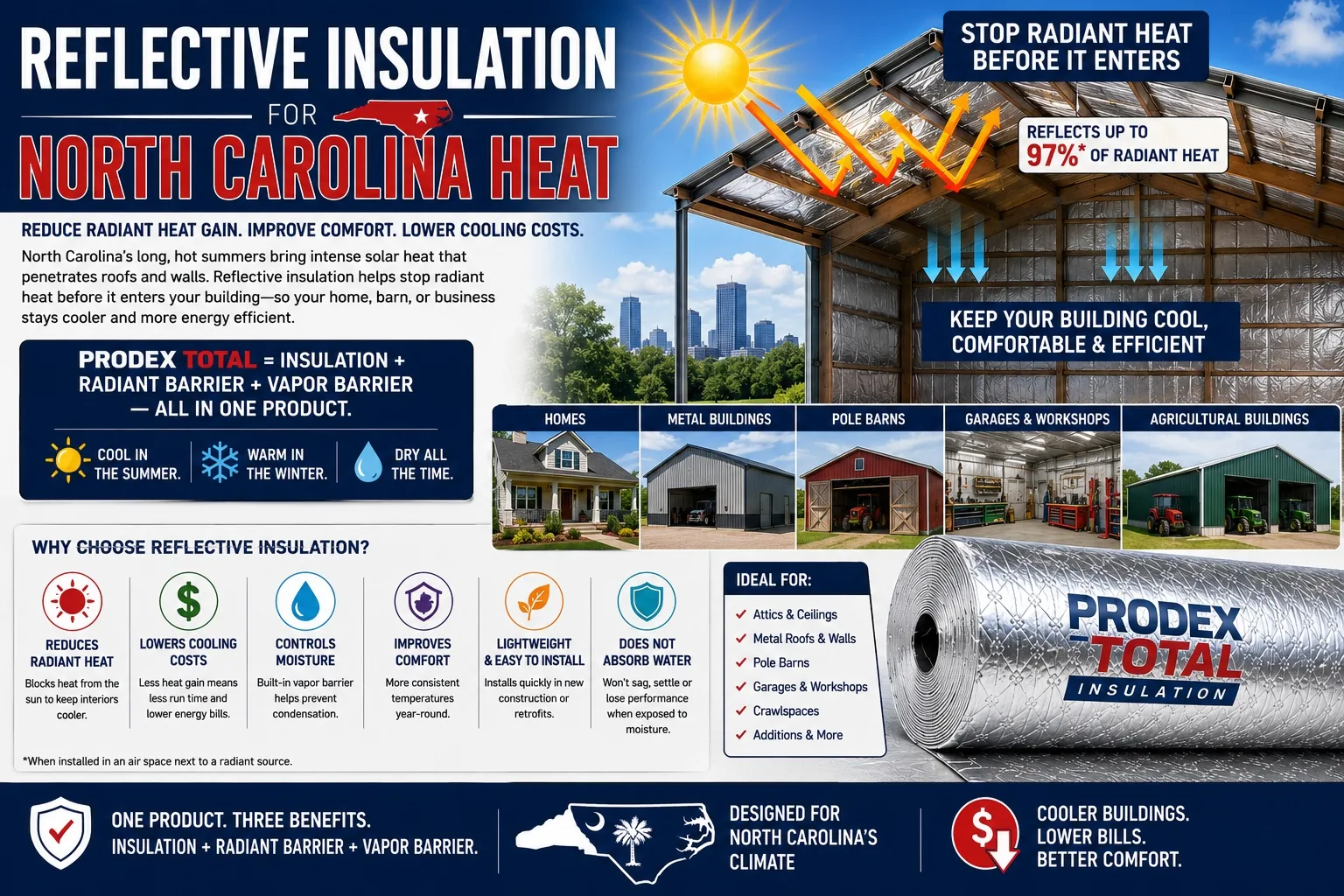
Reflective Insulation for North Carolina Heat
North Carolina homeowners, business owners, farmers, and metal building owners all face a common challenge: heat. During summer months, the sun can place an enormous heat load on roofs, walls, attics, garages, workshops, pole barns, and metal buildings. In many cases, this heat enters the structure long before the air conditioning system has a chance to respond. Understanding how heat moves through a building is the first step toward selecting the right insulation system. Reflective insulation is designed specifically to help reduce radiant heat transfer, making it an effective solution for North Carolina's climate.
Prodex Total = Insulation + Radiant Barrier + Vapor Barrier — All in One Product.
Cool in the Summer. Warm in the Winter. Dry all the Time.
Reflective Insulation for North Carolina Heat
North Carolina homeowners, business owners, farmers, and metal building owners all face a common challenge: heat. During summer months, the sun can place an enormous heat load on roofs, walls, attics, garages, workshops, pole barns, and metal buildings. In many cases, this heat enters the structure long before the air conditioning system has a chance to respond. Understanding how heat moves through a building is the first step toward selecting the right insulation system. Reflective insulation is designed specifically to help reduce radiant heat transfer, making it an effective solution for North Carolina's climate.
Prodex Total = Insulation + Radiant Barrier + Vapor Barrier — All in One Product.
Cool in the Summer. Warm in the Winter. Dry all the Time.
Why North Carolina Buildings Get So Hot
North Carolina experiences:
Long summer seasons
High humidity
Strong solar exposure
Elevated attic temperatures
Significant cooling demands
Buildings absorb solar energy throughout the day. Metal roofs, asphalt shingles, and exterior surfaces can become extremely hot during direct sunlight exposure. Without proper insulation, much of that heat transfers into the building.
The result is:
Higher indoor temperatures
Increased air conditioning use
Reduced comfort
Higher utility bills
Understanding the Three Types of Heat Transfer
Many people think all insulation works the same way. It does not. Heat moves in three ways:
Conduction
Heat travels through solid materials. Examples include:
Roof panels
Wall materials
Structural framing
Convection
Heat moves through air. Warm air rises while cooler air sinks.
Radiation
Radiant heat travels as energy waves. The sun is the largest source of radiant heat affecting buildings. Radiant heat can transfer enormous amounts of energy into a building before traditional insulation has an opportunity to slow it down.
Why Radiant Heat Matters in North Carolina
Radiant heat is one of the primary contributors to overheating during summer. This is especially true in:
Attics
Metal buildings
Pole barns
Garages
Workshops
Agricultural buildings
A roof exposed to direct sunlight continuously absorbs and radiates heat downward. Without reflective protection, that heat enters the building and increases cooling demands.
What Is Reflective Insulation?
Reflective insulation is designed to reflect radiant energy rather than absorb it. Instead of simply slowing heat movement, reflective insulation helps reduce the amount of radiant heat entering the structure. This can help improve comfort while reducing cooling loads.
What Makes Prodex Total Different?
Many products provide only one function.
For example:
Fiberglass provides insulation.
Radiant barriers provide reflectivity.
Separate vapor barriers control moisture.
Prodex Total combines all three.
Prodex Total Provides:
Reflective insulation
Radiant barrier protection
Vapor barrier protection
All in one product.
Benefits Include
Helps reduce radiant heat gain
Helps control condensation
Helps improve comfort
Helps reduce cooling demands
Helps reduce winter heat loss
Does not absorb moisture
Lightweight installation
No fiberglass particles
No itchy fibers
North Carolina Attics and Reflective Insulation
Attics often experience the highest temperatures in a home. Solar energy heats the roof throughout the day.
That heat then radiates into the attic space below. Reflective insulation helps reduce this radiant heat transfer before it reaches living spaces.
Benefits include:
Improved comfort
Reduced attic temperatures
Lower cooling demands
Increased energy efficiency
Learn more: North Carolina House Insulation Guide
Reflective Insulation for Metal Buildings
Metal buildings are particularly vulnerable to radiant heat gain. Metal roofing quickly absorbs solar energy and transfers heat into the building. Reflective insulation helps reduce this heat transfer while also helping control condensation.
Applications include:
Warehouses
Workshops
Commercial buildings
Storage facilities
Equipment buildings
Learn more: North Carolina Metal Building Insulation Guide
Reflective Insulation for Pole Barns
Pole barns frequently experience large temperature swings. Reflective insulation helps:
Reduce heat gain
Improve comfort
Control condensation
Protect equipment and livestock
Learn more: North Carolina Pole Barn Insulation Guide
Coastal North Carolina Heat and Humidity
Coastal regions such as:
Wilmington
Jacksonville
Morehead City
Outer Banks
Experience elevated humidity levels throughout much of the year. Buildings in these areas benefit from insulation systems that help manage both heat and moisture. Prodex Total's built-in vapor barrier helps support moisture control while reflective surfaces help reduce radiant heat gain.
Piedmont Region Cooling Demands
The Piedmont region experiences long cooling seasons. Cities such as:
Charlotte
Raleigh
Durham
Greensboro
Can experience extended periods of hot weather. Reducing solar heat gain helps improve overall building performance.
Mountain Region Performance
Western North Carolina experiences cooler winters but still receives significant solar exposure. Reflective insulation helps reduce summer heat gain while contributing to year-round comfort.
Reflective Insulation vs Fiberglass
Fiberglass and reflective insulation serve different functions. Fiberglass primarily slows conductive heat transfer. Reflective insulation primarily addresses radiant heat transfer.
North Carolina buildings often benefit from insulation systems that address both heat and moisture concerns.
Learn more: Reflective Insulation: Measuring Its R-Value vs Fiberglass
Frequently Asked Questions
Does reflective insulation work in North Carolina?
Yes. North Carolina experiences significant solar heat gain throughout much of the year. Reflective insulation helps reduce radiant heat transfer into buildings.
Is reflective insulation effective in hot climates?
Yes. Reflective insulation is specifically designed to help reduce radiant heat gain.
Can reflective insulation help lower cooling costs?
Reducing heat gain can reduce cooling demands, which may contribute to lower energy consumption.
Does reflective insulation work in attics?
Yes. Attics are one of the most common applications.
Can reflective insulation be used in metal buildings?
Yes. Metal buildings are among the most popular applications because they experience substantial radiant heat gain.
Does reflective insulation help with condensation?
Yes. When properly installed, Prodex Total helps control condensation while also reducing radiant heat transfer.
Can reflective insulation be used in pole barns?
Yes. Pole barns commonly benefit from improved comfort and condensation control.
Does Prodex Total absorb water?
No. Unlike fiberglass insulation, Prodex Total does not absorb moisture.
Is reflective insulation useful in coastal North Carolina?
Yes. Coastal buildings benefit from both heat control and vapor barrier protection.
Can reflective insulation be installed in existing buildings?
Yes. Both new construction and retrofit applications are available.
Recommended Product
For most North Carolina applications we recommend: 10M Prodex Total Insulation Plus
The 10M product is commonly used in:
Homes
Attics
Pole barns
Metal buildings
Workshops
Garages
Agricultural facilities
Additional Resources & Guides
Conclusion
North Carolina buildings face significant heat gain throughout much of the year. Reflective insulation helps reduce radiant heat transfer while supporting comfort, energy efficiency, and moisture control. Whether you're insulating a home, attic, metal building, pole barn, workshop, or garage, reflective insulation can play an important role in overall building performance.
Prodex Total = Insulation + Radiant Barrier + Vapor Barrier — All in One Product.
Cool in the Summer. Warm in the Winter. Dry all the Time.