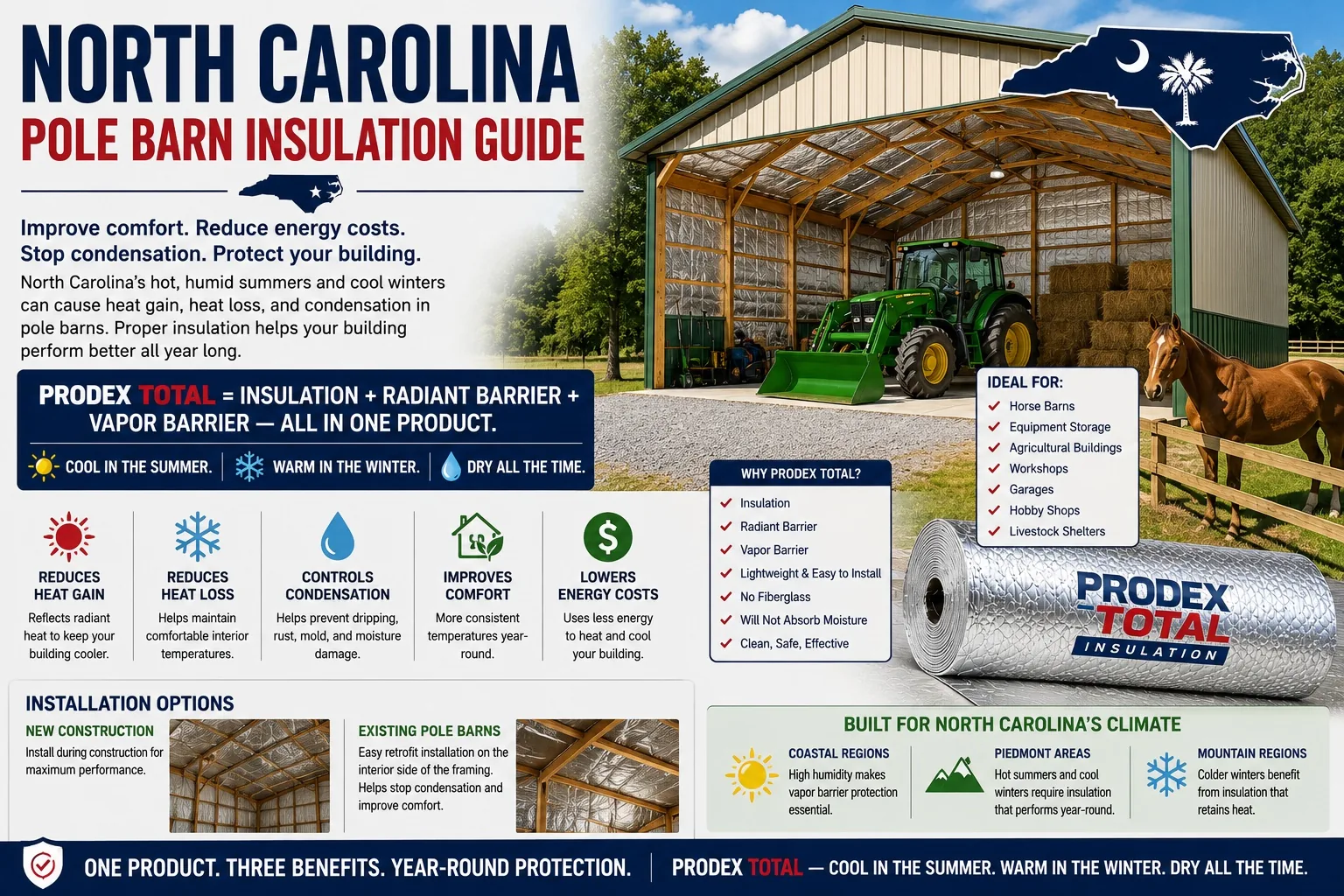
North Carolina Pole Barn Insulation Guide
Pole barns are one of the most versatile building types found throughout North Carolina. From horse barns and agricultural buildings to workshops, garages, equipment storage facilities, and hobby shops, pole barns provide affordable and durable space for a wide variety of uses.
However, without proper insulation, many North Carolina pole barns become uncomfortable, inefficient, and prone to condensation problems. Whether you're constructing a new pole barn or upgrading an existing structure, the right insulation can improve comfort, reduce energy costs, and help protect your building from moisture damage.
Prodex Total = Insulation + Radiant Barrier + Vapor Barrier — All in One Product.
Cool in the Summer. Warm in the Winter. Dry all the Time.
Why North Carolina Pole Barns Need Insulation
North Carolina experiences:
Hot, humid summers
Seasonal winter weather
Coastal moisture
Significant solar heat gain
Condensation-producing temperature swings
Because pole barns typically feature large roof surfaces and open interior spaces, they can experience dramatic temperature fluctuations.
Without insulation, pole barns often become:
Extremely hot during summer
Cold during winter
Vulnerable to condensation
Uncomfortable for people and animals
More expensive to heat and cool
Proper insulation helps address all of these challenges.
Pole Barn Insulation Challenges in North Carolina
Summer Heat
Metal roofing absorbs substantial solar energy. Without insulation, attic and ceiling temperatures can rise dramatically, making the building uncomfortable and increasing cooling costs.
Winter Heat Loss
Even in relatively mild North Carolina winters, significant heat loss occurs through roofs and walls. Insulation helps retain heat and improve comfort.
Condensation
Condensation is one of the most common problems in pole barns. When warm humid air contacts cooler metal surfaces, water forms.
This can result in:
Dripping ceilings
Rust
Mold growth
Wet equipment
Damaged materials
Unhealthy conditions for livestock
What Makes Prodex Total Different?
Many insulation systems require separate products for:
Thermal insulation
Radiant barrier protection
Vapor barrier protection
Prodex Total combines all three.
Benefits of Prodex Total
Helps reduce radiant heat gain
Helps reduce winter heat loss
Helps control condensation
Helps reduce air infiltration
Lightweight installation
No fiberglass particles
No itchy fibers
Does not absorb moisture
Unlike fiberglass insulation, Prodex Total will not become saturated with water. This makes it particularly useful for North Carolina's humid climate.
Pole Barn Applications Throughout North Carolina
Horse Barns
Horse owners often seek insulation to improve comfort and reduce temperature extremes. A properly insulated barn can provide a more stable environment throughout the year.
Equipment Storage Buildings
Protect tractors, implements, trailers, and valuable equipment from condensation and moisture.
Agricultural Buildings
Help reduce humidity-related issues while improving comfort for workers and livestock.
Workshops
Maintain a more comfortable work environment during both summer and winter.
Hobby Shops
Improve year-round usability and comfort.
New Pole Barn Construction
The ideal time to install insulation is during construction.
Typical Installation Method
Apply double-sided tape to framing members.
Unroll insulation perpendicular to the framing.
Allow a slight 1" to 2" sag between framing members when possible.
Seal seams with reflective tape or heat weld seams when using 10M Prodex Total.
Install metal sheeting over the insulation.
This method creates:
Continuous insulation coverage
Vapor barrier protection
Condensation control
Improved thermal performance
Existing Pole Barn Retrofit Installation
Already have a completed pole barn? Prodex Total can still be installed effectively.
Interior Retrofit Method
The insulation is installed on the interior side of the framing.
Benefits include:
Condensation control
Improved comfort
Reduced heat gain
Easier installation than replacing roof panels
Maintaining an air gap between the insulation and metal sheeting helps optimize performance.
North Carolina Agricultural Buildings
Agriculture remains a major part of North Carolina's economy. Common agricultural applications include:
Equipment barns
Hay storage buildings
Livestock shelters
Feed storage facilities
Agricultural workshops
Condensation can damage:
Equipment
Feed
Hay
Electrical systems
Building components
Proper insulation helps create a drier and more controlled environment.
Coastal North Carolina Pole Barns
Pole barns near:
Wilmington
Jacksonville
Morehead City
The Outer Banks
Experience elevated humidity throughout the year. Controlling moisture becomes especially important in these environments. A properly installed vapor barrier helps reduce the risk of condensation and moisture-related damage.
Mountain Region Pole Barns
Western North Carolina areas such as:
Asheville
Boone
Banner Elk
Experience cooler winters and greater heating requirements. Insulation helps retain heat while improving comfort throughout the building.
Reflective Insulation vs Fiberglass
Fiberglass insulation has traditionally been used in pole barns.
However, fiberglass can:
Absorb moisture
Lose effectiveness when wet
Compress over time
Require additional vapor barriers
Prodex Total combines:
Reflective insulation
Vapor barrier protection
Condensation control
Into a single system.
Learn more: Reflective Insulation: Measuring Its R-Value vs Fiberglass
Frequently Asked Questions
What is the best insulation for pole barns in North Carolina?
Most owners are trying to solve:
Heat
Condensation
Energy loss
Prodex Total is designed to help address all three.
Why do pole barns sweat?
Pole barn sweating is caused by condensation. Warm humid air contacts cooler metal surfaces and water forms.
Does reflective insulation work in North Carolina?
Yes. Reflective insulation helps reduce radiant heat transfer, which is one of the largest sources of heat gain during summer.
Can Prodex Total help stop condensation?
Yes. Condensation control is one of the primary reasons pole barn owners install Prodex Total.
Can Prodex Total be installed in existing pole barns?
Yes. Retrofit installation methods are available for existing structures.
Is insulation important for horse barns?
Yes. Insulation helps improve comfort while reducing temperature swings and condensation.
Does Prodex Total absorb water?
No. Unlike fiberglass insulation, Prodex Total does not absorb moisture.
How much air gap should be maintained?
For new construction, a slight 1" to 2" sag is often ideal. For retrofit installations, maintaining at least a ¾-inch air gap is generally recommended.
Is Prodex Total suitable for agricultural buildings?
Yes. It is commonly used in:
Equipment barns
Horse barns
Agricultural buildings
Storage facilities
Workshops
Can Prodex Total be used on walls and ceilings?
Yes. It is commonly installed on roofs, walls, and ceilings.
Recommended Product
For most North Carolina pole barn applications we recommend: 10M Prodex Total Insulation Plus
The 10M product provides excellent performance for:
Heat control
Condensation control
Energy efficiency
Moisture management
Additional Resources & Guides
Conclusion
North Carolina pole barns face heat, humidity, condensation, and seasonal temperature changes throughout the year.
The right insulation system can help:
Reduce heat gain
Lower energy costs
Control condensation
Improve comfort
Protect equipment and livestock
Prodex Total = Insulation + Radiant Barrier + Vapor Barrier — All in One Product.
Cool in the Summer. Warm in the Winter. Dry all the Time.