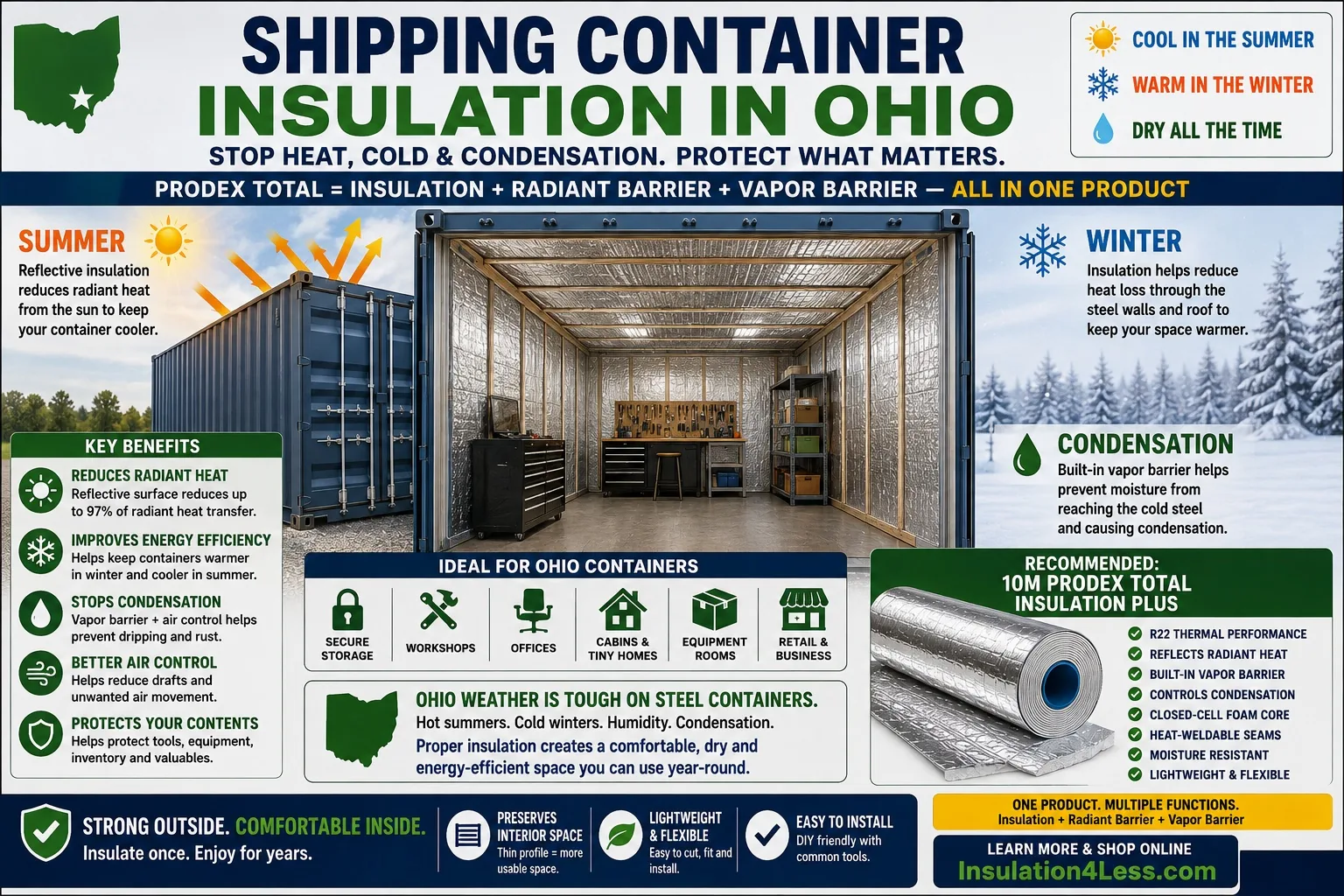
Shipping Container Insulation in Ohio: Stop Condensation, Heat & Cold
Shipping containers are strong, secure and increasingly popular in Ohio for storage, workshops, equipment buildings, offices, cabins, tiny homes and other converted spaces. But a shipping container has one major weakness when it comes to comfort and moisture control:
It is essentially a large steel box.
During summer, sunlight can heat the steel roof and walls rapidly. That hot metal can radiate heat toward the interior, causing temperatures inside an uninsulated container to rise quickly. During an Ohio winter, the problem reverses. The steel shell becomes extremely cold and readily transfers heat out of the container.
Then there is condensation.
Warm, moisture-containing interior air can contact the cold steel shell and produce water droplets on the walls and ceiling. In some containers, the result can become severe enough that moisture appears to be "raining" from the ceiling.
An effective shipping container insulation system therefore needs to address more than R-value.
It should help control:
Summer radiant heat
Winter heat loss
Condensation
Vapor movement
Air movement
Moisture
Interior comfort
For our complete national resource covering insulation materials, installation, condensation and container conversions, see the Shipping Container Insulation Guide. For insulation information covering other building types throughout Ohio, visit our Ohio Insulation Guide.
Why Shipping Containers Are Difficult to Insulate
Shipping containers weren't originally designed to be occupied buildings.They're manufactured primarily to transport cargo. Their corrugated steel shells provide excellent structural strength, but steel readily conducts heat. That creates three major insulation challenges.
Heat
Solar radiation can heat the roof and walls substantially during summer.
Cold
During winter, the thin steel shell provides very little resistance to heat transfer.
Condensation
Cold steel can become a condensation surface when moisture-containing interior air reaches it. These problems are similar to those encountered in other steel structures, but shipping containers add another complication: Interior space is extremely valuable. A standard container is only about eight feet wide. Installing a thick insulation system along both walls can noticeably reduce usable interior width. This makes insulation performance per inch of interior space especially important.
Why the Shipping Container Roof Is Critical
The roof should receive particular attention when insulating a shipping container. It is exposed directly to sunlight and can become extremely hot during summer. That heated steel can then radiate energy toward the interior. During winter, the roof becomes a cold exterior surface and can contribute to heat loss and condensation. Because warm interior air rises, the ceiling may also become one of the most noticeable locations for moisture problems. This makes the container roof central to controlling: Radiant Heat + Heat Loss + Condensation For a deeper look at these principles, see Roof & Ceiling Insulation in Ohio. Our national Roof Insulation Guide explains radiant heat, condensation and insulation considerations for roof assemblies in greater detail.
Why Shipping Containers Get So Hot in Summer
A shipping container exposed to direct sunlight can behave like a solar collector. Solar energy strikes the steel shell. The steel absorbs that energy and becomes hot. The heated metal can then transfer energy toward the interior through conduction and radiation. The roof is particularly important, but sun-exposed walls can also contribute substantial heat. Ventilation may help remove some heated interior air, but ventilation alone doesn't prevent a hot steel roof from continuing to radiate energy toward cooler interior surfaces. This is one reason reflective insulation can be particularly useful in shipping containers. A reflective surface facing an appropriate air space helps reduce radiant heat transfer. For a complete explanation of radiant heat, reflective surfaces, R-value and air spaces, see our national Reflective Insulation Guide.
Keeping an Ohio Shipping Container Warmer in Winter
During cold Ohio weather, the insulation challenge reverses. If a container is heated, the interior is warmer than the exterior steel shell. Heat naturally moves toward colder areas. Without effective insulation, that heat can transfer rapidly through the steel.
This is particularly important when a container is being used as a:
Workshop
Office
Cabin
Tiny home
Commercial workspace
Conditioned storage building
Equipment room
Insulation helps create thermal separation between the conditioned interior and exterior steel. Air sealing also matters because heated interior air escaping through gaps increases energy loss. The goal should be a continuous insulation system, rather than simply placing insulation in isolated areas.
Why Condensation Forms Inside Shipping Containers
Condensation is one of the most common problems associated with shipping containers. It occurs when moisture-containing air contacts steel that is cold enough to reach the dew point.
Moisture inside a container may come from:
People
Wet equipment
Vehicles
Ground moisture
Stored materials
Cooking
Washing
Outdoor humidity
Heating equipment
Normal occupancy
During cold weather, the steel shell may be much colder than the interior air. When warm, humid air reaches that steel, water can form.
You may notice:
Water droplets on the ceiling
Moisture on the walls
Dripping water
Rust
Damp stored materials
Musty conditions
Wet framing or interior finishes
Simply adding insulation isn't enough if moisture-containing air can still reach the cold steel shell.Thermal insulation, vapor control and air control need to work together.
How Insulation Helps Stop Container Condensation
A successful insulation system helps separate the warm interior environment from the cold exterior steel. The system should also limit moisture-containing air from reaching the steel surface.That makes continuity particularly important.
Gaps at:
Seams
Corners
Doors
Windows
Electrical penetrations
Plumbing penetrations
Roof-to-wall transitions
can compromise the system. This is one reason insulation products incorporating vapor-barrier performance can be particularly useful in shipping containers. Prodex Total combines thermal insulation with reflective and vapor-barrier functions in one material.
Interior Space Matters More in a Shipping Container
One of the biggest differences between insulating a shipping container and insulating a conventional building is available space. A conventional framed building may have deep wall cavities capable of holding several inches of insulation. A shipping container doesn't provide that luxury. If you construct thick insulated walls inside the container, you sacrifice interior width. The same is true at the ceiling.
That can matter significantly when converting containers into:
Workshops
Offices
Living spaces
Storage buildings
Equipment rooms
This is why a thin insulation system capable of performing several functions can be particularly attractive. Prodex Total provides thermal insulation, radiant-barrier and vapor-barrier performance in a relatively thin roll.
Reflective Insulation for Ohio Shipping Containers
Reflective insulation is particularly relevant to shipping containers because so much of the exterior surface is steel. During summer, sun-exposed steel can generate substantial radiant heat. Reflective insulation is designed to reduce radiant heat transfer when its reflective surface faces an appropriate air space. Prodex Total goes beyond a foil-only radiant barrier because it incorporates a closed-cell polyethylene foam insulation core.
That means one product can address:
Thermal transfer
Radiant heat
Vapor movement
Condensation
Moisture
For Ohio-specific information about this technology, see Reflective Insulation in Ohio. For the detailed explanation of how reflective insulation works, see our national Reflective Insulation Guide.
Why Prodex Total Works Well in Shipping Containers
Prodex Total is particularly suited to shipping containers because it combines several building-envelope functions while using relatively little interior space. Prodex Total = Insulation + Radiant Barrier + Vapor Barrier — All in One Product. Its closed-cell polyethylene foam core doesn't absorb water. The reflective surfaces help control radiant heat. The product also provides vapor-barrier protection, which is especially important when you're trying to prevent warm, moisture-containing interior air from reaching cold steel.
For a container, this combination can help address the three major problems simultaneously:
Heat + Cold + Condensation
For complete container-specific insulation information, see our national Shipping Container Insulation Guide.
Shipping Container Insulation vs. Fiberglass
Fiberglass is widely used in conventional buildings and can provide substantial thermal resistance when installed at sufficient thickness. Shipping containers create additional considerations. Fiberglass isn't itself a radiant barrier. It also needs to be incorporated into an assembly that properly manages air and vapor movement and protects the insulation from unwanted moisture. Another consideration is thickness. Achieving higher conventional fiberglass R-values generally requires substantial cavity depth. Inside a shipping container, that means framing deeper walls and sacrificing usable interior space. Fiberglass may still be appropriate for some container conversions, particularly where the interior is being framed extensively anyway. But the comparison should consider the entire wall or ceiling assembly, not simply the insulation material.
Shipping Container Insulation vs. Spray Foam
Spray foam is frequently considered for shipping containers because it can conform directly to the corrugated steel surface. It can provide thermal insulation and air sealing when properly installed. However, there are tradeoffs.
Depending on the project, considerations may include:
Installed cost
Required thickness
Professional installation
Interior space consumed
Future access to the steel shell
Repairs
Removal
Fire-protection requirements
Compatibility with interior finishes
Spray foam also isn't a reflective radiant barrier. The best choice depends on the container's use, climate, construction and desired performance. The national Shipping Container Insulation Guide provides a broader look at container insulation options.
Shipping Container Insulation vs. Foam Board
Rigid foam board is another possible container insulation material. It can provide good thermal resistance per inch depending on the foam type. However, corrugated shipping-container walls aren't flat. That can complicate installation and create spaces between rigid boards and the corrugated steel if the system isn't carefully designed. Seams also need to be addressed.
As with every insulation system, the important question isn't simply:
What is the R-value of the material?
It is:
How will the complete installed assembly handle heat, air, vapor and condensation?
Shipping Container Insulation vs. Bubble Insulation
Reflective bubble products are sometimes marketed for container insulation because they're thin and reflective. However, bubble insulation and Prodex Total don't use the same core. Bubble products generally use polyethylene air bubbles. Prodex Total uses a closed-cell polyethylene foam core between reinforced reflective foil surfaces.
When comparing reflective products, consider:
Core construction
Thickness
Thermal performance
Durability
Vapor performance
Strength
Installation method
Two products can both look shiny while being substantially different underneath the foil.
Insulating a Shipping Container for Storage
Many Ohio shipping containers are used primarily for storage. You may not plan to heat or air-condition the container. Insulation can still be valuable.
Stored contents may include:
Tools
Equipment
Furniture
Building materials
Documents
Household belongings
Commercial inventory
Agricultural supplies
Machinery
In an unconditioned storage container, the biggest concerns may be radiant heat, temperature swings and condensation rather than occupant comfort. Condensation can be particularly damaging because moisture may repeatedly form above stored items. Insulating the container can help moderate these conditions and protect its contents.
Insulating a Shipping Container Workshop
Containers are also commonly converted into workshops. In this application, occupant comfort becomes more important. A workshop may need to remain usable during both summer and winter. Tools and machinery also benefit from a dry environment.
Insulation can help:
Reduce radiant summer heat
Retain winter warmth
Control condensation
Protect equipment
Improve comfort
Reduce heating and cooling demands
Because workshop space is valuable, thin insulation can also preserve more usable interior room.
Insulating a Shipping Container Home or Cabin
A container converted into occupied living space requires a more comprehensive building-envelope strategy.
Insulation should be coordinated with:
Local building codes
Heating and cooling
Ventilation
Windows
Doors
Interior finishes
Electrical systems
Plumbing
Moisture control
Code-required insulation levels may differ from what is required for an unconditioned storage container. In occupied applications, Prodex Total may be used as part of a broader insulation assembly depending on the design and applicable requirements. The important point is that a container home should be treated as a complete building system, not simply a steel box with insulation attached to the walls.
New Container Conversion vs. Existing Finished Container
The best time to plan insulation is before interior framing and finishes are installed. An unfinished container provides access to the entire steel shell.
That makes it easier to plan:
Continuous insulation
Air spaces
Seam sealing
Vapor control
Framing
Electrical penetrations
Windows and doors
Interior finishes
If the container has already been finished, retrofit options depend on how the interior was constructed. Planning insulation early can save considerable work later.
Should You Insulate the Container Roof or Walls First?
Ideally, both should be addressed. But if the project requires prioritization, the roof deserves particular attention. The roof receives direct solar exposure and can become a major source of radiant heat. It can also be an important condensation surface during cold weather. After the roof, sun-exposed walls become the next logical priority. The best performance comes from creating a continuous insulation envelope around the conditioned or protected interior space.
Don't Ignore Container Doors
Shipping-container cargo doors represent a substantial portion of one end wall. They are also steel. If the rest of the container is insulated but the doors remain completely uninsulated, they can still transfer substantial heat and become cold condensation surfaces. Container conversions may retain the original cargo doors, install a framed wall behind them or replace portions of the end wall with conventional doors and windows. Whatever approach is used, the doors should be considered part of the insulation envelope.
Air Sealing a Shipping Container
Although the steel shell itself is relatively airtight, modifications to a shipping container can create air-leakage pathways.
Common locations include:
Windows
Personnel doors
Vents
Electrical penetrations
Plumbing penetrations
Exhaust systems
Framed openings
Insulation seams
Uncontrolled air movement can carry heat and moisture. A continuous insulation system with sealed seams can help reduce these pathways. Ventilation, however, is different from uncontrolled leakage. Occupied containers may require deliberate ventilation for indoor air quality and moisture management.
Recommended Shipping Container Insulation: 10M Prodex Total Insulation Plus
For many Ohio shipping-container applications, our primary recommendation is 10M Prodex Total Insulation Plus. 10M Prodex Total is a flexible roll insulation, not a rigid insulation board.
It provides:
R22 performance
10 mm (0.4-inch) closed-cell polyethylene foam
Reinforced reflective foil facings
Radiant-barrier performance
Vapor-barrier protection
Condensation control
Moisture resistance
Heat-weldable seams
Lightweight construction
Thin profile
Each roll is approximately 4 feet wide by 85.3 feet long, covering approximately 341 square feet. The thin profile can be particularly valuable in shipping containers because it helps preserve interior space.
Shop 10M Prodex Total Insulation Plus
Prodex Total = Insulation + Radiant Barrier + Vapor Barrier — All in One Product.
Cool in the Summer. Warm in the Winter. Dry all the Time.
Other Prodex Total Options for Shipping Containers
10M isn't the only Prodex Total option. Different roll widths and 5M products may be appropriate depending on the container dimensions, framing layout and installation method.
When selecting a roll, consider:
Container dimensions
Roof and wall layout
Framing
Seam locations
Interior finish
Desired insulation performance
Installation method
The objective is to minimize unnecessary seams while making installation practical.
How Much Insulation Does a Shipping Container Need?
Don't calculate insulation requirements from floor area. A 40-foot container may have roughly 320 square feet of floor space, but you're insulating much more surface area than the floor.
Depending on the project, you may need to cover:
Ceiling
Two long side walls
End wall
Cargo doors
The actual insulation requirement therefore depends on the surfaces being covered. For a fully insulated container, calculate the total square footage of the interior envelope and allow for cuts and waste.
Frequently Asked Questions About Shipping Container Insulation in Ohio
What Is the Best Insulation for a Shipping Container in Ohio?
The best insulation depends on how the container will be used. For many applications, the system needs to address radiant heat, winter heat loss, condensation, vapor movement and limited interior space. Prodex Total is particularly useful because it combines thermal insulation, radiant-barrier and vapor-barrier performance in a thin roll product. For the complete comparison, see our national Shipping Container Insulation Guide.
How Do I Stop Condensation in a Shipping Container?
The goal is to prevent warm, moisture-containing interior air from reaching cold steel surfaces. That requires attention to thermal insulation, vapor control, air sealing and ventilation where appropriate. Seams and penetrations should be handled carefully so the insulation system remains continuous.
Why Does My Shipping Container Sweat?
The container isn't actually sweating. Water vapor in the air is condensing on cold steel. When the steel shell reaches a temperature below the dew point of the surrounding air, moisture can form on its surface.
Is Reflective Insulation Good for Shipping Containers?
Yes. Shipping containers have large sun-exposed steel surfaces that can produce significant radiant heat. Reflective insulation can reduce radiant heat transfer when installed with an appropriate air space. A product such as Prodex Total also provides thermal insulation and vapor-barrier protection.
Does Shipping Container Insulation Need an Air Gap?
A reflective surface needs to face an appropriate air space to provide radiant-barrier performance. The exact installation configuration depends on the container framing and insulation method. For more about air spaces and reflective performance, see our Reflective Insulation Guide.
Can I Use Fiberglass in a Shipping Container?
Yes, but fiberglass needs to be part of a properly designed complete assembly. It requires adequate cavity depth and appropriate air and vapor management. The thickness needed for conventional fiberglass insulation can also reduce usable interior space.
Is Spray Foam Better for a Shipping Container?
Spray foam can be effective in certain container applications, but it isn't automatically the best solution for every project. Consider cost, thickness, installation, future access to the steel, fire requirements and whether radiant heat control is important.
Should I Insulate a Shipping Container Used Only for Storage?
Often, yes. Even an unconditioned container can experience substantial summer heat and condensation. If you're storing moisture-sensitive equipment, tools, furniture, materials or inventory, insulation can help create a more stable interior environment.
Should I Insulate the Floor?
That depends on how the container will be used. A conditioned office, cabin or living space may benefit from floor insulation as part of the complete thermal envelope. For basic storage, the roof and walls may be higher priorities. The complete design should consider the intended use and applicable building requirements.
Protect Your Ohio Shipping Container From Heat, Cold & Condensation
A shipping container's steel construction is what makes it strong. It is also what creates its greatest insulation challenges. The shell can absorb and radiate substantial summer heat, lose heat rapidly during winter and become a large condensation surface when warm, moisture-containing air reaches cold steel. Because interior dimensions are limited, the insulation system should also use space efficiently. For many Ohio containers, Prodex Total provides an effective combination of:
Thermal Insulation + Radiant Barrier + Vapor Barrier + Condensation Control
in a thin, flexible roll insulation. That makes it particularly useful for storage containers, workshops, offices and other conversions where heat, cold, moisture and usable interior space all matter.
For the definitive national resource covering shipping-container insulation options, condensation, radiant heat, R-value and installation considerations, continue to our Shipping Container Insulation Guide.