Reflective Insulation in Ohio: Radiant Heat, R-Value & Energy Efficiency
Ohio buildings face insulation challenges in every season.
During summer, sunlight heats roofs and exterior building surfaces, creating radiant heat that can move toward the interior. During winter, heat moves toward colder exterior surfaces, increasing heating demands. Metal buildings and metal roofs create an additional concern because steel changes temperature quickly and can become a surface where condensation forms.
Reflective insulation provides a different approach than conventional insulation materials such as fiberglass.
Instead of addressing only conductive heat transfer, reflective insulation is designed to reduce radiant heat transferwhile products such as Prodex Total also provide thermal insulation, vapor-barrier protection and air-barrier performance.
For Ohio property owners, that combination can be particularly useful for:
Metal buildings
Metal roofs
Pole barns
Houses
Garages
Workshops
Agricultural buildings
Warehouses
Quonset huts
Shipping containers
For the complete explanation of how reflective insulation works, including R-value, radiant heat, air spaces and comparisons with fiberglass, spray foam, foam board and bubble insulation, see our national Reflective Insulation Guide.
For a broader look at insulation applications throughout the state, visit our Ohio Insulation Guide.
What Is Reflective Insulation?
Reflective insulation is an insulation system that uses highly reflective surfaces to reduce radiant heat transfer. This makes it fundamentally different from conventional mass insulation. Fiberglass, for example, primarily slows heat moving through the insulation material. Reflective insulation is designed to address radiant energy moving from a warmer surface toward a cooler surface. Some reflective insulation products combine reflective surfaces with an insulating core. Prodex Total uses reinforced reflective foil surfaces surrounding a closed-cell polyethylene foam core. This allows one product to provide several functions:
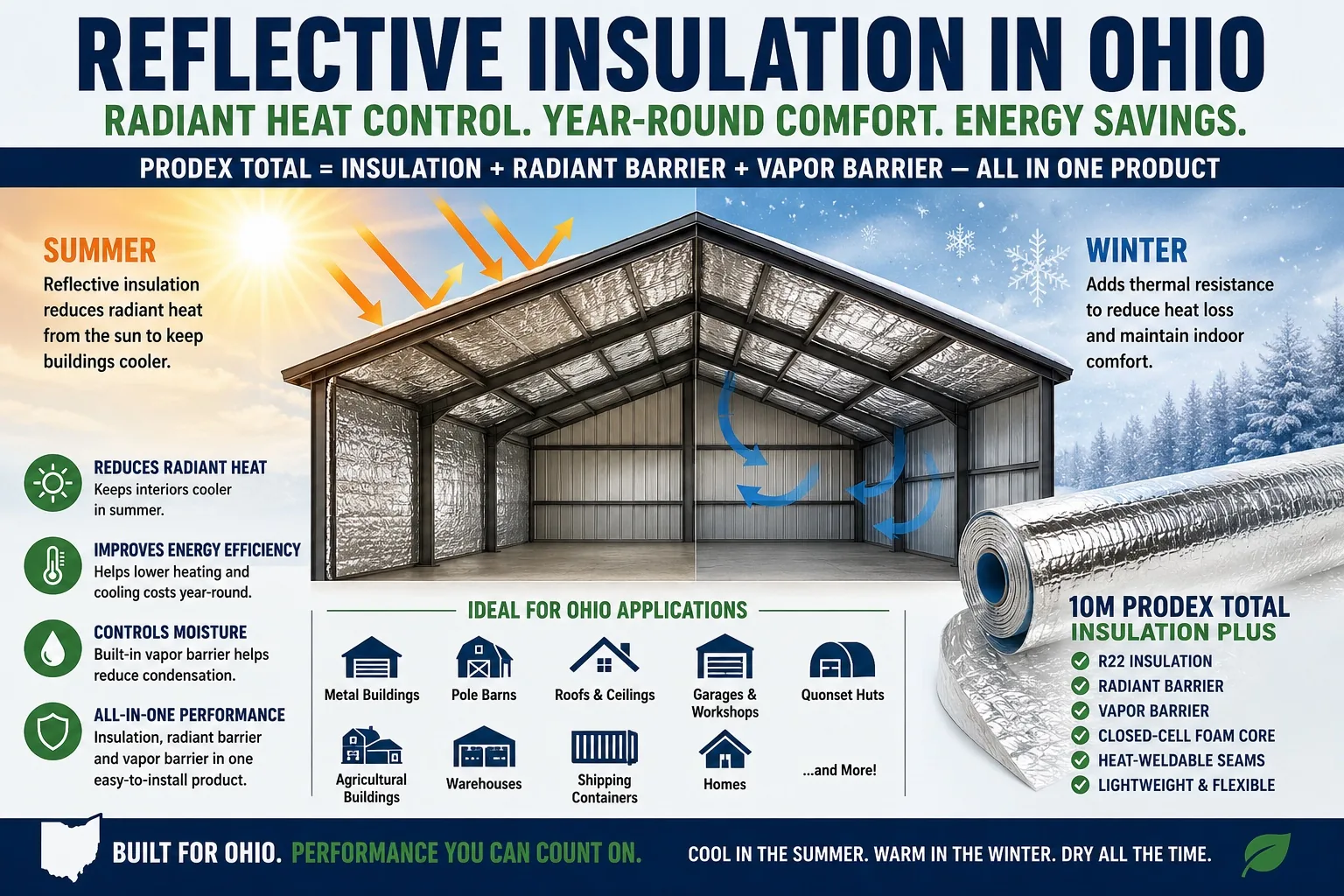
Prodex Total = Insulation + Radiant Barrier + Vapor Barrier — All in One Product.
The distinction between reflective insulation and conventional insulation becomes particularly important in buildings with large roofs or metal exterior surfaces.
Understanding the Three Ways Heat Moves
To understand reflective insulation, it helps to understand how heat moves through a building.
Conduction
Conduction is heat moving through a material. If the exterior surface of a metal roof becomes hot, heat can conduct through the steel. Conventional mass insulation such as fiberglass is primarily designed to resist this type of heat transfer.
Convection
Convection is heat carried by moving air. Air leaking through gaps, seams and penetrations can carry heat into or out of a building. This is why air sealing can be an important part of an effective insulation system.
Radiation
Radiant heat is different. Radiant energy travels from a warmer surface toward a cooler surface. Consider a metal roof exposed to Ohio summer sunshine.
Solar energy heats the roof. The hot roofing can then radiate energy toward cooler surfaces beneath it. Reflective insulation is specifically designed to reduce this form of heat transfer. Our national Reflective Insulation Guide explains these heat-transfer mechanisms and how reflective insulation works within a complete building assembly.
Why an Air Space Matters With Reflective Insulation
One of the most important concepts to understand about reflective insulation is the relationship between the reflective surface and an adjacent air space. A reflective surface needs to face an appropriate air space to provide its radiant-barrier benefit. This is different from conventional mass insulation, which is generally designed to fill a cavity. For example, reflective insulation installed beneath metal roofing can face an air space between the insulation and roof surface. The reflective surface can then reduce radiant heat transfer across that space. Installation design therefore matters. Reflective insulation shouldn't simply be evaluated according to its thickness. The complete assembly—including air spaces, seams, framing and installation method—affects performance.
Why Reflective Insulation Makes Sense in Ohio
Ohio isn't a year-round hot climate, but that doesn't make radiant heat irrelevant. Ohio buildings need to perform during both summer and winter.
Summer
Sunlight can substantially heat roofs and metal exterior surfaces. Reflective insulation can help reduce radiant heat moving toward the building interior. This can be particularly valuable in buildings with large sun-exposed roofs.
Winter
During winter, the insulation system needs to help reduce heat loss and maintain interior comfort. Prodex Total combines reflective surfaces with a closed-cell insulation core, allowing the system to address more than summer radiant heat.
Spring and Fall
Large temperature swings can create additional challenges, particularly in metal buildings. A steel roof may warm substantially during the day and cool rapidly as outdoor temperatures fall. Those changing surface temperatures can contribute to condensation when moisture-containing air reaches cold metal. This is why an Ohio insulation system should be selected for year-round performance, rather than summer heat alone.
Reflective Insulation and R-Value
R-value is important, but it doesn't describe every function of an insulation system. R-value measures resistance to heat flow through an insulation assembly under specified conditions.
It doesn't independently tell you whether an insulation system:
Reflects radiant heat
Provides a vapor barrier
Controls air movement
Resists moisture
Helps manage condensation
Requires substantial cavity depth
This becomes important when comparing reflective insulation with conventional insulation. A thick fiberglass batt and a reflective insulation system don't manage heat in exactly the same way. That doesn't make R-value unimportant. It means R-value should be considered as part of the complete insulation system rather than the only performance characteristic. For a deeper explanation of reflective insulation R-values, testing, air spaces and comparisons with conventional insulation, see our national Reflective Insulation Guide.
Reflective Insulation vs. Radiant Barrier
The terms reflective insulation and radiant barrier are sometimes used as though they mean exactly the same thing. They don't necessarily. A basic radiant barrier may consist primarily of a reflective surface designed to reduce radiant heat transfer. Reflective insulation can combine that reflective surface with an insulating core that also provides thermal resistance.
Prodex Total combines:
Reflective surfaces
Closed-cell foam insulation
Radiant-barrier performance
Vapor-barrier performance
Air-barrier performance when properly installed and sealed
That allows the material to address several aspects of building-envelope performance with one product.
Reflective Insulation vs. Fiberglass in Ohio
Fiberglass and reflective insulation work differently, and both can have appropriate applications. Fiberglass is conventional mass insulation. It can provide substantial thermal resistance when sufficient thickness and cavity depth are available. Reflective insulation provides a different set of advantages, particularly where radiant heat, moisture, condensation or limited installation space are concerns.
Fiberglass May Make Sense When:
Deep framing cavities are available.
High conventional cavity R-values are required.
The building assembly is designed for fiberglass.
Radiant heat isn't the primary concern.
Separate vapor and air-control components can be incorporated where required.
Reflective Insulation May Make Sense When:
Radiant heat is significant.
You're insulating beneath a metal roof.
Condensation is a concern.
Vapor control is important.
Interior space is limited.
You want multiple insulation functions in one product.
For a detailed state-specific comparison, see Fiberglass Insulation vs. Prodex Total in Ohio. For a more comprehensive national comparison of reflective insulation with fiberglass and other insulation systems, continue to our Reflective Insulation Guide.
Reflective Insulation for Ohio Metal Buildings
Metal buildings are among the applications where reflective insulation can be particularly valuable. Steel transfers heat quickly. During summer, a sun-exposed metal roof can become extremely hot and radiate heat toward the interior. During winter, steel panels can become extremely cold. That creates another problem: condensation. When warm, moisture-containing interior air reaches cold metal, water can form on the steel surface. An effective insulation system for a metal building therefore needs to consider more than conventional R-value.
Important considerations include:
Radiant heat
Conductive heat transfer
Air movement
Vapor movement
Condensation
Moisture
Interior comfort
Prodex Total combines reflective insulation with thermal insulation and vapor-barrier protection, making it particularly useful for these conditions. For Ohio steel-building applications, see Metal Building Insulation in Ohio. For the complete national resource on insulation for metal buildings, including insulation selection, condensation, heat, cold and air control, see our metal-building guide.
Why Reflective Insulation Is Particularly Useful Under a Roof
The roof is one of the most important parts of a building to insulate correctly. It receives direct solar exposure. During summer, roofing materials absorb solar energy and can radiate heat toward the interior. During winter, the roof becomes an important pathway for heat loss. With metal roofing, condensation becomes another important consideration because metal changes temperature rapidly. Reflective insulation can be particularly useful beneath a roof because it can address radiant heat while also providing thermal insulation when the reflective material includes an insulating core.
For Ohio-specific roof applications, see Roof & Ceiling Insulation in Ohio. For the national resource covering house roofs, metal roofs, insulation comparisons and condensation control, see our Roof Insulation Guide.
Reflective Insulation and Condensation Control
Condensation is particularly important in metal structures. It occurs when moisture-containing air contacts a surface cold enough for water vapor to condense. This often happens beneath metal roofing. During cold weather, the steel roof may become significantly colder than the interior air. If warm, humid interior air reaches that steel, moisture can form. Insulation helps by changing the thermal relationship between the interior environment and the cold metal surface. Vapor control is also important because reducing moisture movement toward cold steel helps reduce the conditions that produce condensation. This is one reason Prodex Total's combination of insulation and vapor-barrier performance can be useful in metal buildings.
Reflective Insulation for New Construction
New construction can be an excellent time to install reflective insulation because the insulation system can be incorporated into the building envelope before the roof and wall assemblies are completed.
Depending on the building design, this can make it easier to create:
Continuous insulation
Appropriate air spaces
Properly sealed seams
Vapor control
Reduced thermal bridging
Continuous coverage across framing
Reflective insulation is commonly used in new metal buildings, pole barns, garages, workshops, agricultural buildings and other structures. The specific installation method should always match the building design and the insulation manufacturer's instructions.
Can Reflective Insulation Be Added to an Existing Building?
Yes. Reflective insulation can also be used in many retrofit applications. This is particularly valuable for owners of existing metal buildings who want to improve comfort or address condensation without removing the exterior roofing and wall panels. Depending on the building, reflective roll insulation can be installed over or between existing framing from the interior. Retrofit applications commonly include existing metal buildings, garages, workshops, barns, storage buildings, warehouses, shipping containers and Quonset huts. Installation details matter, particularly when maintaining an air space or creating a continuous vapor-control layer.
Is Reflective Insulation Only for Metal Buildings?
No.
Metal structures are a major application because of their radiant-heat and condensation challenges, but reflective insulation can be used in many other building types.
Applications may include:
Houses
Roofs and ceilings
Attics
Walls
Crawlspaces
Garages
Workshops
Pole barns
Agricultural buildings
Commercial buildings
Warehouses
Quonset huts
Shipping containers
Tiny homes
RVs and vans
The appropriate installation method depends on the assembly. The important point is that reflective insulation should be selected according to how the building is constructed and how heat, air and moisture move through that particular assembly.
Reflective Insulation for Metal Roofs in Ohio
Metal roofs deserve special attention because they combine several conditions that favor reflective insulation. They can become extremely hot in sunlight. They can become extremely cold during winter. They transfer heat quickly. And they can develop condensation when warm, humid interior air contacts the cooler underside of the roof.
A properly designed metal-roof insulation system should therefore consider:
Thermal resistance
Radiant heat
Air movement
Vapor control
Condensation
Reflective insulation with a closed-cell thermal core can address several of these issues simultaneously. Our Roof & Ceiling Insulation in Ohio guide examines these issues for Ohio roofs. For a deeper national resource, see the Roof Insulation Guide.
Reflective Insulation for Pole Barns and Agricultural Buildings
Pole barns and agricultural structures frequently have large metal roofs. This can make radiant heat substantial during summer. These buildings may also contain sources of interior moisture, including livestock, wet equipment, soil, concrete and stored agricultural materials. Reflective insulation can help address radiant heat while a properly designed insulation and vapor-control system can help manage condensation. The same principles that apply to other steel structures generally apply here: don't evaluate the insulation based on R-value alone.
Consider heat, moisture, vapor movement, condensation and building use together. For the complete national resource, see our Pole Barn Insulation Guide.
Reflective Insulation for Garages and Workshops
Garages and workshops can also benefit from reflective insulation, particularly when they have metal roofs or metal walls. During summer, radiant heat can make these spaces uncomfortable. During winter, insulation helps retain heat when the building is heated. Vehicles may also bring rain or snow indoors, adding moisture to the building. An insulation system that combines thermal insulation, radiant-barrier performance and vapor control can therefore be useful. For steel garages and shops, see our national Metal Garage Insulation Guide.
Reflective Insulation for Quonset Huts
Quonset huts are another strong application for reflective insulation. Their curved steel shells create an unusually large sun-exposed metal surface. The same steel shell can also become cold enough during winter to create condensation problems. Flexible reflective roll insulation can follow the curved interior profile while helping address radiant heat, thermal transfer and vapor control.
For detailed product selection and installation instructions, see our national Quonset Hut Insulation & Installation Guide.
Reflective Insulation for Shipping Containers
Shipping containers create similar challenges. The steel shell can become extremely hot in sunlight and cold when outdoor temperatures fall. Because containers have limited interior dimensions, insulation thickness also matters. Reflective insulation with a closed-cell core can provide thermal, radiant and vapor-control functions without consuming the interior space associated with very thick insulation systems.
For more information, see our national Shipping Container Insulation Guide.
Reflective Insulation vs. Bubble Insulation
Reflective insulation and bubble insulation are sometimes treated as though they're interchangeable. They aren't. Bubble insulation generally consists of polyethylene air bubbles laminated between reflective surfaces. Prodex Total uses a closed-cell polyethylene foam core between reinforced reflective foil facings. The reflective surfaces may look similar, but the core construction is fundamentally different.
When comparing products, look beyond the shiny exterior and evaluate:
Core material
Thickness
Thermal performance
Strength
Vapor performance
Durability
Installation requirements
Intended application
The national Reflective Insulation Guide provides a broader comparison of reflective insulation, bubble insulation and other insulation technologies.
How to Choose Reflective Insulation for an Ohio Building
Start with the building rather than the insulation product.
Ask:
What Type of Building Is It?
A house, metal building, pole barn and shipping container have very different insulation assemblies.
Where Is the Insulation Going?
Roof, ceiling, wall and floor applications can require different installation methods.
Is Radiant Heat a Major Concern?
This is particularly important beneath sun-exposed roofing and metal surfaces.
Is Condensation a Concern?
Metal buildings, metal roofs and other steel structures require particular attention to condensation.
Is Interior Space Limited?
Thin insulation systems may be particularly valuable in shipping containers, vans, tiny homes and some retrofit projects.
Is the Building New or Existing?
New construction and retrofit projects often require different installation methods.
What Does the Complete Assembly Require?
R-value, radiant performance, vapor control, air movement and moisture management should be considered together.
Recommended Reflective Insulation: 10M Prodex Total Insulation Plus
For many Ohio applications, our primary reflective-insulation recommendation is 10M Prodex Total Insulation Plus. 10M Prodex Total is a flexible roll insulation, not a rigid insulation board.
It features:
10 mm (0.4-inch) closed-cell polyethylene foam
Reinforced reflective foil surfaces
R22 performance
Radiant-barrier protection
Vapor-barrier protection
Condensation control
Moisture resistance
Heat-weldable seams
Lightweight roll construction
Each roll is approximately 4 feet wide by 85.3 feet long, covering approximately 341 square feet.
Shop 10M Prodex Total Insulation Plus
Prodex Total = Insulation + Radiant Barrier + Vapor Barrier — All in One Product.
Cool in the Summer. Warm in the Winter. Dry all the Time.
Other Prodex Total Reflective Insulation Options
Not every project requires the same roll width, thickness or finish. Prodex Total is available in several configurations for different applications, including 5M products and multiple roll widths.
The appropriate product depends on:
Building dimensions
Framing spacing
Installation method
Desired performance
Interior appearance
New construction vs. retrofit
You can compare available products on our Reflective Insulation for Sale page.
Frequently Asked Questions About Reflective Insulation in Ohio
Does Reflective Insulation Really Work?
Yes. Reflective insulation is designed to reduce radiant heat transfer. Its performance depends on the complete assembly and proper installation, including an appropriate air space where required. For the detailed science and performance information, see our Reflective Insulation Guide.
Does Reflective Insulation Need an Air Gap?
A reflective surface needs to face an appropriate air space to provide its radiant-barrier benefit. The exact assembly depends on the application and installation method.
Is Reflective Insulation Good for Ohio Winters?
Reflective insulation shouldn't be evaluated only as a summer product. Products such as Prodex Total combine reflective surfaces with a thermal insulation core, allowing the insulation system to contribute to year-round performance.
Is Reflective Insulation Good Under a Metal Roof?
Yes. This is one of its most important applications. Metal roofing can experience substantial radiant heat during summer while also creating condensation challenges when the roof becomes cold. See our Roof & Ceiling Insulation in Ohio guide for Ohio-specific roof applications.
Is Reflective Insulation Better Than Fiberglass?
Neither is universally better for every application. Fiberglass can provide substantial conventional thermal resistance in deep framing cavities. Reflective insulation provides radiant-heat control and can combine additional functions such as thermal insulation and vapor control. See Fiberglass Insulation vs. Prodex Total in Ohio for a detailed comparison.
Can Reflective Insulation Help With Condensation?
A properly designed insulation system can help control condensation by reducing temperature differences and limiting moisture movement toward cold surfaces. This is particularly important in metal buildings and beneath metal roofs.
Can Reflective Insulation Be Installed in an Existing Metal Building?
Yes. Many existing metal buildings can be insulated from the interior using reflective roll insulation. The exact installation method depends on the framing and existing construction. For installation guidance, see How to Insulate a Metal Building.
Reflective Insulation in Ohio: The Bottom Line
Ohio buildings need insulation capable of performing through hot summer days, cold winters and substantial seasonal temperature changes. Reflective insulation provides an important advantage by addressing radiant heat, something conventional mass insulation doesn't directly address. Prodex Total takes the concept further by combining reflective surfaces with closed-cell thermal insulation and vapor-barrier protection. That makes it particularly useful for Ohio metal buildings, roofs, garages, workshops, agricultural buildings and other applications where heat, cold, moisture and condensation all need to be considered. Don't select insulation based on one number alone.
Consider:
Thermal Insulation + Radiant Heat + Air + Vapor + Moisture + Condensation
For the definitive national resource covering how reflective insulation works, R-value, air spaces, installation considerations, insulation comparisons and product selection, continue to our Reflective Insulation Guide.