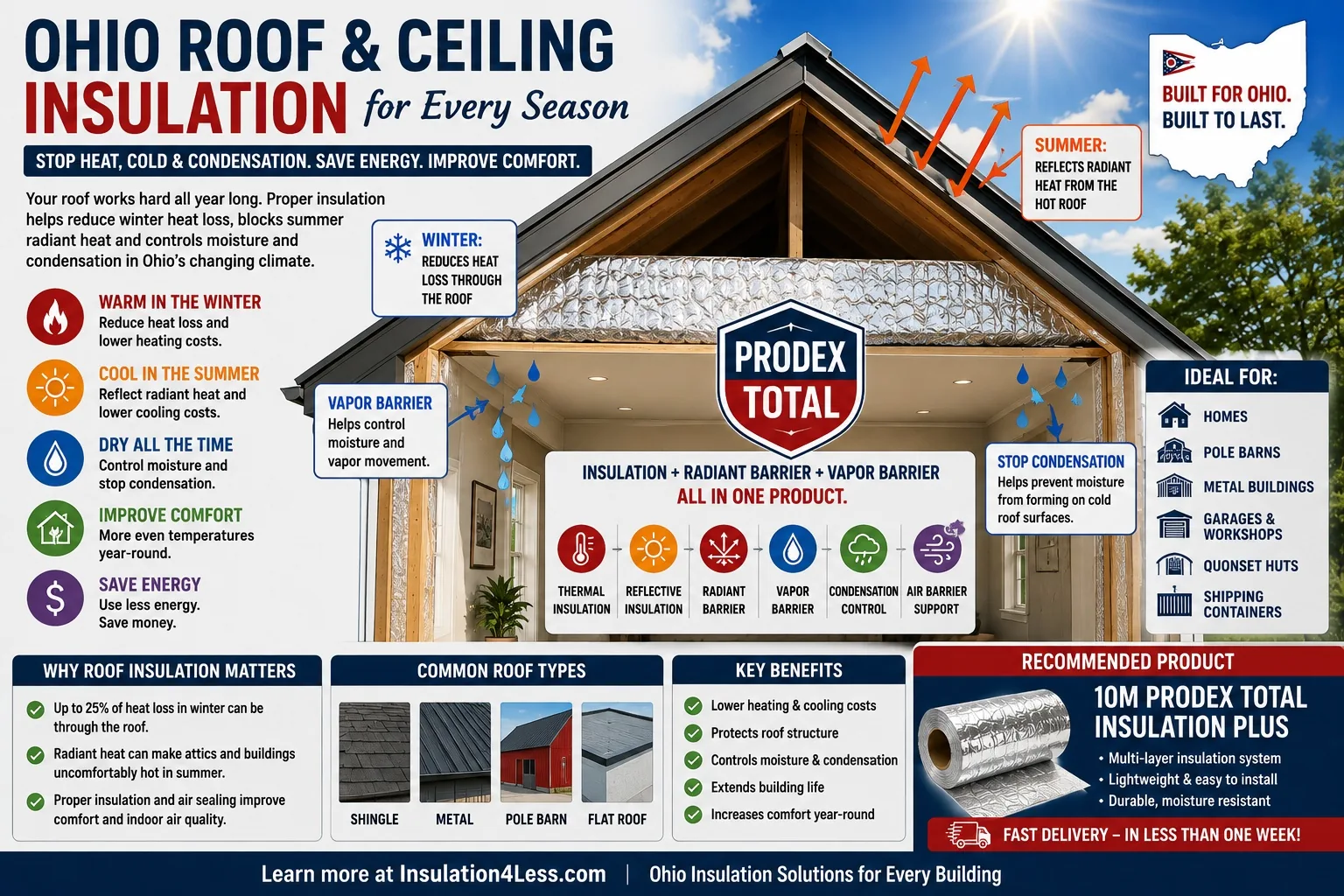
Ohio Roof & Ceiling Insulation for Heat, Cold, Moisture & Energy Savings
The roof is one of the hardest-working parts of an Ohio building. During winter, it separates warm interior conditions from cold outdoor temperatures. During summer, it receives direct solar radiation for hours at a time. And when warm, moisture-containing air reaches a sufficiently cold roof surface, condensation can become another problem entirely.
That's why roof insulation in Ohio needs to do more than address winter cold.
A good roof and ceiling insulation strategy should consider:
- Winter heat loss
- Summer heat gain
- Radiant heat
- Air movement
- Vapor movement
- Moisture
- Condensation
- Energy efficiency
- Year-round comfort
Most Ohio counties are in Climate Zone 5A, classified as cold and moist, while several southern counties are in Climate Zone 4A, classified as mixed-humid.That makes both thermal performance and moisture control important when designing Ohio roof assemblies. For a complete national overview covering different roof types, insulation materials, costs, condensation and installation considerations, start with our Roof Insulation Guide. This Ohio guide focuses specifically on the challenges roofs and ceilings face throughout Ohio's changing seasons.
Cool in the Summer. Warm in the Winter. Dry all the Time.
Prodex Total = Insulation + Radiant Barrier + Vapor Barrier — All in One Product.
Why the Roof Is So Important to Insulate
Every exterior part of a building transfers heat. The roof, however, has some additional challenges. During summer, it receives more direct solar exposure than most walls. During winter, warm interior air rises toward the upper portion of the building, while the roof itself is exposed to cold outdoor temperatures. Moisture-containing air can also move toward roof and ceiling assemblies.
That means the roof sits at the intersection of:
Heat + Cold + Radiant Energy + Air + Moisture
The U.S. Department of Energy describes the building envelope as including the roof, walls, floors, foundation, windows and doors and notes that heat can be lost or gained through all of these components. But because of its exposure to solar radiation and its position above the conditioned space, the roof deserves particular attention.
Ohio Roof Insulation During Winter
Winter creates a straightforward thermal problem. The inside of a heated building is warmer than the outdoors. Heat naturally moves toward colder areas. Without adequate roof and ceiling insulation, some of that valuable interior heat can move through the upper building envelope.
The consequences can include:
- Higher heating demand
- Cold ceilings
- Uneven interior temperatures
- Greater temperature differences across the roof assembly
- Increased potential for condensation in susceptible assemblies
A properly designed insulation system slows that unwanted heat flow. But thermal insulation isn't the only consideration. Air leakage can carry both heat and moisture into roof assemblies, which is why air sealing and insulation should be considered together. DOE specifically identifies insulation and air sealing as complementary measures for improving a home's thermal envelope.
Ohio Roof Insulation During Summer
Summer reverses the direction of unwanted heat flow. Now you're trying to keep heat out. And the roof receives the greatest punishment. Solar radiation strikes the roofing material and heats it. The hot roof can then transfer heat inward through conduction and radiation. This is where reflective insulation becomes particularly valuable. A reflective surface facing an appropriate air space can reduce radiant heat transfer from the hot roof toward the interior. Prodex Total combines this radiant-heat function with thermal insulation.
Instead of addressing only one type of heat transfer, it helps address both: Conductive Heat + Radiant Heat
For a deeper explanation of radiant barriers, air spaces and reflective insulation, see our national Reflective Insulation Guide. Our Reflective Insulation in Ohio guide also examines these principles specifically for Ohio buildings.
How Radiant Heat Moves Through a Roof
Radiant heat is important because it behaves differently from conductive heat. Imagine an Ohio metal roof on a sunny summer afternoon. The sun heats the roofing. The roofing temperature rises. That hot surface then radiates energy toward cooler surfaces below. You may have experienced the result inside an uninsulated metal building, attic, garage or barn—the air may be hot, but standing beneath the roof can feel even hotter. Traditional insulation primarily resists conductive heat flow. Reflective insulation adds another mechanism. When a low-emittance reflective surface faces an appropriate air space, it reduces radiant heat transfer across that space. That's one reason Prodex Total is particularly well suited to roof applications.
Thermal Insulation + Radiant Barrier
Choosing roof insulation doesn't have to mean choosing between thermal insulation and radiant heat control. Prodex Total combines both.
It provides:
Thermal Insulation
Helps resist unwanted heat transfer through the roof assembly.
Reflective Insulation
Helps reduce radiant energy moving across an adjacent air space.
Radiant Barrier
Particularly useful beneath roofs exposed to strong solar radiation.
Vapor Barrier
Helps control water-vapor movement through the assembly.
Condensation Control
Helps address conditions that can produce condensation on cold roof surfaces.
Air Control
When properly installed and sealed at seams, edges and penetrations, the system can contribute to reducing unwanted air movement. That's why we describe Prodex Total as:
Insulation + Radiant Barrier + Vapor Barrier — All in One Product.
Roof Condensation in Ohio
Condensation can occur when moisture-containing air reaches a surface below its dew point. In an Ohio winter, the underside of a roof can become very cold. If warmer interior air reaches that surface, water vapor can condense into liquid.
This can be especially visible beneath:
- Metal roofing
- Pole barn roofs
- Steel-building roofs
- Garage roofs
- Workshop roofs
- Quonset hut shells
- Shipping container roofs
But moisture management matters in residential roof assemblies as well. Ohio's building provisions specifically recognize condensation control as an important consideration in roof assemblies. For example, provisions for unvented roof assemblies specify minimum air-impermeable insulation levels for condensation control that vary by climate zone. The lesson isn't that every roof should be built the same way. It's that roof insulation and moisture control must be designed together.
Roof Insulation for Ohio Homes
Residential roofs have to balance thermal performance, moisture control, ventilation strategy and code requirements.
Depending on the house, the thermal boundary may be located:
- At the attic floor/ceiling
- Along the roof deck
- Within a cathedral ceiling
- Within another engineered roof assembly
The correct insulation method depends on the construction. For Ohio homeowners, our House Insulation in Ohio guide explains how roofs and ceilings fit into the complete residential building envelope. Our national house insulation guide provides additional information about controlling cold, moisture, air and heat throughout the home.
Don't Assume Every Attic Is the Same
A vented attic and an unvented conditioned attic aren't interchangeable assemblies.
Before changing insulation, determine:
- Where the thermal boundary is located
- Where the air barrier is located
- Whether the attic is vented
- Whether HVAC equipment is located in the attic
- Whether moisture problems already exist
- Whether roof leaks are present
- What local code requires
DOE provides climate-specific roof assemblies intended to address both thermal efficiency and condensation control.
Ohio Ceiling Insulation
Ceiling insulation is particularly important when the ceiling plane separates conditioned living space from an unconditioned attic. In that situation, the ceiling becomes a major part of the thermal envelope. Current DOE guidance based on the 2021 IECC shows R-60 for ceilings below uninsulated attics in Climate Zones 4 and 5. However, that doesn't mean every Ohio ceiling project automatically requires the same insulation product or assembly. Existing buildings, renovations and alternative compliance methods may differ, and applicable Ohio or local codes should always be checked for the specific project. The important point is that ceiling insulation represents a major part of thermal-envelope performance in Ohio's climate.
Ohio Attic Insulation
The attic often provides one of the most accessible opportunities to improve an existing home's thermal envelope. Before simply adding more insulation, however, inspect the attic.
Look for:
- Roof leaks
- Water stains
- Wet insulation
- Air leaks
- Unsealed penetrations
- Bathroom exhaust ducts
- Kitchen exhaust ducts
- Attic hatches
- Recessed fixtures
- Plumbing penetrations
- Electrical penetrations
- Ductwork
Adding insulation over unresolved moisture or air-leakage problems doesn't fix the underlying issue. The goal should be to create a continuous thermal and air-control layer appropriate for the particular attic design.
Roof Insulation and Ice Dams
Ohio's colder areas can experience another roof-related winter problem: ice dams. Ice dams can develop when heat escaping toward the roof melts snow. Meltwater moves toward colder roof edges and refreezes. Repeated melting and freezing can allow water to back up beneath roofing materials. DOE's cold-climate guidance notes that good ceiling-plane or roof-deck air sealing, adequate attic insulation and appropriate ventilation can help reduce heat transfer to the roof deck and mitigate ice-dam formation. This illustrates another reason roof insulation should be considered as part of an overall roof system rather than as an isolated material.
Metal Roof Insulation in Ohio
Metal roofing creates some of the strongest arguments for combining thermal and reflective insulation. During summer, metal roofing absorbs solar radiation and can become extremely hot. During winter, it can become an extremely cold condensation surface. Prodex Total addresses both conditions. Its reflective surfaces help control radiant heat. Its thermal properties help resist heat transfer. Its vapor-barrier properties help manage moisture movement. That's why Prodex Total is frequently used as insulation for metal buildings, particularly beneath metal roofing.
For Ohio-specific steel-building applications, see Metal Building Insulation in Ohio.
Pole Barn Roof Insulation in Ohio
The roof is arguably the most critical insulation area in a pole barn. During summer, it receives direct solar radiation. During winter, the underside can become a condensation surface. Warm air and moisture also rise toward it. That's why pole barn roof insulation needs to address radiant heat, thermal transfer and condensation together. Our national pole barn insulation guide explains how to manage heat, cold, condensation and air throughout post-frame buildings. For state-specific information, see Pole Barn Insulation in Ohio.
Steel Building & Metal Barn Roof Insulation
Steel shops, agricultural buildings, warehouses and metal barns share many of the same roof-insulation problems. The metal skin conducts heat readily and responds quickly to outdoor temperature changes. A reflective insulation system beneath the roofing can be particularly valuable because it addresses the radiant energy coming from the hot roof during summer. For a complete national resource on steel building insulation, see our metal-building guide. If you're insulating an agricultural structure, our national metal barn insulation resource covers the same fundamental heat, cold and condensation challenges.
Metal Garage & Workshop Roof Insulation
Garages and workshops often have large roof areas relative to the occupied space beneath them. That makes roof performance especially noticeable. A poorly insulated metal workshop can become extremely hot during summer. During winter, heating the building may be difficult because heat continually moves through the envelope. Then there's condensation. Vehicles can introduce rain and snow into the building. People and heaters can add moisture. That moisture may eventually encounter cold roofing. Our national metal garage insulation guide provides additional information about insulating these steel structures.
Quonset Hut Roof Insulation
A Quonset hut presents a particularly interesting roof-insulation problem because the curved shell serves as both the walls and roof. There isn't a conventional transition where the vertical wall ends and the roof begins. Much of the structure is exposed metal. The upper portion receives substantial solar radiation and can become a major source of radiant heat. During winter, that same steel shell can become a large condensation surface. Our complete national Quonset Hut Insulation & Installation Guide explains both insulation selection and installation.
Shipping Container Roof Insulation
A shipping container is another structure where roof insulation deserves priority. The steel roof receives direct sunlight and can transfer substantial heat toward the interior. During cold weather, the roof can become cold enough to contribute to condensation. Because shipping containers have relatively little interior space, insulation thickness can also be an important consideration. Our national Shipping Container Insulation Guide explains how insulation, radiant barriers and vapor control work together in containers.
New Roof Construction vs. Existing Roofs
The best insulation method can depend on whether the roof is being constructed now or already exists.
New Construction
New construction provides the opportunity to coordinate insulation with the roof framing and roofing installation.
That makes it easier to plan:
- Air spaces
- Continuous insulation
- Sealed seams
- Vapor control
- Roof penetrations
- Thermal bridging
- Roof-to-wall transitions
For reflective insulation, maintaining the appropriate air space is particularly important.
Existing Roofs
Retrofit projects require working with the existing framing and roofing.
Before installing insulation, inspect for:
- Roof leaks
- Corrosion
- Wet materials
- Existing insulation
- Condensation
- Structural problems
Repair bulk-water leaks first. Insulation can help manage heat and condensation, but it shouldn't be expected to stop rain entering through a damaged roof.
Prodex Total vs. Fiberglass for Roof Insulation
Fiberglass is widely used in roof and ceiling assemblies. Prodex Total approaches the problem differently.
| Feature | Prodex Total | Fiberglass |
|---|---|---|
| Thermal insulation | Yes | Yes |
| Reflective insulation | Yes | No |
| Radiant heat control | Yes | Requires separate radiant component |
| Built-in vapor barrier | Yes | Depends on facing/assembly |
| Air barrier contribution | When properly sealed | Not inherently |
| Condensation control | Part of system approach | Assembly-dependent |
| Moisture absorption | Closed-cell, non-absorbent core | Must be protected from moisture |
| Thickness | Thin profile | Generally thicker |
| Weight | Lightweight | Bulkier at higher R-values |
| Metal roof application | Particularly well suited | Commonly used |
| Products/functions | Multiple functions in one product | Often assembly-dependent |
Fiberglass can still be the preferred material for some projects, especially where substantial conventional cavity insulation is required. Insulation4Less sells fiberglass insulation for metal buildings for those applications.
Reflective Roof Insulation vs. Radiant Barrier
The terms reflective insulation and radiant barrier are sometimes used interchangeably, but they aren't exactly the same. A radiant barrier primarily addresses radiant heat transfer. Reflective insulation combines reflective surfaces with an insulating core or other thermal component. Prodex Total is reflective insulation. That means it provides thermal resistance while its reflective surfaces can also reduce radiant heat transfer when installed with the appropriate air space.
This combination is particularly useful for roofs because roofs experience both:
Temperature-driven heat transfer + Solar radiant heat
For a complete explanation, see our Reflective Insulation Guide.
How Much Roof Insulation Do You Need?
Don't calculate roof insulation using floor area alone. A building measuring 40 × 60 feet has 2,400 square feet of floor area. But a pitched roof has more surface area than the building footprint. The steeper the roof, the greater the difference.
To calculate insulation requirements accurately, consider:
- Building length
- Building width
- Roof pitch
- Roof configuration
- Overlaps
- Seams
- Trimming
- Installation waste
For wall-and-roof projects, wall height also matters. Use the insulation calculator on Insulation4Less.com and enter your length, width, wall height and roof pitch to estimate material requirements.
Recommended Roof Insulation: 10M Prodex Total Insulation Plus
For many appropriate Ohio roof applications, our primary recommendation is 10M Prodex Total Insulation Plus.
Its combination of functions makes it particularly attractive for roof assemblies:
- Thermal insulation
- Reflective insulation
- Radiant barrier
- Vapor barrier
- Condensation control
- Moisture resistance
- Lightweight handling
- Thin profile
For metal roofs in particular, the ability to address radiant heat and condensation in addition to thermal transfer is a major advantage.
Prodex Total = Insulation + Radiant Barrier + Vapor Barrier — All in One Product.
Orders are typically delivered in less than one week.
Shop 10M Prodex Total Insulation Plus
Insulate the Roof — Protect the Entire Building
Whether you're insulating an Ohio home, metal building, pole barn, garage, workshop, Quonset hut or shipping container, the roof deserves special attention. It receives direct solar radiation in summer. It separates interior heat from winter cold. It can become a condensation surface. And it represents a substantial portion of the building envelope. That's why roof insulation should address more than one form of heat transfer.
Prodex Total combines:
Thermal Insulation + Reflective Insulation + Radiant Barrier + Vapor Barrier + Condensation Control
For the complete national resource, visit our roof insulation guide.
Cool in the Summer. Warm in the Winter. Dry all the Time.
One Solution to heat, cold and Condensation - Prodex Total.