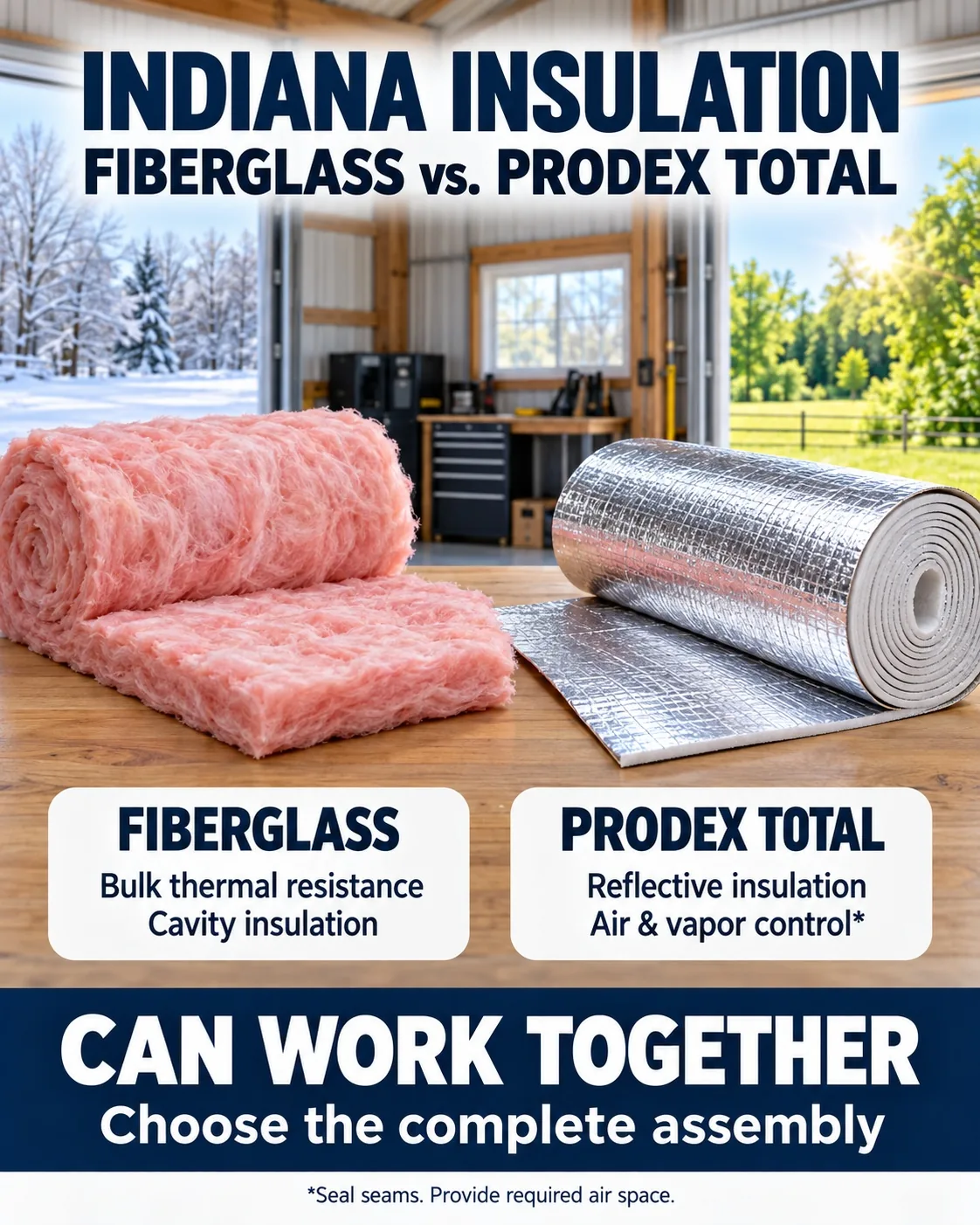
Fiberglass vs. Prodex Total for Indiana Buildings: Heat, Cold & Condensation
Choosing between fiberglass and Prodex Total starts with the building and the problems you need to solve. A heated Indianapolis workshop, a South Bend pole barn and an Evansville house have different assemblies, moisture sources and insulation requirements.
Fiberglass provides conductive thermal resistance through a layer of fibers and trapped air. Prodex Total combines a closed-cell polyethylene foam core with reflective surfaces and can provide insulation, radiant heat control and air and vapor control when properly installed. These functions can complement one another.
For Indiana buildings, the most useful comparison considers winter heat loss, summer roof heat, condensation, installation access and the complete assembly. Start with the Indiana Insulation Guide for an overview of the state’s building applications.
What Indiana Buildings Need From Insulation
Indiana has heating and cooling seasons. Central and northern areas, including Indianapolis, Fort Wayne and South Bend, are in climate zone 5A. Parts of southern Indiana, including Bloomington and Evansville, are in 4A.
In winter, insulation helps limit heat leaving a conditioned building. Air leakage also matters: openings around doors, framing and penetrations can carry warm, moist indoor air toward cold surfaces.
In summer, sunlight heats roofs and exterior walls. Reflective surfaces can reduce radiant heat transfer when they face a suitable adjacent air space. Humidity adds another consideration, especially in garages with wet vehicles, agricultural buildings and intermittently heated shops.
A complete insulation system should address the conditions present in that building. Thermal resistance, air sealing, vapor control and ventilation each have a role.
Fiberglass and Prodex Total: A Practical Comparison
| Consideration | Fiberglass | Prodex Total |
|---|---|---|
| Material | Glass fibers formed into batts, blankets or loose fill | Closed-cell polyethylene foam core with reflective faces |
| Conductive thermal resistance | Depends on product thickness, density and installation | Depends on the product and tested assembly |
| Radiant heat control | Fiberglass itself is not a radiant barrier | Reflective faces reduce radiant transfer when installed with the required adjacent air space |
| Air control | Fiberglass itself is not a complete air barrier | A continuous layer can provide air control when seams, edges and penetrations are properly sealed |
| Vapor control | Depends on the facing and assembly | Nonperforated products provide vapor resistance; placement must suit the assembly |
| Installation | Requires suitable support, coverage and maintained thickness | Requires secure attachment, continuous seams and appropriate air-space details |
| Combining materials | Can provide cavity insulation in a combined system | Can add a continuous reflective and control layer in a combined system |
The table compares material functions. It does not establish that either product alone meets the requirements for every Indiana building.
Where Fiberglass Works Well
Fiberglass is familiar, widely available and useful where a project needs substantial thermal resistance in framed cavities, attics or a designed metal-building insulation system.
In an Indiana house, fiberglass may fit wall cavities or provide attic insulation above the ceiling. In a heated steel building, a supported fiberglass system can help achieve the specified thermal performance.
Installation quality matters. Gaps, compression and poorly supported sections can reduce performance. Air leakage around the insulation can also undermine the finished assembly, even when the material itself is correctly installed.
Fiberglass needs an appropriate strategy for air and moisture control. Depending on the application, that may include a facing, a separate control layer, sealed transitions and ventilation. Properly designed fiberglass assemblies can perform successfully; moisture problems are not inevitable simply because fiberglass is present.
For available building products, see fiberglass insulation for metal buildings and pole barns.
Where Prodex Total Adds Value
Prodex Total combines several functions in a thin, flexible roll:
Prodex Total = Insulation + Radiant Barrier + Vapor Barrier — All in One Product.
Its reflective surfaces can reduce radiant heat transfer when they face the required air space. The foam core provides thermal resistance, while a continuous, properly sealed nonperforated layer can help control air and vapor movement.
These functions are particularly relevant in Indiana buildings with metal roofs and walls. A steel shell can become hot in sunlight and cold during winter nights. When moist air reaches a surface below its dew point, condensation can occur.
Prodex can help manage those conditions as part of an assembly that also addresses leaks, indoor humidity and ventilation. Product selection and installation should match the building’s use.
Compare 5M Prodex Total and 10M Prodex Total for current product information and installation details.
The adjacent air space matters
Reflective performance depends on the assembly around the product. In applicable roof and wall installations, follow the specified air-space detail—often approximately ¾ inch to 1 inch or more, depending on the method.
Pressing a reflective surface directly against another material removes the air space needed for that surface’s radiant-control function. Do not apply an advertised reflective-system R-value to a different installation.
The reflective insulation guide explains these distinctions.
Comparing the Materials by Indiana Building Type
Metal buildings and heated workshops
For a steel shop, consider both the desired indoor temperature and the metal shell. Fiberglass can provide bulk thermal resistance. A continuous Prodex layer can add radiant and moisture-control functions where the assembly is appropriately detailed.
Doors, roof-to-wall transitions, fastener locations and penetrations deserve attention. Frequent door openings and wet equipment also affect heating demand and indoor humidity.
Use the Indiana metal building insulation guide for state-specific considerations and the national insulation for steel buildings guide for a broader comparison.
Pole barns and agricultural buildings
A storage-only pole barn has different needs from a heated workshop or livestock building. Fiberglass may fit a framed and supported assembly, while flexible Prodex rolls can provide continuous coverage using the appropriate attachment method.
For buildings housing animals, ventilation and moisture removal remain essential. Insulation cannot remove the humidity generated by animals, wet bedding or washdown activities.
Read Indiana pole barn insulation alongside the national pole building insulation guide.
Houses, attics and finished rooms
An Indiana home usually needs different insulation details at the attic, walls and foundation. Fiberglass can supply attic or cavity thermal resistance, while Prodex may serve a complementary role in a suitable assembly.
Check where the thermal boundary belongs, how the assembly dries and whether the reflective layer has the required air space. Foundation walls require their own moisture details; a roof or above-grade wall method should not automatically be copied into a basement.
The Indiana house insulation guide covers these decisions in more detail.
Can Fiberglass and Prodex Total Be Used Together?
Yes. They can serve different functions within a properly designed assembly.
In an appropriate metal-building system, a Prodex layer between the exterior metal and fiberglass can help limit condensation reaching the fiberglass. The effectiveness depends on continuity, sealed seams, humidity control and the overall design.
A combined system may be useful when a heated Indiana building needs additional conductive resistance along with radiant, air and vapor control. Before installation, confirm:
- The location and support of each insulation layer.
- The air space required for reflective performance.
- How seams, edges and penetrations will be sealed.
- The vapor-control placement and drying path.
- The thermal performance required for the completed assembly.
Do not simply add two advertised R-values when they were measured under different assembly conditions. Evaluate the combination using applicable product documentation and the project design.
For application-specific comparisons, see Prodex Total versus fiberglass for metal buildings and Prodex Total versus fiberglass for pole barns.
Installation and Cost Considerations
Compare the complete installed system. Material price alone does not include every facing, tape, support, fastener, finishing layer or labor requirement.
Fiberglass needs adequate space and support to maintain its intended thickness. Prodex needs the correct attachment method, seam treatment and air-space detail. New construction often provides easier access than retrofitting around equipment, existing finishes or closely spaced framing.
Use the metal building installation guide or pole barn installation guide for the appropriate construction method.
If you are also considering spray foam, review the spray foam comparison for metal buildings and pole barns. Compare the proposed assemblies, installation access and total cost for your building.
The Advanced Insulation Calculator helps estimate quantities. Check its assumptions against your measurements and allow for overlaps, cuts and waste.
Indiana Building Requirements
Requirements depend on location, occupancy, building type and assembly. A heated commercial workshop, agricultural storage building and residence may have different requirements.
When a specific R-value or assembly is required, verify the design with the appropriate local building official, architect, engineer or other qualified professional. Product ratings and reflective assembly values should be used under the conditions specified in their documentation.
Fiberglass vs. Prodex Total in Indiana: FAQs
Which is better for an Indiana metal building?
It depends on the building’s use and required performance. Prodex offers integrated reflective and control-layer functions, while fiberglass can provide substantial bulk thermal resistance. Some projects benefit from using both.
Does fiberglass itself cause mold?
No. Mold growth depends on moisture and suitable conditions or materials within the assembly. Facings, dust and nearby building materials can be affected when moisture persists. Address the moisture source rather than assuming the insulation material alone caused the problem.
Is fiberglass always ruined if it gets wet?
No. Its condition depends on the extent and duration of wetting, contamination, physical damage and whether it can dry. Investigate the water source and assess affected materials before closing the assembly.
Does Prodex need an air space?
For reflective performance in applicable roof and wall assemblies, yes. Follow the installation method and product documentation. Under-concrete products use a separate installation approach.
Can I add Prodex over existing fiberglass?
It may be possible, but first check the existing insulation, moisture conditions, vapor-control placement and attachment method. Preserve any required reflective air space and confirm that the completed assembly has an appropriate drying path.
Related Indiana Insulation Guides
Explore the Indiana Insulation Guide, Indiana metal building insulation, Indiana pole barn insulation and Indiana house insulation.
Choose the system around the building’s actual needs: thermal resistance, radiant heat control, air leakage and moisture management. Fiberglass, Prodex Total or a coordinated combination can then be evaluated against that plan.