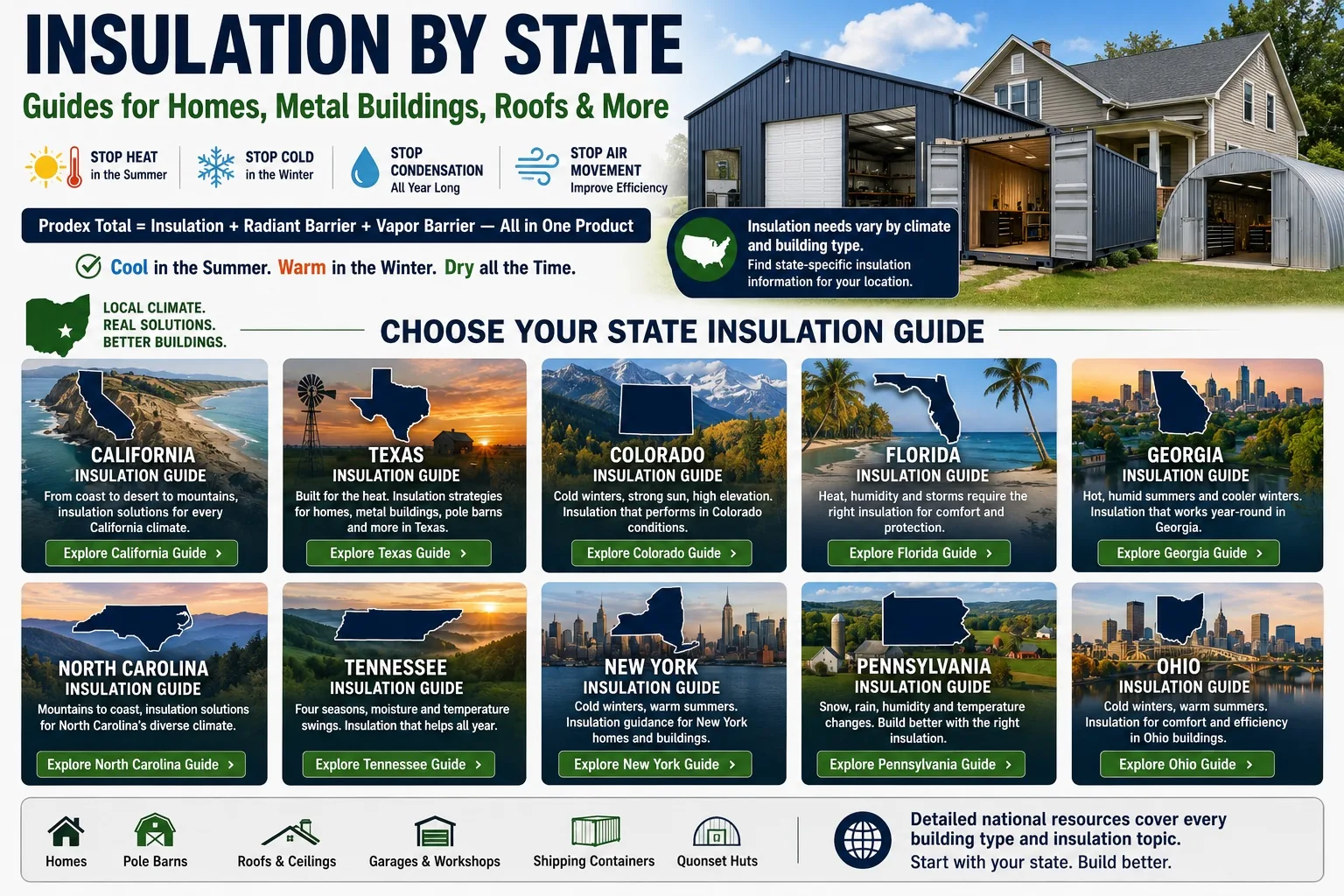
Insulation by State: Guides for Homes, Metal Buildings, Roofs & More
Choosing the right insulation depends on more than R-value.
Climate, temperature, humidity, radiant heat, condensation, building construction and how the space will be used can all influence which insulation system makes sense.
Insulation4Less has created state-specific insulation guides to help homeowners, contractors, builders and building owners understand the insulation challenges found in different parts of the United States.
Our state guides cover applications including:
Metal buildings and steel buildings
Pole barns and agricultural buildings
Houses
Roofs and ceilings
Garages and workshops
Reflective insulation
Fiberglass insulation
Quonset huts
Shipping containers
Each state guide provides a starting point for understanding local climate considerations and connects you with more detailed insulation resources for specific building types.
Prodex Total = Insulation + Radiant Barrier + Vapor Barrier — All in One Product.
Cool in the Summer. Warm in the Winter. Dry all the Time.
Choose your state below.
California Insulation Guide
California insulation requirements can vary considerably because of the state's enormous range of climates. Buildings may face intense solar heat and radiant roof exposure in inland and desert areas, while mountain, northern and coastal regions create very different insulation challenges.
Our California insulation resources cover houses, metal buildings, roofs, garages, agricultural structures and other applications while addressing heat transfer, moisture, condensation and energy efficiency.
Explore the California Insulation Guide
Colorado Insulation Guide
Colorado's combination of cold winters, strong sunshine, elevation and substantial day-to-night temperature changes creates distinctive insulation challenges.
The Colorado insulation guide explores insulation for houses, metal buildings, roofs, pole barns and other structures, with particular attention to winter heat retention, radiant energy, air movement and condensation.
Explore the Colorado Insulation Guide
Florida Insulation Guide
Florida insulation needs are heavily influenced by heat, strong solar exposure and high humidity.
Roofs and metal structures can absorb substantial solar energy, while moisture and condensation require careful attention throughout the building envelope. Our Florida insulation resources cover homes, metal buildings, roofs, garages and other structures where heat and moisture control are priorities.
Explore the Florida Insulation Guide
Georgia Insulation Guide
Georgia's hot, humid summers and cooler winter weather mean insulation systems need to perform throughout the year.
Our Georgia insulation guide covers homes, metal buildings, pole barns, roofs, garages and other applications while explaining radiant heat, thermal insulation, vapor control and condensation considerations.
Explore the Georgia Insulation Guide
Illinois Insulation Guide
Illinois buildings face significant seasonal changes, from cold winters and snow to hot, humid summers. Homes, metal buildings, pole barns and other structures need insulation systems that can address winter heat loss, summer radiant heat, air movement, moisture and condensation.
Our Illinois insulation resources cover houses, metal buildings, pole barns, roofs, garages, workshops, Quonset huts, shipping containers and under-slab applications.
Explore the Illinois Insulation Guide
Indiana Insulation Guide
Indiana buildings face cold winters, warm summers and changing moisture conditions. Much of central and northern Indiana is in climate zone 5A, while parts of southern Indiana are in zone 4A. Those differences affect how owners plan for winter heat loss, summer roof heat, air movement and condensation.
Our Indiana guides cover homes, metal buildings, pole barns, garages, roofs, shipping containers, Quonset huts and concrete slabs. Start with the statewide guide, then choose the article for your building type and project.
Explore the Indiana Insulation Guide
Michigan Insulation Guide
Michigan's cold winters, warm summers, humidity and substantial seasonal temperature changes create year-round insulation challenges for homes, metal buildings and agricultural structures.
Our Michigan insulation resources cover homes, metal buildings, pole barns, roofs, garages, workshops, Quonset huts and shipping containers, with information about reducing winter heat loss, controlling summer radiant heat, managing moisture and preventing condensation.
Explore the Michigan Insulation Guide
New York Insulation Guide
New York insulation needs can range from retaining heat during long, cold winters to controlling summer heat and humidity.
Our New York insulation resources cover houses, metal buildings, roofs, garages and other building types while addressing thermal insulation, air movement, moisture and condensation through changing seasonal conditions.
Explore the New York Insulation Guide
North Carolina Insulation Guide
From the mountains to the Piedmont and coastal regions, North Carolina buildings experience significant differences in temperature, humidity and seasonal conditions.
Our North Carolina insulation resources address homes, roofs, metal buildings, pole barns and other structures while helping property owners consider heat transfer, moisture, condensation and year-round energy performance.
Explore the North Carolina Insulation Guide
Ohio Insulation Guide
Ohio's cold winters, warm summers, humidity and frequent temperature changes make year-round insulation performance particularly important.
Our Ohio insulation resources cover homes, metal buildings, pole barns, roofs, garages, workshops, Quonset huts and shipping containers, with information about thermal performance, radiant heat and condensation control.
Explore the Ohio Insulation Guide
Pennsylvania Insulation Guide
Pennsylvania buildings experience cold winters, warm and humid summers, rain, snow and substantial seasonal temperature changes.
Our Pennsylvania insulation guide covers homes, metal buildings, pole barns, roofs and other structures while helping building owners understand heat loss, radiant heat, moisture and condensation control.
Explore the Pennsylvania Insulation Guide
Tennessee Insulation Guide
Tennessee's combination of hot summers, humidity and cold winter periods creates year-round insulation demands.
The Tennessee insulation guide covers insulation for houses, metal buildings, pole barns, roofs, garages, workshops and other structures, with information about reducing heat gain, winter heat loss and condensation.
Explore the Tennessee Insulation Guide
Texas Insulation Guide
Texas buildings can experience intense solar exposure, high roof temperatures and long cooling seasons. Insulation for Texas homes, metal buildings, pole barns and workshops therefore needs to consider radiant heat as well as conventional thermal resistance.
Our Texas insulation resources explain approaches for controlling heat, condensation and energy loss in residential, agricultural and commercial buildings.
Explore the Texas Insulation Guide
Why Insulation Needs Differ by State
There isn't one insulation challenge shared equally by every building in America.
A metal building exposed to intense Texas sunshine has different demands than a house experiencing a New York winter. A Florida roof faces prolonged heat and humidity, while a Colorado structure may experience cold temperatures combined with intense solar radiation and large daily temperature swings.
Building type matters just as much as location.
A house, metal building, pole barn and shipping container don't move heat, air and moisture in exactly the same way. That's why choosing insulation should involve several factors.
Thermal Performance
Insulation helps reduce heat transfer between conditioned and unconditioned spaces.
Radiant Heat
Roofs and metal exterior surfaces exposed to sunlight can become extremely hot and radiate energy toward the building interior.
Air Movement
Uncontrolled air leakage can increase heating and cooling demands and carry moisture through the building envelope.
Vapor and Moisture
Climate and building use affect how moisture moves through a structure.
Condensation
Metal roofs, steel walls and other cold surfaces can develop condensation when moisture-containing air reaches the dew point. An effective insulation strategy considers these factors together rather than relying on one performance measurement alone.
Insulation for Metal Buildings Across the United States
Metal buildings create some of the most demanding insulation conditions because steel readily transfers heat. During summer, sun-exposed roofing can become extremely hot. During winter, the steel shell can become extremely cold. These temperature differences can also contribute to condensation.
If you're researching insulation for metal buildings, our state guides can help you understand climate-specific considerations. For the complete national resource covering insulation systems, condensation, heat, cold and air movement, see our Metal Building Insulation Guide.
Pole Barn Insulation by State
Pole barns are another major application where climate and building use matter. A pole barn used for agricultural storage may have very different insulation requirements from a heated workshop or conditioned commercial building. Large metal roofs can also create substantial radiant heat and condensation challenges.
Our state insulation resources provide regional information, while the national Pole Barn Insulation Guide provides comprehensive information about insulating pole barns for heat, cold, condensation and air control.
Home Insulation by State
House insulation needs depend on climate, construction and where the insulation is installed. Roofs, ceilings, walls, attics and crawlspaces can each require different approaches. Cold-climate homes need to limit winter heat loss, while buildings in warmer regions may place greater emphasis on reducing solar and radiant heat gain. Many areas need to address both.
For a broader national resource, see our House Insulation Guide.
Roof Insulation by State
The roof is often one of the most important parts of the building envelope. It receives direct solar exposure during summer and can become a major pathway for heat loss during winter. Metal roofs introduce additional radiant-heat and condensation considerations.
Our state guides address these conditions according to regional climate, while our national Roof Insulation Guideprovides detailed information about roof insulation materials, heat transfer, condensation and different roof assemblies.
Reflective Insulation and Radiant Heat
Reflective insulation can be particularly valuable in buildings where radiant heat is significant. Unlike conventional mass insulation, reflective insulation is designed to reduce radiant energy moving across an air space. Prodex Total combines reflective surfaces with a closed-cell polyethylene foam insulation core, allowing the product to provide several functions within the building envelope.
For a detailed explanation of radiant heat, R-value, air spaces and reflective insulation performance, see our national Reflective Insulation Guide.
Finding the Right Insulation for Your State and Building
Your state is only the beginning. After selecting your state guide, choose the resource that most closely matches your building.
A metal building owner should evaluate the particular challenges of steel construction. A homeowner should consider the roof, walls, attic and other parts of the building envelope. A pole barn owner may need to address a large metal roof and condensation. A shipping-container project has limited interior space and an entirely steel shell.
This creates a simple path:
Your State → Your Building Type → Your Insulation Options
As additional state insulation guides are completed, they will be added to this resource. Start by selecting your state above and explore the insulation information most relevant to your climate and building.