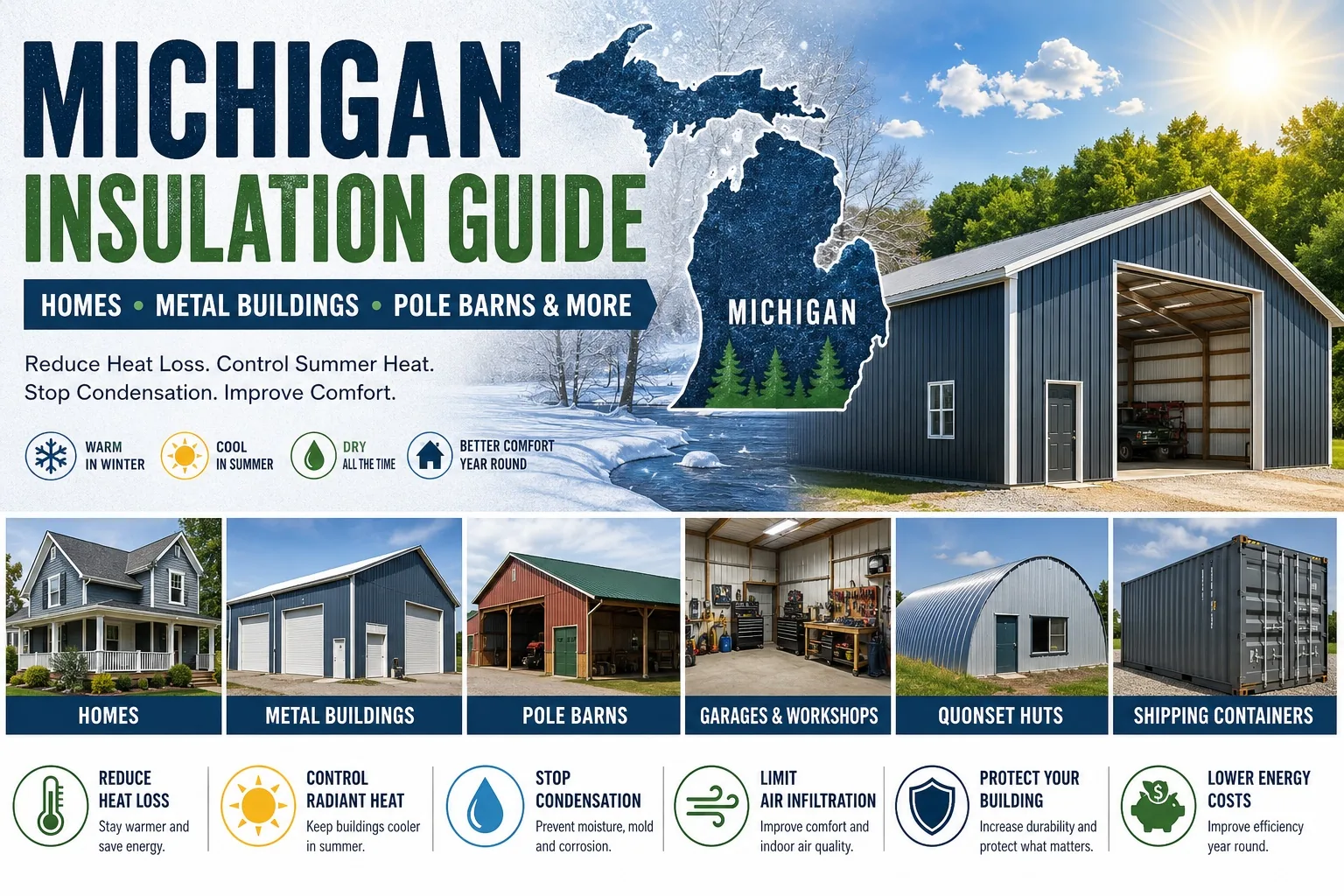
Michigan Insulation: Complete Guide for Homes, Metal Buildings, Pole Barns & More
Michigan's cold winters, warm and humid summer weather, and large seasonal temperature swings make insulation an important part of building performance. The right insulation system can help reduce winter heat loss, limit summer heat gain, control condensation and improve comfort throughout the year.
But the best insulation solution depends heavily on the building.
A Michigan house does not have the same insulation challenges as a steel building. A pole barn, workshop, Quonset hut or shipping container can experience significant radiant heat and condensation problems that may require a different approach than conventional residential construction.
This Michigan insulation guide explains the major insulation challenges property owners and builders face and connects you with detailed guides for specific building types.
Why Insulation Matters in Michigan
Michigan buildings must perform through substantial changes in temperature and moisture conditions. During winter, heated buildings continually lose energy through roofs, walls and uncontrolled air leakage. Metal structures can also develop condensation when warm, moisture-laden interior air encounters cold steel surfaces. Summer creates a different problem. Roofs and exterior metal surfaces exposed to sunlight can become extremely hot and transfer radiant heat toward the building interior.
An effective insulation system should therefore be selected with several forms of heat and moisture movement in mind:
- Conductive heat transfer
- Radiant heat transfer
- Air infiltration
- Water vapor
- Condensation
- Seasonal temperature changes
This is particularly important when insulating steel and post-frame structures. For a deeper explanation of these challenges, see our national guide to metal building insulation.
Michigan Metal Building Insulation
Steel buildings can be especially challenging to insulate in Michigan because metal rapidly conducts outdoor temperatures and can create conditions favorable to condensation. During winter, the exterior steel can become extremely cold while the interior is heated. During summer, metal roofing exposed to direct sunlight can become a major source of radiant heat.
A properly designed insulation system can help:
- Reduce heat loss
- Reduce radiant heat gain
- Control condensation
- Limit uncontrolled air movement
- Improve interior comfort
- Reduce heating and cooling demand
Our Metal Building Insulation in Michigan guide examines these issues specifically for Michigan steel structures. You can also learn more about insulation for steel buildings, including approaches for controlling condensation, heat, cold and air movement.
Michigan Pole Barn Insulation
Pole barns are common throughout Michigan for agricultural buildings, equipment storage, workshops, garages and other post-frame applications. Because many pole barns use exposed metal roofing and siding, condensation and radiant heat can become significant concerns. The roof deserves particular attention. During winter, warm interior air naturally rises toward the roof while cold exterior temperatures chill the metal roofing. During summer, solar radiation can heat that same roof considerably. Our Pole Barn Insulation in Michigan guide explains insulation strategies for new and existing post-frame buildings. For additional information, visit our complete Pole Barn Insulation Guide.
Michigan House Insulation
Michigan homes require insulation primarily to slow heat transfer through the building envelope and reduce unwanted air movement.
Important areas include:
- Attics
- Roofs
- Exterior walls
- Basements
- Crawl spaces
- Floors
- Garages and additions
The appropriate insulation depends on the construction assembly, location within the house, climate requirements and applicable building codes. See House Insulation in Michigan for a more detailed discussion of Michigan residential applications. Our national House Insulation Guide provides additional information about controlling cold, moisture, air and heat.
Michigan Roof & Ceiling Insulation
The roof is one of the most important areas of a building to insulate. During winter, heat generated inside a building naturally moves toward colder areas of the structure, making roofs and ceilings important parts of the thermal envelope. During summer, solar radiation striking the roof can produce substantial heat gain.
This makes roof insulation particularly important for:
- Houses
- Metal buildings
- Pole barns
- Garages
- Workshops
- Warehouses
- Agricultural buildings
Our Roof & Ceiling Insulation in Michigan guide discusses these applications in greater detail. You can also review our comprehensive Roof Insulation Guide.
Reflective Insulation in Michigan
Traditional insulation primarily slows conductive heat transfer. Reflective insulation is designed to address radiant heat transfer when installed as part of an appropriate assembly. This can be particularly useful in buildings with large metal roof and wall surfaces.
Reflective insulation may be considered for:
- Metal buildings
- Pole barns
- Garages
- Workshops
- Agricultural buildings
- Quonset huts
- Shipping containers
- Selected residential applications
Learn more in Reflective Insulation in Michigan. For a detailed explanation of how reflective insulation works, see our Reflective Insulation Guide.
Fiberglass Insulation vs. Prodex Total in Michigan
Fiberglass has been used in residential and commercial buildings for decades, but it is not the only insulation option. The appropriate choice depends on the building assembly and the performance characteristics required.
Important considerations can include:
- Thermal resistance
- Radiant heat
- Condensation control
- Vapor control
- Air movement
- Water absorption
- Installation complexity
- Available space
- Long-term durability
Our Fiberglass Insulation vs. Prodex Total in Michigan guide compares these approaches and explains where each may be appropriate.
Michigan Metal Garage & Workshop Insulation
Michigan garages and workshops can experience many of the same problems as larger metal buildings. An uninsulated metal garage can become extremely cold during winter and hot during summer. Heated workshops can also experience condensation when warm interior moisture encounters cold exterior metal. Our Metal Garage & Workshop Insulation in Michigan guide covers insulation considerations for these structures. For additional information, see our national Metal Garage Insulation Guide.
Michigan Quonset Hut Insulation
The curved steel shell that makes Quonset huts strong and economical also creates unique insulation challenges. Because the roof and walls form a nearly continuous metal surface, controlling radiant heat and condensation can be particularly important. Michigan's winter temperatures can make condensation management especially significant when a Quonset hut is heated. Read Quonset Hut Insulation in Michigan for Michigan-specific considerations. For installation techniques and additional information, see our Quonset Hut Insulation Guide.
Michigan Shipping Container Insulation
Shipping containers are constructed primarily from steel, which means exterior temperatures can transfer rapidly through the container shell. Containers can become hot in direct summer sunlight and very cold during Michigan winters. Interior condensation can also develop when temperature and humidity conditions reach the dew point at the steel surface. Our Shipping Container Insulation in Michigan guide explains how insulation can help address these conditions. For a national overview, visit our Shipping Container Insulation Guide.
Condensation: A Major Concern in Michigan Metal Buildings
Condensation occurs when moisture in the air encounters a surface cold enough for water vapor to condense. This can be particularly noticeable on metal roofing and siding.
Potential consequences include:
- Water dripping from roofs
- Wet building contents
- Corrosion
- Mold or mildew on susceptible materials
- Moisture-damaged framing or finishes
Insulation strategies for metal structures should therefore consider moisture and condensation rather than focusing exclusively on R-value. This is one reason insulation for metal buildings should be evaluated as a complete building-envelope system.
Prodex Total Reflective Insulation
Prodex Total is a reflective insulation system designed to address multiple forms of heat and moisture movement when properly installed. Depending on the product and assembly, Prodex Total combines insulating properties with reflective surfaces and vapor-barrier characteristics.
Prodex Total = Insulation + Radiant Barrier + Vapor Barrier — All in One Product.
These characteristics make Prodex Total particularly relevant to applications such as metal buildings, pole barns, garages, workshops, agricultural structures, Quonset huts and shipping containers. The appropriate product and installation method depend on the specific building and assembly.
Choosing Insulation for a Michigan Building
There is no single insulation material that is automatically best for every Michigan building.
Before choosing insulation, consider:
- Building type
- New construction or retrofit
- Roof and wall construction
- Interior use
- Heating and cooling
- Moisture generation
- Condensation potential
- Available insulation space
- Required thermal performance
- Applicable building and energy codes
These factors should be evaluated together rather than choosing insulation based solely on advertised R-value.
Michigan Insulation Guides by Building Type
Use the following guides to explore insulation options for your particular Michigan project:
- Metal Building Insulation in Michigan
- Pole Barn Insulation in Michigan
- House Insulation in Michigan
- Roof & Ceiling Insulation in Michigan
- Fiberglass Insulation vs. Prodex Total in Michigan
- Quonset Hut Insulation in Michigan
- Reflective Insulation in Michigan
- Metal Garage & Workshop Insulation in Michigan
- Shipping Container Insulation in Michigan
Michigan Insulation for Year-Round Building Performance
Michigan's climate makes insulation a year-round consideration. Winter requires protection against heat loss, cold surfaces and condensation. Summer introduces solar heat gain and humidity. Metal buildings and other steel structures can experience both problems more intensely because of the thermal characteristics of metal.
The objective is straightforward:
Cool in the Summer. Warm in the Winter. Dry all the Time.
Selecting the insulation system according to the building type, construction method and moisture conditions can help create a more comfortable, energy-efficient and durable Michigan building.