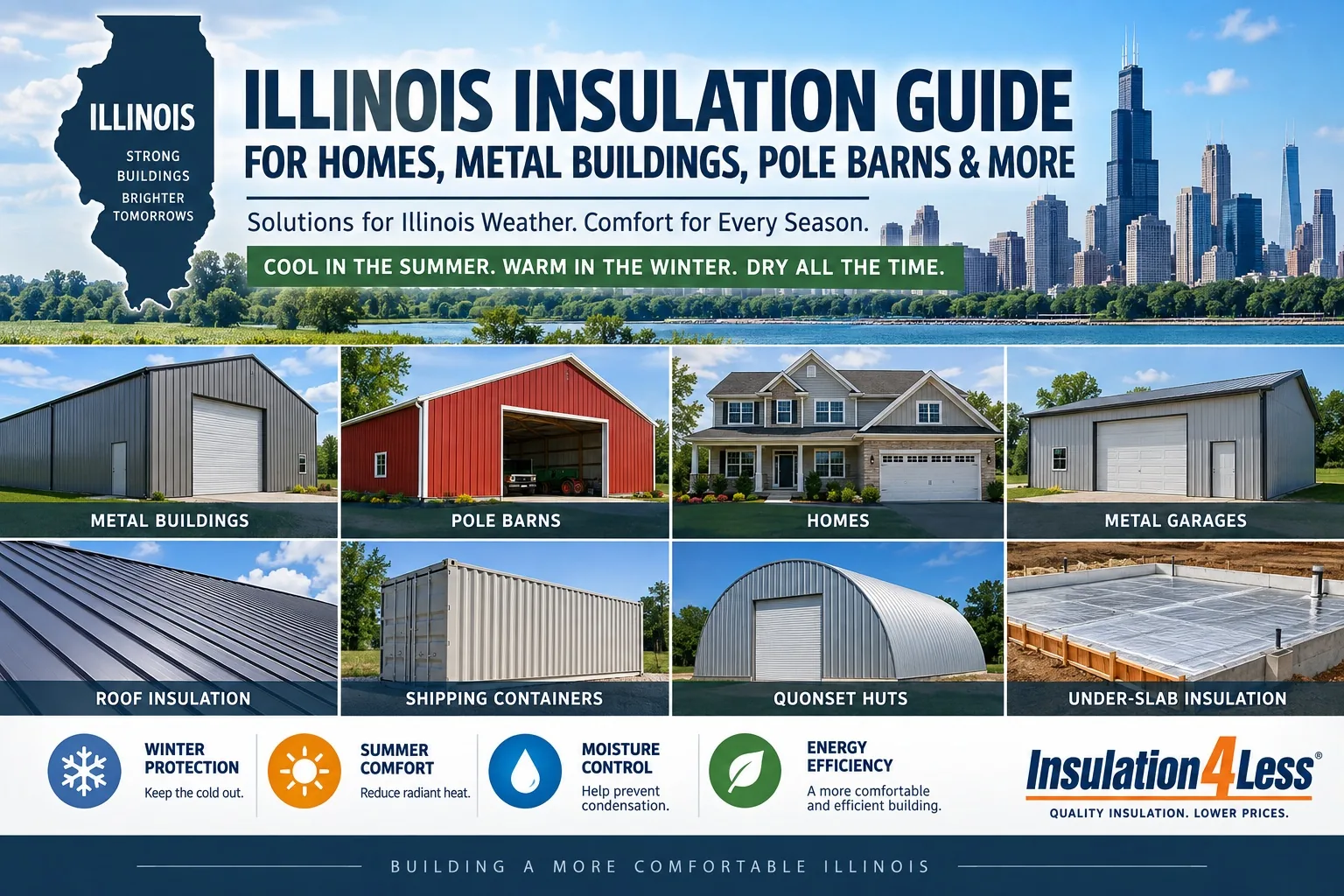
Illinois Insulation Guide: Best Insulation for Illinois Homes, Metal Buildings, Pole Barns & More
Choosing insulation in Illinois requires preparing a building for dramatically different conditions during the year. Winter brings cold temperatures and substantial heating demands, while summer can bring heat and humidity. Spring and fall add repeated temperature swings that can create additional moisture and condensation concerns.
The best insulation system therefore depends on more than a single R-value.
Building construction, moisture exposure, radiant heat, air movement, condensation potential and how the space will be used can all affect the right choice.
This guide provides an Illinois-specific starting point for insulating homes, metal buildings, pole barns, metal garages, roofs, shipping containers, Quonset huts, concrete slabs and other common building types.
What Makes Insulating a Building in Illinois Different?
Illinois buildings may need insulation to perform through both heating and cooling seasons. That means insulation decisions should consider several forms of heat and moisture movement rather than focusing exclusively on keeping a building warm during winter.
Important Illinois insulation considerations include:
- Winter heat loss — Heated buildings need protection against heat moving toward colder exterior surfaces.
- Summer heat gain — Roofs and metal siding exposed to sunlight can become significant sources of radiant heat.
- Humidity and moisture — Warm, moisture-laden air can contribute to condensation when it reaches colder surfaces.
- Seasonal temperature changes — Illinois buildings experience substantial differences between winter and summer conditions.
- Metal construction — Steel roofing and siding transfer heat rapidly and can develop condensation when surface temperatures fall below the dew point.
- Concrete slabs — Cold ground conditions can affect slab temperatures, particularly in garages, workshops, pole barns and heated buildings.
The importance of each factor depends on the building. A conditioned house, agricultural pole barn, unheated equipment building and heated metal workshop may all require different insulation strategies even when they are located only a few miles apart.
How Heat Moves Through Illinois Buildings
Understanding heat transfer helps explain why insulation products can perform differently. Heat moves in three primary ways.
Conduction
Conduction is heat transfer through solid materials. Steel framing, roofing, siding, concrete, wood and other building materials can conduct heat from warmer areas toward colder ones. Traditional insulation materials such as fiberglass are primarily designed to slow conductive heat transfer.
Convection
Convection occurs as heat moves with air. Uncontrolled air movement through gaps and openings can reduce comfort and increase heating and cooling loads. Depending on the assembly and installation method, an insulation system may also help limit unwanted air movement.
Radiation
Radiant heat travels as electromagnetic energy. This is particularly important in buildings with metal roofs and siding exposed to summer sunlight. A hot metal roof can radiate heat toward the interior even when there is no direct contact between the roof and the occupied space. Reflective insulation is designed to reduce this form of heat transfer when installed adjacent to an appropriate air space. For a more detailed explanation, see the Reflective Insulation Guide.
Prodex Total for Illinois Buildings
Prodex Total is a reflective insulation constructed with reinforced reflective surfaces and a closed-cell polyethylene foam center.
Rather than addressing only one part of the building-envelope problem, Prodex Total can provide multiple functions in a properly designed and installed assembly:
- Thermal insulation
- Radiant heat reflection
- Vapor control
- Air-barrier performance
- Condensation control
- Moisture resistance
- Mold and mildew resistance
- Sound dampening
Prodex Total reflects up to 97% of radiant heat. This combination can be particularly useful in Illinois metal buildings, pole barns, garages, workshops, agricultural buildings and other structures where controlling condensation may be nearly as important as controlling temperature.
A useful way to understand the system is:
Prodex Total = Insulation + Radiant Barrier + Vapor Barrier — All in One Product.
For reflective performance, an adjacent air space is important. Approximately 3/4 inch to 1 inch or more of air space is generally recommended where applicable to optimize reflective performance. Building assemblies and code requirements vary, so insulation should always be selected and installed for the particular structure and application.
Metal Building Insulation in Illinois
Metal buildings present some of the most demanding insulation conditions because steel conducts heat efficiently. During summer, solar energy can heat metal roofing and siding, increasing radiant heat toward the building interior. During cold Illinois weather, the same metal surfaces can become extremely cold. That temperature difference can also create condensation. Warm interior air containing moisture can contact a cold metal surface and reach its dew point. Water may then form on the underside of roofing or siding.
This is why insulation for a metal building should address more than R-value alone.
Prodex Total can provide a thermal break while also reducing radiant heat transfer and providing vapor and condensation control when properly installed. Our complete Illinois metal building insulation guide explains these issues specifically for Illinois steel structures.
For a comprehensive nationwide resource covering building types, installation considerations and insulation choices, see our insulation for metal buildings guide.
Pole Barn Insulation in Illinois
Pole barns and post-frame buildings are common choices for agricultural storage, equipment, workshops, garages and other large spaces. Their metal roofs and siding create many of the same heat-transfer and condensation challenges found in other steel structures.
An Illinois pole barn may need protection against:
- Winter heat loss
- Summer radiant heat
- Roof and wall condensation
- Moisture
- Air movement
- Large seasonal temperature changes
This makes insulation selection especially important when the building will be heated, cooled or occupied as a workshop.
See the complete Illinois pole barn insulation guide for application-specific recommendations. Our national pole building insulation resource provides additional information about controlling heat, cold, air and condensation in post-frame construction.
Metal Garage & Workshop Insulation in Illinois
A detached metal garage or workshop can become uncomfortable at either extreme of the Illinois climate. Summer sunlight can heat metal roofing rapidly, while winter temperatures can make an uninsulated garage difficult and expensive to heat. Condensation is another consideration, particularly in garages and workshops where temperature and humidity can change during the day.
Insulation can be especially valuable when the building is used for:
- Vehicle storage
- Automotive work
- Woodworking
- Equipment repair
- Hobby projects
- Home businesses
- Heated workshops
- General storage
The Illinois metal garage insulation guide explains insulation considerations for these buildings. You can also review the national metal garage insulation guide for a more detailed discussion of garage and workshop applications.
Roof Insulation in Illinois
The roof is one of the most important parts of an Illinois building envelope. In winter, heat naturally moves from warmer interior spaces toward colder areas. During summer, roofs exposed to direct sunlight can become major sources of radiant heat gain.
The appropriate roof insulation system depends on factors including:
- Roof construction
- Existing insulation
- Available space
- Desired thermal performance
- Moisture conditions
- Ventilation
- Whether the building is heated or cooled
- Installation access
Cost also varies substantially depending on insulation type, thickness, required R-value, roof configuration and labor. Our Illinois roof insulation guide addresses these considerations in an Illinois context. For a broader comparison of materials, applications and roof insulation costs, see our national roof insulation resource.
Shipping Container Insulation in Illinois
Shipping containers are constructed almost entirely from steel, making insulation particularly important when they are converted to workshops, storage areas or occupied spaces. Their steel shells can gain heat rapidly in sunlight and become very cold during winter. Temperature differences can also contribute to condensation on the interior metal surfaces.
Effective Illinois shipping container insulation should therefore consider:
- Conductive heat transfer through steel
- Summer radiant heat
- Winter cold
- Interior condensation
- Vapor movement
- Available interior space
Our national insulation for shipping containers guide provides additional information about insulating these unique steel structures.
Quonset Hut Insulation in Illinois
Quonset huts create another distinctive insulation challenge. Their curved metal shell functions as both the roof and walls, providing a large steel surface through which heat can move. The shell can become hot under summer sunlight and cold during Illinois winters. Condensation can also develop on the interior surface when warm, moist air encounters cold steel. Insulation needs to work with the curved shape of the structure rather than against it.
Our Illinois Quonset hut insulation guide covers Illinois-specific considerations. For detailed installation information, see our national Quonset hut insulation guide.
Under-Slab Insulation in Illinois
Insulation does not stop at the walls and roof. Concrete slabs can be another important part of the thermal envelope, particularly in heated garages, workshops, pole barns, metal buildings and buildings with radiant floor heating. Insulation installed beneath concrete can help separate the slab from colder ground conditions and reduce downward heat transfer.
For Prodex Under Concrete, the installation orientation is important:
The foil side faces the soil or ground, and the white side faces upward toward the wet concrete.
Our Illinois under-slab insulation guide covers under-concrete applications in greater detail. You can also review our national under-slab insulation resource for information about slab insulation, under-concrete insulation and radiant floor applications.
House Insulation in Illinois
Homes have different insulation requirements from many agricultural and metal buildings. Wall cavities, attics, ceilings, crawl spaces, basements and other parts of the residential building envelope may require different insulation products and strategies. Illinois homeowners should consider both seasons. Winter performance is important because of heating demands, but summer heat, humidity, air leakage and moisture control also affect comfort and energy use. The right system depends on where the insulation is being installed and the construction of the house.
See our Illinois house insulation guide for a more detailed look at residential applications. Our national house insulation guide provides additional information about managing heat, cold, moisture and air movement in homes.
Fiberglass vs. Prodex Total in Illinois
Fiberglass and Prodex Total work differently, and neither comparison nor insulation selection should be reduced to a single number. Fiberglass is widely used and effective at slowing conductive heat transfer. It has legitimate applications in residential buildings and many other construction assemblies. Prodex Total combines a closed-cell polyethylene foam center with reflective surfaces. Depending on the application and installation, it can provide thermal resistance while also helping address radiant heat, vapor movement and condensation. Those additional functions can be particularly important in metal buildings.
Fiberglass does not inherently provide the same integrated radiant barrier and vapor-control functions. In some metal-building assemblies, Prodex can also complement fiberglass by helping protect it from condensation and moisture. For a detailed comparison, see Fiberglass vs. Prodex Total for Illinois Buildings.
Additional information is available in our national fiberglass metal building insulation resource and reflective insulation guide.
Condensation Control in Illinois Metal Buildings
Condensation deserves special attention in Illinois because buildings may experience large temperature differences between indoor air and exterior metal surfaces. Condensation occurs when moisture-containing air encounters a surface cold enough for the air to reach its dew point. In a metal building, that surface can be the underside of the roof or wall panels.
Over time, uncontrolled moisture can contribute to problems involving:
- Wet insulation
- Corrosion
- Mold and mildew
- Water dripping inside the building
- Damage to stored materials or equipment
- Reduced insulation performance
The solution is not simply to add more insulation. A properly designed system should consider interior moisture, vapor movement, air movement, thermal bridging and the temperature of the metal surface. This is one reason Prodex Total is particularly useful for many metal structures: it can combine insulation, radiant heat control and vapor protection while helping prevent condensation when properly installed.
One Solution to Heat, Cold and Condensation – Prodex Total.
How Much Insulation Do I Need?
The amount of insulation required depends on the dimensions and design of the building. Insulation4Less provides an Advanced Insulation Calculator to help estimate material quantities. Enter the building dimensions and select the roof slope to estimate the amount of insulation required. Calculating the quantity before ordering is particularly useful for larger Illinois pole barns, metal buildings, garages and workshops where both walls and roof may be insulated.
Choosing the Best Insulation for an Illinois Building
There is no single insulation answer for every building in Illinois.
Before selecting a system, consider:
- What is the building made from?
Metal, wood framing, masonry and concrete create different heat-transfer and moisture conditions. - Will it be heated or cooled?
Conditioned buildings generally have different thermal and moisture requirements from unconditioned storage structures. - Is condensation a concern?
This is particularly important with metal roofing and siding. - Does radiant heat matter?
Metal roofs exposed to summer sunlight can transfer substantial radiant energy toward the interior. - Where will the insulation be installed?
Roofs, walls, ceilings and concrete slabs each require different considerations. - Is there an appropriate air space for reflective insulation?
Reflective performance depends on an adjacent air space. Approximately 3/4 inch to 1 inch or more is generally recommended where applicable. - What do local building requirements call for?
Insulation assemblies should be appropriate for the particular building and applicable requirements.
For many Illinois metal buildings and pole barns, insulation needs to solve several problems simultaneously rather than simply provide resistance to conductive heat flow. That is where the combination offered by Prodex Total becomes particularly valuable.
Cool in the Summer. Warm in the Winter. Dry all the Time.
Illinois Insulation Guides by Application
Use these Illinois-specific resources to explore the insulation requirements of your building:
- Metal Building Insulation in Illinois — Steel-building insulation for winter cold, summer radiant heat and condensation control.
- Pole Barn Insulation in Illinois — Insulation for agricultural, storage, workshop and post-frame buildings.
- Metal Garage Insulation in Illinois — Insulation for detached garages, vehicle storage, hobby shops and workshops.
- Roof Insulation in Illinois — Roof insulation considerations for heating, cooling, moisture and cost.
- Shipping Container Insulation in Illinois — Insulating steel containers against heat, cold and condensation.
- Quonset Hut Insulation in Illinois — Insulation and condensation control for curved steel structures.
- Under-Slab Insulation in Illinois — Under-concrete and radiant floor insulation for slabs, garages, workshops and other buildings.
- House Insulation in Illinois — Residential insulation for year-round comfort and moisture management.
- Fiberglass vs. Prodex Total for Illinois Buildings — Compare conductive insulation with reflective insulation for different Illinois applications.
Frequently Asked Questions About Insulation in Illinois
What is the best insulation for Illinois?
The best insulation depends on the building and application. Houses, metal buildings, pole barns, garages, roofs and concrete slabs have different requirements. Illinois conditions make both winter heat loss and summer heat gain important, while condensation and moisture deserve additional attention in metal structures.
What insulation is best for an Illinois metal building?
Metal buildings benefit from insulation systems that address conductive heat transfer, radiant heat and condensation. Prodex Total is particularly well suited to many metal-building applications because it combines a closed-cell foam center with reflective surfaces and can provide insulation, radiant heat control and vapor protection in one system when properly installed. For more information, see our Illinois metal building insulation guide.
What insulation is best for an Illinois pole barn?
The answer depends on whether the pole barn is heated, cooled or primarily used for storage. Because most pole barns use metal roofing and siding, radiant heat and condensation should be considered along with conductive heat loss. See our Illinois pole barn insulation guide for more information.
Does Prodex Total help prevent condensation?
Prodex Total can help prevent condensation when properly incorporated into the building assembly. Its closed-cell construction does not absorb moisture, and its vapor-control and thermal properties make it particularly useful where warm, moisture-containing air could otherwise contact cold metal surfaces.
Does reflective insulation need an air gap?
An adjacent air space is important for reflective performance. Approximately 3/4 inch to 1 inch or more is generally recommended where applicable to optimize performance.
Can Prodex Total be used with fiberglass insulation?
Yes. The two products do not necessarily have to be competing systems. In certain metal-building assemblies, Prodex Total can complement fiberglass by providing radiant heat and vapor control and helping protect fiberglass from condensation and moisture.
Is fiberglass insulation bad for Illinois buildings?
No. Fiberglass is a proven insulation material that effectively slows conductive heat transfer and is widely used in homes and other buildings. The issue is choosing the right product and assembly for the application. In metal structures, condensation, vapor movement and radiant heat may require functions that fiberglass does not inherently provide by itself.
Should I insulate under a concrete slab in Illinois?
Under-slab insulation can be valuable where reducing heat transfer between a concrete slab and the ground is important, particularly in heated garages, workshops, pole barns, metal buildings and radiant-floor applications. See the Illinois under-slab insulation guide for more information.
Which way does Prodex Under Concrete face?
The foil side faces the soil or ground, while the white side faces upward toward the wet concrete.
How do I calculate how much Prodex Total I need?
Use the Advanced Insulation Calculator. Enter the building dimensions and select the roof slope to estimate the amount of insulation required.
Insulating Illinois for Heat, Cold & Condensation
Illinois buildings face very different conditions throughout the year. The insulation system that performs well in January also needs to make sense during hot and humid summer weather. For homes, that means creating an effective building envelope appropriate to the particular walls, attic, roof, ceilings and other assemblies. For metal buildings, pole barns, garages, shipping containers and Quonset huts, the challenge can be broader. Insulation may need to address conductive heat transfer, radiant heat, vapor movement and condensation at the same time.
Prodex Total was designed to address these multiple forms of heat and moisture movement in one insulation system.
Prodex Total = Insulation + Radiant Barrier + Vapor Barrier — All in One Product.
Cool in the Summer. Warm in the Winter. Dry all the Time.
One Solution to Heat, Cold and Condensation – Prodex Total.