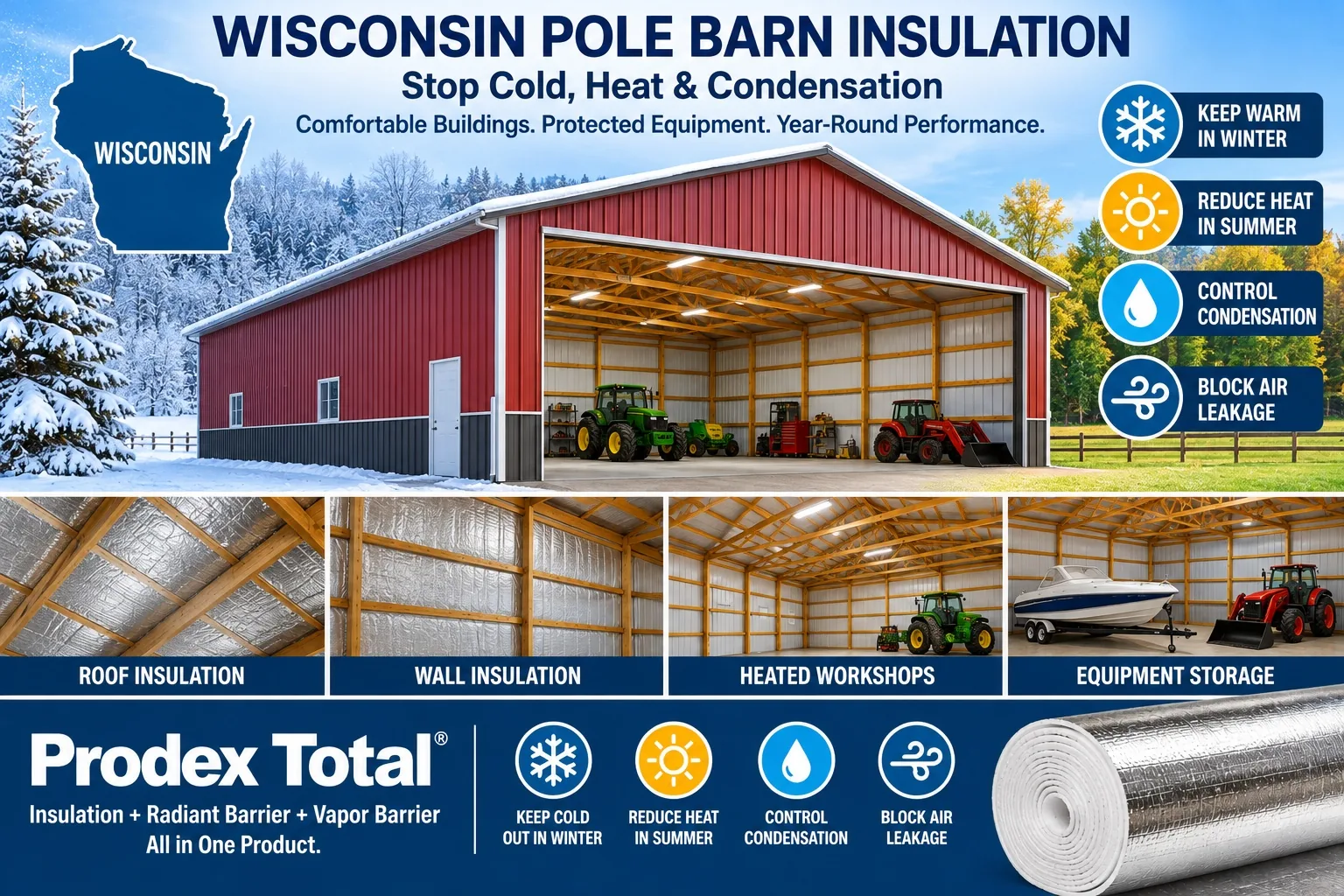
Pole Barn Insulation in Wisconsin: Stop Cold, Heat & Condensation
Wisconsin pole barns face demanding weather conditions throughout the year. Long, freezing winters, heavy snowfall in many areas, warm summers and changing humidity can make post-frame buildings difficult to heat, uncomfortable during summer and vulnerable to condensation. Whether you're insulating a machinery shed near Eau Claire, a heated workshop in Wausau or an agricultural building outside Green Bay, selecting the right insulation requires understanding how heat, air and moisture move through the structure.
Pole barn insulation in Wisconsin should address winter heat loss, summer radiant heat, air leakage and condensation. Metal roofing and siding conduct heat readily, while large roof surfaces can absorb substantial solar energy during summer. During winter, cold metal panels may develop condensation when warm, moisture-containing interior air reaches them.
Prodex Total is one option for pole barn insulation because it combines a closed-cell polyethylene foam core with reinforced reflective surfaces. Fiberglass, spray foam and foam board are also used in post-frame construction, depending on the building's intended use, construction and required thermal performance.
This guide explains the insulation challenges facing Wisconsin pole barns, compares common materials and discusses installation methods for new and existing buildings. For a complete national overview, visit our Pole Barn Insulation Guide. You can also explore our Wisconsin Insulation Guide for other building types.
Why Wisconsin Pole Barns Need Insulation
Wisconsin has a substantial agricultural and post-frame building market. Pole barns are commonly used for machinery storage, vehicle maintenance, livestock facilities, commercial workshops and recreational buildings. Some remain unheated, while others are conditioned throughout the winter.
The building's intended use is one of the most important factors in choosing insulation. An unheated equipment shed may benefit primarily from radiant heat and condensation control, while a heated workshop or commercial facility requires greater attention to conductive thermal resistance and air sealing.
Winter Heat Loss in Wisconsin Pole Barns
Northern Wisconsin communities such as Superior, Ashland and Rhinelander experience prolonged periods of freezing weather. Central Wisconsin, including Wausau and Stevens Point, also faces substantial winter heating demands. Even in southern Wisconsin, temperatures can remain below freezing for extended periods.
In a heated pole barn, heat escapes through roofs, walls, doors, floors and air leaks. Metal panels and structural connections can also create thermal bridges that reduce overall insulation performance.
A well-designed insulation system helps reduce heat transfer while limiting uncontrolled air movement. Heated buildings may require additional insulation layers to achieve the necessary thermal resistance.
Summer Radiant Heat Beneath Metal Roofing
Pole barns often have large metal roof surfaces exposed to direct sunlight. During summer, the roofing can become much hotter than the surrounding air, transferring heat toward the building interior.
This can make workshops, equipment storage buildings and agricultural facilities uncomfortable, even when outdoor temperatures are moderate.
Reflective insulation helps reduce radiant heat transfer when installed with an appropriate adjacent air space. Prodex Total combines this reflective function with a foam insulation core, allowing it to contribute to multiple aspects of the building envelope.
Condensation in Wisconsin Pole Barns
Condensation is a common concern in post-frame buildings with metal roofing and siding. During cold weather, warm, moisture-containing air can contact cold metal surfaces and form water droplets.
Moisture may drip onto equipment, stored materials or interior finishes. Persistent condensation can also contribute to corrosion and deterioration of moisture-sensitive components.
Livestock buildings, wash-down areas and other moisture-generating operations may face additional challenges because of elevated interior humidity.
Proper condensation control involves insulation continuity, air sealing, vapor management and ventilation appropriate to the building's use. No insulation product can guarantee condensation prevention under every condition.
What Is the Best Insulation for a Pole Barn in Wisconsin?
The best insulation depends on whether the pole barn is heated, its construction details, moisture conditions and required thermal performance. Four common options are Prodex Total reflective insulation, fiberglass, spray polyurethane foam and rigid foam board. Each has advantages and limitations.
Prodex Total Reflective Insulation for Wisconsin Pole Barns
Prodex Total combines a closed-cell polyethylene foam core with reinforced reflective surfaces. Depending on the product and installation, it can provide thermal resistance, radiant heat reduction, vapor control and air-barrier performance.
These functions are particularly relevant to Wisconsin pole barns because the insulation system must address cold winters, summer solar heat and condensation.
Prodex Total = Insulation + Radiant Barrier + Vapor Barrier — All in One Product.
Reflective Insulation and Radiant Heat
Prodex Total's reflective surfaces are designed to reduce radiant heat transfer across an adjacent air space. This can be particularly useful beneath sun-exposed metal roofing.
Reflective performance depends on the installation assembly, including the presence and dimensions of an appropriate air space. Direct contact with another material does not provide the same radiant benefit.
For a more detailed explanation, visit our Reflective Insulation Guide.
Vapor Control and Condensation Management
Prodex Total's closed-cell foam core and reflective facings can help manage vapor movement when installed with properly sealed seams, edges and penetrations.
In Wisconsin's cold climate, limiting moisture-containing interior air from reaching cold metal surfaces can help reduce condensation risk.
However, the overall assembly must be designed to manage drying potential, especially when additional insulation materials are installed.
Prodex Total 5M vs. 10M for Pole Barns
Prodex Total is available in different thicknesses and configurations. Prodex Total 5M uses an approximately 5 mm foam core, while Prodex Total 10M uses an approximately 10 mm foam core. Product selection depends on the application, installation method and required thermal performance. Prodex Total 10M Plus also offers heat-weldable seams, while standard 5M installations generally use appropriate seam tape.
For product specifications, see Prodex Total 10M Insulation.
Published R-values should be interpreted according to the tested assembly and installation conditions rather than treated as universal material-only values.
Fiberglass Insulation for Wisconsin Pole Barns
Fiberglass is commonly used in post-frame buildings where substantial conductive thermal resistance is needed. It is available in blankets, batts and other configurations designed for walls and roofs.
Properly installed fiberglass can provide effective insulation for heated workshops, agricultural buildings and commercial facilities.
However, fiberglass alone does not form a complete air barrier or radiant barrier. Its performance depends on correct installation, avoiding gaps and compression, and protecting the assembly from problematic moisture accumulation.
Combining Fiberglass and Prodex Total
Fiberglass and Prodex Total can be used together in appropriately designed assemblies. Fiberglass contributes conductive thermal resistance, while Prodex may provide additional radiant, air and vapor-control functions.
In certain metal-roof assemblies, placing Prodex between the exterior metal and fiberglass may help limit condensation reaching the fiberglass. However, the entire assembly must be evaluated to ensure moisture is not trapped between low-permeability layers.
For a broader discussion of fiberglass insulation in metal structures, visit our Fiberglass Metal Building Insulation Guide.
Spray Foam Insulation for Wisconsin Pole Barns
Spray polyurethane foam is another option for post-frame buildings. It expands during application, allowing it to conform to irregular surfaces and fill many gaps.
Open-cell and closed-cell spray foams differ in density, thermal resistance and moisture characteristics. Closed-cell spray foam is often considered for metal structures because of its thermal resistance per inch and air-sealing properties.
However, spray foam requires careful attention to application conditions, substrate preparation, professional installation, curing, fire protection and cost.
Spray Foam vs. Prodex Total for Pole Barns
Spray foam and Prodex Total work differently. Spray foam provides conductive thermal resistance and air sealing, while Prodex Total combines a foam core with reflective surfaces and vapor-control functions.
Prodex Total can be installed without spray equipment and may be practical for many new-construction and retrofit projects. Spray foam can be useful where direct application to irregular surfaces is preferred.
The correct choice depends on required thermal resistance, installation conditions, moisture management, budget and future access to roofing or siding.
For a detailed comparison, read our Spray Foam Insulation for Metal Buildings and Pole Barns guide.
Foam Board Insulation for Wisconsin Pole Barns
Rigid foam board is another insulation option for post-frame construction. Common types include expanded polystyrene (EPS), extruded polystyrene (XPS) and polyisocyanurate.
Foam board can provide continuous insulation when installed across framing or other suitable surfaces. This may help reduce thermal bridging through structural components.
Rigid panels may also be used in certain roof, wall, foundation and under-slab assemblies.
Foam Board vs. Prodex Total
Foam board provides conductive thermal resistance through rigid insulation panels. Depending on the product, it can offer substantial R-value at relatively modest thicknesses.
Prodex Total is flexible and can be installed across framing or around certain irregular surfaces more easily than rigid panels.
Foam board requires careful treatment of joints, penetrations, fastening and fire-protection requirements. Moisture performance must also be considered as part of the complete assembly.
For material comparisons and installation considerations, visit our Foam Board Insulation Guide.
Wisconsin Pole Barn Insulation Comparison
| Insulation type | Advantages | Important considerations |
|---|---|---|
| Prodex Total | Reflective surfaces, foam core, air and vapor-control functions | Radiant performance depends on air space and assembly |
| Fiberglass | Widely available, substantial conductive thermal resistance | Requires appropriate air and moisture-control detailing |
| Spray foam | Air sealing, conforms to irregular surfaces, thermal resistance | Cost, installation conditions, fire protection and future access |
| Foam board | Rigid continuous insulation, reduced thermal bridging | Panel joints, fastening, moisture and fire-protection requirements |
The best insulation system depends on the pole barn's intended use and the performance required from the complete assembly.
How to Insulate a New Pole Barn in Wisconsin
New construction allows insulation to be installed before the exterior roofing and siding are fully attached. This provides an opportunity to create a continuous insulation layer and manage gaps around framing.
Prodex Total can be installed perpendicular to framing members in suitable post-frame assemblies. Depending on the installation method, the insulation may be supported with a slight sag to maintain the required adjacent air space.
Seams, edges and penetrations should be treated according to the product's installation instructions.
For heated buildings, determine the required insulation assembly before construction begins. Additional insulation may be necessary to achieve the required thermal performance.
How to Insulate an Existing Wisconsin Pole Barn
Existing pole barns often require retrofit installation methods because the roofing and siding are already in place. One approach is to install insulation across the interior faces of framing members, creating a continuous layer over the framing. This can help reduce gaps and some thermal bridges compared with installing insulation only between framing members. Depending on the structure, insulation may be secured using suitable screws and washers, staples, mechanical supports or other approved attachment methods. Another approach is to install insulation between girts or other framing members, but this requires careful attention to air spaces, insulation continuity and moisture management.
The appropriate method depends on framing geometry, intended interior finishes and whether additional insulation layers will be installed.
Pole Barn Roof Insulation in Wisconsin
The roof is often one of the largest exposed surfaces of a pole barn. In Wisconsin, roof insulation must address winter heat loss, summer radiant heat and condensation beneath cold metal panels. A reflective insulation layer can help reduce radiant heat transfer when installed with an appropriate air space. Additional insulation may be necessary where higher thermal resistance is required.Roof assembly design should also consider air leakage, snow conditions and moisture movement.
For broader guidance, see our Roof Insulation Guide.
Pole Barn Wall Insulation in Wisconsin
Pole barn walls may be framed with posts, girts and metal siding. These components create cavities and structural connections that influence insulation performance. Continuous insulation installed across framing can help reduce thermal bridging and improve insulation continuity. However, wall assemblies must also account for vapor control, air leakage, drying potential and interior finishes. The appropriate installation method depends on whether the building is new or existing, heated or unheated, and whether the walls will be finished.
Insulation for Heated and Unheated Wisconsin Pole Barns
A heated pole barn workshop has different insulation requirements from an unheated machinery shed. Heated buildings generally require greater conductive thermal resistance and careful air sealing to limit winter heat loss. Moisture control is also important because warm indoor air can carry vapor toward cold exterior surfaces. Unheated buildings may still benefit from insulation that reduces radiant heat and helps manage condensation, but their thermal performance requirements may be different.
Livestock buildings and other high-humidity agricultural facilities require special attention to ventilation and moisture management.
How Much Pole Barn Insulation Do You Need?
Before ordering insulation, calculate the roof and wall areas that will be covered. For a Wisconsin pole barn, the required quantity depends on building length, width, wall height, roof slope and installation method. Allowances may also be necessary for overlaps, seams and cutting.
Use our Advanced Insulation Calculator to estimate the number of insulation rolls required.
For additional measuring guidance, visit How Much Insulation Do I Need?.
Wisconsin Pole Barn Insulation Requirements
Insulation requirements depend on the building's location, occupancy, construction type and applicable building and energy codes.
A heated commercial post-frame building may have different requirements from an unconditioned agricultural storage structure. Roofs and walls may also have different insulation requirements.
Before selecting materials, verify the applicable requirements with the local building department, architect, engineer or other qualified professional.
Where a code specifies a particular insulation assembly or thermal performance level, use the relevant tested and documented values rather than assuming a product's advertised R-value applies to every installation.
Frequently Asked Questions About Wisconsin Pole Barn Insulation
What is the best insulation for a pole barn in Wisconsin?
The best insulation depends on whether the building is heated or cooled, its construction, moisture conditions and required thermal performance. Prodex Total, fiberglass, spray foam and foam board can each be suitable for different assemblies.
How do I stop condensation in a Wisconsin pole barn?
Condensation control involves limiting warm, moisture-containing air from reaching cold metal surfaces, managing indoor humidity and designing the insulation assembly appropriately. Proper air sealing, vapor control and ventilation may all be necessary.
Is Prodex Total effective during Wisconsin winters?
Prodex Total can contribute to winter thermal performance when installed in an appropriate assembly. Its reflective surfaces and foam core provide different thermal functions, but the complete assembly must be evaluated against the building's requirements.
Is spray foam better than Prodex Total for a pole barn?
Not necessarily. Spray foam offers strong air sealing and conductive thermal resistance, while Prodex Total combines reflective surfaces with a closed-cell foam core. Cost, installation method, required R-value, condensation control and maintenance considerations influence the choice.
Can I use foam board insulation in an existing pole barn?
Yes, rigid foam board may be suitable for certain retrofit assemblies. Panel attachment, joint sealing, fire protection and moisture management must be addressed.
Can I combine fiberglass and Prodex Total?
Yes. The materials can provide complementary functions when combined in a properly designed assembly. The arrangement should be evaluated for thermal performance and moisture control.
Should I insulate the roof or walls first?
The best priority depends on the building's construction and use. Roof insulation can be especially important for radiant heat and condensation, while both roofs and walls contribute to winter heat loss. A complete building-envelope approach is preferable for heated structures.
How much insulation do I need for my Wisconsin pole barn?
Use the Advanced Insulation Calculator to estimate insulation quantities based on your building's dimensions and roof configuration.
Related Wisconsin Insulation Guides
Explore our Wisconsin Insulation Guide for a broader overview of insulation options across the state.
Additional Wisconsin resources will cover metal buildings, garages and workshops, roofs, shipping containers, Quonset huts, under-slab applications, houses and fiberglass-versus-Prodex comparisons as the cluster is published.
For related national applications, see our Metal Building Insulation Guide and Metal Garage Insulation Guide.
Choose the Right Pole Barn Insulation for Wisconsin
From dairy farms in central Wisconsin to machinery sheds near Eau Claire and heated workshops outside Green Bay, pole barns must withstand substantial seasonal temperature changes. Winter cold, summer radiant heat and condensation all deserve consideration when selecting insulation.
Prodex Total offers a combination of insulation, radiant barrier and vapor-control functions in one flexible product. Fiberglass, spray foam and foam board provide additional options for buildings with different thermal, installation and code requirements.
Cool in the Summer. Warm in the Winter. Dry all the Time.
For more information about materials, condensation control and installation options, visit our national Pole Barn Insulation Guide.
When you're ready to calculate materials, use the Advanced Insulation Calculator.