Wisconsin Insulation: Complete Guide for Metal Buildings, Pole Barns, Homes & More
Wisconsin buildings face some of the most demanding seasonal insulation conditions in the Midwest. Long, cold winters, snowfall, freezing temperatures, warm summers and changing humidity levels make insulation an important consideration for homes, metal buildings, pole barns, garages and commercial structures.
During winter, inadequate insulation allows heat to escape through roofs, walls and floors. During summer, sun-exposed metal roofing can absorb substantial solar energy, contributing to uncomfortable indoor temperatures. Condensation can also develop when moisture-containing air encounters cold metal surfaces.
Choosing the right Wisconsin insulation system means evaluating thermal resistance, radiant heat, air movement, moisture control and the building's intended use.
This guide explains Wisconsin's major insulation challenges, compares common materials and connects you with detailed resources for different building types.
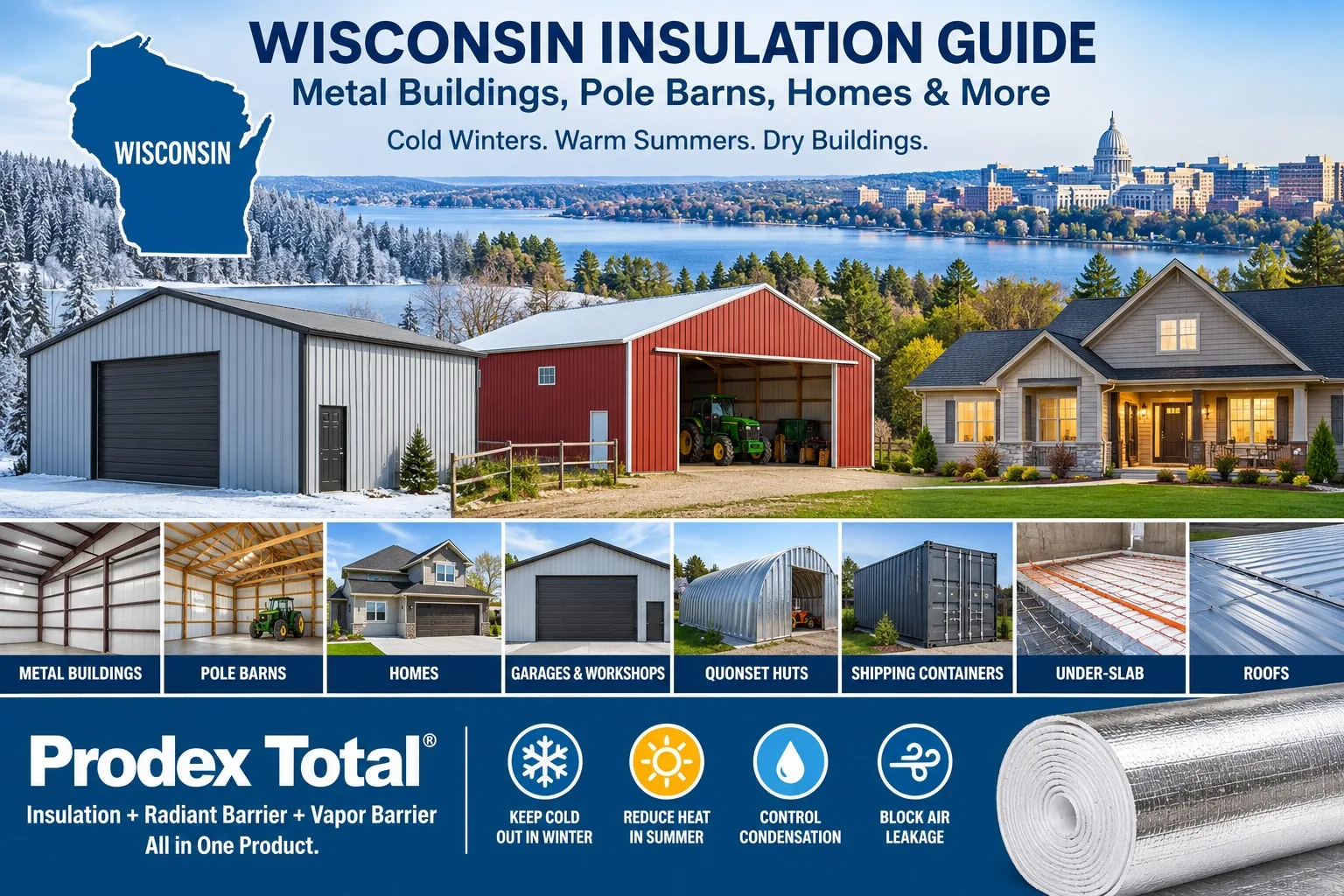
Prodex Total = Insulation + Radiant Barrier + Vapor Barrier — All in One Product.
For insulation information throughout the United States, visit our Insulation by State Guide.
Wisconsin Climate and Insulation Challenges
Wisconsin's climate varies considerably between northern, central and southern regions.
Northern Wisconsin, including Superior, Ashland and Rhinelander, experiences particularly cold winters and prolonged heating seasons. Central Wisconsin, including Wausau and Stevens Point, experiences substantial winter cold along with warm summer conditions.
Southern Wisconsin, including Madison, Milwaukee and Janesville, generally has somewhat milder winters but still faces freezing temperatures, snow, summer heat and humidity.
Areas near Lake Michigan and Lake Superior also experience lake-influenced weather conditions.
These differences affect building insulation requirements, moisture management and heating and cooling demands.
Winter Heat Loss
Cold Wisconsin winters create substantial temperature differences between heated building interiors and the outdoors. Heat moves through roofs, walls, floors and structural framing. Uncontrolled air leakage can further increase heating demands. An effective insulation assembly should limit unwanted heat transfer while addressing gaps, joints and thermal bridges.
Summer Radiant Heat
Although Wisconsin is known for cold winters, summer heat is also an important consideration. Sunlight can heat metal roofing well above the surrounding air temperature. The hot roof surface can then radiate energy toward the interior. This is especially relevant in metal buildings, pole barns, garages, workshops and agricultural structures. Reflective insulation can help reduce radiant heat transfer when installed with an appropriate adjacent air space.
Condensation and Moisture
Condensation is a common concern in metal buildings throughout Wisconsin. When warm, moisture-containing air contacts a cold metal surface, water droplets can form if the surface temperature is at or below the dew point. Potential consequences include dripping, corrosion, wet building materials and damage to stored equipment. Condensation control requires attention to insulation continuity, air leakage, vapor movement and indoor humidity.
Metal Building Insulation in Wisconsin
Metal buildings are used throughout Wisconsin for equipment storage, agricultural operations, manufacturing, commercial warehouses, vehicle maintenance and workshops.
Steel conducts heat readily, making metal buildings vulnerable to winter heat loss, summer solar heating and condensation.
An effective metal-building insulation system should consider:
Conductive heat transfer through metal panels and framing
Radiant heat beneath sun-exposed roofs
Condensation on cold steel surfaces
Air leakage through joints and openings
Moisture and vapor control
Building occupancy and heating requirements
Prodex Total combines a closed-cell polyethylene foam core with reinforced reflective surfaces. When installed appropriately, it can contribute thermal resistance, radiant heat control, air-barrier performance and vapor control. Fiberglass, spray foam and rigid foam board are also options, depending on the building's required performance and assembly. For material comparisons and installation considerations, read our national Metal Building Insulation Guide.
Our Wisconsin Metal Building Insulation article will examine these challenges in greater detail.
Pole Barn Insulation in Wisconsin
Pole barns and post-frame buildings are important parts of Wisconsin's agricultural and rural landscape. They are commonly used for farm equipment, machinery storage, livestock, vehicle maintenance, workshops and commercial operations. Some buildings remain unheated, while others are heated throughout the winter.
These differences matter.
A heated repair workshop requires a different insulation strategy from an unconditioned machinery shed. Livestock buildings may also generate substantial interior moisture, making ventilation and humidity control particularly important. Large metal roofs can create significant radiant heat and condensation concerns. A well-designed pole barn insulation system should account for winter thermal resistance, air sealing, roof and wall construction, moisture management and the intended building use.
Explore our national Pole Barn Insulation Guide for a comprehensive overview.
House Insulation in Wisconsin
Wisconsin homes require insulation systems that provide effective winter thermal resistance while also addressing summer cooling, air leakage and moisture.
Important areas include:
Attics and roof assemblies
Exterior walls
Basements and foundation walls
Crawlspaces
Rim joists
Floors above unconditioned spaces
Attached garages
Fiberglass, cellulose, mineral wool, spray foam and rigid foam board may be used in different parts of the building envelope. The correct insulation strategy depends on construction details, required R-values, air sealing and moisture control. For example, basement insulation must account for foundation moisture, while attic insulation must be coordinated with air sealing and the roof's ventilation or unvented assembly design.
Learn more in our House Insulation Guide.
Roof Insulation in Wisconsin
Roofs are a major pathway for heat transfer.
During Wisconsin winters, inadequate roof insulation can contribute to heat loss, higher heating demands and uneven indoor temperatures. In some roof assemblies, heat escaping through the roof can contribute to snow melting and refreezing near colder eaves, increasing the risk of ice dams. During summer, roof surfaces receive direct sunlight and may transfer heat toward the interior. Metal roofs introduce additional considerations involving radiant heat, thermal bridging and condensation. Proper roof insulation should be selected as part of the complete roof assembly, including air sealing, moisture control and ventilation where appropriate.
For additional information, visit our Roof Insulation Guide.
Metal Garage and Workshop Insulation in Wisconsin
Wisconsin garages and workshops may be used for vehicle maintenance, woodworking, farm equipment repairs, storage or commercial operations. Many are constructed with metal roofing and siding. During winter, uninsulated garages can become extremely cold. During summer, solar heat gain through metal roofing can make working conditions uncomfortable. Heated garages also require attention to air leakage, condensation and the thermal performance of doors, walls and roofs. Prodex Total may be suitable for some metal garage and workshop assemblies, while fiberglass, spray foam and foam board offer alternative approaches.
Learn more in our Metal Garage and Workshop Insulation Guide.
Shipping Container Insulation in Wisconsin
Shipping containers present distinctive insulation challenges because their walls and roofs are constructed from steel. Wisconsin's winter temperatures can make the interior steel surfaces extremely cold. When interior air contains moisture, condensation can develop on the metal shell. Summer sunlight can also heat the container substantially. Because shipping containers have limited interior space, insulation thickness and installation details are important. Options include reflective insulation, spray foam, rigid foam board and combinations of materials. The selected system should address thermal resistance, condensation, air leakage and interior space limitations.
See our Shipping Container Insulation Guide.
Quonset Hut Insulation in Wisconsin
Quonset huts feature curved steel walls and roofs that create unusual insulation and attachment requirements. Their metal shells experience Wisconsin's seasonal temperature extremes, making thermal performance and condensation control important. Flexible insulation materials can be useful because they can follow the building's curved shape. Installation methods must account for secure attachment, insulation continuity and proper seam treatment.
Our Quonset Hut Insulation Installation Guide explains application-specific installation considerations.
Under-Slab Insulation in Wisconsin
Concrete floors can transfer heat into the ground, particularly in heated buildings. Under-slab insulation may help reduce heat loss and improve floor comfort in homes, garages, workshops, pole barns and commercial buildings. It is particularly relevant for radiant-heated concrete floors. Important material characteristics include thermal resistance, compressive strength, moisture resistance and compatibility with the slab assembly. Rigid foam board products designed for below-slab use are one option. Prodex Total Under Concrete is another product designed for appropriate under-slab applications. When installing Prodex Total Under Concrete, the white side faces upward toward the concrete, while the foil side faces downward toward the ground.
Explore our Under-Slab Insulation Guide for more information.
Comparing Insulation Materials for Wisconsin Buildings
Choosing insulation based solely on advertised R-value can overlook important differences in how insulation systems manage air movement, radiant heat and moisture. The following materials offer different advantages.
Prodex Total Reflective Insulation
Prodex Total combines a closed-cell polyethylene foam core with reinforced reflective surfaces. Depending on the product and installation, it can provide thermal resistance, radiant heat reduction, vapor control and air-barrier performance. It is particularly relevant to metal buildings, pole barns, garages, workshops and other structures where condensation and radiant heat are important considerations. Reflective performance depends on the installation assembly, including appropriate adjacent air spaces.
Learn more in our Reflective Insulation Guide.
Fiberglass Insulation
Fiberglass is widely used in residential, agricultural and commercial construction. It provides conductive thermal resistance and is available in different thicknesses and R-values. However, fiberglass alone does not form a complete air barrier or reflective radiant barrier. Its performance depends on proper installation, avoiding gaps and compression, and managing moisture within the building assembly. In some applications, fiberglass and Prodex Total can be combined to provide complementary insulation functions.
See our Fiberglass Metal Building Insulation Guide.
Spray Foam Insulation
Spray polyurethane foam expands during application, allowing it to fill many gaps and irregular spaces. It can provide strong air sealing and conductive thermal resistance. Closed-cell spray foam generally provides greater R-value per inch and moisture resistance than open-cell spray foam, although the appropriate choice depends on the building assembly. Considerations include installed cost, surface preparation, installer experience, curing conditions, fire protection and future access to roof or wall panels. For Wisconsin metal buildings and pole barns, spray foam should be compared with other systems that address radiant heat, condensation and thermal bridging.
Read our comprehensive Spray Foam Insulation Guide for Metal Buildings and Pole Barns.
Foam Board Insulation
Foam board insulation consists of rigid panels designed to reduce conductive heat transfer. Common types include expanded polystyrene (EPS), extruded polystyrene (XPS) and polyisocyanurate. Foam board can be useful for continuous insulation, foundation walls, basements, roofs and certain under-slab applications. However, the products differ in thermal resistance, moisture characteristics, compressive strength and temperature performance. Proper installation requires attention to panel joints, penetrations, attachment and fire-protection requirements.
For a complete comparison, explore our Foam Board Insulation Guide.
Choosing the Right Insulation for Your Wisconsin Building
The best insulation system depends on the structure and its intended use.
| Building type | Major insulation considerations |
|---|---|
| Metal building | Heat loss, radiant heat, condensation and thermal bridging |
| Pole barn | Roof condensation, moisture, winter temperatures and building use |
| House | Code-required thermal resistance, air sealing and moisture control |
| Garage or workshop | Heating requirements, roof heat, air leakage and condensation |
| Roof or attic | Heat loss, air sealing, moisture and roof assembly design |
| Shipping container | Steel condensation, limited space and thermal resistance |
| Quonset hut | Curved surfaces, fastening and insulation continuity |
| Concrete slab | Ground heat loss, moisture and compressive strength |
No single insulation material is ideal for every application.
In some buildings, combining materials produces a more suitable assembly than relying on one product alone.
How Much Insulation Do You Need in Wisconsin?
Before ordering insulation, calculate the roof, wall or floor area you intend to cover. For metal buildings, pole barns and garages, consider building length, width, wall height, roof slope and the installation method. Use our Advanced Insulation Calculator to estimate the amount of insulation needed. For additional measuring guidance, visit How Much Insulation Do I Need?.
Wisconsin Insulation Requirements and Building Codes
Wisconsin's climate creates significant heating-season demands, but insulation requirements depend on more than outdoor temperatures. Applicable requirements can vary according to building type, occupancy, construction method, location and the governing code. Homes, heated commercial buildings, agricultural structures and unconditioned storage buildings may have different requirements. Wisconsin includes cold-climate regions where building-envelope design and moisture control deserve particular attention. Before selecting insulation for a project with specific code requirements, verify the applicable standards with the local building department or a qualified building professional.
Do not assume that a product's advertised R-value represents the performance of every possible installation assembly.
Frequently Asked Questions About Wisconsin Insulation
What is the best insulation for a metal building in Wisconsin?
The best choice depends on whether the building is heated, its construction, the required thermal resistance and moisture conditions. Prodex Total, fiberglass, spray foam and foam board may each be suitable for different assemblies.
How do I prevent condensation in a Wisconsin pole barn?
Condensation control requires attention to cold surfaces, indoor humidity, air leakage, insulation continuity and appropriate ventilation. The best strategy depends on whether the pole barn is heated, unheated or used for livestock.
Is reflective insulation effective in cold Wisconsin winters?
Reflective insulation can contribute to winter performance, but the results depend on the product and assembly. Reflective surfaces require appropriate adjacent air spaces for their intended radiant performance, and code-required thermal resistance must still be satisfied.
Can I combine Prodex Total with fiberglass insulation?
Yes. The materials can be used together in appropriately designed assemblies. Fiberglass provides conductive thermal resistance, while Prodex may provide additional radiant, air and vapor-control functions.
Is spray foam insulation better for Wisconsin buildings?
Spray foam offers strong air sealing and high thermal resistance, particularly in closed-cell formulations. However, it is not automatically the best option for every building. Cost, installation, radiant heat, moisture and future maintenance should also be considered.
Where is foam board insulation commonly used in Wisconsin?
Rigid foam board is commonly used in foundations, basements, continuous wall insulation, roofs and suitable under-slab assemblies. The appropriate foam type depends on the application.
Should I insulate beneath a heated concrete floor?
Under-slab insulation is often beneficial for heated concrete floors because it reduces downward heat transfer. The design should account for insulation strength, moisture and the floor's heating requirements.
Does every Wisconsin building need the same R-value?
No. Insulation requirements depend on building type, location, occupancy, construction and applicable energy codes.
How do I calculate insulation quantities?
Use the Advanced Insulation Calculator to estimate the material required for your building.
Explore More Wisconsin Insulation Guides
Our Wisconsin insulation collection will provide detailed information for specific building types.
The following companion guides will be linked as they are published:
Wisconsin Metal Building Insulation
Wisconsin Pole Barn Insulation
Wisconsin Metal Garage & Workshop Insulation
Wisconsin Roof Insulation
Wisconsin Shipping Container Insulation
Wisconsin Quonset Hut Insulation
Wisconsin Under-Slab Insulation
Wisconsin House Insulation
Fiberglass vs. Prodex Total for Wisconsin Buildings
Each guide will explain application-specific challenges, material comparisons and installation considerations.
Find the Right Insulation for Your Wisconsin Project
Whether you are insulating a metal building in Milwaukee, a pole barn near Eau Claire, a workshop in Wausau or a home in Green Bay, selecting insulation begins with understanding the conditions your building faces. Wisconsin's cold winters make thermal resistance and air sealing especially important. Summer sunshine, changing humidity and condensation risks mean that radiant heat and moisture management should also be considered.
Choose insulation as part of a complete building system rather than relying on one performance number.
Prodex Total = Insulation + Radiant Barrier + Vapor Barrier — All in One Product.
Cool in the Summer. Warm in the Winter. Dry all the Time.
Use our Advanced Insulation Calculator to plan your insulation project.