
The Ultimate Spray Foam Insulation Guide: Cost, DIY Kits, R-Value, Open vs. Closed Cell & Expert Comparisons
Thinking about spray foam insulation? Whether you're insulating a house, attic, walls, metal building, pole barn, garage, workshop, shipping container, barndominium, or commercial building, this comprehensive guide explains everything you need to know before purchasing, choosing, or installing spray foam insulation.
You'll learn how spray foam insulation works, compare open-cell and closed-cell spray foam, understand spray foam insulation costs, evaluate DIY spray foam insulation kits, learn how R-value affects thermal performance, and explore important topics such as moisture control, condensation, energy efficiency, air sealing, and common installation problems. We'll also compare spray foam with fiberglass insulation, mineral wool, cellulose, rigid foam board, and reflective insulation - to help you choose the insulation system that best matches your building, climate, budget, and long-term performance goals. On the subject of reflective insulation, see 10M Prodex Total Insulation Plus - The standard bearer in the industry.
Whether you're a homeowner, contractor, builder, architect, farmer, or commercial property owner, this guide combines building science, practical installation advice, cost comparisons, and real-world performance insights to help you confidently choose the best insulation system for your project.
Choosing the right insulation is one of the most important decisions you'll make when building or improving a home, garage, workshop, metal building, pole barn, barndominium, warehouse, shipping container, or commercial facility. The insulation you choose affects far more than indoor temperatures—it influences energy costs, comfort, condensation control, moisture management, indoor air quality, and the long-term durability of the building itself. It also affects heating and cooling costs, HVAC efficiency, occupant comfort, and the overall performance of your building envelope for decades to come.
Spray foam insulation has become one of the most widely discussed insulation products because it combines thermal insulation, air sealing, and energy efficiency into a single system. Homeowners appreciate its potential to reduce heating and cooling costs, while contractors value its ability to expand into irregular spaces that are difficult to insulate using traditional materials.
At the same time, spray foam is also one of the most misunderstood insulation systems. Questions about cost, R-value, open-cell versus closed-cell foam, DIY spray foam kits, installation methods, building code considerations, moisture performance, condensation control, long-term durability, and overall value are common. There is also considerable confusion about how spray foam compares with fiberglass, mineral wool, cellulose, rigid foam board, and reflective insulation.
The truth is that there is no single insulation product that is ideal for every building or every application. The best insulation depends on the building design, climate, budget, installation method, moisture conditions, and the types of heat transfer you are trying to control. Understanding the strengths and limitations of each insulation system is often more important than simply choosing the product with the highest advertised R-value.
This guide was written to provide objective, practical, and easy-to-understand information for homeowners, contractors, builders, architects, farmers, and commercial property owners.
Whether you're insulating a new home, upgrading an existing garage, building a pole barn, finishing a metal workshop, converting a shipping container, or trying to eliminate condensation beneath a steel roof, you'll learn:
How spray foam insulation works
The differences between open-cell and closed-cell spray foam
How spray foam compares with fiberglass, mineral wool, cellulose, rigid foam board, and reflective insulation
How R-value, radiant heat, air sealing, condensation, and moisture control affect building performance
The advantages and limitations of spray foam insulation
How to estimate costs and evaluate DIY spray foam insulation kits
How to choose the right insulation system for your specific project
If you're specifically researching insulation for metal buildings or pole barns, you may also find our Metal Building Insulation Guide and Pole Barn Insulation Guide helpful. These in-depth resources explain the unique challenges of radiant heat, condensation, thermal bridging, air leakage, and moisture control in steel-framed buildings while comparing multiple insulation systems for these applications.
You may also find these related resources helpful:
Spray Foam vs. Fiberglass, Rigid Board and Prodex Insulation
Prodex Total Insulation vs. Spray Foam Insulation for Metal Buildings
What You'll Learn
This guide contains 10 in-depth chapters, more than 60 frequently asked questions, detailed comparison tables, expert buying advice, custom illustrations, practical installation guidance, and side-by-side insulation comparisons to help you confidently choose the best insulation system for your project.
Before We Compare Insulation Systems
Before comparing spray foam with other insulation systems—or discussing costs, R-values, and installation methods—it’s important to understand what spray foam insulation actually is and how it works.
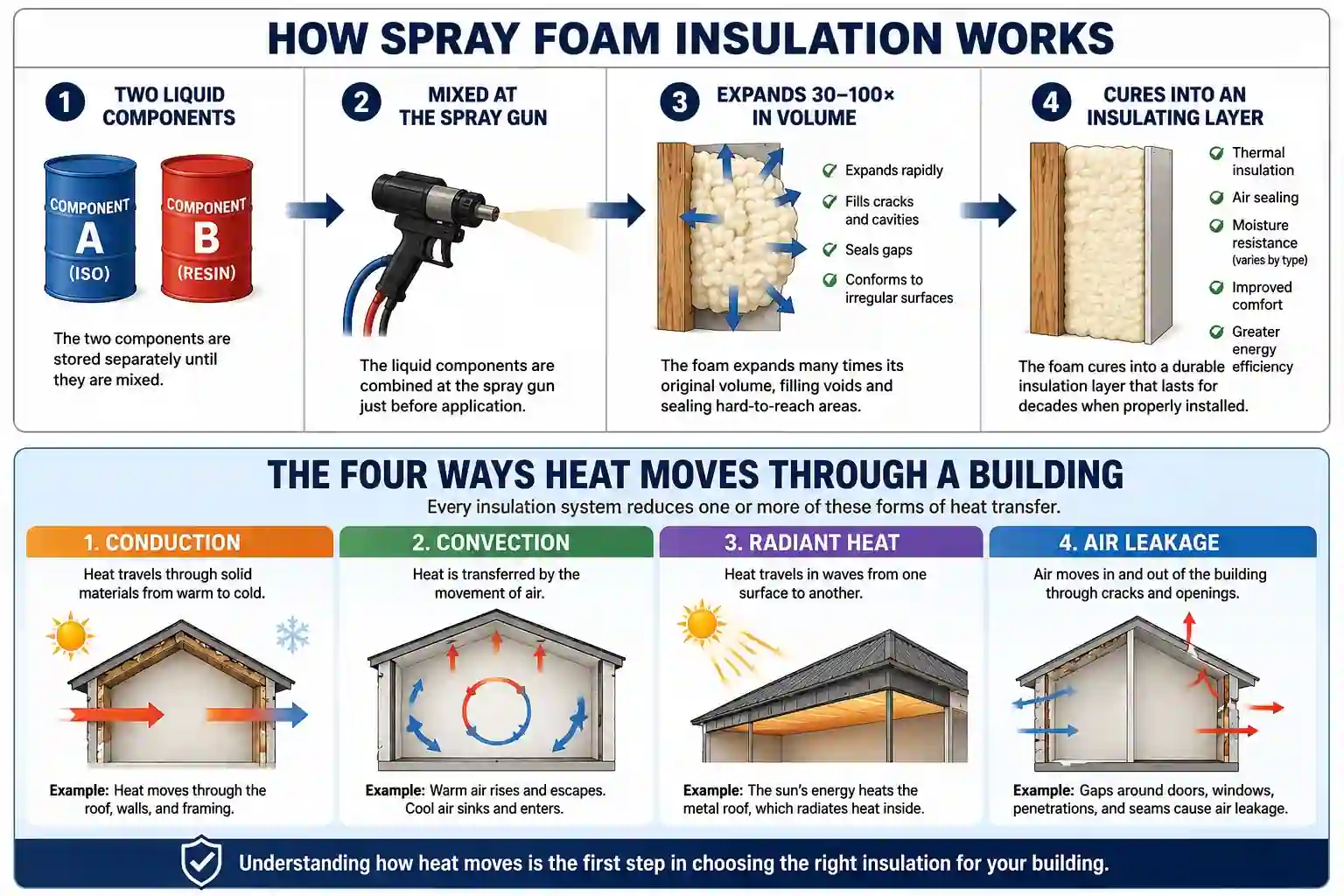
Figure 1. How Spray Foam Works. Two liquid components combine at the spray gun, rapidly expand after application, fill cracks and irregular cavities, then cure into a continuous insulation layer that helps reduce air leakage while providing thermal resistance. Click image to enlarge.
"Before comparing spray foam with other insulation systems—or discussing costs, R-values, and installation methods—it’s important to understand what spray foam insulation actually is and how it works."
In the next section, we’ll explain the chemistry behind spray foam, how it expands after application, the difference between one-component and two-component foam, and why understanding the four types of heat transfer is essential when choosing the best insulation for any building.
Table of Contents
What Is Spray Foam Insulation?
How Spray Foam Insulation Works
One-Component vs. Two-Component Spray Foam
Open-Cell vs. Closed-Cell Spray Foam
Understanding the Four Types of Heat Transfer
Types of Spray Foam Insulation
Open-Cell Spray Foam
Closed-Cell Spray Foam
Which Type Is Right for Your Project?
Understanding Spray Foam Insulation R-Value
What R-Value Means
R-Value per Inch
Why R-Value Isn't the Only Performance Factor
Common R-Value Misconceptions
Spray Foam Insulation Cost
What Affects Cost?
DIY vs. Professional Installation
Cost per Square Foot
Long-Term Value
DIY Spray Foam Insulation
DIY Spray Foam Insulation Kits
When DIY Makes Sense
Common Installation Mistakes
Safety Considerations
Where Can Spray Foam Insulation Be Used?
Homes
Attics
Walls
Crawl Spaces
Basements
Garages & Workshops
Metal Buildings
Pole Barns
Barndominiums
Shipping Containers
Commercial Buildings
Agricultural Buildings
How to Choose the Right Insulation for Your Building
Which Insulation Is Right for Your Building?
Comparing Building Types
Comparing Performance Priorities
Choosing the Best Insulation System
Common Spray Foam Insulation Problems
Installation Errors
Moisture Issues
Shrinkage & Cracking
Roof Leaks
When Spray Foam Isn't the Best Choice
Spray Foam Insulation Pros & Cons
Advantages
Disadvantages
When Spray Foam Excels
When Another Insulation May Be Better
Frequently Asked Questions
General Questions
Cost & Installation
Performance & R-Value
Metal Buildings & Pole Barns
Safety & Fire Protection
Repairs, Maintenance & Comparisons
What Is Spray Foam Insulation?
Spray foam insulation is a polyurethane-based insulation system that begins as two separate liquid components. When these components are mixed together at the spray gun, they react chemically, expand many times their original volume, and cure into a durable insulation layer.
Unlike fiberglass batts, mineral wool, cellulose, or rigid foam board insulation, spray foam is applied as a liquid. This allows it to expand into cracks, gaps, and irregular spaces while creating a continuous layer of insulation that helps reduce unwanted air leakage.
Because of its ability to both insulate and air seal, spray foam is widely used in:
- Homes
- Attics
- Crawl spaces
- Basements
- Garages
- Workshops
- Metal buildings
- Pole barns
- Agricultural buildings
- Warehouses
- Shipping containers
- Barndominiums
- Commercial buildings
Every building has different insulation requirements. For example, a home may prioritize energy efficiency and comfort, while a steel building must also address radiant heat, thermal bridging, and condensation. If you're insulating a steel structure, our Metal Building Insulation Guide explains these challenges in much greater detail.
Quick Answer
Spray foam insulation is a two-component polyurethane insulation that expands after application to create thermal insulation while sealing many gaps that allow unwanted air movement. It is commonly used in homes, garages, attics, metal buildings, pole barns, and commercial buildings where improved energy efficiency and air sealing are desired.
How Spray Foam Insulation Works
Unlike traditional insulation products that are manufactured into batts, blankets, or boards, spray foam insulation is created during installation.
Two liquid chemical components—commonly referred to as the "A" and "B" sides—are stored separately until they are combined at the spray gun. Once mixed, a chemical reaction begins almost immediately.
Within seconds, the material expands dramatically before curing into either open-cell or closed-cell foam, depending on the product being installed.
As the foam expands, it conforms to the shape of the surrounding surfaces, filling many small gaps and irregular spaces that would otherwise allow unwanted air movement.
When properly installed, spray foam can provide:
- Thermal insulation
- Air sealing
- Reduced drafts
- Improved indoor comfort
- Lower heating and cooling loads
- Enhanced energy efficiency
Some spray foam products also provide varying levels of moisture resistance and vapor control, depending on the formulation and installed thickness.
Although spray foam offers several advantages, no insulation system is ideal for every application. Understanding how heat moves through a building is the key to selecting the best insulation system for your specific project.
Why Buildings Get Hot, Cold, and Wet
Many people believe insulation has only one purpose—keeping a building warm during winter. In reality, insulation works throughout the year. During summer, insulation slows unwanted heat entering the building. During winter, it slows valuable indoor heat from escaping. In many structures, insulation also plays an important role in reducing condensation, improving comfort, and lowering heating and cooling costs. Whether you're insulating a home, garage, Pole Barn, warehouse, or Shipping Container, heat is constantly trying to move from warmer areas to cooler areas. The greater the temperature difference, the faster heat attempts to equalize those temperatures.
To understand why different insulation products perform differently, it's important to understand the four primary ways heat moves through a building.
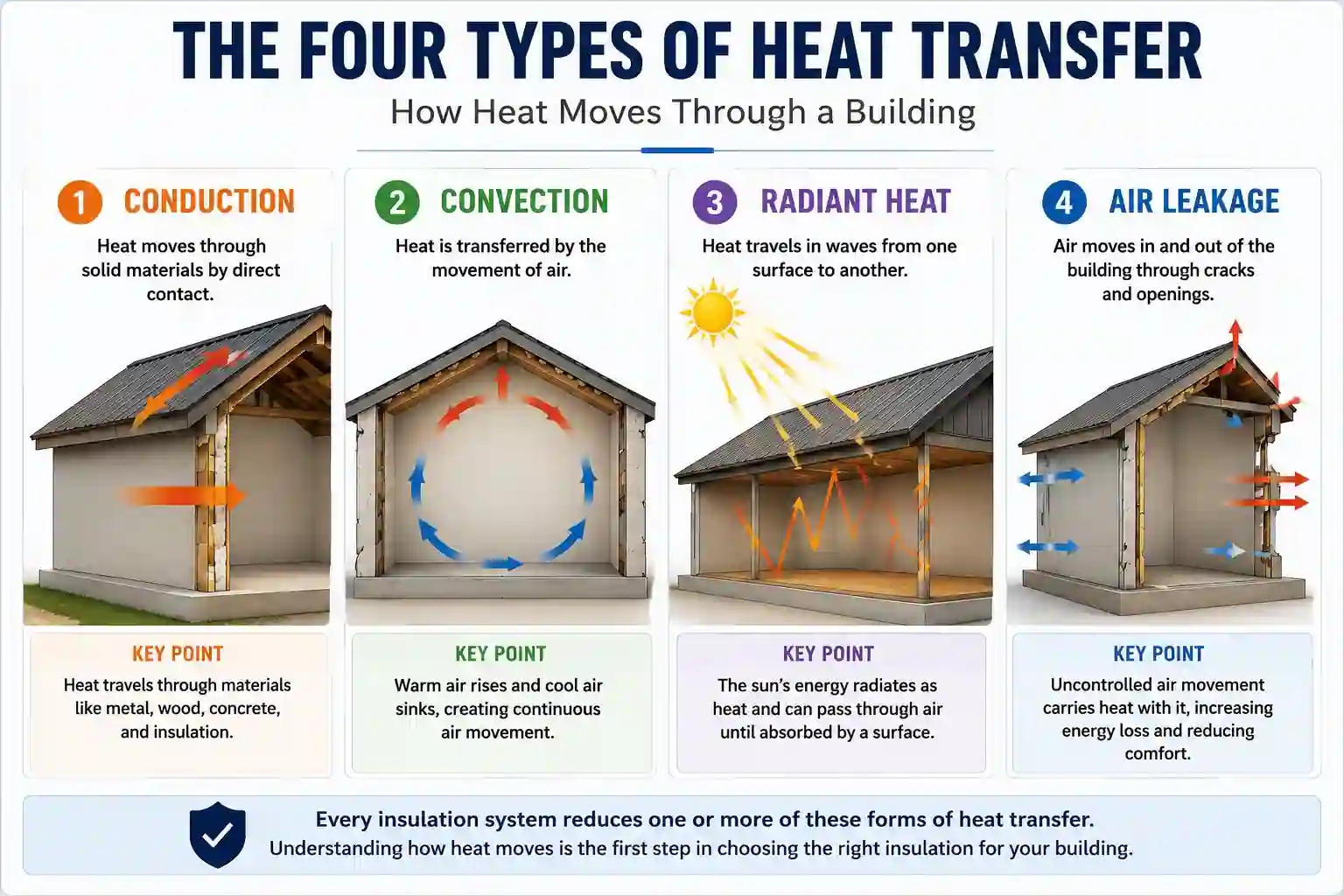
The Four Types of Heat Transfer
Every insulation system is designed to reduce one or more forms of heat transfer. No insulation material addresses every form equally well. Understanding these four mechanisms will help you evaluate not only spray foam, but also fiberglass, mineral wool, cellulose, and Reflective Insulation much more accurately than simply comparing R-values.
Conduction
Conduction is heat moving directly through a solid material. If you've ever touched a hot frying pan, you've experienced conduction. The heat traveled through the metal handle into your hand. The same process occurs every day in buildings. During summer, roofing, wall panels, framing, and other building materials absorb heat from the sun. That heat is conducted through the material toward the cooler interior. During winter, indoor heat conducts outward through walls and roofs toward colder outdoor temperatures.
R-value measures a material's resistance to this type of conductive heat flow.
Convection
Convection is heat transferred through moving air. Warm air naturally rises while cooler air sinks, creating continuous air movement inside a building. If conditioned indoor air escapes through openings around windows, doors, plumbing penetrations, electrical boxes, or roof assemblies, your HVAC system must work harder to replace that lost air. One of spray foam insulation's greatest strengths is its ability to expand and seal many of these air leaks while simultaneously providing thermal insulation.
Radiant Heat
Radiant heat behaves differently than conduction and convection. Instead of moving through materials or air, radiant energy travels in electromagnetic waves.
The sun is the best example.
Even though outer space is nearly a vacuum, radiant energy travels millions of miles before heating roofs, walls, vehicles, and buildings here on Earth. This is particularly important for metal buildings because steel roofing absorbs enormous amounts of solar radiation throughout the day. Traditional insulation primarily slows conductive heat flow after the roof has already become hot.
Reflective insulation works differently.
When installed with the proper adjacent air space, reflective insulation is specifically designed to reduce radiant heat transfer before much of that solar energy enters the building. Our Reflective Insulation Guide explains radiant heat in much greater detail and why it plays such an important role in metal buildings, garages, pole barns, and shipping containers.
Air Leakage
Air leakage deserves special attention because it is responsible for a surprising amount of energy loss. Small openings around framing, plumbing, wiring, ridge vents, and other building penetrations allow conditioned indoor air to escape while permitting outside air to enter. This uncontrolled air movement increases heating and cooling costs, reduces comfort, contributes to condensation, and places additional demands on HVAC systems. Because spray foam expands after application, it can seal many of these openings while simultaneously providing insulation.
Other insulation systems often require a separate air barrier to achieve similar levels of air sealing.
Why Understanding Heat Transfer Matters
Many insulation comparisons focus almost exclusively on R-value. While R-value is extremely important, it measures only one aspect of insulation performance.
Successful insulation systems should also consider:
- Air leakage
- Radiant heat
- Moisture movement
- Condensation control
- Thermal bridging
- Installation quality
Different insulation systems excel in different areas.
Rather than asking:
"Which insulation has the highest R-value?"
A better question is:
"Which insulation best addresses the specific challenges affecting my building?"
Answering that question will almost always lead to a better insulation decision.
Types of Spray Foam Insulation
Not all spray foam insulation is the same.
When people talk about "spray foam insulation," they are usually referring to one of two products:
- Open-cell spray foam
- Closed-cell spray foam
While both are polyurethane-based insulation systems that expand after application, they differ significantly in density, R-value, moisture resistance, strength, cost, and recommended applications.
Choosing between open-cell and closed-cell spray foam is not simply a matter of selecting the product with the higher R-value. The right choice depends on your climate, building design, available cavity depth, moisture conditions, budget, and overall performance goals.
Understanding the differences between these two products is one of the most important steps in selecting the right insulation for your project.
Quick Answer
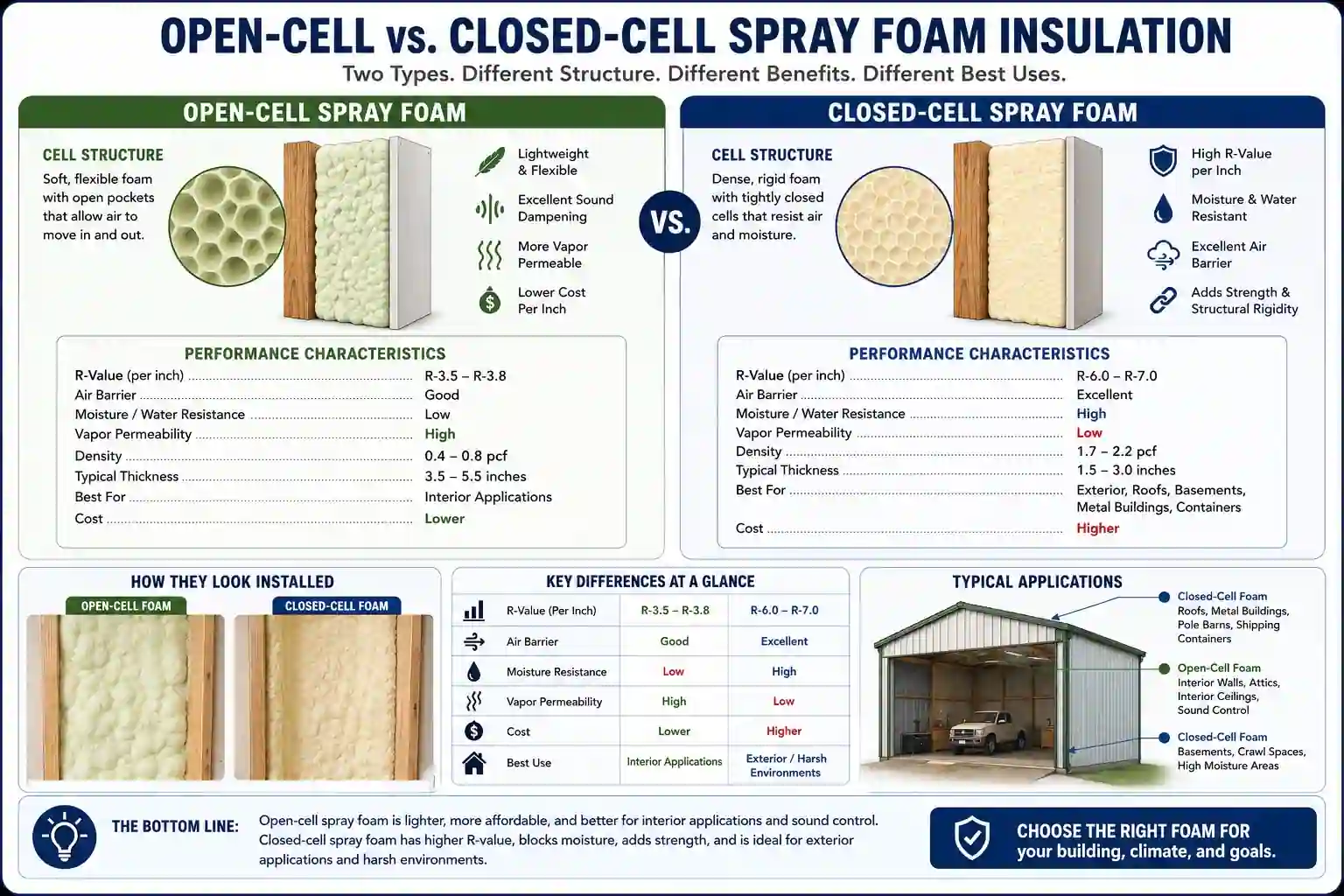
Open-cell spray foam is lighter, softer, and generally less expensive. It expands more during installation, making it well suited for filling large wall and ceiling cavities while also providing excellent sound dampening. Closed-cell spray foam is denser, more rigid, and provides a higher R-value per inch. It offers greater resistance to moisture and is often selected for applications where space is limited or additional durability is desired.
Neither product is automatically better.
The best choice depends on the building, the climate, and the specific problems you're trying to solve.
What Is Open-Cell Spray Foam?
Open-cell spray foam is a low-density insulation made up of millions of tiny interconnected cells. Because these cells are not completely enclosed, air fills many of the spaces within the cured foam, creating a softer, more flexible insulation material.
One of the defining characteristics of open-cell spray foam is how much it expands after being applied. The foam rapidly fills wall cavities, roof assemblies, and irregular spaces, making it particularly effective at reducing air leakage while insulating difficult-to-reach areas.
Because open-cell foam uses less raw material than closed-cell foam, it generally costs less while still providing excellent insulating performance for many residential applications.
Open-cell spray foam is commonly used in:
- Interior walls
- Exterior wall cavities
- Attics
- Cathedral ceilings
- Sound-control walls
- Bonus rooms
- Interior partitions
Advantages of Open-Cell Spray Foam
Open-cell spray foam offers several benefits that make it a popular choice for many residential projects.
Excellent Air Sealing
As the foam expands, it fills many cracks, gaps, and irregular spaces that would otherwise allow conditioned air to escape. Reducing uncontrolled air leakage can improve indoor comfort while reducing heating and cooling costs.
Lower Material Cost
Because open-cell foam uses less material and expands more aggressively, it generally costs less than closed-cell spray foam. For projects with deep framing cavities, this lower cost can make open-cell foam an attractive option.
Excellent Sound Dampening
One of open-cell spray foam's biggest advantages is its ability to absorb sound. Its softer structure helps reduce airborne noise between rooms, making it a popular choice for:
- Bedrooms
- Home offices
- Media rooms
- Interior walls
- Multi-family housing
Many homeowners choose open-cell foam as much for sound control as for thermal performance.
Expands Into Irregular Spaces
Open-cell spray foam expands significantly during installation. This allows it to conform around wiring, plumbing, framing, and other irregular building components that are difficult to insulate with batt insulation.
Lightweight
Because it contains more air within its cellular structure, open-cell foam places relatively little additional weight on walls and roof assemblies.
Disadvantages of Open-Cell Spray Foam
Like every insulation product, open-cell spray foam has limitations. Understanding these limitations helps determine whether it is the right choice for a particular project.
Lower R-Value Per Inch
Open-cell spray foam typically provides an R-value of approximately R-3.5 to R-3.8 per inch. While this is suitable for many applications, it requires more thickness than closed-cell spray foam to achieve the same overall thermal resistance. Where wall or roof depth is limited, this can become a disadvantage.
More Vapor Permeable
Unlike closed-cell spray foam, open-cell foam allows more water vapor to move through the insulation. This does not mean water passes freely through the foam, but it does mean open-cell foam should not automatically be considered a vapor barrier.
The appropriate vapor-control strategy depends on:
- Climate
- Building design
- Indoor humidity
- Wall assembly
- Roof assembly
- Local building codes
Less Resistant to Water
Because of its open cellular structure, open-cell spray foam is generally less resistant to water absorption than closed-cell foam. Areas that may experience prolonged moisture exposure often require careful evaluation before selecting open-cell insulation.
Lower Structural Rigidity
Open-cell spray foam remains relatively soft after curing. While this flexibility has advantages, it does not provide the same rigid insulation layer produced by closed-cell foam.
Best Applications for Open-Cell Spray Foam
Open-cell spray foam is commonly selected for projects where:
- Large framing cavities are available
- Sound reduction is important
- Lower material cost is desired
- Air sealing is a priority
- Interior wall assemblies require insulation
- Additional cavity depth is available
It is frequently used in residential homes, finished basements, bonus rooms, and interior partitions where moisture exposure is limited and sound control is valued.
Is Open-Cell Spray Foam a Good Choice for Metal Buildings?
It can be—but not always.
Metal buildings present insulation challenges that differ from conventional wood-frame homes. Large roof surfaces are exposed to intense solar radiation, steel framing creates thermal bridges, and condensation beneath metal roofing can become a significant concern. Because of these conditions, many builders compare open-cell spray foam with other insulation systems specifically designed for steel construction.
If you're insulating a steel building, our Metal Building Insulation Guide explains how radiant heat, condensation, and installation methods influence insulation performance.
Likewise, if you're building a post-frame structure, our Pole Barn Insulation Guide discusses the unique insulation challenges associated with pole barns.
Key Takeaways
- Open-cell spray foam is lightweight, flexible, and expands significantly during installation.
- It typically provides an R-value of approximately R-3.5 to R-3.8 per inch.
- It offers excellent air sealing and sound dampening.
- It generally costs less than closed-cell spray foam.
- It requires greater thickness to achieve the same R-value as closed-cell foam.
- It is more vapor permeable and less resistant to water than closed-cell foam.
- The best application depends on the building design, climate, and performance goals—not simply the insulation type.
What Is Closed-Cell Spray Foam?
Closed-cell spray foam is a high-density polyurethane insulation composed of millions of tiny, completely enclosed cells. Unlike open-cell foam, these sealed cells create a harder, more rigid insulation with greater thermal resistance and increased resistance to moisture.
Because the cells remain closed, the finished foam contains insulating gases that slow conductive heat transfer more effectively than open-cell foam. This is why closed-cell spray foam typically provides nearly twice the R-value per inch of open-cell spray foam. Its dense structure also makes it one of the most durable spray foam insulation products available.
Closed-cell spray foam is commonly used in:
- Exterior walls
- Rim joists
- Crawl spaces
- Foundations
- Metal buildings
- Pole barns
- Shipping containers
- Agricultural buildings
- Commercial facilities
- Refrigerated buildings
- Cold storage applications
It is often selected where maximum insulation performance is needed within limited wall or roof thickness.
Advantages of Closed-Cell Spray Foam
Closed-cell spray foam offers several important advantages that have made it a popular insulation choice for residential, agricultural, commercial, and industrial construction.
Higher R-Value Per Inch
One of the biggest advantages of closed-cell spray foam is its higher thermal resistance. Closed-cell spray foam typically provides approximately R-6 to R-7 per inch, allowing builders to achieve higher insulation values where cavity depth is limited.
This makes it particularly useful in:
- Metal-framed walls
- Shipping containers
- Pole barns
- Existing buildings
- Rim joists
- Renovation projects
where every inch of insulation matters.
Excellent Air Sealing
Like open-cell foam, closed-cell spray foam expands after application, sealing many of the small cracks and gaps that allow conditioned air to escape. Reducing uncontrolled air leakage can improve indoor comfort while helping lower heating and cooling costs.
Greater Moisture Resistance
Closed-cell foam absorbs significantly less water than open-cell spray foam. Its dense cellular structure provides greater resistance to moisture intrusion, making it a common choice in locations where humidity or incidental moisture exposure may occur. Although closed-cell foam is more moisture resistant, it should not be viewed as a solution for roof leaks, plumbing leaks, or poor drainage. Water management should always begin by correcting the source of the moisture.
Dense, Durable Structure
After curing, closed-cell spray foam forms a hard, rigid insulation layer. Its density allows it to withstand incidental contact and maintain its shape better than lower-density insulation materials. This durability makes it popular in demanding environments such as workshops, warehouses, equipment buildings, and agricultural facilities.
Performs Well in Limited Space
Many buildings simply don't have enough wall or roof depth to install thick layers of insulation. Because closed-cell foam provides more thermal resistance per inch, it is often selected where space is limited.
Examples include:
- Shipping containers
- Tiny homes
- Vans
- Steel framing
- Existing buildings
- Mechanical rooms
Disadvantages of Closed-Cell Spray Foam
Despite its many advantages, closed-cell spray foam is not automatically the best insulation for every project. Like all insulation systems, it has limitations that should be considered before making a decision.
Higher Cost
Closed-cell spray foam generally costs more than open-cell foam. Its higher density requires more raw material, increasing both material and installation costs. For projects with large wall and roof areas, the additional cost can become significant.
Professional Installation Is Often Recommended
Closed-cell spray foam requires careful installation.
Proper results depend on:
- Chemical temperature
- Surface temperature
- Correct mixing ratio
- Spray technique
- Lift thickness
- Ventilation
- Surface preparation
Errors during installation can reduce insulation performance and may require costly repairs. Large projects are therefore commonly installed by experienced professionals using specialized equipment.
Future Repairs Can Be More Difficult
One consideration that is often overlooked is future maintenance. When closed-cell spray foam is bonded directly to roof panels or wall panels, replacing damaged steel may require cutting or removing cured foam from the surface. For buildings expected to undergo future roof replacement or remodeling, this can increase labor and repair costs.
Not a Complete Solution for Every Type of Heat Transfer
Closed-cell spray foam is excellent at reducing conductive heat flow and limiting air leakage. However, buildings also gain heat through radiation. This distinction is especially important in metal buildings, where large roof surfaces absorb intense solar energy throughout the day.
Reflective insulation is specifically designed to reduce radiant heat transfer when installed with the proper adjacent air space. If you'd like to better understand this difference, our Reflective Insulation Guide explains how radiant heat behaves and why it is often the largest source of heat gain beneath metal roofs.
Best Applications for Closed-Cell Spray Foam
Closed-cell spray foam is commonly selected when:
- High R-value per inch is needed.
- Wall or roof cavity depth is limited.
- Air sealing is important.
- Greater moisture resistance is desired.
- Additional durability is beneficial.
- A dense insulation layer is preferred.
Typical applications include:
- Exterior walls
- Crawl spaces
- Foundations
- Commercial buildings
- Refrigerated facilities
- Agricultural buildings
- Metal-framed structures
It is also frequently considered for Metal Building Insulation, Pole Barn Insulation, and Shipping Container Insulation projects where insulation thickness is limited and condensation control is an important consideration.
Open-Cell vs. Closed-Cell Spray Foam Comparison
| Feature | Open-Cell Spray Foam | Closed-Cell Spray Foam |
|---|---|---|
| Cell Structure | Open | Closed |
| Density | Low | High |
| Texture | Soft and flexible | Hard and rigid |
| Typical R-Value | R-3.5 to R-3.8 per inch | R-6 to R-7 per inch |
| Air Sealing | Excellent | Excellent |
| Moisture Resistance | Moderate | Greater |
| Vapor Permeability | Higher | Lower |
| Sound Dampening | Excellent | Good |
| Cost | Lower | Higher |
| Expansion | Expands significantly | Expands less |
| Best For | Interior walls, sound control, deep cavities | Limited space, higher R-value, demanding environments |
Which Type of Spray Foam Is Best?
There is no universal answer. The better choice depends on your building, climate, performance goals, and budget.
Open-Cell Spray Foam May Be the Better Choice If:
- Sound reduction is important.
- You have deep framing cavities.
- Lower material cost is a priority.
- The assembly is designed to allow greater vapor permeability.
- Maximum R-value per inch is not required.
Closed-Cell Spray Foam May Be the Better Choice If:
- Space is limited.
- Higher R-value per inch is needed.
- Greater moisture resistance is desired.
- The building may benefit from a denser insulation layer.
- The project involves a crawl space, shipping container, metal framing, or other confined assembly.
Neither product is inherently "better." The best insulation is the one that addresses the specific conditions of your building rather than simply offering the highest published R-value.
Key Takeaways
- Closed-cell spray foam provides approximately R-6 to R-7 per inch, nearly twice the thermal resistance per inch of open-cell foam.
- It offers greater moisture resistance, a denser structure, and excellent air sealing.
- It is generally more expensive and often best installed by experienced professionals.
- Future repairs can be more difficult when foam is adhered directly to roof or wall panels.
- For metal buildings, radiant heat, condensation, and thermal bridging should be evaluated alongside R-value when selecting an insulation system.
- The best insulation choice depends on the building's design, climate, and performance goals—not just whether the foam is open-cell or closed-cell.
Understanding Spray Foam Insulation R-Value
If you've been researching insulation, you've almost certainly come across the term R-value. Manufacturers, contractors, and building codes frequently use R-value to describe insulation performance. It's one of the most important measurements in the insulation industry—but it's also one of the most misunderstood.
Many homeowners assume the insulation with the highest R-value is automatically the best choice.
In reality, R-value is only one part of the equation.
A well-designed insulation system must also consider air leakage, radiant heat, moisture movement, condensation, thermal bridging, and installation quality. Understanding what R-value measures—and what it doesn't—will help you make a much more informed insulation decision.
Quick Answer
R-value measures an insulation material's resistance to conductive heat transfer. The higher the R-value, the greater the material's ability to slow heat moving through it by conduction.
However, R-value does not directly measure:
- Air leakage
- Radiant heat transfer
- Moisture management
- Condensation control
- Thermal bridging
- Installation quality
These factors also have a major impact on how comfortable and energy-efficient a building becomes.

What Is R-Value?
R-value is a standardized measurement of an insulation material's resistance to conductive heat flow.
Simply stated:
The higher the R-value, the more the insulation resists heat traveling through the material.
Think of R-value like resistance in a water pipe. A larger restriction slows the flow of water. Likewise, a higher R-value slows the movement of heat. During winter, this helps keep heated indoor air from losing energy to the colder outdoors. During summer, it slows outdoor heat from moving toward the cooler interior of the building. Because spray foam insulation reduces conductive heat transfer, R-value is one of its most commonly advertised performance characteristics.
How Is R-Value Measured?
R-values are determined using standardized laboratory test methods that allow insulation products to be compared under controlled conditions. These tests measure how well a material resists conductive heat transfer under specific temperatures and testing procedures. Laboratory testing provides an excellent way to compare insulation products, but real-world building performance depends on much more than laboratory conditions.
Actual performance is influenced by:
- Building design
- Climate
- Solar exposure
- Air leakage
- Moisture
- Installation quality
- Thermal bridges
- Occupancy patterns
For this reason, two buildings insulated with products having similar R-values may perform quite differently.
Typical Spray Foam R-Values
Although exact values vary by manufacturer, formulation, and testing conditions, the following ranges are typical:
| Spray Foam Type | Typical R-Value Per Inch |
|---|---|
| Open-Cell Spray Foam | R-3.5 to R-3.8 |
| Closed-Cell Spray Foam | R-6.0 to R-7.0 |
Closed-cell spray foam provides significantly more thermal resistance within the same wall or roof cavity because of its higher density and enclosed cell structure. This higher R-value per inch is one reason it is commonly selected where insulation space is limited.
Why Closed-Cell Spray Foam Has a Higher R-Value
Closed-cell spray foam contains millions of tiny sealed cells. These enclosed cells slow conductive heat movement more effectively than the open cellular structure found in open-cell spray foam. As a result, closed-cell foam can provide more insulation within the same thickness.
This makes it particularly useful in:
- Metal framing
- Shipping containers
- Existing walls
- Crawl spaces
- Rim joists
- Renovation projects
where maximizing insulation thickness may not be possible.
Does a Higher R-Value Always Mean Better Insulation?
No.
This is one of the biggest misconceptions in the insulation industry. R-value measures only conductive heat transfer.
It does not directly evaluate:
- Air leakage
- Solar radiant heat
- Condensation
- Moisture movement
- Thermal bridging
- Installation quality
A building with a high R-value but significant air leaks can still be uncomfortable and expensive to heat or cool. Likewise, a metal building exposed to intense summer sunshine can still experience substantial heat gain if radiant heat is not addressed. Choosing insulation based only on R-value is similar to buying a truck based only on horsepower. Horsepower is important—but it doesn't tell you anything about towing capacity, braking, fuel economy, reliability, or payload.
The same principle applies to insulation.

R-Value and Metal Buildings
Metal buildings behave differently than conventional wood-frame homes. Steel conducts heat extremely well. Large metal roofs absorb enormous amounts of solar energy. Temperature differences beneath steel roofing frequently create condensation.
These buildings are affected by:
- Conductive heat
- Radiant heat
- Air leakage
- Thermal bridging
- Moisture
Spray foam helps reduce conductive heat transfer and air leakage. However, radiant heat behaves differently than conductive heat. When installed with the proper adjacent air space, reflective insulation is specifically designed to reduce radiant heat transfer before much of that energy enters the building.
If you're insulating a steel structure, our Metal Building Insulation Guide explains these unique building science principles in much greater detail.
You may also find our Reflective Insulation Guide helpful for understanding how radiant heat differs from conductive heat.
Understanding Thermal Bridging
Even excellent insulation cannot stop heat that completely bypasses the insulation.
This is known as thermal bridging.
In metal buildings, steel framing members create direct pathways for heat movement because steel is an excellent conductor.
Heat can travel through:
- Steel purlins
- Steel girts
- Metal studs
- Structural framing
- Fasteners
This means the overall wall or roof assembly may perform differently than the published R-value of the insulation alone.
Thermal bridging is one reason complete building assemblies should be evaluated—not just individual insulation products.
Looking Beyond R-Value
When comparing insulation systems, consider all of the following characteristics.
| Performance Factor | Why It Matters |
|---|---|
| R-Value | Slows conductive heat transfer. |
| Air Sealing | Reduces drafts and conditioned air loss. |
| Radiant Heat Control | Especially important beneath metal roofs. |
| Moisture Management | Helps protect building materials and indoor comfort. |
| Condensation Control | Reduces the risk of water forming on interior metal surfaces. |
| Thermal Bridging | Affects the overall performance of the wall or roof assembly. |
| Installation Quality | Poor installation can reduce the effectiveness of any insulation system. |
| Long-Term Durability | Helps determine how the insulation performs over decades of service. |
Looking at the complete performance picture almost always leads to a better insulation decision than comparing R-values alone.
Key Takeaways
- R-value measures resistance to conductive heat transfer.
- Closed-cell spray foam typically provides approximately R-6 to R-7 per inch.
- Open-cell spray foam typically provides approximately R-3.5 to R-3.8 per inch.
- R-value does not directly measure radiant heat, air leakage, condensation, or thermal bridging.
- Building performance depends on the entire insulation system—not just one published R-value.
- The best insulation choice considers the building type, climate, installation quality, and all forms of heat transfer.
Spray Foam Insulation Cost: What Should You Expect to Pay?
Spray foam insulation cost is one of the first concerns homeowners, contractors, and building owners have—and one of the hardest questions to answer with a single number. The final price depends on much more than the size of the building. Spray foam type, required thickness, surface area, accessibility, preparation, labor rates, code requirements, and installation conditions all influence the completed cost. A small rim-joist project may require only a few hundred board feet. Insulating an entire home, metal building, pole barn, warehouse, or commercial roof can require thousands—or tens of thousands—of board feet. That difference can turn spray foam from a manageable small-project expense into a substantial whole-building investment.
Before estimating cost, first determine the total area you need to insulate and the amount of material your project may require. Our How Much Insulation Do I Need? guide explains how to estimate insulation requirements for roofs, walls, ceilings, metal buildings, pole barns, homes, and other structures.
Quick Answer
Professionally installed open-cell spray foam generally costs less than closed-cell foam because it has a lower density and requires less raw material. Current national planning estimates commonly place installed open-cell foam at approximately $0.60 to $1.60 per board foot and closed-cell foam at approximately $1.30 to $3.10 per board foot. Actual contractor quotes can fall outside these ranges depending on the project, location, thickness, accessibility, and included work.
The only reliable way to determine your project cost is to compare detailed proposals that specify:
Foam type
Installed thickness
Total board feet
Areas included
Surface preparation
Protective coatings
Equipment and access
Cleanup and disposal
Average Spray Foam Insulation Cost per Board Foot
Spray foam is commonly priced by the board foot.
| Spray Foam Type | Approximate Installed Cost per Board Foot |
|---|---|
| Open-cell spray foam | $0.60–$1.60 |
| Closed-cell spray foam | $1.30–$3.10 |
These are broad national budgeting ranges—not fixed prices. Large, accessible projects may be priced lower per board foot, while small, difficult, remote, or highly detailed projects may cost considerably more.
What Is a Board Foot of Spray Foam?
One board foot is a volume measuring: 12 inches wide × 12 inches long × 1 inch thick
In practical terms, that means one board foot covers one square foot at a thickness of one inch. The Spray Polyurethane Foam Alliance uses this same definition for spray polyurethane foam materials. Use this formula:
Surface area in square feet × foam thickness in inches = total board feet
For example, insulating 1,000 square feet at two inches thick requires: 1,000 × 2 = 2,000 board feet
The thickness must always be included when comparing prices. A quote of “$2 per square foot” does not provide enough information unless it also states whether the contractor is applying one inch, two inches, three inches, or more.
Spray Foam Cost Calculation Example
Suppose you want to insulate 1,000 square feet at a thickness of two inches.
The project requires: 1,000 square feet × 2 inches = 2,000 board feet
Using the broad installed planning ranges above:
| Foam Type | Calculation | Approximate Planning Cost |
|---|---|---|
| Open-cell spray foam | 2,000 × $0.60–$1.60 | $1,200–$3,200 |
| Closed-cell spray foam | 2,000 × $1.30–$3.10 | $2,600–$6,200 |
This example covers only the spray foam installation at the stated pricing range. It may not include demolition, old-insulation removal, surface repairs, lifts, fire-protective coatings, interior finishes, ventilation changes, or other project-specific expenses.
Spray Foam Cost per Square Foot
Board-foot pricing can be converted into square-foot pricing by multiplying the board-foot rate by the installed thickness.
For example, at $1.50 per board foot:
| Installed Thickness | Cost per Square Foot |
|---|---|
| 1 inch | $1.50 |
| 2 inches | $3.00 |
| 3 inches | $4.50 |
| 4 inches | $6.00 |
| 5 inches | $7.50 |
This is why a low square-foot price may not represent a lower-cost insulation system. It may simply represent a thinner application.
Before accepting a proposal, ask:
What thickness will be installed?
Is that the minimum or average thickness?
What total R-value is expected?
How will thickness be verified?
Are framing members included in the measured area?
Will uneven or missed areas be corrected?
Why Closed-Cell Spray Foam Costs More
Closed-cell spray foam is denser than open-cell foam. Because it contains more material per cubic foot, it generally costs more to manufacture and install. It also provides greater R-value per inch, meaning less thickness may be needed to reach a particular thermal target.
The correct cost comparison is therefore not always: One inch of open-cell vs. one inch of closed-cell
A more meaningful comparison may be: The amount of each product needed to reach the project’s required performance
Closed-cell foam may cost more per board foot but require less cavity depth. Open-cell foam may cost less per board foot but need greater thickness.
The best choice depends on the assembly, climate, available space, and moisture-control strategy—not simply the lowest unit price.
What Affects Spray Foam Insulation Cost?
Foam Type
Open-cell foam generally costs less. Closed-cell foam typically costs more because of its greater density, higher material use, and higher R-value per inch.
Installed Thickness
Thickness is one of the largest cost factors. Doubling the thickness approximately doubles the foam volume required.
For a 1,000-square-foot surface:
One inch requires 1,000 board feet.
Two inches require 2,000 board feet.
Three inches require 3,000 board feet.
Four inches require 4,000 board feet.
A contractor proposal should always identify the thickness—not merely the total square footage.
Project Size
Larger projects use more material, but the per-board-foot price may sometimes decrease because equipment transportation, setup, masking, and cleanup costs are spread over a larger installation. Small jobs often have minimum service charges because the contractor still needs to transport equipment, prepare the chemicals, ventilate the work area, and complete cleanup.
New Construction vs. Existing Buildings
New construction generally provides easier access because the framing and surfaces are exposed.
Retrofitting an existing structure may require:
Removing drywall or ceiling panels
Removing old insulation
Working around electrical wiring
Protecting finished surfaces
Accessing narrow cavities
Repairing damaged substrates
Reinstalling interior finishes
These additional steps increase labor and material costs.
Surface Preparation
Spray foam requires a suitable surface.
Depending on the project, preparation may include:
Cleaning dust and debris
Removing oil or grease
Drying damp surfaces
Correcting leaks
Treating corrosion
Removing loose material
Masking areas against overspray
Preparation can become particularly important in older workshops, agricultural buildings, warehouses, and metal structures where dirt, oil, corrosion, or condensation may be present.
Building Height and Accessibility
Spraying a ground-level open wall is easier than applying foam beneath a tall warehouse roof.
Some projects require:
Scaffolding
Scissor lifts
Boom lifts
Fall-protection equipment
Additional installers
Extended setup and masking
Low crawl spaces, steep roofs, confined attics, and buildings filled with machinery or stored materials can also increase labor.
Geographic Location
Labor rates, contractor availability, transportation, insurance, climate, and market demand vary by location. A spray foam project in a high-cost metropolitan area may be priced differently from a similar project in a rural market. Remote jobs may also include travel, lodging, or mobilization expenses.
Climate and Code Requirements
The amount of insulation required depends partly on climate and local construction requirements. Greater required R-value generally means additional foam thickness and higher material cost.
Certain installations may also require:
Ignition barriers
Thermal barriers
Fire-protective coatings
Vapor-control materials
Protective finishes
Mechanical ventilation changes
These items should be included when comparing the complete cost of the insulation system.
Professional Spray Foam Installation Cost
Professional installation includes much more than the chemical material.
A contractor’s price may include:
Foam components
Proportioning equipment
Heated hoses
Spray guns and nozzles
Protective clothing
Respiratory protection
Ventilation equipment
Surface preparation
Masking and overspray control
Labor
Transportation
Cleanup
Waste
Insurance
Required protective coatings
Professional equipment carefully heats, meters, pressurizes, and mixes the foam components. Incorrect chemical ratios, unsuitable temperatures, excessive lift thickness, or poor spray technique can produce foam that is soft, brittle, uneven, poorly adhered, or otherwise defective.
The quality of the installation can be as important as the product selected.
DIY Spray Foam Insulation Kit Cost
DIY spray foam insulation kits can reduce labor costs, but the kit price is not the complete project cost.
Additional expenses may include:
Protective coveralls
Chemical-resistant gloves
Eye protection
Appropriate respiratory protection
Ventilation equipment
Masking plastic
Tape and drop cloths
Cleaning supplies
Replacement nozzles
Shipping
Waste disposal
DIY kits are commonly sold according to their theoretical board-foot yield.
For example, a kit rated for 600 board feet could theoretically cover:
600 square feet at one inch
300 square feet at two inches
200 square feet at three inches
Manufacturers emphasize that published yield is theoretical and actual coverage varies with temperature, technique, surface conditions, thickness, waste, and equipment performance. Never assume a kit will deliver its maximum advertised coverage under real jobsite conditions.
Why Actual DIY Kit Coverage May Be Lower
Actual spray foam yield may be reduced by:
Chemical tanks being too cold
Surfaces being outside the recommended temperature range
Uneven spray thickness
Frequent starting and stopping
Foam remaining in tanks or hoses
Worn or clogged nozzles
Overspray
Irregular framing
Applying more thickness than planned
Poor mixing
Running out of foam during a project creates another problem: the installer must stop, order additional material, and attempt to blend the new application into the existing work. For larger projects, the apparent savings from DIY kits may disappear once shipping, protective equipment, waste, and lower real-world yield are included.
Spray Foam Insulation Cost by Application
Attics and Roof Decks
Attic cost depends heavily on access, roof pitch, clearance, existing insulation, HVAC equipment, wiring, and whether the assembly is vented or unvented. Applying foam beneath a roof deck can change how the entire roof assembly handles heat and moisture. It should be evaluated as a building system—not treated as a simple material replacement.
Exterior Walls
Open framing in new construction is usually easier to spray. Existing finished walls may require demolition, injection methods, exterior access, or later repairs to interior finishes.
Rim Joists and Crawl Spaces
Rim joists are common spray foam applications because they contain many joints and potential air leaks.
Crawl spaces may cost more because of:
Limited working room
Moisture
Dirt
Existing insulation
Mechanical equipment
Ventilation challenges
Garages and Workshops
The cost depends on whether the garage is attached or detached, finished or unfinished, conditioned or unconditioned, and whether the roof, walls, doors, and ceiling are included. Before choosing a system, review the insulation priorities discussed in our Garage and Workshop Insulation Guide.
Metal Buildings and Pole Barns
Metal buildings and pole barns often contain very large roof and wall areas, causing spray foam material costs to increase quickly.
Additional cost factors may include:
Tall eaves and roof peaks
Lift equipment
Surface cleaning
Corrosion treatment
Masking machinery and stored materials
Large foam volumes
Fire-protective coatings
Future roof-panel replacement
Spray foam can reduce conductive heat transfer and air leakage, but metal structures must also address radiant heat, condensation, and thermal bridging.
Before committing to spray foam, compare the complete installed system with the alternatives discussed in our Metal Building Insulation Guide and Pole Barn Insulation Guide.
Shipping Containers
Shipping containers have limited interior space, which can make the higher R-value per inch of closed-cell foam appealing. However, cost, condensation, thermal bridging, radiant heat, interior-space loss, and future modifications should all be evaluated.
Our Shipping Container Insulation Guide explores these considerations in greater detail.
Hidden Spray Foam Expenses
When comparing proposals, determine whether each price includes:
Existing-insulation removal
Demolition
Surface cleaning
Moisture repairs
Rust treatment
Masking and overspray protection
Lift or scaffolding rental
Waste disposal
Ignition or thermal barriers
Fire-protective coatings
Interior finishes
Ventilation changes
Electrical modifications
Mechanical-system changes
Final cleanup
Inspection
Warranty service
A lower quote that excludes several necessary items may ultimately cost more than a complete proposal.
Spray Foam Cost Compared With Prodex Total
For metal buildings, pole barns, garages, workshops, barndominiums, and similar structures, spray foam should be compared with insulation systems designed to address the special challenges of metal construction.
Prodex Total Insulation Plus combines:
Thermal insulation
Reflective radiant-barrier performance
A built-in vapor barrier
Air-barrier performance
Condensation control
It can be installed without spray equipment, chemical mixing, respirator-dependent application, extensive overspray masking, or foam bonded directly to every roof and wall panel. That does not mean one system is automatically right for every project.
It means the comparison should include:
Total installed cost
Labor requirements
Radiant heat
Condensation control
Air sealing
Required thickness
Future repairs
Roof-panel replacement
Ease of modification
Long-term performance
For a detailed application-specific comparison, read Prodex Total Insulation vs. Spray Foam Insulation for Metal Buildings.
Is Spray Foam Insulation Worth the Cost?
Spray foam may be worth its higher initial expense when its particular strengths match the project.
It can be a strong choice when:
Air sealing is a major priority.
High R-value is required in limited space.
Irregular cavities are difficult to insulate.
A continuous foam layer fits the assembly design.
The project can accommodate professional installation.
The moisture strategy has been properly designed.
Another system may deserve stronger consideration when:
The building has enormous roof and wall areas.
Radiant heat is a major concern.
The owner wants a simpler DIY installation.
Future roof or wall-panel replacement is expected.
Easy access for wiring or building changes is important.
Total project cost is the primary constraint.
The best value is not necessarily the insulation with the lowest material price—or the highest installed price. The best value is the system that solves the building’s actual problems at a reasonable total cost.
How to Compare Spray Foam Quotes
Request detailed written proposals from qualified installers.
Every proposal should identify:
The manufacturer and exact foam product.
Whether the foam is open-cell or closed-cell.
The installed thickness.
The expected R-value.
The total surface area.
The total board feet.
Surface-preparation requirements.
Areas included and excluded.
Required protective coatings or barriers.
Ventilation and re-entry requirements.
Cleanup and disposal responsibilities.
Warranty terms.
The complete installed price.
Do not compare quotes solely by their total dollar amounts. A lower proposal may specify less foam, exclude preparation, omit required coatings, or cover fewer surfaces.
Key Takeaways
Spray foam is generally priced by the board foot.
One board foot equals one square foot at one inch thick.
Open-cell foam generally costs less per board foot than closed-cell foam.
Installed thickness can dramatically change the total price.
DIY kit yield is theoretical; actual coverage may be lower.
Labor, preparation, access, coatings, and cleanup can materially increase cost.
For metal structures, compare radiant heat, condensation, installation, and future repairs—not price and R-value alone.
Detailed written proposals are essential for accurate comparisons.
The Bottom Line
The question is not simply: “How much does spray foam insulation cost?”
The better question is: “What will the complete insulation system cost, and will it solve the specific heat, air, moisture, and condensation problems affecting my building?”
Once you understand the total project cost, the next decision is whether to hire a professional or use a DIY spray foam insulation kit. The next section examines DIY spray foam, kit coverage, protective equipment, project suitability, common mistakes, and when professional installation is the wiser choice.
DIY Spray Foam Insulation: Can You Install It Yourself?
DIY spray foam insulation kits make it possible to insulate and air-seal smaller areas without hiring a professional spray foam contractor. That does not mean every spray foam project is suitable for do-it-yourself installation. Spray foam is created through a chemical reaction. Successful installation requires the components, surfaces, equipment, protective measures, and work environment to remain within the product manufacturer’s requirements. An error can affect foam yield, adhesion, curing, thermal performance, appearance, and occupant safety. A small rim-joist project may be manageable for a careful, well-prepared installer. Spraying an entire attic, home, metal building, pole barn, or warehouse is a very different undertaking.
Quick Answer
DIY spray foam insulation may be appropriate for a small, accessible, clearly defined project when the installer:
Reads and follows the product instructions and Safety Data Sheets.
Has the required protective equipment.
Can isolate and ventilate the work area properly.
Can maintain the required chemical and surface temperatures.
Understands board-foot calculations and realistic kit yield.
Can apply the foam at a consistent thickness.
Can keep occupants, pets, and unprotected workers away during installation and curing.
Professional installation is generally the stronger choice for large buildings, complex roof assemblies, occupied homes, confined spaces, difficult access, or projects requiring thousands of board feet.
What Is a DIY Spray Foam Insulation Kit?
Most DIY spray foam insulation kits are portable, low-pressure, two-component systems.
The kit normally contains:
An A-side chemical tank
A B-side chemical tank
Hoses
A dispensing gun
Replaceable mixing nozzles
Product instructions
The components remain separated until they reach the applicator gun. They mix inside the nozzle immediately before being sprayed onto the surface. That chemical reaction creates heat and causes the material to expand and cure into polyurethane foam. The A-side commonly contains isocyanates, while the B-side contains polyols and other formulation ingredients. DIY insulation kits should not be confused with the small one-component aerosol cans used around windows, pipes, wiring, and minor gaps. One-component foam is generally intended for sealing small openings—not insulating an entire wall, ceiling, roof, or building.
What Projects Are Suitable for DIY Spray Foam?
DIY kits tend to work best where the project is small, accessible, and easy to measure.
Possible applications include:
Rim joists
Small sections of crawl space
Utility rooms
Small unfinished walls
Plumbing and electrical penetrations
Minor air-sealing projects
Small sheds or equipment rooms
Limited repairs to compatible existing foam
These projects allow the installer to work methodically without managing an enormous surface area, tall building, complex roofline, or multiple sets of chemical tanks.
Projects That Usually Favor Professional Installation
Professional installation is generally worth considering for:
Entire homes
Large attics
Full roof decks
Metal buildings
Pole barns
Barndominiums
Warehouses
Aircraft hangars
Large garages and workshops
Agricultural buildings
Commercial facilities
Cold-storage buildings
Projects requiring lifts or scaffolding
These applications may require consistent thickness across thousands of square feet, controlled ventilation, extensive overspray protection, fall protection, and multiple installers. An entire building is not simply a larger version of a rim-joist project. The work becomes more difficult as the foam volume, spraying time, height, surface variation, and risk of inconsistent application increase.
DIY Spray Foam Safety
Safety should be planned before the kit is purchased—not after the tanks arrive. Spray polyurethane foam installation can produce vapors, aerosols, and particles that may expose workers through inhalation, skin contact, or eye contact. Isocyanate exposure can cause irritation, respiratory problems, occupational asthma, and sensitization. Once a person becomes sensitized, even lower future exposures may trigger a reaction.
Always review:
The product label
Installation instructions
Safety Data Sheets
Required protective equipment
Ventilation instructions
Cure time
Re-entry and re-occupancy requirements
Disposal instructions
Do not assume that equipment suitable for painting, sanding, or handling ordinary household products is automatically suitable for spray foam chemicals.
Personal Protective Equipment
The exact protective equipment must be determined from the product instructions and Safety Data Sheets.
Depending on the product and application, requirements may include:
Appropriate respiratory protection
Chemical-resistant gloves
Protective coveralls
Eye and face protection
Head covering
Protective footwear or shoe covers
OSHA guidance for workers applying spray polyurethane foam emphasizes respiratory, skin, eye, and full-body protection, along with engineering controls such as ventilation. A respirator must be appropriate for the chemical hazard and used correctly. Tight-fitting respirators also require a proper seal, and facial hair can interfere with that seal.
Isolate and Ventilate the Work Area
Opening a door or window is not automatically an adequate ventilation plan. The work area should be isolated to help keep vapors, aerosols, dust, and overspray from migrating into occupied areas. EPA guidance recommends creating controlled airflow across the spray area, exhausting contaminants outdoors to a safe location, isolating HVAC openings, and continuing ventilation after application according to product-specific requirements.
Ventilation should:
Draw contaminants away from the installer.
Prevent migration into other rooms.
Avoid exhausting toward people, vehicles, neighboring buildings, or air intakes.
Continue for the manufacturer’s recommended period after spraying.
Use equipment appropriate for the product and work environment.
Do not circulate spray-area air through the building’s normal HVAC system unless the manufacturer’s procedure specifically allows it.
Keep Occupants and Pets Away
Only properly protected workers should remain in the spray area during installation. Building occupants, children, pets, customers, employees, and unrelated trades should be kept out until the product’s curing, ventilation, cleaning, and re-occupancy requirements have been satisfied.
There is no universal re-entry time for every spray foam product. Cure and re-occupancy periods depend on formulation, application conditions, ventilation, and manufacturer guidance. EPA advises consulting the specific manufacturer rather than assuming one standard time applies to every job.
Measure the Project in Board Feet
DIY spray foam kits are normally sold by theoretical board-foot yield.
One board foot covers: One square foot at one inch thick
Use this calculation: Surface area × installed thickness = board feet required
For example, a wall measuring 300 square feet and receiving two inches of foam requires: 300 × 2 = 600 board feet
That does not necessarily mean one kit advertised as producing 600 board feet will finish the project.
Advertised yield is generally based on controlled conditions. Real-world yield can be reduced by:
Cold chemicals
Cold or overheated surfaces
Irregular framing
Uneven application
Overspray
Nozzle changes
Starting and stopping
Foam remaining in the tanks or hoses
Applying more thickness than planned
Poor mixing
Order calculations should include a reasonable allowance for waste and jobsite variation.
Prepare the Chemical Tanks Properly
Spray foam components must generally remain within the manufacturer’s specified temperature range before and during use.
Tanks that are too cold may produce:
Poor mixing
Reduced expansion
Lower yield
Inconsistent cell structure
Poor adhesion
Soft or brittle foam
Do not improvise tank-heating methods. Follow the kit manufacturer’s instructions for storage, conditioning, use, and temperature verification. The room temperature may feel comfortable while the chemicals inside the tanks remain too cold. The actual tank and chemical temperatures matter.
Check the Surface Temperature
Air temperature and surface temperature are not always the same. Metal roofing, concrete, masonry, wood sheathing, and framing may remain colder—or become hotter—than the surrounding air. Foam applied outside the product’s approved substrate-temperature range may not adhere or cure as intended.
This is especially important when spraying:
Metal roofs
Exterior walls
Concrete
Masonry
Crawl spaces
Unconditioned buildings
Winter projects
Sun-heated metal panels
Measure the surface rather than relying solely on the thermostat or outdoor temperature.
Prepare the Surface
Foam should be applied only to a suitable substrate prepared according to the manufacturer’s instructions.
The surface may need to be:
Dry
Clean
Structurally sound
Free of oil and grease
Free of loose rust
Free of dust and debris
Within the approved temperature range
Do not spray foam over an active roof leak or ongoing condensation and assume the foam will solve the water problem. Water sources should be identified and corrected first. In older metal buildings and workshops, surface preparation may require particular attention because steel panels can contain dust, oil residue, corrosion, or moisture.
Protect Everything From Overspray
Spray foam is difficult to remove after it cures.
Protect:
Windows
Doors
Floors
Vehicles
Machinery
Tools
Electrical panels
Finished walls
Lighting
HVAC equipment
Stored products
Neighboring surfaces
Overspray can travel farther than expected, especially when airflow is poorly controlled. Masking and containment often take longer than the actual spraying.
Perform a Test Spray
Before beginning the main installation, test the foam on a disposable or approved test surface.
Check:
Foam color
Expansion
Texture
Adhesion
Cure
Spray pattern
Chemical flow from both tanks
Stop if the foam appears unusually dark, brittle, soft, sticky, shrunken, or poorly mixed. Do not continue spraying in the hope that the product will correct itself. A test spray can reveal equipment, temperature, nozzle, or mixing problems before hundreds of square feet are affected.
Use a Consistent Spray Technique
The product instructions should control the application method, including:
Spray distance
Gun angle
Pass speed
Lift thickness
Time between passes
Nozzle-change frequency
Keeping the applicator perpendicular to the surface and moving at a steady speed can help produce more uniform coverage. Spraying too quickly may leave thin areas. Moving too slowly may create excessive thickness. Foam thickness should be checked during installation rather than estimated by appearance alone.
Do Not Apply Too Much Foam in One Pass
Two-component foam creates heat as it reacts. Applying more than the manufacturer’s permitted thickness in one pass can cause excessive internal heat, improper curing, dimensional problems, or other defects. Thicker assemblies may need to be built in multiple passes, with the required cooling or curing interval between lifts. The correct maximum lift thickness varies by product. Follow the specific instructions rather than relying on a general rule from another kit or online video.
Watch for Off-Ratio Foam
Two-component spray foam must receive the proper proportion of A-side and B-side chemicals.
Off-ratio foam may be:
Sticky
Soft
Brittle
Dark or discolored
Poorly expanded
Strong-smelling
Shrunken
Poorly adhered
Possible causes include:
Unequal chemical flow
A blocked nozzle
Emptying one tank first
Improper temperature
Damaged hoses
Incorrect equipment operation
Stop immediately when the foam does not look or behave as expected. Covering defective foam with another layer does not correct the underlying problem.
Change Nozzles as Required
The two components begin reacting inside the mixing nozzle. If spraying stops for too long, the foam may cure inside the nozzle and partially or completely block the flow. A restricted nozzle can produce an uneven chemical ratio and defective foam. Keep the supplied replacement nozzles available and follow the manufacturer’s instructions for changing them.
Common DIY Spray Foam Mistakes
Buying Too Little Foam
Many installers calculate the exact theoretical yield and provide no allowance for waste, irregular surfaces, or thicker areas. Running out partway through the job delays the project and may create inconsistent transitions between applications.
Inadequate Surface Preparation
Foam applied over dust, oil, moisture, loose rust, or unstable material may fail to bond correctly.
Spraying Wet Surfaces
Foam should not be used to hide an unresolved leak or moisture problem.
Incorrect Chemical Temperature
Improper tank temperature can reduce yield and foam quality.
Ignoring Surface Temperature
A cold metal panel or overheated roof deck can affect adhesion even when the surrounding air is within range.
Uneven Thickness
Thin areas reduce thermal performance. Excessively thick areas increase material use and may violate the manufacturer’s lift requirements.
Poor Ventilation
Inadequate isolation and ventilation can allow vapors and particles to migrate into occupied areas.
Inadequate Protective Equipment
Ordinary dust masks, work gloves, and safety glasses should not be assumed adequate. Use the protection required by the product documentation.
Failing to Protect Nearby Property
Overspray can damage vehicles, equipment, glass, flooring, and finished surfaces.
Continuing After Foam Quality Changes
If the spray pattern, color, expansion, or texture changes, stop and determine the cause.
DIY Spray Foam for Metal Buildings
DIY spray foam is frequently promoted for metal buildings, but an entire steel structure is rarely a simple beginner project.
Challenges include:
Large roof and wall areas
Tall eaves and peaks
Lift requirements
Changing steel temperatures
Condensation on the substrate
Overspray throughout the building
Machinery and stored-property protection
Maintaining consistent thickness
Managing multiple kits
Ventilation of a large enclosed space
Foam bonded directly to roof and wall panels
Spray foam addresses conductive heat transfer and air leakage, but metal buildings also experience substantial radiant heat, thermal bridging, and condensation risk. Before selecting spray foam, compare its complete installed cost and performance with the systems discussed in our Metal Building Insulation Guide. For a direct comparison, read Prodex Total Insulation vs. Spray Foam Insulation for Metal Buildings.
DIY Spray Foam for Pole Barns
Pole barns have many of the same challenges as metal buildings:
Large metal roofs
Wide framing spaces
Condensation
Radiant heat
Tall interiors
Agricultural dust
Equipment and animal considerations
Spray foam may be appropriate for some pole barns, but the project should be evaluated as a complete roof-and-wall system. Our Pole Barn Insulation Guide explains how insulation, radiant heat, condensation, ventilation, and building use interact. You can also review Prodex Total vs. Spray Foam for Pole Barns for a more focused comparison.
DIY Spray Foam vs. Prodex Total
For metal buildings, pole barns, garages, workshops, barndominiums, and similar structures, DIY spray foam is not the only installation option. Prodex Total Insulation Plus provides insulation, radiant-barrier performance, a built-in vapor barrier, air-barrier performance, and condensation control in one product.
Unlike spray foam installation, Prodex Total does not require:
Mixing reactive chemicals
Spray equipment
Full-building overspray protection
Foam applied directly to every panel
Managing chemical tank temperatures
Spray nozzles
Product cure and re-occupancy procedures
The systems perform differently, and neither should be selected by one feature alone.
Compare:
Building type
Climate
Radiant heat
Condensation
Required R-value
Installation skill
Labor
Safety procedures
Future roof replacement
Access for wiring and modifications
Total installed cost
The best insulation is the system that solves the building’s actual problems while fitting the owner’s budget, installation abilities, and long-term plans.
DIY vs. Professional Spray Foam Installation
| Consideration | DIY Spray Foam Kit | Professional Installation |
|---|---|---|
| Best suited to | Small, accessible projects | Large or complex projects |
| Equipment | Portable low-pressure kit | Commercial proportioning and spray equipment |
| Labor cost | Supplied by the owner | Included in the contractor’s price |
| Installer experience | Varies | Experienced crew should provide greater consistency |
| Foam volume | Limited by kit capacity | Better suited to thousands of board feet |
| Thickness control | Depends on installer technique | Professional equipment and experience improve consistency |
| Ventilation planning | Owner’s responsibility | Contractor should plan containment and ventilation |
| PPE | Owner must select and use correctly | Contractor is responsible for worker protection |
| Overspray protection | Owner’s responsibility | Usually included or specified in the proposal |
| Warranty | Product-dependent | May include workmanship and product coverage |
| Risk of waste | Higher for inexperienced installers | Generally lower with a qualified crew |
| Building size | Small areas | Homes, attics, metal buildings, warehouses, and commercial projects |
When Should You Hire a Professional?
Professional installation deserves strong consideration when:
The project involves an occupied home.
The spray area is large.
The roof or walls are difficult to access.
Lifts, scaffolding, or fall protection are required.
The assembly has complex moisture or ventilation requirements.
Thousands of board feet are needed.
Consistent thickness is critical.
The owner cannot establish proper containment and ventilation.
The installer is uncertain about respiratory protection.
The project involves cold storage or specialized commercial use.
Local codes require specific documentation or inspections.
Hiring a contractor does not eliminate the need for due diligence.
Ask the installer about:
Training and experience
Exact foam product
Installed thickness
Surface preparation
Ventilation
Re-occupancy
Protective coatings
Warranty
How defective foam is identified and corrected
Is DIY Spray Foam Insulation Worth It?
DIY spray foam may be worthwhile when the project is small, easy to isolate, accessible from the ground, and within the installer’s ability to prepare and spray consistently.
It may not provide good value when:
Several kits are required.
Actual yield falls short of the advertised amount.
Extensive protective equipment is needed.
The project requires lift rental.
Large areas must be masked.
The installer cannot maintain the required temperatures.
Defective foam must be removed.
Professional correction is later required.
The lowest kit price does not necessarily produce the lowest finished cost.
Key Takeaways
DIY spray foam kits are best suited to smaller, clearly defined projects.
Two-component kits involve reactive chemicals and require careful exposure controls.
Follow the product label, instructions, and Safety Data Sheets.
Use the manufacturer-required protective equipment.
Isolate and ventilate the work area.
Keep occupants, pets, and unprotected workers away until re-occupancy requirements are satisfied.
Advertised board-foot yield is theoretical; actual coverage may be lower.
Chemical temperature, substrate temperature, preparation, mixing, and lift thickness all affect foam quality.
Large metal buildings, pole barns, homes, and commercial projects generally favor professional installation or a different insulation system.
Compare total installed cost and complete building performance—not merely the kit price.
The Bottom Line
DIY spray foam insulation is not simply a matter of pointing a gun at a wall and filling the cavity. It requires accurate measurement, proper material conditioning, surface preparation, containment, ventilation, protective equipment, consistent spray technique, and careful attention to the finished foam.
On the right small project, a DIY kit can provide useful insulation and air sealing.
On a large or complex project, professional installation—or a more DIY-friendly insulation system—may provide better value, fewer risks, and more predictable long-term performance. The next section examines where spray foam is used in homes, attics, garages, metal buildings, pole barns, barndominiums, shipping containers, and other structures—and why the best insulation choice changes with the application.
Spray Foam Insulation Applications: Where It Works Best
Spray foam insulation is used in a wide variety of residential, agricultural, commercial, and industrial buildings. Its ability to expand after application allows it to insulate irregular spaces while helping reduce uncontrolled air leakage. However, the best insulation system depends on the building—not simply the insulation material.
A home, metal building, pole barn, shipping container, and commercial warehouse all experience heat transfer differently. Understanding the specific challenges of each building type is essential before selecting an insulation system.
Quick Answer
Spray foam insulation can be an excellent choice for many applications, particularly where air sealing and high R-value per inch are important. However, every building presents different challenges. Homes often prioritize comfort and energy efficiency, while metal buildings, pole barns, garages, and shipping containers must also address radiant heat, condensation, and thermal bridging. Selecting the right insulation means matching the insulation system to the building—not simply choosing the product with the highest R-value.
Spray Foam Insulation for Homes
Spray foam is widely used in residential construction because it provides both insulation and air sealing.
Common residential applications include:
Exterior walls
Attics
Cathedral ceilings
Crawl spaces
Rim joists
Basements
Bonus rooms
Homeowners often choose spray foam to improve:
Indoor comfort
Energy efficiency
Draft reduction
Heating and cooling performance
Depending on the climate and wall assembly, either open-cell or closed-cell spray foam may be appropriate.
Spray Foam Insulation for Attics
Attics are one of the most common locations for spray foam insulation. Depending on the design, foam may be installed:
Along the attic floor
Against the underside of the roof deck
Within roof rafters
Around difficult-to-insulate framing
Spraying directly beneath the roof deck changes how the attic performs as part of the building envelope. Before converting a vented attic into an unvented assembly, the complete roof system—including ventilation, moisture control, and local code requirements—should be evaluated.
Spray Foam Insulation for Crawl Spaces
Crawl spaces frequently experience:
Air leakage
Moisture
Humidity
Cold floors
Energy loss
Spray foam is often used around rim joists and crawl-space walls to reduce uncontrolled air movement while improving thermal performance. Proper moisture management remains essential. Standing water, plumbing leaks, drainage issues, or excessive ground moisture should be corrected before insulation is installed. Before selecting an insulation system, review our Crawl Space Insulation Guide to understand how moisture levels and affect long-term performance.
Spray Foam Insulation for Garages and Workshops
Garages and workshops often experience large temperature swings throughout the year. Spray foam can help improve comfort by reducing air leakage and slowing conductive heat transfer through the building envelope. However, many detached garages and metal workshops also experience significant radiant heat through the roof. Before selecting an insulation system, review our Garage & Workshop Insulation Guide to understand how radiant heat, condensation, and building construction affect long-term performance.
Spray Foam Insulation for Metal Buildings
Metal buildings present unique insulation challenges. Unlike conventional wood-frame homes, steel buildings are heavily influenced by:
Solar radiant heat
Thermal bridging through steel framing
Condensation beneath metal roofing
Large roof surface areas
Air leakage around panels and trim
Closed-cell spray foam is frequently selected because of its high R-value per inch and excellent air-sealing capability. However, metal buildings should not be evaluated based solely on R-value. Radiant heat and condensation often have a major influence on occupant comfort and energy performance. Our comprehensive Metal Building Insulation Guide explains these challenges in detail and compares multiple insulation approaches for steel buildings.
Spray Foam Insulation for Pole Barns
Pole barns have many of the same insulation challenges as metal buildings.
Common concerns include:
Condensation
Radiant heat
Large open roof areas
Wide framing spacing
Agricultural moisture
Livestock environments
Spray foam is one possible solution, but building owners should also evaluate condensation control, ventilation, and radiant heat management as part of the complete insulation strategy. For a more detailed discussion, see our Pole Barn Insulation Guide.
Spray Foam Insulation for Shipping Containers
Shipping containers have become increasingly popular for homes, offices, workshops, storage, and commercial applications.
Their steel construction presents several insulation challenges:
Limited interior space
Thermal bridging
Solar heat gain
Condensation
Interior moisture
Because interior space is limited, closed-cell spray foam is often considered due to its high R-value per inch. Before making a decision, compare all available insulation systems in our Shipping Container Insulation Guide.
Spray Foam Insulation for Barndominiums
Modern barndominiums combine residential living with steel construction. While they offer many advantages, they also inherit many of the insulation challenges associated with metal buildings.
Important considerations include:
Radiant heat beneath metal roofing
Condensation
Air leakage
Thermal bridging
Interior comfort
Energy efficiency
Our Barndominium Insulation Guide explains these issues in greater detail while comparing different insulation systems.
Spray Foam for Commercial Buildings
Commercial buildings often have different insulation priorities than residential construction.
These may include:
Large roof systems
Warehouses
Manufacturing facilities
Cold storage
Distribution centers
Aircraft hangars
Project goals frequently include:
Energy efficiency
Worker comfort
Moisture control
Equipment protection
Reduced operating costs
Large commercial projects typically require careful coordination between architects, engineers, insulation contractors, and building owners.
Warehouses deserve particular attention because their large roof and wall areas can create significant heat gain, heat loss, air leakage, and condensation challenges. Spray foam is one option, but building design, roof construction, climate, moisture conditions, and the way the space is used should all be considered before selecting an insulation system. Our warehouse insulation guide explains these challenges and compares insulation strategies specifically for warehouse and distribution buildings.
Spray Foam for Agricultural Buildings
Agricultural structures often experience:
High humidity
Condensation
Livestock moisture
Equipment storage
Wash-down conditions
Large roof spans
Choosing the right insulation involves balancing thermal performance with moisture management and long-term durability.
Which Building Benefits Most from Spray Foam?
The answer depends on the building's specific needs.
| Building Type | Common Benefits of Spray Foam | Additional Considerations |
|---|---|---|
| Home | Air sealing, comfort, energy efficiency | Climate, wall design, ventilation |
| Attic | Air sealing, insulation | Roof assembly design |
| Crawl Space | Air sealing, thermal insulation | Moisture control |
| Garage | Comfort, reduced drafts | Radiant heat through metal roofs |
| Metal Building | High R-value, air sealing | Radiant heat, thermal bridging, condensation |
| Pole Barn | Air sealing, insulation | Condensation, ventilation |
| Shipping Container | High R-value per inch | Limited space, condensation |
| Barndominium | Comfort, energy efficiency | Metal roof performance |
| Commercial Building | Energy savings | Large-scale installation logistics |
No insulation system is ideal for every building.
The best-performing projects evaluate all forms of heat transfer, moisture movement, installation methods, maintenance, and long-term operating costs before selecting an insulation system.
Key Takeaways
Spray foam is used in residential, agricultural, commercial, and industrial buildings.
Different building types present different insulation challenges.
Homes prioritize comfort and energy efficiency.
Metal buildings, pole barns, and shipping containers must also address radiant heat and condensation.
Building design should determine insulation selection—not simply published R-values.
Understanding the building's unique characteristics leads to better long-term performance.
Spray Foam vs. Other Insulation Materials
Spray foam is only one of several insulation systems available to homeowners, contractors, and building owners.
Other common options include:
Fiberglass
Mineral wool
Cellulose
Rigid foam board
Reflective insulation
Each product handles heat, air, moisture, installation, and long-term maintenance differently.
The best comparison is not simply:
“Which insulation has the highest R-value?”
A more useful question is:
“Which insulation best solves the heat, air, moisture, condensation, installation, and budget challenges affecting my building?”
Quick Answer
Spray foam provides strong air sealing and high thermal resistance, especially when closed-cell foam is used. Fiberglass is generally less expensive but usually requires separate air- and vapor-control measures. Mineral wool offers excellent fire resistance and sound control. Cellulose is commonly used in attics and retrofit projects. Rigid foam board provides continuous insulation but requires careful sealing at joints and penetrations. Reflective insulation is specifically designed to reduce radiant heat and can be particularly effective in metal buildings, pole barns, garages, workshops, and shipping containers when installed with the proper adjacent air space.
No single insulation is best for every application.
Spray Foam vs. Fiberglass Insulation
Fiberglass is one of the most widely used insulation materials in residential and commercial construction.
It is available as:
Batts
Rolls
Loose-fill insulation
Duct insulation
Faced and unfaced products
Spray foam and fiberglass can both reduce conductive heat transfer, but they perform very differently in several important areas.
Air Sealing
Spray foam expands and seals many cracks, gaps, and irregular spaces. Fiberglass does not automatically create an air barrier. Air can move through and around poorly fitted batts unless the assembly includes a properly installed separate air-control layer.
Moisture
Fiberglass itself does not function as a built-in vapor barrier unless it includes an appropriate facing, and even then, seams, penetrations, and installation details must be sealed correctly. Closed-cell spray foam can provide lower vapor permeance at sufficient thickness, although the complete wall or roof assembly still requires proper moisture design.
Installation
Fiberglass is generally easier and less expensive to install.
However, its performance can be reduced by:
Compression
Gaps
Poor cutting
Misalignment
Moisture
Air movement
Incomplete cavity coverage
Spray foam is more expensive and technically demanding but can conform more easily to irregular framing and penetrations.
Cost
Fiberglass generally has a lower material and installation cost.
Spray foam typically costs more because of:
Chemical materials
Specialized equipment
Protective measures
Skilled labor
Ventilation
Preparation
Spray Foam vs. Fiberglass Comparison
| Feature | Spray Foam | Fiberglass |
|---|---|---|
| Thermal insulation | Good to excellent | Good when properly installed |
| Air sealing | Excellent | Requires a separate air barrier |
| Typical R-value per inch | Approximately R-3.5 to R-7 | Varies by product |
| Moisture resistance | Greater with closed-cell foam | Limited |
| Sound control | Good, especially open-cell foam | Good |
| Installation difficulty | Higher | Lower |
| DIY suitability | Small projects only for many users | Generally more DIY-friendly |
| Cost | Higher | Lower |
| Irregular cavities | Conforms well | Requires careful cutting and fitting |
| Future removal | Difficult | Relatively easy |
For a more detailed comparison, read Spray Foam vs. Fiberglass, Rigid Board and Prodex Insulation.
Spray Foam vs. Mineral Wool
Mineral wool is made from stone or slag fibers and is commonly available as rigid or semi-rigid batts.
It is frequently chosen for:
Fire resistance
Sound control
Dimensional stability
Thermal insulation
Moisture resistance
Fire Performance
Mineral wool is noncombustible and offers excellent resistance to high temperatures. Spray polyurethane foam is combustible and generally requires code-approved protection from occupied spaces, such as a thermal or ignition barrier, depending on the application and local requirements.
Sound Control
Both products can improve sound control. Open-cell spray foam absorbs airborne sound well, while dense mineral wool batts are often used in interior walls, ceilings, mechanical rooms, and commercial assemblies.
Air Sealing
Spray foam provides a strong air seal when installed correctly. Mineral wool does not create an air barrier by itself. The assembly typically requires a separate sealed air-control layer.
Installation and Future Access
Mineral wool batts can be cut, fitted, removed, and replaced. Spray foam adheres to the substrate and is much more difficult to remove when future access, remodeling, electrical work, or roof replacement is required.
Spray Foam vs. Mineral Wool Comparison
| Feature | Spray Foam | Mineral Wool |
|---|---|---|
| Fire resistance | Requires approved protection | Excellent |
| Air sealing | Excellent | Requires separate air barrier |
| Sound control | Good to excellent | Excellent |
| Moisture resistance | Greater with closed-cell foam | Good moisture tolerance |
| R-value per inch | Generally higher with closed-cell foam | Moderate to high |
| Installation | Sprayed in place | Cut and fitted |
| Future removal | Difficult | Easier |
| Cost | Generally higher | Moderate to high |
| Best uses | Air sealing, irregular spaces, limited depth | Fire-rated, acoustic, wall and ceiling assemblies |
For a focused comparison involving steel buildings, see Mineral Wool vs. Spray Foam for Metal Buildings.
Spray Foam vs. Cellulose Insulation
Cellulose is commonly manufactured from recycled paper fibers treated for fire and pest resistance.
It is often installed as:
Loose-fill attic insulation
Dense-packed wall insulation
Blown-in retrofit insulation
Retrofit Applications
Cellulose is especially useful where insulation must be added to an existing attic or enclosed wall cavity without completely removing interior finishes. Spray foam may require greater access to the substrate and more extensive preparation.
Air Sealing
Dense-pack cellulose can reduce air movement, but it does not normally create the same continuous air seal as properly installed spray foam. Separate air sealing is often recommended before cellulose is installed.
Moisture
Cellulose can absorb and release moisture, but persistent wetting can reduce performance and contribute to settling or material damage. Spray foam reacts differently depending on whether it is open-cell or closed-cell. Neither product should be used to conceal an unresolved roof, plumbing, drainage, or condensation problem.
Cost
Cellulose is generally less expensive than professionally installed spray foam. It can be particularly cost-effective for attic retrofits and existing wall cavities.
Spray Foam vs. Cellulose Comparison
| Feature | Spray Foam | Cellulose |
|---|---|---|
| Air sealing | Excellent | Moderate; separate sealing often recommended |
| Retrofit walls | More difficult | Common application |
| Attic use | Common | Very common |
| Moisture behavior | Depends on foam type | Can absorb and release moisture |
| Settling | Does not settle like loose-fill products | Can settle depending on installation |
| Sound control | Good | Good |
| Installation cost | Higher | Generally lower |
| Removal | Difficult | Easier, though potentially messy |
| Irregular spaces | Excellent | Good when properly dense-packed |
A dedicated spray foam versus cellulose page would be a useful future addition to this content cluster because these products often serve different retrofit and new-construction needs.
Spray Foam vs. Rigid Foam Board
Rigid foam board is manufactured in panels and commonly includes:
Expanded polystyrene
Extruded polystyrene
Polyisocyanurate
Rigid boards are frequently installed on:
Exterior walls
Foundations
Roof assemblies
Concrete walls
Continuous-insulation systems
Continuous Insulation
One major advantage of rigid foam board is its ability to provide continuous insulation across framing members. This can help reduce thermal bridging when panels are installed continuously over the structure. Spray foam can fill framing cavities effectively, but heat may still bypass cavity insulation through steel or wood framing unless the complete assembly is designed to interrupt thermal bridges.
Air Sealing
Rigid foam can function as part of an air barrier when:
Seams are taped or sealed
Edges are sealed
Penetrations are detailed properly
The selected product and installation meet assembly requirements
The panels themselves do not automatically produce a complete air seal if joints and penetrations are left open.
Installation
Rigid boards require measuring, cutting, fastening, sealing, and careful detailing around corners and penetrations. Spray foam conforms more easily to irregular spaces but involves greater chemical, equipment, ventilation, and safety requirements.
Spray Foam vs. Rigid Foam Board Comparison
| Feature | Spray Foam | Rigid Foam Board |
|---|---|---|
| Form | Sprayed liquid that expands | Manufactured panels |
| Air sealing | Excellent when properly installed | Good when all seams and penetrations are sealed |
| Continuous insulation | Possible depending on installation | Major strength |
| Thermal bridging | May remain through framing | Can reduce bridging when installed continuously |
| Irregular surfaces | Excellent | Requires cutting and fitting |
| Installation complexity | Chemical and equipment intensive | Labor-intensive detailing |
| Future removal | Difficult | Easier |
| Moisture performance | Depends on foam type | Depends on board type and assembly |
| Cost | Generally high | Varies by product and installation |
Read Spray Foam vs. Fiberglass, Rigid Board and Prodex Insulation for a broader side-by-side comparison.
Spray Foam vs. Reflective Insulation
Spray foam and reflective insulation address building performance in different ways.
Spray foam is especially effective at:
Slowing conductive heat transfer
Sealing air leaks
Filling irregular spaces
Delivering high R-value per inch, particularly with closed-cell foam
Reflective insulation is designed to:
Reduce radiant heat transfer
Provide thermal insulation as part of a tested assembly
Assist with condensation control
Function as a vapor barrier when properly sealed
Provide air-barrier performance when installed correctly
Reflective insulation requires an adjacent air space to achieve radiant-barrier performance. It should not be compressed between two solid materials and expected to reflect radiant heat effectively.
Why the Difference Matters in Metal Buildings
Metal roofs can absorb large amounts of solar energy.
That heat affects the building through:
Radiation
Conduction
Air movement
Thermal bridging
Spray foam can reduce conduction and air leakage, but it does not provide the same reflective surface function as a radiant barrier. Reflective insulation can reduce radiant heat gain before much of that energy reaches the interior, while also helping manage condensation when the seams and perimeter are properly sealed. This is why metal-building owners frequently compare spray foam with reflective insulation rather than treating them as interchangeable products.
Spray Foam vs. Reflective Insulation Comparison
| Feature | Spray Foam | Reflective Insulation |
|---|---|---|
| Conductive heat resistance | Good to excellent | Depends on product and assembly |
| Air sealing | Excellent | Can provide air-barrier performance when sealed |
| Radiant heat control | Not its primary function | Major strength |
| Vapor barrier | Closed-cell may provide lower permeance | Built-in with many products |
| Condensation control | Depends on design and installation | Major application in metal buildings |
| Installation | Chemical spray application | Rolled or sheet installation |
| Protective equipment | Extensive during spraying | Standard construction precautions |
| Overspray risk | Yes | No |
| Future roof-panel replacement | Can be difficult | Generally easier |
| DIY suitability | Better for small projects | Often well suited to larger DIY installations |
| Best applications | Homes, cavities, rim joists, space-limited areas | Metal roofs, pole barns, garages, workshops, steel structures |
Our Reflective Insulation Guide explains how reflective insulation works and why an adjacent air space is important. For metal-building applications, read Prodex Total Insulation vs. Spray Foam Insulation for Metal Buildings. For pole barns, see Prodex Total vs. Spray Foam for Pole Barns.
Where Prodex Total Fits Into the Comparison
Prodex Total Insulation Plus combines several building-envelope functions in one product:
Insulation
Reflective radiant-barrier performance
Built-in vapor-barrier performance
Air-barrier performance
Condensation control
This combination can make it particularly useful in:
Metal buildings
Pole barns
Garages
Workshops
Barndominiums
Aircraft hangars
Agricultural buildings
Shipping containers
Spray foam may still be a strong choice where maximum R-value per inch, cavity filling, or aggressive air sealing is the primary concern.
Prodex Total may be the stronger option where the project prioritizes:
Radiant heat reduction
Condensation control
Easier installation
Avoiding chemical spraying
Future access to roof and wall panels
A thin insulation profile
A combined insulation, radiant, vapor, and air-control system
The correct choice depends on the building and application—not on a universal claim that one insulation wins everywhere.
Insulation Comparison at a Glance
| Insulation Type | Primary Strengths | Common Limitations | Common Applications |
|---|---|---|---|
| Spray foam | Air sealing, high R-value, irregular cavities | Cost, difficult removal, installation complexity | Homes, attics, rim joists, crawl spaces |
| Fiberglass | Affordable, widely available, DIY-friendly | Requires careful fitting and separate air control | Homes, walls, ceilings, attics |
| Mineral wool | Fire resistance, sound control, durability | Higher cost than fiberglass, separate air barrier | Walls, ceilings, commercial and acoustic assemblies |
| Cellulose | Retrofit use, attic coverage, recycled content | Settling, moisture sensitivity, separate air sealing | Attics and enclosed wall retrofits |
| Rigid foam board | Continuous insulation, reduced thermal bridging | Seams and penetrations require detailed sealing | Exterior walls, roofs, foundations |
| Reflective insulation | Radiant heat and condensation control | Requires proper air space and installation | Metal buildings, pole barns, garages, steel roofs |
Which Insulation Is Best?
There is no single best insulation for every building.
Spray Foam May Be a Strong Choice When:
Maximum R-value is needed in limited space.
Air sealing is a major priority.
Cavities are irregular or difficult to fill.
The project is designed around a spray foam assembly.
Professional installation fits the budget.
Fiberglass May Be a Strong Choice When:
Initial cost is a major concern.
Framing cavities are regular and accessible.
A separate air- and vapor-control system will be installed.
Easy future removal is important.
Mineral Wool May Be a Strong Choice When:
Fire resistance is a major priority.
Sound control is important.
A dense, dimensionally stable batt is desired.
Separate air sealing is acceptable.
Cellulose May Be a Strong Choice When:
Existing wall cavities need retrofit insulation.
Attic coverage is required.
Lower cost is important.
The assembly has an appropriate air- and moisture-control strategy.
Rigid Foam Board May Be a Strong Choice When:
Continuous exterior insulation is desired.
Thermal bridging must be reduced.
Flat, accessible surfaces are available.
Seams and penetrations can be carefully sealed.
Reflective Insulation May Be a Strong Choice When:
Radiant heat is a major concern.
The building has a large metal roof.
Condensation control is important.
A thin, lightweight insulation is preferred.
The owner wants a more DIY-friendly system.
Future roof or wall access matters.
Key Takeaways
Spray foam is not automatically better than every other insulation.
Each product addresses heat, air, moisture, fire, sound, installation, and cost differently.
Fiberglass is economical but requires careful installation and separate air control.
Mineral wool excels in fire resistance and sound control.
Cellulose is useful for attic and retrofit applications.
Rigid foam can reduce thermal bridging when installed continuously.
Reflective insulation is designed to reduce radiant heat and is especially useful in metal buildings.
Prodex Total combines insulation, radiant-barrier, vapor-barrier, air-barrier, and condensation-control functions.
The best insulation is the one that matches the building’s design, climate, budget, and long-term needs.
The Bottom Line
The most expensive insulation is not automatically the best. The insulation with the highest R-value is not automatically the best. The most familiar insulation is not automatically the best. The right choice is the system that addresses the actual forms of heat transfer, air movement, moisture, condensation, installation, and maintenance affecting your building.
The next section examines common spray foam insulation problems—including poor mixing, shrinkage, odors, voids, difficult repairs, roof replacement concerns, moisture issues, fire protection, and improper installation.
Common Spray Foam Insulation Problems
Spray foam insulation can provide excellent thermal resistance and air sealing when the correct product is selected and installed properly.
Most serious spray foam problems are not caused by the idea of spray foam itself. They usually result from:
Incorrect chemical ratios
Improper temperatures
Wet or contaminated surfaces
Excessive application thickness
Poor ventilation
Inadequate building-envelope design
Failure to follow the manufacturer’s instructions
Using the wrong foam for the application
Because spray foam adheres directly to building materials and can be difficult to remove, an installation error may be more complicated and expensive to correct than a problem involving removable batt or board insulation.
Quick Answer
The most common spray foam insulation problems include:
Off-ratio or improperly mixed foam
Shrinkage and separation from framing
Poor adhesion
Voids and uneven thickness
Persistent odors
Moisture trapped within an assembly
Difficult roof, wiring, and plumbing repairs
Inadequate fire protection
Excessive internal heat during installation
Health and exposure concerns during application and curing
A properly designed and installed spray foam system can perform well for decades. The key is preventing problems before the foam is sprayed.
Off-Ratio Spray Foam
Two-component spray foam requires the correct proportion of A-side and B-side chemicals. When one chemical is delivered at a different rate from the other, the result is known as off-ratio foam. The Spray Polyurethane Foam Alliance defines off-ratio foam as material produced by a deficiency of either component during application. The resulting foam can have reduced yield, poor performance, and increased worker-safety concerns.
Off-ratio foam may appear:
Sticky
Soft
Brittle
Dark or discolored
Poorly expanded
Shrunken
Friable or crumbly
Strong-smelling
Poorly adhered
Possible causes include:
A blocked mixing nozzle
Unequal tank pressure
One tank becoming empty first
Incorrect chemical temperature
Damaged hoses
Improper equipment settings
A malfunctioning proportioner
The installer should stop immediately when the foam’s color, texture, expansion, or spray pattern changes. Adding another layer over defective foam does not correct the chemical imbalance underneath.
Spray Foam Shrinkage
Improperly installed spray foam can shrink after application and pull away from:
Framing
Roof decking
Metal panels
Studs
Rafters
Joists
Other surfaces
Even a narrow separation can create an air channel that reduces the insulation system’s effectiveness. The Spray Polyurethane Foam Alliance identifies incorrect equipment settings and excessive pass thickness as potential causes of shrinkage. Gaps created by substantial shrinkage can compromise the air seal and may contribute to condensation in colder climates.
What Spray Foam Shrinkage Looks Like
Common signs include:
Visible cracks alongside framing
Foam pulling away from studs or rafters
Curved or cupped foam surfaces
Air movement around the foam edges
Condensation near separated areas
Unexpected hot or cold spots
Small, isolated defects may sometimes be repaired locally. Widespread shrinkage should be evaluated by the installer, foam manufacturer, or an independent qualified professional.
Poor Adhesion and Delamination
Spray foam should bond firmly to a properly prepared surface. Poor adhesion occurs when the foam does not attach correctly or later separates from the substrate.
Likely causes include:
Wet surfaces
Dust
Oil or grease
Loose rust
Dirt
Improper substrate temperature
Incorrect chemical temperature
Off-ratio foam
Applying foam to an incompatible material
Industry guidance emphasizes that substrates should be clean, dry, and free from oils, grease, dust, dirt, and moisture.
Adhesion problems are especially important in:
Older metal buildings
Agricultural structures
Workshops
Warehouses
Concrete or masonry walls
Roof decks with active moisture
Buildings with oil or industrial residue
Spray foam should not be applied over an unresolved leak, active condensation, or deteriorating substrate.
Voids, Gaps, and Uneven Thickness
A finished foam surface may look complete while still containing:
Thin areas
Missed framing corners
Hidden voids
Irregular thickness
Gaps behind pipes or wiring
Incomplete coverage at transitions
These defects reduce thermal performance and may weaken the air seal. The installed R-value depends on the actual thickness, not the thickest area or the average appearance of the wall. A quality installation should be checked during and after application using appropriate depth measurements.
Particular attention should be given to:
Corners
Roof-to-wall transitions
Around framing
Behind mechanical equipment
Around electrical penetrations
Narrow spaces between structural members
Areas that are difficult to reach from the floor or lift
Excessive Lift Thickness and Internal Heat
The chemical reaction that creates polyurethane foam releases heat. This is known as an exothermic reaction.
Closed-cell foam installed in passes thicker than the manufacturer allows can trap excessive heat within the foam. Industry guidance warns that excessive lift thickness may produce poorly formed foam, reduced coverage, lost R-value, shrinkage, and—under extreme conditions—enough heat to ignite the foam. This is why thick spray foam assemblies may need to be installed in multiple passes with the required waiting period between applications.
Installers should follow the specific manufacturer’s limits for:
Maximum pass thickness
Cooling time
Recoat time
Substrate temperature
Chemical temperature
Ambient conditions
A general rule from another product or online video should never replace the instructions for the actual foam being installed.
Persistent Spray Foam Odors
Some spray foam installations may produce a noticeable odor for several days. Industry guidance notes that temporary odors may come from residual amine catalysts and may resemble fish, cat urine, latex paint, or other chemical smells. Additional ventilation may help reduce normal short-term odors. Persistent odors—especially when accompanied by sticky, discolored, soft, or friable foam—may indicate improper installation. A persistent odor should not be ignored or automatically covered with paint, drywall, or another layer of insulation.
Possible causes include:
Off-ratio foam
Incomplete curing
Poor ventilation
Excessively thick passes
Contaminated surfaces
Improper temperatures
Chemical residues elsewhere in the building
EPA notes that the potential for long-term off-gassing is not fully understood and that improperly installed foam may leave contaminants on other building surfaces. Removing the visible foam may therefore not always eliminate the source of a problem.
What to Do About Persistent Odors
If an odor continues beyond the expected curing and ventilation period:
Contact the installer.
Obtain the product name, batch information, and Safety Data Sheets.
Contact the foam manufacturer or system supplier.
Avoid disturbing or heating the foam.
Consider an independent indoor-air-quality professional.
Seek medical attention if occupants experience breathing problems or other symptoms.
Exposure During Installation and Curing
Spray polyurethane foam installation creates vapors and aerosols that can contain isocyanates and other chemicals. EPA states that spray application can produce exposures requiring skin, eye, and respiratory protection, and that vapors and aerosols may migrate through a building if the work area is not isolated and ventilated correctly.
OSHA identifies isocyanate exposure with health effects including:
Skin and mucous-membrane irritation
Chest tightness
Difficult breathing
Occupational asthma
Other lung problems
Eye, nose, throat, and skin irritation
Only protected workers should remain in the work area during spraying. Occupants, pets, customers, employees, and unrelated trades should remain out until the product-specific curing, ventilation, cleaning, and re-occupancy requirements have been satisfied. EPA states that there is no universal safe re-entry period for every spray foam product because curing depends on the formulation, application, temperature, humidity, thickness, and ventilation. The foam manufacturer’s instructions must control the decision.
Foam Can Look Cured Before It Is Fully Cured
Spray foam may become firm or tack-free within seconds or minutes. That does not necessarily mean the chemical reaction is complete. EPA explains that foam can appear hardened while still curing and containing unreacted chemicals.
This distinction matters when:
Trimming foam
Cleaning the work area
Removing masking
Allowing other trades to return
Reoccupying a home or business
Operating the HVAC system
Do not assume that a hard surface means the area is ready for unprotected occupancy.
Dust From Cutting or Trimming Spray Foam
Trimming, cutting, drilling, sanding, or scraping foam may create airborne dust. EPA warns that cutting foam during the curing stage may create dust containing unreacted isocyanates and other chemicals.
Appropriate protection and ventilation may therefore remain necessary during:
Trimming
Grinding
Drilling
Sawing
Electrical work
Plumbing work
Renovation
Demolition
The work area should be cleaned thoroughly before unprotected occupants or workers return.
Heat, Welding, and Cutting Near Spray Foam
Cured spray foam should not be exposed casually to high-temperature work. EPA warns that drilling, welding, soldering, grinding, sawing, or sanding on or near polyurethane foam may generate airborne degradation products.
This is especially relevant in:
Metal buildings
Workshops
Manufacturing facilities
Agricultural buildings
Vehicle shops
Buildings undergoing roof replacement
Contractors performing hot work should be told that spray foam is present before work begins.
Fire Protection Requirements
Spray polyurethane foam is a foam-plastic insulation. Building codes may require the foam to be separated from occupied spaces by an approved thermal barrier or protected in attics, crawl spaces, and other locations with an approved ignition-barrier assembly or a specifically tested alternative. The International Code Council’s spray-foam standard includes requirements for fire performance and for qualifying alternative ignition- and thermal-barrier assemblies.
Exact requirements depend on:
Product
Thickness
Location
Building type
Occupancy
Tested assembly
Local code adoption
Approval by the authority having jurisdiction
Do not assume that leaving foam exposed is permitted simply because the foam is described as “Class 1” or has a flame-spread rating. A flame-spread test result does not automatically eliminate every thermal- or ignition-barrier requirement.
Fire-protection materials may include approved:
Gypsum board
Mineral-fiber insulation
Wood structural panels
Metal
Tested coatings
Listed proprietary systems
The complete product evaluation report and local code requirements should be reviewed before installation.
Moisture Trapped in Roof and Wall Assemblies
Spray foam can dramatically change how a roof or wall dries. This can be beneficial when the assembly is properly designed—but problematic when moisture is already present or can enter from another direction.
Potential sources include:
Roof leaks
Plumbing leaks
Exterior water intrusion
Indoor humidity
Condensation
Wet roof sheathing
Damp concrete or masonry
Construction moisture
A low-permeance insulation layer can limit drying toward the interior.
Open-cell foam allows more vapor movement, but that does not automatically make every open-cell roof assembly safe. Building Science Corporation has documented moisture-related problems in unvented attics where vapor-open open-cell foam was installed beneath roof sheathing without an adequate humidity-control strategy.
The correct design depends on:
Climate
Roof type
Interior humidity
Foam type
Foam thickness
Vapor control
HVAC operation
Ventilation strategy
Exterior roofing materials
Spray foam should be treated as part of a complete building assembly—not as an isolated product.
Spray Foam Can Hide Roof Leaks
When foam is bonded directly to the underside of roof decking or metal panels, water may not drip directly beneath the source of a leak.
It may travel along:
Framing
Fasteners
Roof panels
Deck joints
The foam-to-substrate interface
This can make the leak more difficult to locate. Closed-cell foam’s resistance to water absorption does not repair damaged flashing, failed fasteners, open seams, or deteriorated roofing. A roof should be watertight before it is insulated.
Roof Replacement Can Become More Difficult
Foam bonded directly to metal roof panels or roof decking can complicate future replacement. During a roof repair or replacement, contractors may need to:
Cut cured foam away
Remove damaged foam
Separate foam from panels
Repair the insulation afterward
Work around concealed fasteners
Manage dust and debris
This is especially important for:
Metal buildings
Pole barns
Warehouses
Agricultural buildings
Older roofs
Buildings expected to undergo future expansion
Before spraying foam directly onto roof panels, consider the expected life of the existing roof and how replacement will be handled. For steel structures, compare these long-term maintenance issues in our Metal Building Insulation Guide.
Electrical, Plumbing, and Mechanical Repairs
Spray foam may cover or surround:
Electrical wiring
Junction boxes
Plumbing
Fasteners
Roof seams
Mechanical components
Structural connections
Future work may require the foam to be cut away. Electrical boxes, service openings, shutoffs, inspection points, and equipment requiring maintenance should not be concealed improperly. Before installation, coordinate with electricians, plumbers, HVAC contractors, roofers, and other trades. Photographing the framing and services before foam is applied can make future repairs easier.
Spray Foam Removal Is Difficult
One of spray foam’s strengths—its adhesion—is also one of its major disadvantages.
Cured foam can be extremely difficult to remove from:
Wood
Metal
Masonry
Wiring
Roof panels
Sheathing
Mechanical equipment
Removal commonly involves cutting, scraping, grinding, or replacing affected building materials. EPA states that there are no universally accepted standard removal or remediation practices for problematic spray foam and warns that removal may not resolve every odor or contamination concern. This is why installer selection, documentation, product verification, and inspection are so important before the foam becomes part of the building.
Spray Foam and Metal Buildings
Spray foam can provide useful conductive insulation and air sealing in metal structures.
However, several long-term concerns deserve attention:
Foam bonded directly to roof panels
Difficult roof replacement
Hidden roof leaks
Hot work near foam
Large-scale removal costs
Thermal bridges through steel
Radiant heat not directly addressed
Condensation caused by gaps or shrinkage
Fire-protection requirements
Extensive masking during installation
Before choosing spray foam, compare it with systems intended specifically for steel structures. Our Prodex Total Insulation vs. Spray Foam Insulation for Metal Buildings comparison examines installation, radiant heat, condensation, cost, panel access, and long-term maintenance.
Spray Foam and Pole Barns
Pole barns often include:
Metal roofing
Wood framing
Wide framing spaces
High interior humidity
Livestock or agricultural moisture
Dust
Tall roofs
Unconditioned areas
Foam quality, ventilation, condensation control, fire protection, animal exposure, and future roof repairs should all be considered. For a focused comparison, read Prodex Total vs. Spray Foam for Pole Barns.
How to Reduce the Risk of Spray Foam Problems
Choose a Qualified Installer
Ask about:
Training
Experience
Insurance
References
Manufacturer authorization
Quality-control procedures
Similar completed projects
Corrective-work policy
Identify the Exact Product
Request:
Manufacturer
Product name
Product evaluation report
Safety Data Sheets
Technical data sheet
Approved thickness
Fire-protection requirements
Re-entry instructions
Warranty
Inspect the Building First
Confirm that:
The roof does not leak.
Substrates are dry.
Moisture problems have been corrected.
Rust and contamination have been addressed.
Electrical and mechanical work is complete.
The assembly is appropriate for the climate.
The ventilation strategy has been reviewed.
Require a Written Scope
The proposal should state:
Areas to be sprayed
Foam type
Thickness
R-value
Surface preparation
Ventilation
Protective coatings
Cleanup
Re-entry requirements
Warranty
Procedures for correcting defects
Inspect the Foam Before It Is Covered
Look for:
Consistent color
Consistent thickness
Strong adhesion
Complete coverage
No sticky or friable areas
No substantial shrinkage
No large voids
No exposed areas requiring additional protection
Keep Documentation
Retain:
Contract
Product information
Batch information
Installer credentials
Photographs
Thickness measurements
Warranty
Inspection records
This information may become important during a future sale, repair, renovation, warranty claim, or roof replacement.
Warning Signs That Deserve Further Investigation
Contact the installer or an independent professional when you find:
Strong odors that persist
Sticky foam
Soft foam
Brittle or crumbly foam
Major color variation
Shrinkage
Cracks
Separation from framing
Large voids
Moisture staining
Condensation
Occupant breathing problems
Eye, nose, throat, or skin irritation
Unexplained indoor-air-quality concerns
Do not grind, heat, or remove questionable foam without an appropriate plan.
Common Spray Foam Problems at a Glance
| Problem | Possible Causes | Potential Result |
|---|---|---|
| Off-ratio foam | Unequal chemical flow, blocked nozzle, wrong temperatures | Soft, brittle, sticky, odorous, or poorly performing foam |
| Shrinkage | Excessive pass thickness, improper settings, unsuitable conditions | Gaps, air leakage, condensation |
| Poor adhesion | Moisture, oil, dirt, dust, wrong temperature | Foam separating from the substrate |
| Uneven thickness | Poor technique, difficult access | Reduced R-value and incomplete coverage |
| Persistent odor | Incomplete cure, off-ratio foam, poor ventilation | Indoor-air-quality complaints |
| Excessive internal heat | Foam applied too thickly | Shrinkage, poor foam quality, possible ignition |
| Moisture problems | Incorrect assembly design, leaks, humidity | Wet sheathing, decay, mold risk |
| Hidden roof leaks | Foam bonded to roof surface | Difficult leak detection |
| Difficult repairs | Foam covering services or panels | Greater labor and removal cost |
| Missing fire protection | Incorrect design or code compliance | Increased fire and code risk |
Key Takeaways
Most significant spray foam problems begin with poor design, preparation, or installation.
Off-ratio foam may be sticky, soft, brittle, discolored, odorous, or poorly adhered.
Excessive pass thickness can trap heat and damage the foam.
Shrinkage and separation can compromise the air seal.
Spray installation requires strict exposure controls and product-specific re-entry procedures.
Spray foam may need approved thermal- or ignition-barrier protection.
Roof and wall assemblies must be designed to manage moisture and drying.
Foam bonded directly to panels can complicate roof repairs and future modifications.
Persistent odors or health symptoms deserve professional investigation.
Prevention is much less expensive than removal or remediation.
The Bottom Line
Spray foam insulation is not inherently a problem product. It is an installation-sensitive and design-sensitive product. When the building is dry, the assembly is appropriate, the correct foam is selected, the installer follows the manufacturer’s requirements, and the work is inspected carefully, spray foam can provide strong insulation and air-sealing performance. When those conditions are not met, the same adhesion and permanence that make spray foam effective can also make problems difficult and expensive to correct.
The next section will help readers decide whether spray foam is the right choice by comparing its major advantages and disadvantages in one practical, balanced summary.
Spray Foam Insulation Pros and Cons
Every insulation system has strengths and limitations. Spray foam insulation is no exception. Some articles describe spray foam as the perfect insulation solution, while others suggest it should never be used. Neither position is accurate.
Spray foam can be an excellent insulation system when it is properly selected, correctly installed, and matched to the right building. At the same time, it may not be the best solution for every project, particularly when factors such as radiant heat, condensation, future maintenance, installation cost, or ease of remodeling are major considerations.
The goal is not to determine whether spray foam is "good" or "bad." The goal is to determine whether it is the right insulation for your specific building and application.
Quick Answer
Spray foam insulation offers several important advantages, including excellent air sealing, high R-value per inch (closed-cell), and the ability to insulate irregular spaces. However, it also has disadvantages, including higher cost, installation complexity, difficult removal, and the need to carefully address moisture, ventilation, and fire-protection requirements. Understanding both the advantages and disadvantages helps building owners make better long-term decisions.
Advantages of Spray Foam Insulation
Excellent Air Sealing
One of spray foam's greatest strengths is its ability to expand and seal many cracks, gaps, and irregular spaces.
Reducing uncontrolled air leakage can:
Improve indoor comfort
Reduce drafts
Lower heating and cooling costs
Improve HVAC efficiency
Reduce infiltration of outdoor air
In many buildings, reducing air leakage can have as much impact on comfort as increasing insulation thickness.
High R-Value Per Inch
Closed-cell spray foam typically provides approximately R-6 to R-7 per inch, making it one of the highest R-value insulation products commonly used in building construction. This allows more insulation performance within limited wall or roof cavities.
Projects that often benefit include:
Shipping containers
Rim joists
Existing homes
Renovations
Metal framing
Tight wall assemblies
Fills Irregular Cavities
Unlike batt insulation, spray foam expands around:
Pipes
Wiring
Framing
Corners
Penetrations
Irregular roof structures
This helps reduce gaps that can occur when rigid insulation materials are cut and fitted.
Can Improve Energy Efficiency
By reducing conductive heat transfer and uncontrolled air leakage, spray foam can improve the overall energy performance of many buildings.
Actual savings vary depending on:
Climate
Existing insulation
HVAC efficiency
Occupancy
Building design
Installation quality
Energy savings should be evaluated over the life of the building rather than only during the first heating or cooling season.
Durable Insulation
Properly installed spray foam does not typically sag or settle in the same way as some loose-fill insulation materials. Because it bonds directly to the substrate, it generally remains in place unless intentionally removed or physically damaged.
Excellent for Difficult-to-Insulate Areas
Spray foam performs particularly well where traditional insulation may be difficult to install.
Examples include:
Rim joists
Narrow framing cavities
Complex roof framing
Curved surfaces
Utility penetrations
Mechanical rooms
Sound Reduction
Open-cell spray foam is particularly effective at reducing airborne sound transmission.
It is frequently installed in:
Bedrooms
Interior walls
Home offices
Media rooms
Multi-family housing
Although it is not a dedicated acoustic insulation product, many homeowners appreciate its sound-dampening characteristics.
Disadvantages of Spray Foam Insulation
Higher Initial Cost
Spray foam generally costs more than fiberglass, cellulose, and many other insulation systems.
The higher cost reflects:
Chemical materials
Specialized equipment
Protective equipment
Surface preparation
Skilled labor
Ventilation
Cleanup
The higher initial investment should be weighed against the expected performance, service life, and operating costs of the building.
Installation Is More Complex
Unlike batt insulation, spray foam cannot simply be placed into a framing cavity.
Proper installation depends on:
Chemical temperature
Surface temperature
Mixing ratio
Spray technique
Ventilation
Lift thickness
Surface preparation
Mistakes can reduce insulation performance and may require costly repairs.
Difficult to Remove
Once cured, spray foam adheres strongly to:
Wood
Metal
Concrete
Masonry
Roof decking
Steel panels
Future remodeling, wiring changes, plumbing repairs, or roof replacement may require cutting or removing cured foam. This is one reason planning ahead before installation is so important.
Future Roof Repairs May Be More Difficult
When spray foam is bonded directly to the underside of roof decking or metal roof panels, locating leaks and replacing damaged roofing materials can become more labor-intensive.
This is particularly important for:
Metal buildings
Pole barns
Commercial roofs
Warehouses
Agricultural buildings
Owners should consider the expected life of the roof before selecting an insulation system.
Installation Safety Requirements
During installation, spray polyurethane foam requires careful attention to:
Respiratory protection
Skin protection
Eye protection
Ventilation
Occupant isolation
Re-entry procedures
These precautions are temporary during installation but should be taken seriously.
Fire Protection Requirements
Building codes frequently require spray polyurethane foam to be protected from occupied spaces by approved thermal barriers or ignition barriers, depending on the application. These additional materials should be included when evaluating total project cost.
Not a Complete Solution for Every Type of Heat Transfer
Spray foam is excellent at reducing:
Conductive heat transfer
Air leakage
However, buildings also gain heat through:
Radiant heat
Thermal bridging
Metal buildings, in particular, receive tremendous amounts of radiant energy through their roofs. When installed with the proper adjacent air space, reflective insulation is specifically designed to reduce radiant heat before much of that solar energy enters the building. This is why many owners of steel buildings compare spray foam with reflective insulation rather than assuming one product is automatically better. Our Reflective Insulation Guide explains these differences in much greater detail.
Spray Foam Pros and Cons Comparison
| Advantages | Disadvantages |
|---|---|
| Excellent air sealing | Higher installation cost |
| High R-value per inch (closed-cell) | Professional installation often recommended |
| Expands into irregular cavities | Difficult to remove after curing |
| Helps reduce drafts | Future roof repairs can become more difficult |
| Improves energy efficiency | Installation requires protective equipment |
| Good sound reduction (open-cell) | Fire-protection requirements may apply |
| Durable when properly installed | Does not directly address radiant heat in the same manner as reflective insulation |
| Performs well in limited space | Poor installation can create expensive problems |
Is Spray Foam Worth the Cost?
For many projects, the answer is yes.
For others, another insulation system may provide a better balance of:
Performance
Installation
Maintenance
Cost
Future flexibility
Rather than asking:
"Is spray foam the best insulation?"
Ask:
"Is spray foam the best insulation for my building?"
The answer depends on:
Building type
Climate
Roof design
Moisture conditions
Budget
Long-term maintenance plans
Desired energy performance
When Spray Foam May Be the Best Choice
Spray foam is often an excellent option when:
Air sealing is a primary goal.
Space is limited.
High R-value per inch is important.
The building contains irregular framing.
Professional installation is available.
Future access behind the insulation is unlikely to be needed.
When Another Insulation System May Be Worth Considering
Other insulation systems deserve careful consideration when:
Radiant heat is a major concern.
Condensation control is a primary objective.
Future roof replacement is expected.
Lower installation cost is important.
A simpler DIY installation is preferred.
Future access to wiring or plumbing is anticipated.
Owners of steel structures should compare spray foam with the systems discussed in our Metal Building Insulation Guide and Pole Barn Insulation Guide before making a final decision.
For detailed side-by-side evaluations, see:
Key Takeaways
Spray foam provides excellent air sealing and high thermal performance.
Closed-cell spray foam delivers one of the highest R-values per inch available for common building insulation.
Installation quality has a major influence on long-term performance.
Spray foam generally costs more than many traditional insulation systems.
Future repairs and remodeling can be more difficult because the foam bonds directly to building materials.
Metal buildings, pole barns, and other steel structures should evaluate radiant heat, condensation, and thermal bridging—not just R-value.
The best insulation system is the one that addresses the specific needs of the building rather than relying on a single performance characteristic.
The Bottom Line
Spray foam insulation has earned its reputation because it combines thermal insulation with outstanding air-sealing performance. At the same time, it is not a universal solution. Every insulation system involves tradeoffs involving cost, installation, maintenance, moisture management, and long-term building performance. Understanding those tradeoffs allows you to select the insulation system that delivers the best overall value for your home, business, or building—not simply the highest published R-value.
Frequently Asked Questions About Spray Foam Insulation
If possible - Add a small search box (table of contents filter) here:
For example:
Search FAQs: __________________
With a note like:
Looking for a specific question? Use your browser's Find function (Ctrl+F or Command+F) or search the categories below.
With 70–90 FAQs, that small usability enhancement makes the guide much easier to navigate and reinforces its role as a comprehensive reference resource. I don't think many competitors offer that level of usability.
Whether you're insulating a home, garage, attic, metal building, pole barn, workshop, or commercial structure, questions are inevitable.
The answers below address the most common questions homeowners, contractors, builders, architects, and property owners ask before purchasing or installing spray foam insulation. While some questions have straightforward answers, others depend on the building design, climate, insulation thickness, moisture conditions, and installation quality.
We've organized these questions by topic so you can quickly find the information most relevant to your project.
General Questions
1. What Is Spray Foam Insulation?
Short Answer
Spray foam insulation is a two-component polyurethane insulation that is sprayed as a liquid and quickly expands into foam, creating both thermal insulation and an effective air seal.
Detailed Explanation
Unlike traditional batt or board insulation, spray foam begins as two liquid components that mix at the spray gun. Once combined, the chemicals react and expand many times their original volume, filling cracks, gaps, and irregular spaces before curing into solid foam.
The two primary types are:
Open-cell spray foam, which is lighter, softer, and typically provides an R-value of approximately R-3.5 to R-3.8 per inch.
Closed-cell spray foam, which is denser, more rigid, and typically provides an R-value of approximately R-6 to R-7 per inch.
Both products reduce conductive heat transfer and uncontrolled air leakage, but they differ in density, moisture resistance, vapor permeability, sound absorption, and cost.
2. How Does Spray Foam Insulation Work?
Short Answer
Spray foam works by expanding after application to fill cavities, reduce conductive heat transfer, and seal many air leaks throughout the building envelope.
Detailed Explanation
After the two chemical components are mixed, they react almost immediately and expand to fill the intended space.
Once cured, the foam:
Slows conductive heat transfer.
Reduces uncontrolled air leakage.
Helps improve indoor comfort.
Can improve energy efficiency by reducing the workload on heating and cooling systems.
Closed-cell spray foam also creates a dense, rigid insulation layer that provides more thermal resistance per inch than open-cell foam.
3. What Is the Difference Between Open-Cell and Closed-Cell Spray Foam?
Short Answer
Open-cell spray foam is softer, less expensive, and better suited for sound control, while closed-cell spray foam is denser, provides a higher R-value per inch, and offers greater moisture resistance.
Detailed Comparison
| Feature | Open-Cell | Closed-Cell |
|---|---|---|
| Density | Low | High |
| Texture | Soft | Rigid |
| Typical R-Value | R-3.5 to R-3.8/in. | R-6 to R-7/in. |
| Sound Control | Excellent | Good |
| Moisture Resistance | Moderate | Higher |
| Cost | Lower | Higher |
Neither product is automatically better.
The best choice depends on your building, climate, available cavity depth, moisture conditions, and performance goals.
Pro Tip
Many homeowners focus only on R-value when comparing open-cell and closed-cell spray foam. While R-value is important, it is only one part of the equation.
Also consider:
Available wall or roof depth
Moisture exposure
Air sealing
Condensation potential
Future maintenance
Installation cost
Choosing the right insulation system means evaluating the entire building—not just selecting the product with the highest published R-value.
4. How Long Does Spray Foam Insulation Last?
Short Answer
When properly installed and protected from physical damage and prolonged water exposure, spray foam insulation can remain effective for decades and may last for the life of the building.
Detailed Explanation
Unlike some loose-fill insulation materials, spray foam generally does not settle over time.
Its longevity depends on factors such as:
Proper installation
A dry building envelope
Protection from ultraviolet (UV) exposure where applicable
Roof integrity
Structural movement
Avoiding physical damage during renovations or repairs
If these conditions are maintained, spray foam can provide reliable insulation performance for many years.
5. Does Spray Foam Lose Its R-Value Over Time?
Short Answer
Properly installed spray foam generally maintains most of its thermal performance over time.
Detailed Explanation
The insulation itself does not typically experience the settling associated with some loose-fill products.
However, the overall performance of the building can be reduced if the foam:
Shrinks or pulls away from framing.
Is damaged during remodeling.
Is exposed to prolonged water intrusion.
Was improperly installed.
Contains large voids or thin areas.
Regular roof maintenance and correcting water leaks promptly help preserve the long-term performance of any insulation system.
Related Reading
If you'd like to explore these topics in greater detail, you may also find these resources helpful:
Understanding Spray Foam R-Value (Section 4 of this guide)
Types of Spray Foam Insulation (Section 3 of this guide)
Spray Foam Insulation Applications (Section 7 of this guide)
6. How Much Does Spray Foam Insulation Cost?
Short Answer
Spray foam insulation is typically priced by the board foot, not by the roll or square foot. The total cost depends on the type of foam, the required thickness, the size of the project, labor rates, accessibility, and preparation work.
Detailed Explanation
One of the most common misconceptions is that spray foam has a fixed price per square foot. In reality, installers generally calculate projects using board feet because spray foam thickness varies from one application to another.
Several factors influence the final cost, including:
Open-cell or closed-cell foam
Required insulation thickness
Total board feet
New construction versus retrofit
Ease of access
Surface preparation
Local labor rates
Geographic location
Protective coatings or ignition barriers when required
Because every project is different, obtaining detailed written proposals from qualified contractors is usually the best way to compare pricing accurately. For a complete breakdown of board-foot calculations, hidden costs, and pricing factors, see Section 5 – Spray Foam Insulation Cost earlier in this guide.
7. Is Spray Foam Insulation Worth the Money?
Short Answer
For many buildings, yes—but not every building. Spray foam can provide excellent air sealing and thermal performance, but whether it offers the best value depends on your building, climate, installation costs, and long-term goals.
Detailed Explanation
Spray foam generally costs more than fiberglass, cellulose, or many other insulation materials. However, the value of any insulation system should be measured by more than its purchase price.
Consider:
Energy efficiency
Comfort
Air leakage reduction
Moisture management
Expected service life
Future maintenance
Ease of repairs
Installation complexity
For example, spray foam may be an excellent investment in a home with many air leaks or irregular framing. On the other hand, a large metal building with significant radiant heat gain may benefit from evaluating reflective insulation systems alongside spray foam rather than comparing R-values alone. The best value comes from selecting the insulation system that addresses the building's actual challenges—not simply choosing the most expensive or the least expensive option.
8. How Much Spray Foam Do I Need?
Short Answer
The amount of spray foam required depends on the surface area and the desired thickness. Spray foam is measured in board feet, so both dimensions must be considered.
Detailed Explanation
Calculating spray foam begins with measuring the total surface area to be insulated. Then multiply that area by the planned foam thickness.
For example:
500 square feet × 2 inches = 1,000 board feet
1,200 square feet × 3 inches = 3,600 board feet
Accurate measurements are important because ordering too little foam can delay a project, while ordering too much increases material costs. When purchasing DIY spray foam kits, remember that the advertised coverage is usually based on theoretical yield. Actual coverage may vary depending on:
Chemical temperature
Surface temperature
Spray technique
Overspray
Waste
Surface irregularities
Pro Tip
Always calculate spray foam using board feet, not just square feet. A contractor quoting "$2.50 per square foot" hasn't given you enough information until you know how many inches of foam will be installed. One inch and four inches of spray foam have very different material requirements—and very different costs.
9. What Is a Board Foot?
Short Answer
A board foot is a unit of volume equal to one square foot of coverage at one inch thick.
Detailed Explanation
Board feet provide a consistent way to compare spray foam projects of different thicknesses.
Examples:
| Coverage Area | Thickness | Board Feet |
|---|---|---|
| 100 sq. ft. | 1 inch | 100 |
| 100 sq. ft. | 2 inches | 200 |
| 500 sq. ft. | 3 inches | 1,500 |
| 1,000 sq. ft. | 2 inches | 2,000 |
Nearly all professional spray foam estimates use board feet because it accurately reflects the amount of foam required. Understanding this calculation also makes it much easier to compare contractor proposals and DIY kit ratings.
10. Can I Install Spray Foam Insulation Myself?
Short Answer
Yes —some smaller projects can be completed using DIY spray foam kits. However, large homes, attics, metal buildings, pole barns, and commercial projects are generally better suited to professional installation.
Detailed Explanation
DIY spray foam kits are commonly used for:
Rim joists
Utility penetrations
Small crawl spaces
Equipment rooms
Small sheds
Minor repairs
Larger projects require considerably more planning.
Successful installation depends on:
Proper chemical temperatures
Correct surface preparation
Ventilation
Personal protective equipment
Consistent spray thickness
Correct mixing ratios
Large projects also involve managing significant quantities of foam, making uniform application more difficult. If you're considering installing spray foam yourself, read Section 6 – DIY Spray Foam Insulation earlier in this guide before purchasing a kit.
Related Reading
For more detailed information on these topics, continue with:
Spray Foam Insulation Cost (Section 5)
DIY Spray Foam Insulation (Section 6)
Types of Spray Foam Insulation (Section 3)
Perfect. Now we move into what I think is one of the highest-value FAQ categories.
These are the questions people ask immediately before purchasing. They also align with high-volume search queries.
Performance Questions
11. Does Spray Foam Insulation Really Save Money?
Short Answer
Yes—but the amount varies depending on the building, climate, existing insulation, air leakage, HVAC efficiency, and energy costs.
Detailed Explanation
Spray foam insulation can reduce heating and cooling costs by slowing heat transfer and reducing uncontrolled air leakage. Buildings with significant air leaks often experience greater improvements than already well-sealed structures.
Potential savings depend on several factors, including:
Climate
Building design
Existing insulation
HVAC equipment
Indoor thermostat settings
Building occupancy
Installation quality
Rather than asking, "How much money will spray foam save?" it's more useful to ask: "How much energy is my building currently wasting?" A properly installed insulation system can also improve indoor comfort, reduce drafts, and lessen temperature fluctuations throughout the year.
12. Does Spray Foam Stop Air Leaks?
Answer: ✅ Yes
Short Answer
One of spray foam's greatest advantages is its ability to reduce uncontrolled air leakage.
Detailed Explanation
As spray foam expands, it fills many of the cracks, joints, and irregular spaces that allow conditioned air to escape.
Reducing air leakage can help:
Improve comfort
Reduce drafts
Lower heating and cooling costs
Improve HVAC efficiency
Create more consistent indoor temperatures
This air-sealing ability is one of the primary reasons spray foam often outperforms traditional batt insulation in buildings with numerous penetrations or irregular framing.
13. Does Spray Foam Block Radiant Heat?
Answer: ⚠️ Not Directly
Short Answer
Spray foam primarily reduces conductive heat transfer and air leakage. It is not designed to reflect radiant heat in the same manner as reflective insulation.
Detailed Explanation
Radiant heat behaves differently than conductive heat. When sunlight strikes a metal roof, much of the heat enters the building through radiation before becoming conductive heat. Spray foam slows heat once it moves through the insulation layer, but it is not a reflective surface. Reflective insulation is specifically engineered to reduce radiant heat transfer when installed with the proper adjacent air space.
This distinction becomes particularly important in:
Metal buildings
Pole barns
Workshops
Garages
Shipping containers
Aircraft hangars
These buildings often experience intense solar loading through large metal roof surfaces.
Related Reading
Pro Tip
Many people compare insulation products using R-value alone. However, R-value measures resistance to conductive heat transfer, not radiant heat. For buildings with large metal roofs exposed to direct sunlight, understanding both conductive and radiant heat is essential when selecting an insulation system.
14. Does Spray Foam Reduce Noise?
Answer: ✅ Yes
Short Answer
Spray foam can reduce airborne sound, with open-cell spray foam generally providing better sound absorption than closed-cell spray foam.
Detailed Explanation
Open-cell spray foam has a softer, less dense structure that helps absorb sound waves.
It is commonly used in:
Bedrooms
Home offices
Interior walls
Media rooms
Apartment buildings
Multi-family housing
Closed-cell spray foam also reduces noise but is typically selected for its higher R-value and moisture resistance rather than its acoustic performance. If sound control is the primary goal, mineral wool and specialized acoustic insulation should also be considered.
15. Does Spray Foam Improve Energy Efficiency?
Answer: ✅ Yes
Short Answer
Properly installed spray foam can improve a building's overall energy efficiency by reducing heat transfer and uncontrolled air leakage.
Detailed Explanation
Heating and cooling systems must continually replace energy lost through:
Walls
Roofs
Floors
Air leaks
Ceiling penetrations
Spray foam helps reduce these losses, allowing HVAC systems to operate more efficiently.
Actual performance depends on:
Proper installation
Adequate insulation thickness
Building design
Climate
Mechanical systems
Window performance
Occupant behavior
Spray foam should be viewed as one part of a complete energy-efficient building envelope.
Related Reading
Have below links jump to that section of this article
For more information, see:
Understanding Spray Foam R-Value (Section 4)
Spray Foam Insulation Applications (Section 7)
Spray Foam vs. Other Insulation Materials (Section 8)
Moisture & Condensation Questions
16. Does Spray Foam Stop Condensation?
Answer: ⚠️ It Depends
Short Answer
Spray foam can significantly reduce condensation in many situations, but it is not a universal solution. Whether condensation is prevented depends on the building design, humidity levels, insulation thickness, thermal bridging, ventilation, and installation quality.
Detailed Explanation
Condensation forms when warm, moisture-laden air contacts a surface that is below the dew point. Spray foam helps reduce condensation by limiting temperature differences within the building envelope and reducing uncontrolled air leakage that can carry moisture into wall and roof assemblies. However, spray foam alone cannot eliminate every source of condensation.
Other important factors include:
Indoor humidity
Building ventilation
Roof design
Thermal bridges
Outdoor weather conditions
Proper installation
Vapor-control strategy
This is especially important in metal buildings, where large steel roof panels can become cold enough for moisture to condense on their underside. For steel structures, condensation control should always be considered as part of the complete building envelope rather than relying on insulation alone.
Related Reading
17. Is Spray Foam Waterproof?
Answer: ❌ No
Short Answer
Spray foam is not considered waterproof. Closed-cell spray foam is highly resistant to water absorption, while open-cell spray foam is much more permeable to water and water vapor.
Detailed Explanation
Many people assume spray foam completely blocks water because it hardens into a solid material. That isn't entirely accurate. Closed-cell spray foam absorbs very little water compared with many insulation materials, making it suitable for applications where occasional moisture exposure may occur. Open-cell spray foam has interconnected cells that allow significantly greater water movement.
Neither product should be used as a substitute for:
Proper roofing
Flashing
Waterproof membranes
Drainage systems
Moisture management
If water is entering the building, the leak should be repaired rather than relying on insulation to solve the problem.
18. Can Spray Foam Get Wet?
Answer: ✅ Yes
Short Answer
Yes.
Spray foam can become wet, but how it responds depends on whether it is open-cell or closed-cell foam and how long the moisture remains.
Detailed Explanation
Closed-cell spray foam generally resists water absorption much better than open-cell foam. Open-cell foam can absorb and retain considerably more water because of its open cellular structure.
Regardless of foam type, prolonged water exposure can lead to additional problems such as:
Hidden leaks
Damaged framing
Wet sheathing
Corrosion
Mold growth on adjacent building materials
The source of the water should always be corrected before replacing or repairing insulation.
Pro Tip
Insulation should never be expected to solve a roof leak. If moisture is entering through damaged roofing, flashing, plumbing, or wall penetrations, repairing the water intrusion should always come before installing new insulation.
19. Can Mold Grow on Spray Foam?
Answer: ⚠️ Generally No—but Mold Can Grow Nearby
Short Answer
Spray foam itself is not a food source for mold. However, mold can grow on nearby materials such as wood, drywall, dust, or debris if sufficient moisture is present.
Detailed Explanation
Mold requires three primary conditions:
Moisture
A food source
Suitable temperatures
Cured polyurethane foam generally does not provide nutrients that support mold growth. However, moisture trapped within a wall or roof assembly can allow mold to develop on:
Wood framing
Roof sheathing
Drywall
Dust accumulation
Paper products
Organic debris
Preventing moisture intrusion remains far more important than choosing an insulation that does not support mold growth.
20. Does Spray Foam Trap Moisture?
Answer: ⚠️ It Depends
Short Answer
Spray foam changes how moisture moves through a building assembly. Whether this is beneficial or problematic depends on the wall or roof design, climate, vapor-control strategy, and installation details.
Detailed Explanation
Closed-cell spray foam significantly slows vapor movement. Open-cell spray foam allows much greater vapor permeability.
Neither characteristic is inherently good or bad.
The correct choice depends on:
Climate zone
Interior humidity
Exterior weather conditions
Building use
Roof assembly
Wall design
Drying potential
A properly designed assembly allows moisture to be managed without becoming trapped. An improperly designed assembly can retain moisture regardless of the insulation selected.
Related Reading
Have below links jump to that section article
For additional information, see:
Understanding Spray Foam R-Value (Section 4)
Common Spray Foam Insulation Problems (Section 9)
21. Can Spray Foam Cause Roof Rot?
Answer: ⚠️ It Depends
Short Answer
Spray foam itself does not cause roof rot. However, if moisture becomes trapped within a roof assembly due to leaks, poor design, or improper installation, wood roof components can eventually deteriorate.
Detailed Explanation
Roof rot occurs when wood remains wet for extended periods, allowing fungi to break down the wood fibers. Properly installed spray foam does not create moisture. Instead, it changes how moisture moves through a roof assembly.
Potential problems may occur if:
The roof leaks before insulation is installed.
Wet roof decking is covered with foam.
Moisture becomes trapped without an adequate drying path.
The roof assembly is not designed for the local climate.
The key is ensuring the roof is dry and structurally sound before applying spray foam. Spray foam should never be used to cover an existing moisture problem.
22. Can Spray Foam Hide Roof Leaks?
Answer: ✅ Yes
Short Answer
Yes. Spray foam bonded directly to the underside of roof decking or metal panels can make roof leaks more difficult to locate.
Detailed Explanation
Without insulation, water often drips directly beneath a roof leak.
With spray foam adhered to the roof, water may instead travel along:
Roof panels
Roof decking
Framing members
Fasteners
Foam interfaces
As a result, the visible water stain may appear many feet away from the actual leak. This doesn't mean spray foam causes leaks—it simply changes how water travels after a leak occurs. Building owners should understand this possibility before insulating an existing roof.
23. Is Spray Foam a Vapor Barrier?
Answer: ⚠️ It Depends
Short Answer
Some closed-cell spray foam installations may function as a vapor retarder or vapor barrier depending on the product and installed thickness. Open-cell spray foam generally remains much more vapor permeable.
Detailed Explanation
Whether an insulation assembly qualifies as a vapor barrier depends on:
Foam formulation
Installed thickness
Tested vapor permeance
Building code
Climate zone
Wall or roof design
For this reason, it is inaccurate to say:
"All spray foam is a vapor barrier."
Instead, evaluate the entire wall or roof assembly to determine the appropriate vapor-control strategy.
Pro Tip
Many insulation failures are actually moisture-management failures, not insulation failures.
Before choosing any insulation system, ask:
Where will water come from?
How will vapor move?
How will the assembly dry if moisture enters?
Answering those three questions often prevents costly problems later.
24. Can Spray Foam Be Installed on a Wet Surface?
Answer: ❌ No
Short Answer
Spray foam should only be installed on surfaces that meet the manufacturer's requirements for cleanliness and moisture content.
Detailed Explanation
Moisture on the substrate can interfere with:
Adhesion
Foam expansion
Cell structure
Long-term durability
Wet surfaces may include:
Roof decking after rain
Condensation on metal panels
Damp concrete
Wet wood framing
The surface should be allowed to dry completely before installation proceeds. Ignoring moisture during installation can lead to adhesion problems and reduced insulation performance.
25. Does Spray Foam Reduce Indoor Humidity?
Answer: ⚠️ Sometimes
Short Answer
Spray foam may help reduce humidity entering through uncontrolled air leakage, but it does not remove moisture from indoor air.
Detailed Explanation
Indoor humidity is affected by:
Occupants
Cooking
Bathing
Laundry
Ventilation
Air conditioning
Outdoor weather
Air leakage
Because spray foam reduces air infiltration, it may reduce some moisture entering from outdoors. However, maintaining comfortable indoor humidity still depends on proper ventilation and HVAC design. Spray foam should not be viewed as a replacement for mechanical humidity control.
26. Can Condensation Form Behind Spray Foam?
Answer: ⚠️ Yes
Short Answer
Yes. Condensation can still occur if the building assembly is improperly designed or if moisture reaches cold surfaces within the structure.
Detailed Explanation
Condensation depends on:
Surface temperature
Indoor humidity
Air movement
Vapor movement
Thermal bridging
Building design
Even an insulated wall or roof can experience condensation if moisture reaches a sufficiently cold surface. This is why successful condensation control requires more than simply increasing insulation thickness.
27. Does Closed-Cell Spray Foam Prevent Condensation Better Than Open-Cell?
Answer: ⚠️ Often, But Not Always
Short Answer
Closed-cell spray foam generally provides greater moisture resistance than open-cell spray foam, but neither product guarantees condensation-free performance.
Detailed Explanation
Closed-cell foam typically:
Absorbs less water.
Slows vapor movement more effectively.
Provides a higher R-value per inch.
These characteristics often make it the preferred choice for applications where moisture resistance is an important design objective.
However, condensation can still occur if:
Indoor humidity is excessive.
Thermal bridges remain.
Air leaks bypass the insulation.
Roof or wall assemblies are poorly designed.
Good building design is just as important as insulation selection.
Pro Tip
Condensation is caused by temperature differences and moisture, not by a particular insulation product.
The best-performing buildings combine:
Proper insulation
Air sealing
Moisture management
Ventilation
Thermal-bridge reduction
Appropriate vapor control
Looking at only one of these factors often leads to disappointing results.
28. Can Spray Foam Prevent Rust in a Metal Building?
Answer: ⚠️ It Can Help, But It Doesn't Prevent Rust by Itself
Short Answer
Spray foam can help reduce condensation, which may reduce one of the primary causes of corrosion inside metal buildings. However, it does not prevent rust caused by roof leaks, damaged coatings, standing water, or exterior weather exposure.
Detailed Explanation
Rust develops when steel is exposed to oxygen and moisture. By helping reduce condensation on interior steel surfaces, spray foam may reduce one source of moisture that contributes to corrosion.
Other important factors include:
Roof maintenance
Proper flashing
Protective coatings
Drainage
Ventilation
Building humidity
Metal buildings should be evaluated as complete systems rather than relying on insulation alone to prevent corrosion. Our Metal Building Insulation Guide explains how insulation, radiant heat, and condensation interact in steel structures.
29. Will Spray Foam Stop Condensation on a Metal Roof?
Answer: ⚠️ It Can Reduce It, But Results Depend on the Entire Roof System
Short Answer
Spray foam can reduce condensation by helping keep interior roof surfaces warmer and limiting humid air movement. However, the effectiveness depends on the complete roof assembly—not just the insulation.
Detailed Explanation
Metal roofs are especially prone to condensation because steel changes temperature quickly.
Whether condensation forms depends on:
Interior humidity
Outdoor temperature
Roof-panel temperature
Air leakage
Thermal bridges
Insulation continuity
Ventilation
Spray foam can improve several of these factors, but no insulation should be viewed as a guaranteed cure for every condensation problem. For buildings with large metal roofs, compare spray foam with systems specifically designed for radiant heat and condensation control.
30. Is Moisture More Important Than R-Value?
Answer: ✅ Often, Yes
Short Answer
In many buildings—especially metal buildings, pole barns, and agricultural structures—moisture management can be just as important as thermal resistance.
Detailed Explanation
A high R-value is valuable, but it cannot compensate for:
Roof leaks
Condensation
Trapped moisture
Poor ventilation
Thermal bridges
Excess indoor humidity
Buildings fail because of water far more often than because they lack one additional inch of insulation.
The most successful insulation systems address:
Heat transfer
Air leakage
Moisture movement
Condensation
Long-term durability
Considering all of these factors together usually leads to a better-performing building than focusing on R-value alone.
Related Reading
To explore these topics further, see:
Understanding Spray Foam R-Value (Section 4)
Common Spray Foam Insulation Problems (Section 9)
Metal Buildings & Pole Barns Questions
31. Is Spray Foam Good for Metal Buildings?
Answer: ✅ Yes—But It Isn't the Only Good Option
Short Answer
Spray foam can be an excellent insulation choice for metal buildings because it provides high R-value per inch and excellent air sealing. However, it should be compared with other insulation systems that also address radiant heat, condensation, thermal bridging, installation, maintenance, and long-term cost.
Detailed Explanation
Metal buildings behave differently than conventional wood-frame construction. Steel transfers heat rapidly, roof panels receive intense solar radiation, and condensation can develop when warm, humid air contacts cool metal surfaces.
Closed-cell spray foam is often selected because it:
Provides high R-value per inch
Adheres directly to steel
Reduces uncontrolled air leakage
Helps reduce temperature differences that contribute to condensation
These are important advantages.
However, spray foam is not the only insulation system designed for steel structures.
Other considerations include:
Radiant heat entering through the roof
Future roof replacement
Roof leak detection
Installation cost
Overspray protection
Long-term maintenance
Ease of future modifications
The best insulation depends on the entire building—not simply the insulation material.
Related Reading
32. Can Spray Foam Be Applied Directly to Metal?
Answer: ✅ Yes
Short Answer
Yes. Closed-cell spray foam is commonly applied directly to properly prepared metal surfaces.
Detailed Explanation
Before spraying, the metal should generally be:
Clean
Dry
Structurally sound
Free of oil and grease
Free of loose rust
Within the manufacturer's approved temperature range
Improper surface preparation may reduce adhesion. Spraying over active condensation, standing water, or loose corrosion is not recommended. Proper preparation is one of the most important steps in achieving a durable installation.
33. Does Spray Foam Stop Condensation in a Metal Building?
Answer: ⚠️ It Can Greatly Reduce It—but It Is Not a Guarantee
Short Answer
Spray foam can significantly reduce condensation by insulating the steel and reducing air movement, but condensation depends on the complete building system.
Detailed Explanation
Condensation develops when warm, moisture-laden air contacts a surface below the dew point.
Spray foam helps by:
Keeping interior metal surfaces warmer
Reducing humid air movement
Limiting temperature differences
However, condensation is also influenced by:
Indoor humidity
Ventilation
Roof design
Thermal bridges
Building occupancy
Weather conditions
The insulation alone cannot control every variable.
Pro Tip
Many condensation complaints are actually ventilation problems rather than insulation problems.
Good building performance usually requires the combination of:
Proper insulation
Air sealing
Moisture control
Adequate ventilation
34. Will Spray Foam Eliminate Thermal Bridging?
Answer: ❌ No
Short Answer
Spray foam reduces heat transfer through insulated cavities but cannot completely eliminate thermal bridges created by exposed steel framing.
Detailed Explanation
Steel is an excellent conductor of heat.
Even when the cavity is completely filled with spray foam, heat can still travel through:
Steel purlins
Steel girts
Structural tubing
Fasteners
Framing connections
This phenomenon is known as thermal bridging. Reducing thermal bridging often requires evaluating the entire building assembly rather than relying solely on cavity insulation.
35. Is Closed-Cell Spray Foam Better Than Open-Cell for Metal Buildings?
Answer: ✅ Usually
Short Answer
Closed-cell spray foam is generally preferred for metal buildings because it provides a higher R-value per inch and greater moisture resistance.
Detailed Explanation
Compared with open-cell foam, closed-cell foam typically offers:
Higher R-value
Greater rigidity
Better moisture resistance
Lower vapor permeability
Better performance where cavity depth is limited
These characteristics make it a common choice for steel buildings.
However, the final decision should also consider:
Budget
Building use
Climate
Installation cost
Condensation strategy
Roof design
⚠️ Common Mistake
Many building owners assume closed-cell spray foam is automatically the best insulation simply because it has a higher R-value.
R-value is important, but metal buildings are also heavily affected by:
Radiant heat from the roof
Thermal bridging through steel framing
Condensation
Air leakage
Future maintenance and roof replacement
Evaluating insulation based only on R-value often leads to disappointing results. The best-performing metal buildings are designed as complete building-envelope systems, not around a single insulation specification.
Related Reading
For more information, see:
Understanding Spray Foam R-Value (Section 4) Have jump to this section of FAQ
36. Is Spray Foam Good for Pole Barns?
Answer: ✅ Yes—But Evaluate the Entire Building System
Short Answer
Spray foam performs well in many pole barns, especially where air sealing and insulation are priorities. However, condensation control, roof design, ventilation, and intended building use should all be considered before choosing an insulation system.
Detailed Explanation
Pole barns are used for a wide variety of purposes, including:
Equipment storage
Workshops
Livestock
Horse barns
Garages
Residential barndominiums
Commercial storage
Each use creates different insulation requirements. Livestock buildings, for example, produce much higher humidity than equipment sheds, making moisture management a critical design consideration. Spray foam can be an effective solution, but it should be evaluated alongside other insulation systems that address radiant heat and condensation.
Related Reading
37. Can Spray Foam Be Used on the Underside of a Metal Roof?
Answer: ✅ Yes
Short Answer
Yes. Closed-cell spray foam is commonly applied directly to the underside of metal roof panels in many building types.
Detailed Explanation
This approach can:
Reduce conductive heat transfer
Help control condensation
Improve air sealing
Increase R-value within limited roof depth
However, owners should also consider:
Future roof replacement
Leak detection
Maintenance access
Fire-protection requirements
Long-term repair costs
These practical considerations are often overlooked during the initial installation but can become important years later.
38. Is Spray Foam Better Than Reflective Insulation for Metal Buildings?
Answer: ⚠️ It Depends
Short Answer
Neither insulation is universally better. They address different aspects of building performance.
Detailed Explanation
Spray foam excels at:
Air sealing
Conductive insulation
High R-value per inch
Filling irregular cavities
Reflective insulation is specifically designed to:
Reduce radiant heat transfer
Help control condensation
Provide a vapor barrier when properly sealed
Create an air barrier when properly installed
For many steel buildings, the best choice depends on the climate, building use, budget, and performance priorities. A comparison should include more than just R-value.
Related Reading
39. Is Spray Foam a Good Choice for Shipping Containers?
Answer: ✅ Often
Short Answer
Closed-cell spray foam is commonly used in shipping containers because it provides a high R-value within very limited wall thickness.
Detailed Explanation
Shipping containers present unique insulation challenges, including:
Thin steel walls
Limited interior space
Thermal bridging
Condensation
Solar heat gain
Spray foam addresses several of these issues, but owners should also consider interior space loss, future modifications, and moisture management. For a deeper discussion, see our Shipping Container Insulation Guide.
40. What Is the Best Insulation for a Metal Building?
Answer: ⚠️ It Depends on the Building
Short Answer
The best insulation is the one that addresses the building's specific challenges, including heat transfer, condensation, air leakage, maintenance, and budget.
Detailed Explanation
Instead of asking:
"What insulation has the highest R-value?"
Ask:
How much radiant heat enters through the roof?
Is condensation a concern?
Will the roof need replacement in the future?
Is DIY installation preferred?
What is the available budget?
How important is long-term maintenance?
Answering these questions usually leads to a much better insulation decision than comparing R-values alone. For many metal buildings, evaluating the complete building system is more important than selecting a single insulation product based on one specification.
⚠️ Common Mistake
One of the biggest mistakes building owners make is trying to compare insulation products using only one specification, such as R-value or price.
A successful metal building insulation system should also consider:
Radiant heat gain
Condensation control
Air leakage
Thermal bridging
Moisture management
Ease of installation
Future roof repairs
Long-term maintenance
Total installed cost—not just material cost
The best insulation isn't the one with the highest published R-value. It's the one that solves the real performance challenges of your building over the long term.
Related Reading
Safety, Health & Fire Protection Questions
41. Is Spray Foam Insulation Safe?
Answer: ✅ Yes—When Properly Installed and Fully Cured
Short Answer
Spray foam insulation is considered safe for its intended use when it is installed according to the manufacturer's instructions, allowed to cure properly, and all recommended ventilation and re-occupancy guidelines are followed.
Detailed Explanation
During installation, spray foam contains reactive chemicals that require appropriate personal protective equipment (PPE), ventilation, and restricted access to the work area. Once the foam has cured in accordance with the manufacturer's recommendations, it becomes an inert insulation material intended for long-term use within the building envelope.
The most important safety factors include:
Using trained installers
Following the manufacturer's installation procedures
Maintaining proper ventilation during application
Observing recommended re-entry times
Inspecting the completed installation for defects
Most concerns arise from improper installation rather than the cured insulation itself.
42. Is Spray Foam Toxic?
Answer: ⚠️ Not After Proper Curing
Short Answer
The chemicals used to create spray foam require careful handling during installation. After proper curing, the finished foam is intended to remain stable under normal service conditions.
Detailed Explanation
Before the two liquid components react, they contain chemicals that require appropriate safety precautions. During spraying, installers wear protective equipment because they may be exposed to airborne chemicals and aerosols. After curing, the chemistry changes significantly, and the finished foam is no longer handled in the same manner as the uncured materials. Questions about a specific product should always be directed to the manufacturer and reviewed using the applicable Safety Data Sheets (SDS).
43. How Long Should You Stay Out of the Building After Spray Foam Is Installed?
Answer: ⚠️ Follow the Manufacturer's Instructions
Short Answer
There is no single re-entry time that applies to every spray foam product. Always follow the foam manufacturer's published guidance regarding ventilation and occupancy.
Detailed Explanation
Re-entry recommendations depend on several factors, including:
Foam formulation
Ventilation rate
Temperature
Humidity
Thickness of the application
Building size
Some installations may require only a limited waiting period, while others require significantly longer before occupants should return. Never rely on internet advice that suggests one universal waiting time for every spray foam product. The manufacturer's instructions should always take precedence.
Pro Tip
Before work begins, ask your installer to provide:
The product name
Safety Data Sheets (SDS)
Technical Data Sheet (TDS)
Recommended re-entry time
Ventilation requirements
Having this information before installation helps avoid confusion later.
44. Does Spray Foam Smell?
Answer: ⚠️ Sometimes
Short Answer
A temporary odor may be noticeable during installation and the curing process. Persistent or unusually strong odors should be discussed with the installer or manufacturer.
Detailed Explanation
Odors may vary depending on:
The specific foam formulation
Ventilation
Application thickness
Installation quality
Ambient temperature
In most properly installed projects, odors diminish as curing is completed and the building is ventilated. If odors remain unusually strong or continue well beyond the expected curing period, the installation should be evaluated.
45. Can Spray Foam Cause Allergic Reactions?
Answer: ⚠️ During Installation, Some Individuals May Be Sensitive
Short Answer
People exposed to spray foam chemicals during installation may experience irritation or sensitization. This is why installers use protective equipment and why unprotected occupants should stay out of the work area until it is safe to return.
Detailed Explanation
Exposure concerns primarily involve the application process rather than cured foam. Possible symptoms reported by exposed individuals may include:
Eye irritation
Nose irritation
Throat irritation
Skin irritation
Respiratory discomfort
Anyone who experiences symptoms should leave the area and seek appropriate medical advice. Following manufacturer safety procedures greatly reduces these risks.
Related Reading
Common Spray Foam Insulation Problems (Section 9)
46. Is Spray Foam Flammable?
Answer: ⚠️ Yes—Like Many Building Materials
Short Answer
Spray polyurethane foam is a combustible material and must be used in accordance with applicable building codes and manufacturer requirements.
Detailed Explanation
Although many spray foam products achieve specific fire-test ratings, they are still foam plastic insulation products. Depending on the application, building codes may require protection using approved thermal barriers or ignition barriers.
These requirements vary according to:
Occupancy
Location
Building type
Foam product
Local building codes
Building owners should not assume that exposed spray foam automatically complies with code requirements.
47. Does Spray Foam Need to Be Covered?
Answer: ⚠️ Often, Yes
Short Answer
Many spray foam installations require an approved thermal barrier or ignition barrier, depending on where the foam is installed and the applicable building code.
Detailed Explanation
Common protective coverings include:
Gypsum wallboard (drywall)
Approved intumescent coatings
Other tested assemblies recognized by the applicable code
Requirements vary by:
Occupancy
Attic versus living space
Crawl space
Mechanical room
Commercial building
Local code adoption
Always verify requirements with the local building authority before installation.
48. Can Spray Foam Be Installed Around Electrical Wiring?
Answer: ✅ Yes
Short Answer
Yes. Spray foam is commonly installed around electrical wiring, but all electrical work should be completed before the foam is applied whenever possible.
Detailed Explanation
Spray foam expands around wiring and other penetrations.
However, future electrical modifications may require cutting away cured foam.
For this reason, electricians should complete as much work as possible before insulation begins.
Photographs of the framing before spraying can also simplify future renovations.
Common Mistake
Many homeowners assume spray foam will make future electrical work impossible. In reality, modifications can still be made—but they often require additional labor because the cured foam must be carefully removed before wiring can be accessed. Planning ahead before installation is far easier and less expensive than modifying the insulation afterward.
49. Can Rodents or Insects Damage Spray Foam?
Answer: ⚠️ Sometimes
Short Answer
Spray foam is not intended to serve as pest control. Rodents and some insects may tunnel through or damage many building materials, including certain insulation products, if they are trying to reach food, shelter, or nesting areas.
Detailed Explanation
Good pest prevention depends on:
Sealing building openings
Proper sanitation
Moisture control
Routine inspections
Exterior maintenance
Insulation should be viewed as one part of the building envelope—not as a substitute for pest-management practices.
50. Is Spray Foam Safe for Pets?
Answer: ✅ Yes—After Proper Curing
Short Answer
Pets should not be present during spray foam installation or the curing process. Once the foam has cured and the manufacturer's re-entry requirements have been met, the insulated area is generally considered suitable for normal occupancy.
Detailed Explanation
Animals can be more sensitive to airborne chemicals than people.
For that reason:
Remove pets before spraying begins.
Keep them away during curing.
Return them only after the recommended re-entry period has passed.
If you have concerns about a specific product, consult both the manufacturer and your veterinarian.
⚠️ Common Mistake
A common mistake is assuming that "dry to the touch" means the installation is fully cured. The surface of spray foam may harden quickly, but curing continues after the foam appears solid. Always follow the manufacturer's recommended curing and re-entry guidance rather than relying solely on appearance or odor.
Related Reading
Common Spray Foam Insulation Problems (Section 9) Make link jump to this section
Spray Foam Insulation Pros and Cons (Section 10) Make link jump to this section
Repairs, Maintenance & Insulation Comparisons
51. Can Spray Foam Insulation Be Removed?
Answer: ⚠️ Yes—But It Can Be Difficult
Short Answer
Yes. Spray foam can be removed, but because it bonds tightly to the surfaces where it is applied, removal is often labor-intensive and may damage surrounding materials.
Detailed Explanation
One of spray foam's greatest strengths is its strong adhesion. That same characteristic makes removal more challenging than with batt or rigid board insulation.
Removing spray foam may involve:
Cutting
Scraping
Grinding
Sawing
Replacing damaged building materials
Removal becomes especially challenging when the foam is adhered to:
Roof decking
Metal roof panels
Wall framing
Sheathing
Mechanical equipment
Before choosing spray foam, consider whether future remodeling, roof replacement, or utility upgrades are likely.
52. Can Spray Foam Be Repaired?
Answer: ✅ Yes
Short Answer
Small areas of damaged spray foam can often be repaired, although the repair method depends on the type and extent of the damage.
Detailed Explanation
Minor damage caused by plumbing, electrical work, or remodeling may sometimes be repaired by:
Cleaning the area
Removing loose foam
Applying compatible replacement foam
Trimming excess material after curing
Large areas affected by moisture, improper installation, or off-ratio foam may require more extensive corrective work. Repairs should always follow the foam manufacturer's recommendations.
53. Can Spray Foam Be Painted?
Answer: ✅ Yes
Short Answer
Yes. Interior spray foam may be painted after it has fully cured, provided the paint is compatible with the substrate and any required fire-protective coatings.
Detailed Explanation
Paint is sometimes applied to:
Improve appearance
Increase light reflectivity
Help protect exposed foam in approved applications
However, painting spray foam does not replace required thermal or ignition barriers where building codes require them. Always verify the manufacturer's recommendations before applying coatings.
Pro Tip
If spray foam will remain exposed in a workshop, warehouse, or utility area, determine before painting whether a code-approved protective coating or thermal barrier is required. Decorative paint and code-approved fire-protective coatings are not necessarily the same product.
54. Can You Cut or Trim Spray Foam?
Answer: ✅ Yes
Short Answer
Yes. After curing, excess spray foam is commonly trimmed flush with framing before drywall or other finishes are installed.
Detailed Explanation
Professional installers often trim foam using:
Insulation saws
Long-blade knives
Specialty trimming tools
When trimming cured foam:
Wear appropriate personal protective equipment.
Control dust.
Avoid damaging wiring or plumbing hidden beneath the foam.
Only trim foam after it has cured according to the manufacturer's instructions.
55. Does Spray Foam Crack?
Answer: ⚠️ Sometimes
Short Answer
Properly installed spray foam is designed to remain stable. However, cracking or separation can occur if the foam was improperly installed or if significant building movement occurs.
Detailed Explanation
Possible causes include:
Off-ratio foam
Excessive lift thickness
Structural movement
Shrinkage
Poor adhesion
Thermal stress
Minor surface imperfections are not necessarily a performance concern. Larger cracks or areas where the foam has pulled away from framing should be evaluated.
Related Reading
Common Spray Foam Insulation Problems (Section 9) Have link jump to this section
Spray Foam Insulation Comparisons
56. Is Spray Foam Better Than Fiberglass?
Answer: ⚠️ It Depends
Short Answer
Neither insulation is universally better. Spray foam provides excellent air sealing and higher R-value per inch, while fiberglass is more economical, easier to install, and simpler to remove or replace.
Detailed Explanation
Spray foam is often chosen when:
Air sealing is a priority.
Space is limited.
Irregular framing must be insulated.
Fiberglass is often chosen when:
Lower initial cost is important.
Future remodeling is anticipated.
Standard framing cavities are available.
A DIY-friendly installation is desired.
Both products perform well when used appropriately.
Related Reading
57. Is Spray Foam Better Than Cellulose?
Answer: ⚠️ It Depends
Short Answer
Spray foam and cellulose serve different purposes. Spray foam excels at air sealing, while cellulose is widely used for attic insulation and retrofit wall applications.
Detailed Explanation
Cellulose is commonly selected for:
Existing homes
Attic retrofits
Dense-pack wall insulation
Spray foam is often preferred when:
Air leakage must be reduced.
Higher R-value per inch is needed.
Irregular cavities are present.
The best choice depends on the goals of the project rather than one material being universally superior.
58. Is Spray Foam Better Than Mineral Wool?
Answer: ⚠️ It Depends
Short Answer
Spray foam and mineral wool each have unique strengths. Spray foam offers excellent air sealing, while mineral wool is highly regarded for fire resistance, dimensional stability, and sound control.
Detailed Explanation
Spray foam is commonly selected for:
Air sealing
Limited wall thickness
Irregular framing
Mineral wool is frequently selected for:
Fire-rated assemblies
Acoustic insulation
Moisture-tolerant wall systems
Choosing between them depends on the building's priorities.
Related Reading
⚠️ Common Mistake
Many comparisons ask only:
"Which insulation has the higher R-value?"
A better comparison asks:
Which controls air leakage better?
Which manages moisture more effectively?
Which best fits the building?
Which simplifies future maintenance?
Which provides the best long-term value?
Looking beyond a single specification often leads to a better decision.
59. Is Spray Foam Better Than Rigid Foam Board?
Answer: ⚠️ It Depends
Short Answer
Spray foam conforms to irregular surfaces and provides excellent air sealing, while rigid foam board provides continuous insulation that can reduce thermal bridging when installed correctly.
Detailed Explanation
Rigid foam board is often selected for:
Exterior continuous insulation
Foundation walls
Roof assemblies
New construction
Spray foam is often selected for:
Interior cavities
Complex framing
Retrofit work
Areas requiring air sealing
Both products have important roles in modern building construction.
60. Is Spray Foam Better Than Reflective Insulation?
Answer: ⚠️ It Depends on the Building
Short Answer
Spray foam and reflective insulation solve different building-performance challenges. Neither is automatically better for every project.
Detailed Explanation
Spray foam is primarily designed to:
Reduce conductive heat transfer
Seal air leaks
Provide high R-value per inch
Reflective insulation is designed to:
Reduce radiant heat transfer
Help control condensation
Provide vapor-barrier performance when properly sealed
Function as an air barrier when properly installed
In many steel buildings, radiant heat entering through the roof can be a significant source of heat gain. In those situations, reflective insulation addresses a different performance challenge than spray foam.
The best solution depends on:
Building type
Climate
Roof construction
Moisture conditions
Budget
Long-term maintenance requirements
Related Reading
⚠️ Common Mistake
A common mistake is assuming insulation products are direct substitutes for one another.
In reality, different insulation systems are engineered to address different aspects of building performance. Before making a decision, compare how each product performs in terms of:
Conductive heat transfer
Radiant heat transfer
Air leakage
Condensation control
Moisture management
Thermal bridging
Installation complexity
Future maintenance
Total installed cost
The best-performing building is rarely created by optimizing just one of these factors.
Final Thoughts
Choosing insulation is one of the most important decisions you'll make for the long-term comfort, durability, and energy efficiency of your building. Spray foam insulation offers excellent air sealing, strong thermal performance, and versatility across many applications. At the same time, every insulation system involves tradeoffs involving cost, installation, moisture management, maintenance, and long-term performance.
Rather than focusing on a single specification such as R-value, evaluate how the insulation will perform as part of the entire building envelope. Factors such as radiant heat, thermal bridging, condensation, ventilation, and future maintenance often have as much influence on building performance as the insulation itself.
Whether you're insulating a home, metal building, pole barn, garage, workshop, shipping container, or commercial facility, taking the time to understand these principles will help you choose the insulation system that delivers the best long-term value for your specific project.
How to Choose the Right Insulation for Your Building
Choosing insulation isn't about finding the product with the highest advertised R-value. It's about selecting the insulation system that best addresses how your building gains and loses heat, controls air leakage, manages moisture, prevents condensation, and performs over the long term. A house, metal building, pole barn, garage, workshop, shipping container, and barndominium all behave differently. The insulation that performs exceptionally well in one building may not be the best choice for another. Use the guide below to help narrow your options.
Which Insulation Is Right for Your Building?
Insert Flow chart _ Which Insulation in right for your building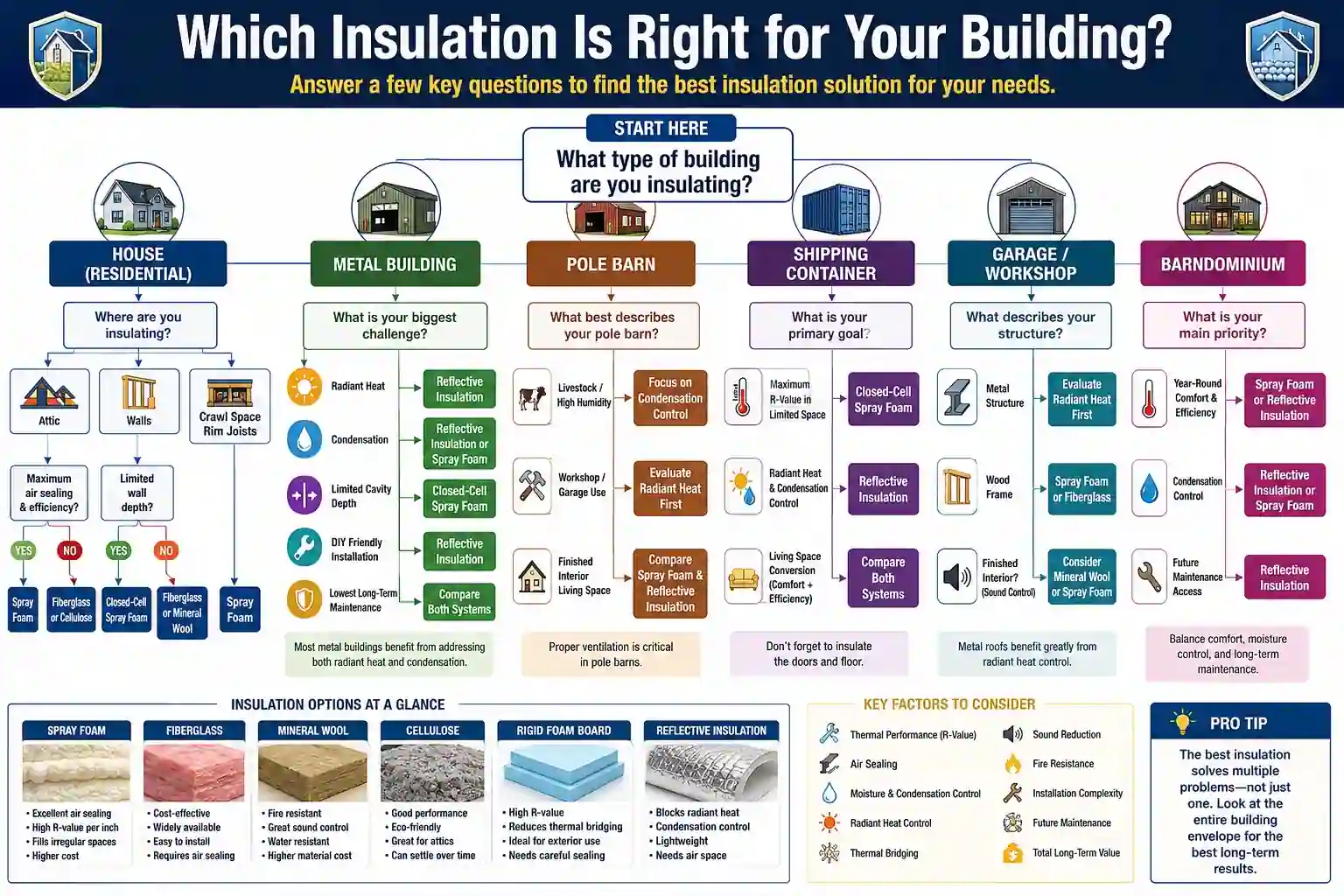
Step 1 – Identify Your Building Type
Different buildings experience different forms of heat transfer and moisture movement.
Residential Homes
Most homeowners focus on:
Energy efficiency
Comfort
Air sealing
Lower utility bills
Sound control
Read our House Insulation Guide.
Metal Buildings
Steel buildings require careful attention to:
Radiant heat
Condensation
Thermal bridging
Air leakage
Roof performance
Read our Metal Building Insulation Guide.
Pole Barns
Pole barns often combine agricultural moisture with large roof areas and wide framing spacing. Read our Pole Barn Insulation Guide.
Shipping Containers
Containers have unique challenges because of their thin steel walls and limited interior space. Read our Shipping Container Insulation Guide.
Garages & Workshops
Metal garages frequently experience large daily temperature swings and intense solar heat gain. Read our Garage & Workshop Insulation Guide.
Barndominiums
Barndominiums combine residential comfort with metal-building construction, making insulation design especially important. Read our Barndominium Insulation Guide.
Step 2 – Identify Your Biggest Challenge
Instead of asking,
"Which insulation has the highest R-value?"
Ask,
"What problem am I trying to solve?"
| If Your Biggest Challenge Is... | Consider Evaluating... |
|---|---|
| Air leakage | Spray foam |
| Limited cavity depth | Closed-cell spray foam |
| Lower installation cost | Fiberglass or cellulose |
| Fire resistance | Mineral wool |
| Radiant heat | Reflective insulation |
| Condensation | Reflective insulation and closed-cell spray foam |
| Sound reduction | Mineral wool or open-cell spray foam |
| Future roof access | Insulation systems that simplify maintenance |
💡 Pro Tip
Many buildings suffer from multiple problems at the same time.
For example, a metal workshop may experience:
Radiant heat
Condensation
Air leakage
Thermal bridging
The best insulation strategy addresses all of these issues together, rather than optimizing a single performance characteristic.
Step 3 – Think Beyond Initial Cost
The least expensive insulation isn't always the lowest-cost solution over the life of the building.
Compare:
Material cost
Installation cost
Energy savings
Maintenance
Future repairs
Roof replacement
Ease of remodeling
Expected service life
Long-term value often matters more than initial price.
Step 4 – Compare the Entire Building Envelope
No insulation works in isolation.
Successful buildings consider:
Conductive heat transfer
Radiant heat transfer
Air leakage
Vapor movement
Condensation
Thermal bridging
Ventilation
Moisture management
Improving only one of these while ignoring the others may limit overall performance.
⚠️ Common Mistake
One of the most common mistakes is selecting insulation based only on a brochure, online review, or advertised R-value.
The right insulation depends on:
Your building type
Your climate
Your budget
Your long-term maintenance plans
Your performance priorities
The best insulation isn't always the one with the highest published R-value—it's the one that solves the actual challenges your building faces.
Related Reading
To compare insulation systems in more detail, explore these resources:
The Bottom Line
Every insulation material has strengths and tradeoffs. Rather than searching for a single "best" insulation, identify the challenges your building faces first, then compare the insulation systems that best address those needs. Taking this building-first approach will help you make a more informed decision, improve long-term performance, and maximize the value of your insulation investment.