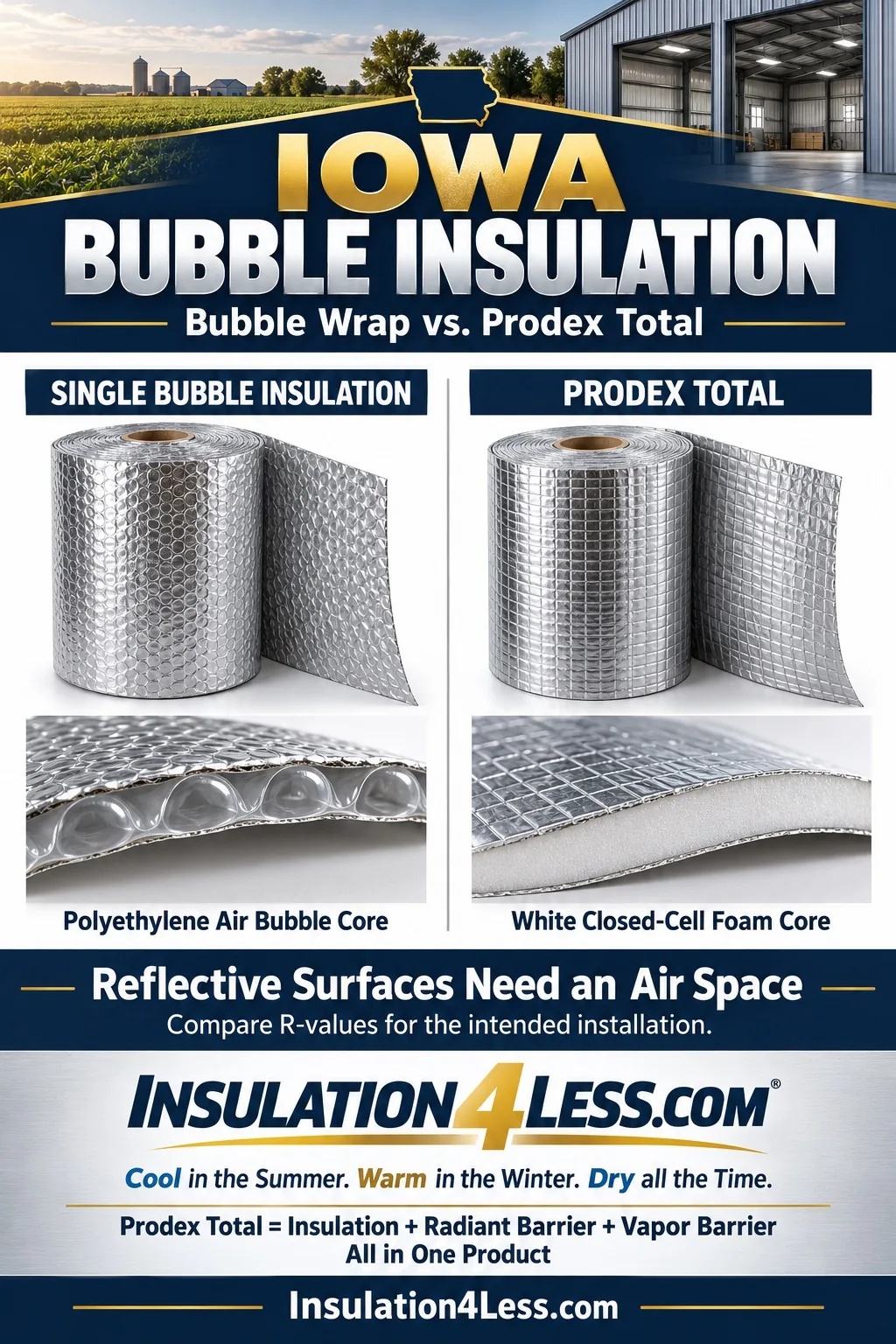
Iowa Bubble Insulation: Choosing Reflective Insulation for Your Building
Bubble insulation is a lightweight reflective insulation option used in metal buildings, pole barns, garages, homes and agricultural structures. Its construction combines encapsulated polyethylene air bubbles with reflective facings.
For an Iowa project, choosing the right insulation requires more than identifying a shiny surface. Winter heat loss, summer radiant heat, indoor moisture and the building’s heating schedule all influence the appropriate assembly.
This guide explains where bubble insulation fits, how it differs from Prodex Total and what to compare before ordering. Our national bubble insulation guide provides additional background on product construction and applications.
For other local building guides, visit the Iowa Insulation Guide.
What Is Bubble Wrap Insulation?
Bubble wrap insulation contains one or more layers of sealed polyethylene air bubbles combined with reflective surfaces. It is a building insulation product, distinct from ordinary clear packaging bubble wrap.
The reflective facing helps reduce radiant heat transfer when it faces an appropriate air space. The bubble layer contributes thermal resistance and separates the facings.
Different products use different combinations of bubble layers and finishes. Review the actual specifications rather than assuming all reflective rolls perform alike.
Single Bubble Insulation
A single bubble product contains one layer of polyethylene air bubbles.
Our single bubble insulation has a nominal thickness of 5/32 inch and comes in a 4-foot-by-125-foot roll covering 500 square feet. It combines the bubble layer with two metalized, low-emissivity surfaces.
Double Bubble Insulation
Double bubble products contain two bubble layers. The additional layer changes the construction and thickness, but it does not establish a universal system R-value.
Compare the specific product’s tested installation conditions, including air spaces and heat-flow direction. Two bubble layers should not automatically be interpreted as twice the thermal performance.
Reflective and White-Faced Finishes
Products can have reflective surfaces on both sides or a reflective surface on one side with a white polyethylene finish on the other.
Our reflective bubble insulation has two reflective faces. If a white interior appearance is preferred, review Reflective Bubble White Poly.
How Bubble Insulation Works
Radiant Heat Control
A low-emissivity reflective surface reduces radiant heat transfer across an adjacent air space. This can be useful beneath sun-warmed roofing in garages, workshops and agricultural buildings.
The reflective surface needs that air space to provide its radiant-barrier benefit. Contact with another material changes the heat-transfer conditions.
Our reflective insulation guide explains how reflective surfaces and air spaces contribute to installed performance.
Thermal Resistance
The bubble layer provides some resistance to heat flow. A complete installed system may also receive thermal resistance from its specified air spaces and other components.
This distinction matters when comparing a thin reflective roll with fiberglass, rigid foam or other insulation. Compare equivalent assemblies rather than unrelated headline R-values.
Air and Vapor Control
A suitably specified bubble product can contribute to vapor control. A continuous installation also requires attention to seams, edges, fasteners and penetrations.
The roll’s facing alone does not establish a complete building air barrier. Connections to adjacent surfaces need appropriate detailing.
What Iowa Buildings Need From Bubble Insulation
Cold-Weather Performance
A heated Iowa workshop or home needs an assembly that provides the required overall thermal resistance. Bubble insulation should be evaluated against that requirement using the actual installation configuration.
A reflective roll may serve a useful role within a larger system, but its presence does not automatically establish sufficient winter insulation for every building.
Summer Heat Control
Reflective insulation can help reduce radiant heat transfer beneath roofing when the required air space is maintained.
This function can be useful in unconditioned storage buildings as well as conditioned spaces. However, insulation alone cannot hold an unheated or uncooled building at a selected temperature.
Condensation Management
Condensation occurs when moist air reaches a surface below its dew point. Cold metal roofing, siding and framing can become collection points.
Insulation and properly detailed control layers can help manage these conditions. Roof leaks, ground moisture, wet machinery, livestock moisture and ventilation also need attention.
Bubble Insulation vs. Prodex Total
The main construction difference is the core.
Bubble insulation uses encapsulated air bubbles. Prodex Total uses a closed-cell polyethylene foam core with reinforced reflective foil.
Both are reflective insulation products, but they should be evaluated separately.
| Consideration | Bubble Insulation | Prodex Total |
|---|---|---|
| Core | Encapsulated polyethylene air bubbles | Closed-cell polyethylene foam |
| Reflective finish | Depends on the product | Reinforced reflective foil; finish varies by product |
| Radiant-barrier performance | Requires an adjacent air space | Requires an adjacent air space |
| Thermal comparison | Use product-specific material or system data | Use product-specific material or system data |
| Installation priorities | Protect bubble integrity; seal and support as specified | Maintain specified air spaces, support and seam closure |
| Vapor control | Depends on product specifications and continuity | Depends on product selection and continuity; perforated versions differ |
For a broader comparison, review single bubble, double bubble and Prodex Total.
Why Consider Prodex Total?
Prodex Total provides a foam-core alternative when you want reinforced reflective facings and a continuous closed-cell core.
Its suitability still depends on the assembly: thermal requirements, air spaces, attachment, seam closure and vapor-control placement must work together.
Cool in the Summer. Warm in the Winter. Dry all the Time.
Prodex Total = Insulation + Radiant Barrier + Vapor Barrier — All in One Product.
Iowa Applications for Bubble Insulation
Metal Buildings
Metal buildings need coordinated control of heat flow, air leakage and moisture. Compare the roof and wall assemblies, including framing and penetrations.
Our Iowa metal building insulation guide explains these planning considerations.
Pole Barns and Agricultural Buildings
An equipment shelter, heated repair shop and livestock building have different operating conditions. Choose insulation around the intended use and moisture load.
Explore Iowa pole barn insulation before selecting materials.
Garages and Workshops
Identify whether the space will be unconditioned, occasionally heated or continuously conditioned. Door leakage and wall-to-roof transitions can affect comfort alongside the insulation.
Our Iowa metal garage and workshop insulation guide covers these applications.
Houses and Crawl Spaces
Residential roofs, walls and floors need different details. Consider existing insulation, vapor-resistant layers and drying potential before adding another product.
Review Iowa house insulation and the national crawl space insulation guide when planning residential work.
Installation Details That Affect Performance
Maintain the Specified Air Space
Follow the installation configuration associated with the product’s thermal data. The Reflective Bubble Reflective product page recommends incorporating an air space of at least one inch between the insulation and the structure’s outer surface.
That recommendation does not mean every arrangement with a one-inch gap achieves the same system R-value.
Seal Seams and Transitions
Use the specified reflective tape and compatible closure materials. Detail edges and penetrations so they support the intended air and vapor-control functions.
Provide suitable mechanical support. Tape used for seam closure should not be assumed to replace the required attachment system.
Inspect Existing Materials
Repair leaks and address damp or damaged materials before installing a new layer. Evaluate how existing vapor-resistant materials affect drying.
Consult the applicable insulation installation instructions before beginning.
Compare Other Materials Before Ordering
If the project needs additional thermal resistance or a different installation approach, compare other insulation systems.
Our spray foam insulation guide explains spray-applied options. The foam board insulation guide covers rigid panels, while our Iowa fiberglass vs. Prodex Total comparison examines fibrous and reflective foam systems.
Choose the complete assembly first, then calculate quantities. Use the Advanced Insulation Calculator where its configurations match your project, and check the estimate against overlaps, cuts and the installation layout.
Frequently Asked Questions About Iowa Bubble Insulation
Is bubble insulation the same as packaging bubble wrap?
No. Building insulation products incorporate specified facings and performance characteristics. Ordinary clear packaging bubble wrap should not be treated as an equivalent product.
Can bubble wrap insulation be used in Iowa?
It can be considered where its specifications and installed performance suit the application. Heated buildings may require additional insulation to meet the assembly’s thermal requirements.
Does single bubble insulation need an air gap?
Its reflective surface needs an adjacent air space for radiant-barrier performance. Follow the product’s installation instructions and tested configuration.
Is double bubble insulation twice as effective?
Not necessarily. Compare tested values for equivalent installation conditions rather than assuming performance doubles with the number of bubble layers.
Is Prodex Total a bubble product?
No. Prodex Total contains closed-cell polyethylene foam rather than encapsulated air bubbles.
Where can I learn more about bubble wrap insulation?
Read our national bubble wrap insulation guide, then review the specifications for the particular product and installation you are considering.