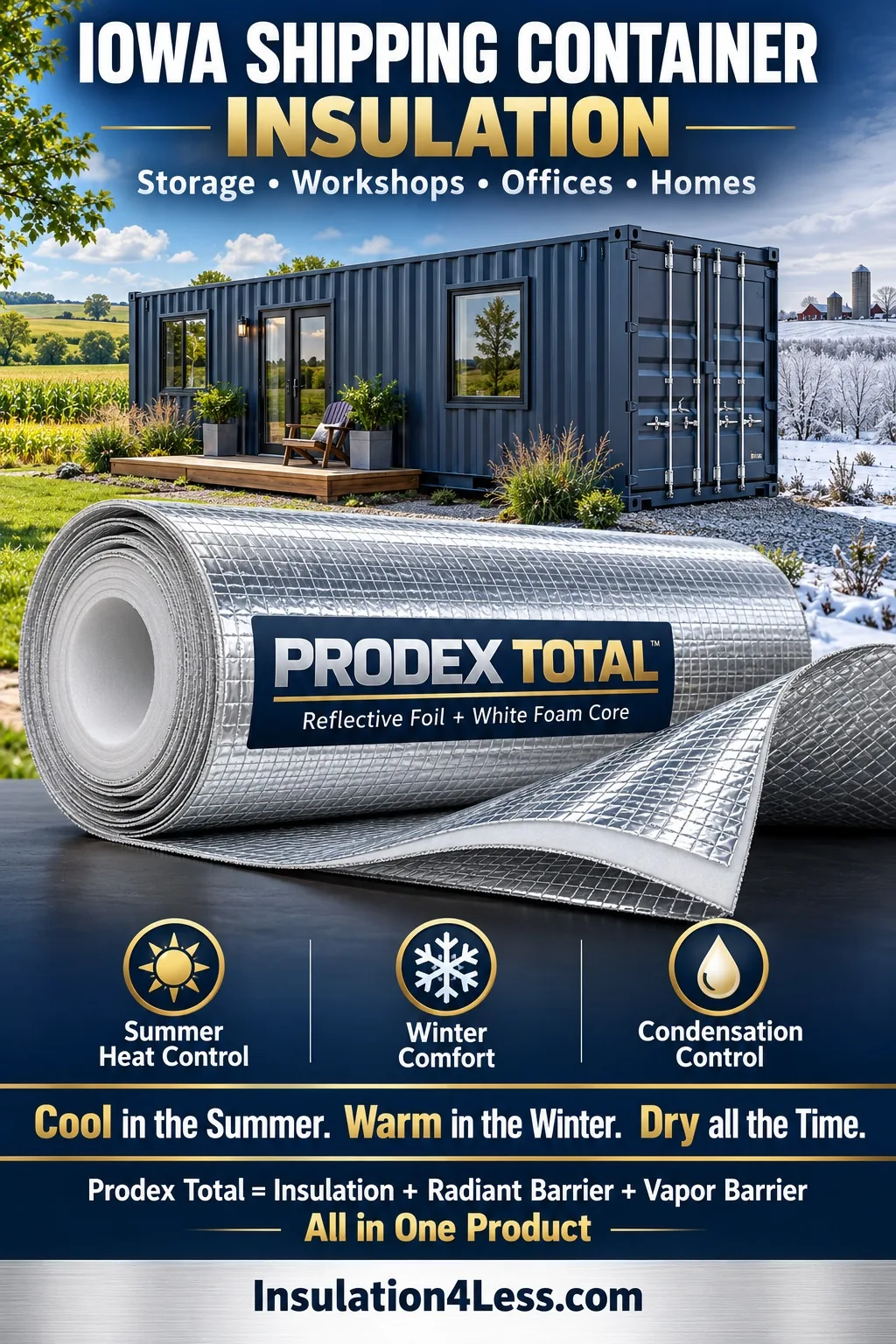
Iowa Shipping Container Insulation: Protect Against Heat, Cold and Condensation
A shipping container provides a durable steel enclosure, but its original purpose was transporting cargo—not maintaining comfortable indoor conditions. In Iowa, that steel shell faces cold winters, summer sun and changing moisture conditions.
The right insulation approach depends on how the container will be used. Tool storage, an occasionally heated workshop and a full-time residence have different thermal, ventilation and moisture-management needs.
Prodex Total combines reinforced reflective foil with a white closed-cell polyethylene foam core. In a suitable assembly, it provides insulation, radiant heat control and vapor-barrier functionality while offering a flexible roll format.
Cool in the Summer. Warm in the Winter. Dry all the Time.
Prodex Total = Insulation + Radiant Barrier + Vapor Barrier — All in One Product.
For broader planning advice, explore our national shipping container insulation guide. Visit the Iowa Insulation Guide for other local building applications.
Start With the Container’s Intended Use
Decide how the space will operate before selecting materials or adding interior finishes.
Unconditioned Storage
An unheated container may need protection against summer radiant heat and condensation that could affect tools, equipment or stored materials.
Insulation can help moderate conditions, but it does not maintain a selected temperature or humidity level by itself. Sensitive contents may require ventilation, dehumidification or conditioning suited to their storage requirements.
Workshops and Occasionally Heated Spaces
A container workshop can experience rapid temperature changes when heating starts. The indoor air may warm while the steel shell, tools and other surfaces remain cold.
Plan insulation alongside air sealing, heating and moisture management. Consider how often the doors will open and whether wet equipment will be brought inside.
Offices and Container Homes
Regularly occupied containers need a complete building-envelope design. Roofs, walls, floors, doors and windows must work together with ventilation and heating or cooling.
Cooking, bathing and occupancy introduce moisture. Interior space, required finishes and the thermal performance of the complete assembly all influence insulation selection.
For residential planning, see our Iowa house insulation guide.
Why Shipping Containers Need Careful Insulation Details
Steel Conducts Heat Readily
The steel shell offers little resistance to conductive heat flow compared with an insulated building assembly. Exposed steel framing and connections can also provide thermal bridges.
A continuous insulation strategy can help reduce these pathways, but door frames, corners and penetrations need attention alongside the broad wall surfaces.
Sun-Warmed Surfaces Transfer Radiant Heat
The roof and sun-facing walls can become hot and transfer heat toward the interior.
A reflective surface facing an appropriate air space helps reduce radiant heat transfer. Our reflective insulation guideexplains how air spaces and installation conditions affect performance.
Cold Steel Can Collect Condensation
Condensation occurs when moist air reaches a surface below its dew point. In a container, droplets may form on exposed steel or moisture may collect behind an interior lining.
Air-control continuity, suitable insulation and moisture-source management are essential. A vapor-resistant product only performs its intended control function when seams, edges and penetrations are properly detailed.
Where Prodex Total Fits in a Container Assembly
Prodex Total uses a closed-cell polyethylene foam core between reinforced reflective foil surfaces. It differs from bubble insulation, which contains encapsulated air bubbles, and from fibrous cavity insulation.
Its reflective faces help reduce radiant heat transfer when facing the specified air space. The foam contributes thermal resistance, while sealed joints and transitions allow the installed layer to support air and vapor control.
For an Iowa container project, evaluate the complete assembly. Published system R-values apply to particular configurations; they should not be treated as the material-only value of the roll.
A heated office or residence may need additional insulation to meet the project’s overall thermal requirements.
Preserve Interior Space Without Overlooking Performance
Shipping containers have limited interior width and height. Insulation, supports, air spaces, services and finishes all reduce the usable dimensions.
Compare the total assembly thickness rather than the insulation product alone. A thin reflective roll still needs the specified air space to provide its radiant-barrier benefit.
Plan the finished dimensions before locating doors, cabinets, plumbing or electrical equipment. This helps avoid conflicts after the insulation is installed.
Plan the Roof, Walls and Floor Together
Roof Insulation
The roof receives direct solar exposure and needs careful detailing around penetrations and perimeter connections.
Inspect the exterior for leaks, damaged seams and corrosion before covering the interior. Maintain the air spaces required by the chosen insulation method and connect the roof’s control layers to the walls.
Our Iowa roof and ceiling insulation guide explains broader roof-assembly considerations.
Wall Insulation
Corrugated walls create an uneven surface. Choose a support and attachment approach that accommodates the corrugations without leaving unintended openings in the control layer.
Corners, door frames, windows and service penetrations need deliberate detailing. Plan how interior finishes will attach without unnecessarily damaging the insulation system.
Floor Insulation
Inspect the existing floor and its underside before deciding how to insulate. Check for water entry, deterioration and conditions unsuitable for the intended occupancy.
Floor insulation needs suitable support, protection and continuity at the wall connection. The chosen approach should account for available headroom and exposure beneath the container.
Condensation Control Begins Before Installation
Repair Leaks and Corrosion
Weatherproofing comes first. Repair roof and wall leaks, address corrosion and confirm that door seals function properly.
Do not conceal damp or damaged materials behind new insulation and finishes.
Limit Moist Air Reaching Cold Steel
A continuous air-control layer helps reduce moist indoor air movement toward cold surfaces. Detail seams, perimeter edges and penetrations as part of one connected system.
Metal corners and door surrounds deserve particular attention because small gaps can interrupt otherwise continuous coverage.
Provide a Moisture-Removal Strategy
Ventilation, dehumidification or conditioning may be needed, depending on use. Insulation does not remove moisture produced by people, wet equipment or indoor activities.
If a container will be occupied regularly, include indoor humidity management in the original plan.
Consider Drying Potential
The exterior steel shell is highly resistant to vapor movement. Adding interior vapor-resistant materials requires careful assembly design.
Avoid enclosing wet materials. Determine how the proposed layers will manage moisture before installing an interior finish.
Compare Shipping Container Insulation Materials
Spray Foam
Spray foam can follow corrugated surfaces and provide insulation and air sealing, depending on the product, thickness and installation.
Consider substrate preparation, application conditions, protective coverings and future access to the steel. Review our spray foam insulation guide when evaluating this option.
Foam Board
Rigid panels can provide thermal resistance where the support system accommodates them. Corrugations, panel joints and perimeter edges require careful detailing.
Explore our foam board insulation guide for the main types and application considerations.
Fiberglass
Fiberglass provides thermal resistance through its fibrous structure, but it needs appropriate support and a suitable cavity. Air sealing and vapor control require separate attention.
Gaps, compression and moisture exposure can affect the finished assembly. Our Iowa fiberglass vs. Prodex Total comparison explains the construction differences.
Bubble Insulation
Bubble wrap insulation uses encapsulated polyethylene air bubbles with reflective facings.
For a bubble-core product, review the specifications for single bubble insulation. Compare system values under equivalent installation conditions rather than assuming all reflective products perform alike.
Our Iowa bubble insulation guide provides additional comparisons.
Installation Planning for an Existing Container
Select the insulation method before building the interior lining. Coordinate supports, electrical work, ventilation openings and finishes so they do not conflict with the control layers.
Use compatible attachments suited to the selected method. Do not assume that fastening through the exterior steel shell is necessary; unintended penetrations can create weatherproofing problems.
Provide lasting support and use the product-specific seam closure. Prodex Total 10M Plus uses heat-welded seams, while other products have their own closure requirements.
Follow the applicable shipping container insulation installation instructions.
Estimate Materials Before Ordering
Measure the actual interior surfaces and account for corrugations, overlaps, corners and openings. Confirm whether the floor and doors are included in the project.
Use the Advanced Insulation Calculator where its configurations match the planned layout, then check the result against the container’s dimensions.
Include the specified attachments, seam materials and supports. For larger steel-building projects, explore our Iowa metal building insulation guide.
Frequently Asked Questions About Iowa Shipping Container Insulation
What is the best insulation for a shipping container in Iowa?
Choose a complete assembly that suits the container’s use, thermal requirements, moisture conditions and available interior space. Compare insulation, air sealing, radiant heat control and finishes together.
Can Prodex Total be used in a container home?
Yes, within an appropriate assembly. Confirm the specified air spaces, control-layer details and any additional insulation needed for the home’s thermal requirements.
Will insulation stop a shipping container from sweating?
A suitable insulation and air-control system can help manage condensation conditions. Leaks, indoor humidity, exposed cold surfaces and gaps in coverage must also be addressed.
Does reflective insulation need an air gap inside a container?
Its reflective surface needs an adjacent air space for radiant-barrier performance. Follow the product’s installation method and use thermal values for that configuration.
Can I insulate a container without drilling through its shell?
Suitable methods can use interior supports or compatible attachment systems. Follow the applicable installation instructions and plan attachments before adding finishes.
Will an insulated storage container stay warm without heating?
Insulation slows heat transfer but does not produce heat. An unheated container will still respond to outdoor temperatures, sunlight and other heat sources.