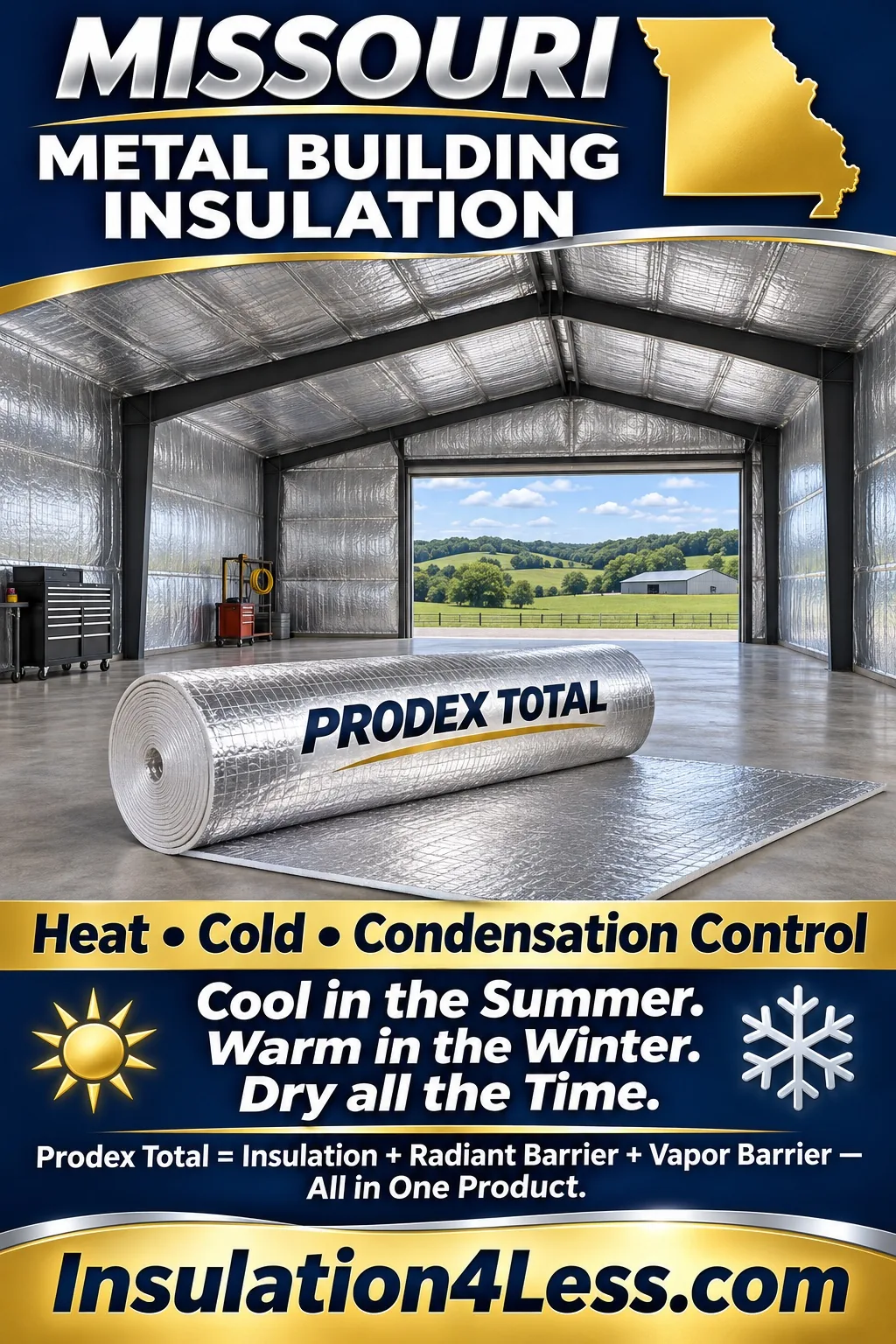
Missouri Metal Building Insulation for Heat, Cold and Condensation Control
A Missouri metal building may serve as a farm repair shop, warehouse, equipment shelter or year-round workspace. The insulation system should reflect how that building will be used.
An unconditioned storage structure outside Columbia has different needs from a heated workshop near Springfield or a commercial building in the St. Louis area. Start with the intended indoor conditions, then consider roofing, steel framing, moisture sources and installation access.
Prodex Total combines a closed-cell polyethylene foam core with reflective facing. In a suitable installation, it adds insulation and provides radiant-barrier and vapor-barrier functions.
Explore the best metal building insulation for product benefits and buying considerations. For related applications, visit our Missouri insulation guide.
Cool in the Summer. Warm in the Winter. Dry all the Time.
Prodex Total = Insulation + Radiant Barrier + Vapor Barrier — All in One Product.
Start With the Building’s Intended Use
Equipment and Agricultural Storage
An equipment shelter may need to address radiant heat beneath metal roofing and moisture affecting stored items.
Consider whether wet machinery enters regularly, whether the floor exposes soil and how air moves through the building. Insulation should be coordinated with those conditions.
Heated Shops and Workspaces
A shop used throughout winter needs adequate thermal resistance across its roof, walls and other enclosure components.
Large doors, gaps around openings and frequently interrupted heating schedules also affect comfort. Choose an assembly suited to the building rather than relying on a roll’s advertised rating alone.
Warehouses and Commercial Buildings
Commercial spaces may include different temperature requirements, occupancy patterns and moisture-producing activities.
Establish the required roof and wall performance before choosing materials. Plan insulation and finishes around lighting, equipment, access doors and other services.
What Missouri Steel Building Insulation Should Address
Radiant Heat Beneath Metal Panels
Sun-heated roofing can radiate heat toward the building interior.
A reflective surface reduces radiant heat transfer when it faces an appropriate adjacent airspace. That space must be included in the installation design.
Foil pressed directly against another solid material does not provide the same radiant-barrier benefit at that interface. Our reflective insulation guide explains how reflective surfaces and airspaces work together.
Winter Heat Loss
Conditioned buildings need thermal resistance appropriate to their use and construction.
Prodex Total may form part of an assembly that includes additional insulation. Evaluate the complete arrangement, including framing, cavities and airspaces, before deciding which materials to purchase.
Air Leakage
Open seams and gaps around doors, windows and penetrations can allow air to bypass insulated areas.
Where Prodex Total serves as part of the air-control layer, detail its seams, edges and transitions accordingly. Connections between roof and wall insulation deserve particular attention.
Condensation
Condensation can occur when moist air reaches steel cold enough for water vapor to condense.
Managing that risk requires attention to indoor moisture, ventilation, air movement and insulation placement. A properly installed, sealed Prodex Total layer can help limit moisture reaching cold metal surfaces, but it does not repair leaks or remove indoor humidity.
Inspect an Existing Building Before Insulating
Check roof and wall panels for leaks, damaged joints and corrosion before covering interior surfaces.
Identify moisture sources such as wet equipment, washing activities or exposed soil. Assess existing insulation and facings so the new installation can be coordinated with them.
Plan access around wiring, lighting and door tracks. Decide how the insulation will be supported and how seams will remain accessible for joining.
These decisions are easier to resolve before the rolls are installed.
Choosing Prodex Total for a Missouri Metal Building
10M Prodex Total Plus
10M Prodex Total Plus is the most popular and thickest reflective insulation roll in the Prodex Total range.
It features a 10 mm, approximately 0.4-inch, closed-cell polyethylene foam core with reflective foil on both sides. Each 4-foot × 85.3-foot roll covers 341 square feet and features heat-welded seams.
Plan roll direction, seam locations and attachment before installation. Follow the product instructions for joining adjoining rolls.
5M Plus Finish Options
The 5M Plus range is 5 mm thick and includes white, black or rustic finishes on one side, with reflective foil on the other.
Choose the finish alongside the assembly design. The orientation of the reflective face and its adjacent airspace matter wherever radiant-barrier performance is intended.
Insulating a New Steel Building
New construction allows insulation placement to be coordinated with framing and exterior panel installation.
Where the selected method calls for it, Prodex Total runs across steel purlins or girts before the panels are attached. Follow the specified roll direction, support, fastening and airspace details.
Where continuous insulation is intended, carry the layer across the secondary framing rather than leaving exposed members between insulated sections.
Plan transitions at eaves, end walls, corners and openings before roofing and siding work begins.
Use the new-construction methods in our guide to how to insulate a metal building.
Retrofitting an Existing Metal Building
Existing buildings may require installation from inside, using the accessible steel framing.
Select an attachment method suited to the framing and the product instructions. Depending on the specified method, supports may include screws with locking washers, adhesive-mounted pins and caps or other approved components.
Maintain the intended airspace without overstretching the material. Provide sufficient support and detail edges and penetrations.
For adhesive-mounted pins, follow surface-preparation and curing instructions before loading the insulation. Do not assume adhesive that feels firm has completed its required cure.
Review the existing-building methods in our metal building insulation installation guide.
Combining Prodex Total With Fiberglass
Fiberglass and Prodex Total can perform complementary roles in a steel building.
Fiberglass provides thermal resistance within the available space. Properly positioned Prodex Total adds insulation and can contribute radiant heat and vapor control.
Added R, radiant heat and vapor control.
Preserve the fiberglass’s specified thickness and provide the intended airspace wherever reflective performance is required. Fiberglass may touch one face of Prodex where the chosen assembly permits it; that contact does not create a reflective airspace on that face.
Coordinate vapor-resistant layers with the assembly’s moisture-management and drying needs.
Our Missouri fiberglass vs. Prodex Total comparison explains these roles. Review available fiberglass metal building insulation and the national Prodex Total vs. fiberglass comparison for additional information.
Comparing Other Insulation Materials
Bubble Insulation
Bubble insulation contains an air-bubble core. Prodex Total contains closed-cell polyethylene foam.
Similar-looking foil surfaces do not establish identical construction or performance. Our Missouri bubble insulation guide explains what to compare.
Spray Foam
When evaluating spray foam, consider the specific product, required thickness, surface preparation, protective coverings and implications for future panel repairs.
Review our guide to spray foam insulation for metal buildings and pole barns.
Foam Board
Rigid boards require a plan for attachment, joint treatment and connections around framing and openings.
Our foam board insulation guide explains additional considerations.
For every material, compare ratings under equivalent conditions. Distinguish material R-values from assembly ratings that include airspaces and other components.
Match the Installation Guide to the Structure
A steel-framed building, wood-framed pole barn and curved Quonset hut require different attachment details.
For post-frame construction, see our Missouri pole barn insulation guide. For curved corrugated steel structures, use our Missouri Quonset hut insulation guide.
If your project focuses on the overhead assembly, our Missouri roof and ceiling insulation guide provides related planning information.
Estimate Materials Before Ordering
Measure the actual roof slopes, wall heights and end walls you intend to insulate.
Allow for overlaps, cuts and transitions. Floor area alone does not describe total roof and wall coverage.
Read how much insulation you need, then use the Advanced Insulation Calculator to estimate quantities.
Confirm the roll selection, attachment method, seam treatment and accessories before purchasing.
Plan Your Missouri Metal Building Insulation
Start with how the building will be used, then coordinate thermal resistance, radiant heat control, air sealing and moisture management.
Explore insulation for metal buildings, review the installation method appropriate to your structure and consider 10M Prodex Total Plus for your project.
Cool in the Summer. Warm in the Winter. Dry all the Time.
Prodex Total = Insulation + Radiant Barrier + Vapor Barrier — All in One Product.