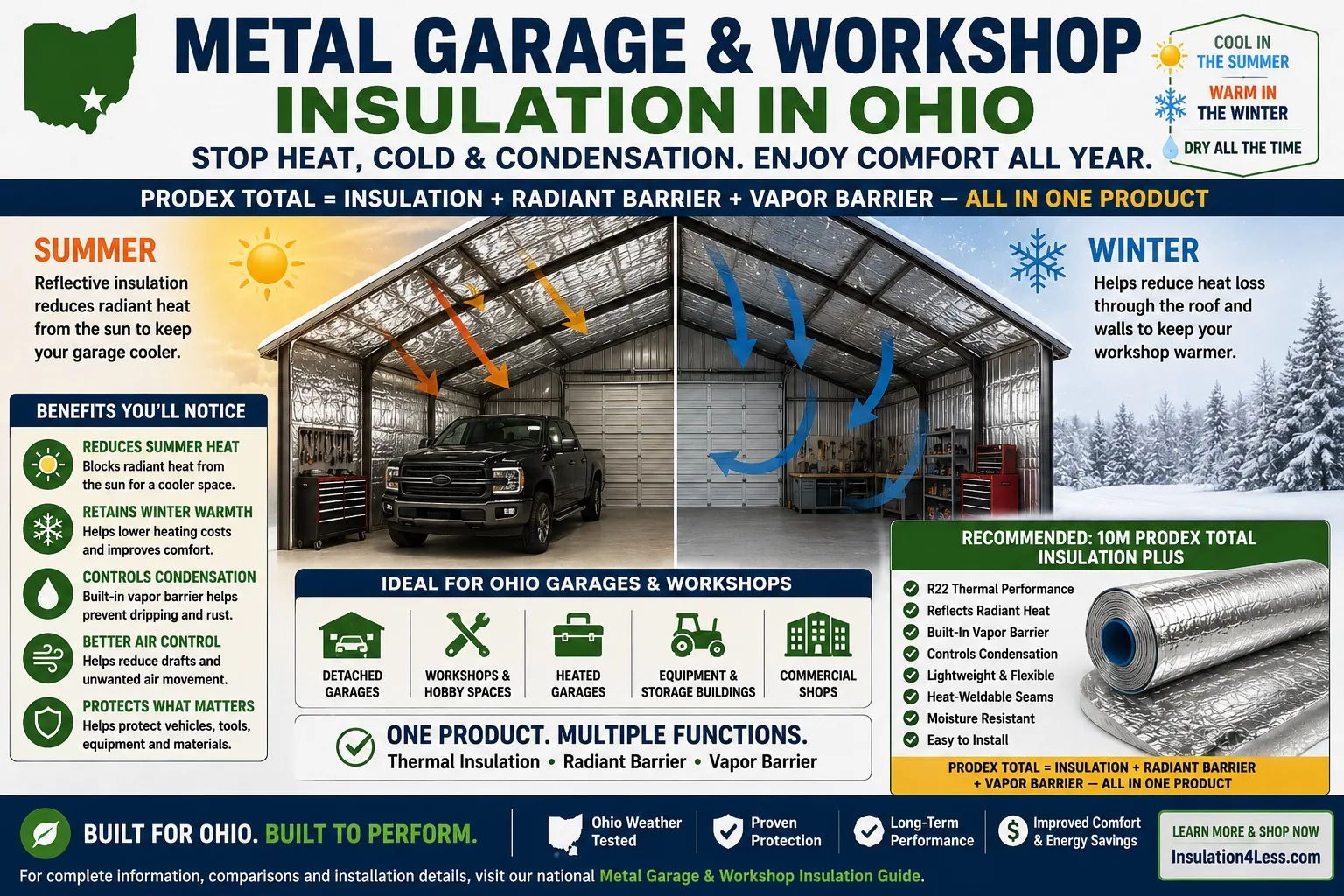
Metal Garage & Workshop Insulation in Ohio: Stop Heat, Cold & Condensation
A metal garage or workshop can be one of the most useful buildings on an Ohio property—but without proper insulation, it can also become extremely uncomfortable.
During summer, sunlight heats the metal roof and walls. That heat can radiate toward the interior, making a garage or workshop difficult to use during the hottest part of the day. During winter, the problem reverses. Steel rapidly transfers heat, allowing valuable interior warmth to escape while exterior metal surfaces become extremely cold.
Then there is condensation.
Vehicles covered with rain, snow and ice can introduce additional moisture into a garage. Workshops may also contain heaters, people, wet equipment and other moisture sources. When warm, moisture-containing air reaches cold metal roofing or siding, condensation can form and potentially drip onto vehicles, tools, machinery and stored materials. For these reasons, garage and workshop insulation needs to address more than R-value.
For Ohio property owners, that combination can be particularly useful for:
An effective insulation system should help control:
Summer radiant heat
Winter heat loss
Condensation
Vapor movement
Air movement
Moisture
Interior comfort
Energy use
For our complete national resource covering insulation choices, installation considerations and condensation control, see the Metal Garage & Workshop Insulation Guide. For insulation information covering other building types throughout the state, visit our Ohio Insulation Guide.
Why Ohio Metal Garages and Workshops Need Insulation
Metal garages are strong, durable and relatively economical to construct. But steel is also highly conductive. That means outdoor temperature changes can quickly affect the interior environment. An uninsulated metal garage may become extremely hot when sunlight strikes the roof and walls. When temperatures fall, the same steel shell rapidly loses heat. If the building is used only occasionally for vehicle storage, these temperature swings may simply be inconvenient. If it is used as a workshop, hobby space, commercial work area or heated garage, they become much more important. Insulation can help create a more stable interior environment while also protecting the building and its contents. For a broader discussion of these challenges in steel structures, see Metal Building Insulation in Ohio.
Our national guide to steel building insulation explains how insulation can address heat, cold, condensation and air movement throughout a metal structure.
The Roof Is the Most Important Area to Insulate
If you have to prioritize one area of a metal garage or workshop, start with the roof. The roof receives more direct solar exposure than any other part of most buildings. During summer, sunlight heats the metal roofing. The heated metal can then radiate energy toward the cooler surfaces and occupants below. That can make a garage uncomfortable even when outdoor air temperatures aren't extreme. During winter, the roof becomes an important pathway for heat loss. It can also become a major condensation surface.
This makes the roof central to controlling: Heat + Cold + Condensation
For a deeper look at these issues, see Roof & Ceiling Insulation in Ohio. Our national Roof Insulation Guide covers metal roofs and other roof assemblies in greater detail.
Why Metal Garages Get So Hot in Summer
A common misconception is that summer heat inside a metal garage comes only from hot outdoor air. Solar radiation can be just as important. Sunlight strikes the roof and exterior metal panels. Those surfaces absorb energy and become hot. The heated metal then transfers energy toward the building interior through a combination of conduction and radiation. This is why simply ventilating a hot metal garage doesn't necessarily address the entire problem. Ventilation may help remove hot air, but it doesn't prevent the hot roof from continuing to radiate energy toward the interior. Reflective insulation can help address this radiant component of heat transfer.
For more information about radiant heat and how reflective insulation works, see our national Reflective Insulation Guide.
Keeping an Ohio Workshop Warmer in Winter
If you heat your workshop during winter, insulation becomes particularly important. Without insulation, heat can move rapidly through the metal roof and walls. The heating system must then continually replace that lost energy. Insulation helps separate the conditioned interior from the exterior metal shell.
That can make the building:
More comfortable
Easier to heat
More useful throughout winter
Better suited for temperature-sensitive equipment or materials
Air sealing is also important. Warm air escaping through gaps and seams carries energy with it, while cold outside air entering the building increases heating demands. A well-designed insulation system therefore needs to address both heat transfer and unwanted air movement.
Condensation Can Be a Major Garage Problem
Condensation deserves special attention in a metal garage or workshop. Imagine driving into a heated Ohio garage with a vehicle covered in rain, slush or snow.
That moisture begins evaporating into the interior air. At the same time, the metal roof and wall panels may be extremely cold. When warm, moisture-containing air reaches a sufficiently cold metal surface, water vapor can condense.
You may see:
Water droplets beneath the roof
Wet framing
Dripping condensation
Damp floors
Moisture on tools
Rust on equipment
Water stains
Damp stored materials
A garage used as a workshop may create even more interior moisture depending on the activities taking place inside. This is why simply adding thermal resistance isn't necessarily enough. The insulation system also needs to consider vapor movement and condensation control.
Protect Vehicles, Tools and Equipment From Moisture
Many garages contain considerably more value than the building itself.
Inside may be:
Cars
Trucks
Motorcycles
ATVs
Tractors
Lawn equipment
Power tools
Hand tools
Welding equipment
Compressors
Woodworking machinery
Automotive parts
Building materials
Household storage
Persistent condensation isn't something you want dripping onto those items. Moisture can contribute to rust and deterioration and can damage materials stored inside the building. For many garage and workshop owners, creating a dry interior environment is therefore just as important as making the building warmer or cooler.
What Should Metal Garage Insulation Accomplish?
When comparing insulation systems, don't look only at thickness. Ask what the entire insulation assembly is expected to do. A strong metal-garage insulation system should address several functions.
Thermal Insulation
The system should resist unwanted heat transfer and help stabilize interior temperatures.
Radiant Heat Control
Because metal roofing can become extremely hot in sunlight, controlling radiant heat can substantially improve summer comfort.
Vapor Control
The insulation assembly should help prevent moisture-containing interior air from reaching cold metal surfaces.
Condensation Control
Reducing the conditions that allow condensation to form is particularly important in steel garages and workshops.
Air Control
Gaps and unsealed seams can allow conditioned air to escape and moisture-containing air to move through the building envelope.
Moisture Resistance
An insulation system used in a garage should be able to function in an environment where wet vehicles and equipment may regularly introduce moisture.
Why Prodex Total Works Well in Metal Garages & Workshops
Prodex Total is particularly well suited to metal garages because it addresses several of these requirements with one product.
It combines:
Insulation + Radiant Barrier + Vapor Barrier — All in One Product.
Instead of installing separate products to address thermal insulation, radiant heat and vapor movement, Prodex Total combines these functions into a lightweight roll insulation.
This can be particularly useful in a garage or workshop where the primary objectives include:
Reducing summer heat
Retaining winter warmth
Controlling condensation
Creating a vapor barrier
Reducing unwanted air movement
Preserving interior space
For the complete comparison of insulation systems specifically for garages and workshops, see our national Metal Garage & Workshop Insulation Guide.
Reflective Insulation for an Ohio Metal Garage
Reflective insulation addresses a form of heat transfer that conventional mass insulation doesn't directly address: radiant heat. This can be especially valuable beneath a metal garage roof. The reflective surface faces an appropriate air space and reduces radiant energy moving across that space. Prodex Total goes beyond a foil-only radiant barrier because it includes a closed-cell insulation core. This allows the product to provide both thermal and reflective performance. For Ohio-specific information about this technology, see Reflective Insulation in Ohio. For the detailed national explanation of reflective insulation, radiant barriers, R-value and air spaces, see the Reflective Insulation Guide.
Metal Garage Insulation vs. Fiberglass
Fiberglass is another insulation option for garages and workshops. It can provide substantial conventional thermal resistance when sufficient thickness is installed.
Fiberglass may make sense when:
The building has deep framing cavities.
The assembly is designed for fiberglass.
High conventional cavity R-values are required.
Proper facing and vapor control are incorporated.
The fiberglass can be protected from unwanted moisture.
However, fiberglass isn't itself a radiant barrier. It also needs to be considered as part of the entire moisture-management system. Prodex Total takes a different approach by combining thermal insulation, reflective surfaces and vapor-barrier performance in one product. The choice should therefore be based on the complete garage assembly and the problems you're trying to solve, rather than simply comparing the thickness of two products.
Metal Garage Insulation vs. Spray Foam
Spray foam is another product frequently considered for metal garages. It can conform to irregular surfaces and provide thermal insulation and air sealing when properly installed. However, spray foam and reflective insulation are different insulation technologies. Spray foam isn't a reflective radiant barrier.
Other considerations can include:
Installed cost
Required thickness
Professional installation
Access to the metal panels later
Repair or replacement of roofing or siding
Fire-protection requirements
Compatibility with the building assembly
A garage owner should evaluate the entire system rather than assuming one insulation material is automatically best for every structure. Our national Metal Garage & Workshop Insulation Guide provides a broader comparison of garage insulation options.
Metal Garage Insulation vs. Bubble Insulation
Reflective bubble insulation is also frequently marketed for metal structures. Bubble insulation generally consists of polyethylene bubbles between reflective surfaces. Prodex Total uses a closed-cell polyethylene foam core between reinforced reflective facings. Although both products may have shiny reflective surfaces, they aren't constructed the same way.
When comparing them, consider:
Core construction
Thermal performance
Strength
Durability
Vapor performance
Installation requirements
Long-term shape retention
Don't choose reflective insulation simply because two products look similar from the outside. The material between the reflective surfaces matters.
New Metal Garage Insulation in Ohio
New construction provides an excellent opportunity to plan the insulation system before the metal roofing and siding are fully installed.
This allows the building owner or contractor to consider:
Continuous insulation
Air-space requirements
Vapor control
Seam placement
Framing
Roof and wall transitions
Doors and openings
Penetrations
For many new metal buildings, Prodex Total can be installed across framing as the building is being constructed. The installation method should match the building design and the particular Prodex Total product being used. For detailed metal-building installation methods, see How to Insulate a Metal Building.
Can You Insulate an Existing Metal Garage?
Yes. An existing metal garage or workshop can often be insulated from the interior without removing the exterior metal panels. This makes retrofit insulation practical for buildings that were originally constructed without insulation.
The appropriate installation method depends on:
Framing type
Framing spacing
Existing interior finishes
Roof configuration
Wall configuration
Available attachment points
Existing insulation
A retrofit also provides an opportunity to identify areas where air leakage or condensation is already occurring. The goal should be to create a continuous insulation system rather than simply attaching isolated pieces of insulation wherever space is available. For detailed retrofit methods, see How to Insulate a Metal Building.
Don't Forget the Garage Doors
Large overhead doors can represent a significant portion of a garage's exterior surface. You can carefully insulate the roof and walls and still have substantial heat transfer through poorly insulated doors.
When planning the complete garage, consider:
Overhead doors
Personnel doors
Windows
Weatherstripping
Door seals
Gaps around openings
The insulation system works best when the entire building envelope is considered.
Insulating a Workshop You Heat or Cool
A workshop that is actively heated or air-conditioned deserves additional attention. If you're paying to condition the interior air, uncontrolled heat transfer and air leakage directly affect how hard the heating or cooling system must work.
Insulation can help create a more stable environment for:
Woodworking
Automotive work
Welding and fabrication
Equipment repair
Hobby spaces
Home businesses
Commercial workshops
Temperature stability may also benefit materials, finishes, adhesives, batteries and equipment stored inside. In these buildings, insulation becomes part of the overall operating efficiency of the workspace rather than simply an improvement in comfort.
Insulating an Unheated Garage
Insulation can still be useful even when a garage isn't continuously heated.
An unconditioned metal garage may still experience:
Extreme summer heat
Rapid temperature swings
Condensation
Moisture
Cold interior surfaces
Reflective insulation can help reduce radiant heat entering through the roof and walls. A properly designed insulation and vapor-control system can also help address condensation.
So the question isn't simply:
Will I heat the garage?
It is also:
Do I want to reduce heat, condensation and temperature extremes inside the building?
Garage Roof Insulation vs. Wall Insulation
Ideally, the complete building envelope should be addressed. However, roof insulation often deserves first priority because the roof typically experiences the greatest direct solar exposure and can be a significant location for both heat transfer and condensation. Walls matter too. Sun-exposed walls can contribute substantial heat, particularly during the afternoon Insulating both roof and walls creates a more complete thermal and vapor-control envelope. If budget or construction sequencing requires prioritization, evaluate the roof first and then determine how the walls should be incorporated into the final insulation system.
Workshops With Metal Roofs and Wood-Framed Walls
Not every workshop is an all-metal building.
Some Ohio garages and workshops have:
Wood-framed walls with metal roofing
Pole-frame construction
Masonry walls with a metal roof
Conventional framed walls with steel siding
Mixed construction
The insulation doesn't necessarily need to be identical throughout the entire building. The roof may benefit strongly from reflective insulation because of radiant heat, while wall cavities may be designed for another type of insulation. The best approach is to evaluate each part of the building envelope according to its construction and performance requirements.
Insulation for Detached Garages
Detached garages often experience greater temperature fluctuations than garages incorporated into a house because the entire structure may be exposed to outdoor conditions. These buildings may also have limited heating or cooling.
Insulation can help make a detached garage more usable for:
Vehicle storage
Workshops
Exercise areas
Hobby spaces
Equipment storage
Home businesses
If the garage will eventually be heated, cooled or converted into a more frequently occupied workspace, planning the insulation correctly from the beginning can avoid additional work later.
Insulation for Commercial Workshops
Commercial workshops may contain expensive equipment and may be occupied for many hours each day. Comfort, moisture control and energy efficiency therefore become increasingly important.
Depending on the operation, a commercial workshop may contain:
Automotive lifts
Welding equipment
CNC equipment
Compressors
Woodworking machinery
Electrical equipment
Inventory
Parts storage
Condensation dripping from an uninsulated metal roof can be more than an inconvenience in these environments. A dry, more temperature-stable building can help protect equipment while improving the workspace for employees.
Why Air Sealing Matters
Insulation and air sealing are closely connected.
Gaps around:
Doors
Roof transitions
Wall transitions
Fasteners
Penetrations
Seams
can allow air to move into and out of the building. During winter, heated air can escape. During summer, hot outdoor air can enter. Moving air can also carry moisture.
When Prodex Total is installed as a continuous system with properly sealed seams, it can contribute to controlling unwanted air and vapor movement in addition to providing thermal and reflective insulation.
Recommended Insulation: 10M Prodex Total Insulation Plus
For many Ohio metal garages and workshops, our primary recommendation is 10M Prodex Total Insulation Plus.
10M Prodex Total is a flexible roll insulation, not a rigid insulation board.
It features:
R-value unaffected by humidity
10 mm (0.4-inch) closed-cell polyethylene foam
Reinforced reflective foil facings
Radiant-barrier performance
Vapor-barrier protection
Condensation control
Moisture resistance
Heat-weldable seams
Lightweight roll construction
Each roll measures approximately 4 feet wide by 85.3 feet long and covers approximately 341 square feet.
Shop 10M Prodex Total Insulation Plus
Prodex Total = Insulation + Radiant Barrier + Vapor Barrier — All in One Product.
Cool in the Summer. Warm in the Winter. Dry all the Time.
Other Prodex Total Options for Garages & Workshops
10M Prodex Total isn't the only option. Prodex Total 5M products are available in several widths and configurations that may better match particular framing layouts or installation methods.
The best roll width depends on factors such as:
Building dimensions
Framing spacing
New construction or retrofit
Roof configuration
Wall configuration
Desired installation method
The objective is to choose the product and roll dimensions that allow the insulation to be installed efficiently while creating continuous coverage.
How Much Insulation Does My Garage Need?
Don't calculate insulation requirements from floor area alone. A 30 × 40 garage may have 1,200 square feet of floor area, but you're not insulating only the floor. You need to calculate the surfaces that will actually receive insulation.
That may include:
Roof
End walls
Side walls
Gables
Roof pitch also increases the actual roof surface area compared with the building footprint. Use the insulation calculator available on Insulation4Less to estimate the amount of material required based on your building dimensions.
Frequently Asked Questions About Metal Garage & Workshop Insulation in Ohio
What Is the Best Insulation for an Ohio Metal Garage?
The best insulation depends on the building and your objectives. For many metal garages, the insulation system needs to address radiant heat, winter heat loss, vapor movement and condensation, rather than R-value alone. Prodex Total is particularly useful because it combines thermal insulation, radiant-barrier performance and vapor-barrier protection in one roll product. For a complete comparison, see our national Metal Garage & Workshop Insulation Guide.
How Do I Stop Condensation in My Metal Garage?
Condensation occurs when moisture-containing air reaches a sufficiently cold surface. In a metal garage, that surface is frequently the underside of the roof or wall panels. The insulation system should help separate warm interior air from cold metal while also controlling vapor and unwanted air movement.Seams, edges and penetrations matter because the insulation system needs to function continuously.
Should I Insulate the Roof or Walls First?
If you must prioritize, the roof is generally the logical place to begin because it receives substantial solar exposure and is an important area for heat loss and condensation. For Ohio-specific information, see Roof & Ceiling Insulation in Ohio.
Is Reflective Insulation Good for a Metal Garage?
Yes. Metal roofs can generate substantial radiant heat during sunny weather. Reflective insulation is designed to reduce radiant heat transfer when installed with the appropriate air space. Prodex Total combines that reflective performance with a closed-cell thermal insulation core and vapor-barrier protection.
Can I Insulate an Existing Garage?
Yes. Many existing metal garages and workshops can be insulated from the interior. The correct installation method depends on the building's framing, roof configuration and existing construction. See How to Insulate a Metal Building for detailed new-construction and retrofit methods.
Is Fiberglass Good for a Metal Garage?
Fiberglass can be used in metal garages when the complete assembly is designed for it. It can provide substantial conventional thermal resistance, but it isn't itself a radiant barrier and requires proper moisture and vapor management.
Will Insulation Make My Garage Cooler in Summer?
Proper insulation can reduce heat transfer into the building. Reflective insulation can be particularly valuable beneath sun-exposed metal roofing because it addresses radiant heat moving toward the interior.
Will Insulation Help Keep My Workshop Warmer in Winter?
Yes.
Insulation reduces heat transfer through the building envelope. The effectiveness of the complete system also depends on air sealing, doors, windows and other areas where heat can escape.
Do I Need to Insulate a Garage That Isn't Heated?
It may still be worthwhile.
Even an unheated garage can experience extreme summer heat, rapid temperature changes and condensation. If your goal is to protect vehicles, equipment and stored materials while moderating interior conditions, insulation can still provide significant benefits.
Build a Garage or Workshop You Can Use Year-Round
A metal garage shouldn't have to become an oven in summer, an icebox in winter or a source of dripping condensation when temperatures change. The right insulation system can help turn the building into a more comfortable, useful and protected space. For Ohio garages and workshops, that means looking beyond insulation thickness and considering the entire building:
Heat + Cold + Radiant Energy + Air + Vapor + Condensation
Prodex Total addresses these challenges by combining thermal insulation, radiant-barrier performance and vapor-barrier protection in one flexible roll insulation.
Cool in the Summer. Warm in the Winter. Dry all the Time.
For the definitive national resource on choosing insulation for garages and workshops, comparing insulation materials, controlling condensation and improving year-round comfort, continue to our Metal Garage & Workshop Insulation Guide.