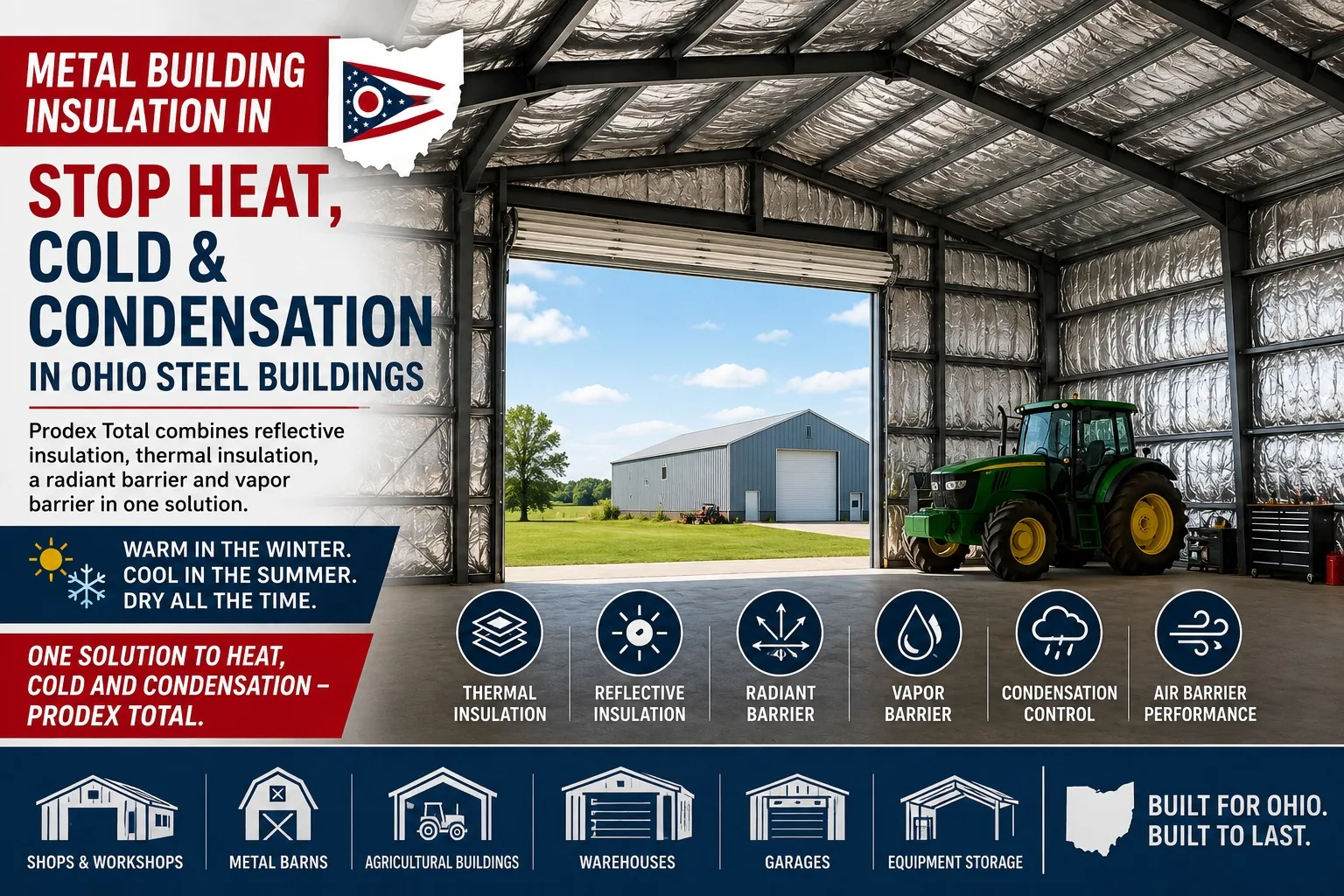
Metal Building Insulation in Ohio for Heat, Cold & Condensation
A metal building in Ohio has to deal with two very different insulation problems. During winter, the steel shell can become extremely cold and interior heat can move rapidly toward the outdoors. During summer, sunlight heats the metal roof and can turn it into a major source of radiant heat.
Then there's the problem that often gets overlooked until water starts appearing inside the building: Condensation.
Warm, moisture-containing air can reach cold steel roofing or siding and condense into water. In the right conditions, droplets can form on the underside of the roof and eventually drip onto vehicles, machinery, tools, inventory, livestock areas or stored materials. That's why choosing insulation for an Ohio steel building shouldn't be based on R-value alone. The insulation system needs to address heat, cold, radiant energy, moisture and condensation. Prodex Total is designed to tackle these problems together.
It combines thermal insulation, reflective insulation, a radiant barrier and vapor barrier in one lightweight product.
Warm in the Winter. Cool in the Summer. Dry All the Time.
One Solution to heat, cold and Condensation - Prodex Total.
For many Ohio steel-building projects, we recommend 10M Prodex Total Insulation Plus.
Why Metal Buildings Are Difficult to Insulate in Ohio
Steel makes an excellent structural and exterior building material, but thermally it presents some unique challenges. Metal readily transfers heat. When the outdoor temperature falls, an uninsulated steel roof and walls can become cold quickly. When summer sun strikes that same building, the exterior metal absorbs solar energy and heats up. This creates three major insulation challenges.
Winter Heat Loss
If you're heating an Ohio workshop, warehouse, barn or other metal structure, an inadequate insulation system allows valuable heat to move toward the colder exterior. Improving the thermal envelope helps reduce that unwanted heat transfer and makes conditioned buildings easier to keep comfortable.
Summer Radiant Heat
Summer heat isn't simply a matter of outdoor air temperature. Solar radiation can heat metal roofing well above the surrounding air temperature. The heated roof then radiates energy toward cooler surfaces inside the building. This is where reflective insulation becomes particularly valuable. Prodex Total's reflective surface can reduce radiant heat transfer when facing the appropriate air space.
Our national Reflective Insulation Guide explains how radiant barriers, reflective insulation and R-value work together.
Condensation on Metal
Condensation is one of the biggest reasons to think differently about insulating a steel building. If moisture-containing air reaches metal that is below the air's dew point, water can form on the steel surface. In a metal building, that can mean condensation on the underside of the roof or walls. An effective insulation strategy should therefore do more than slow conductive heat transfer. It should also consider surface temperatures, vapor movement, air movement and condensation control.
Why Prodex Total Works So Well in Metal Buildings
Prodex Total isn't simply conventional insulation with a shiny surface. It combines several building-envelope functions in one product.
Thermal Insulation
Prodex Total helps resist unwanted heat transfer through the building envelope. That's useful in both directions—helping retain heat during Ohio winters while reducing unwanted heat entering the building during warmer weather.
Reflective Insulation
Its reflective surfaces address radiant heat transfer. This is particularly useful beneath metal roofing, where solar radiation can create significant heat gain.
Radiant Barrier
A properly installed reflective surface facing an air space can reduce radiant energy moving from a hot roof toward the interior. That's a fundamentally different function from conventional mass insulation alone.
Vapor Barrier
Moisture movement matters in a metal structure. Prodex Total incorporates vapor-barrier performance into the insulation system rather than requiring the insulation itself to absorb and hold moisture.
Condensation Control
By combining thermal performance with vapor control, Prodex Total helps address the conditions that cause condensation on steel surfaces. That's especially important in Ohio buildings that may be heated intermittently or experience large indoor-to-outdoor temperature differences.
Air Control
When Prodex Total seams, edges and penetrations are properly installed and sealed, the system can also help reduce unwanted air movement through the building envelope.The result is an insulation approach designed around the actual problems encountered inside metal structures—not simply one insulation number.
The Roof Is the Most Important Area to Insulate
If an Ohio metal building can't be insulated everywhere at once, the roof deserves serious priority.
Why?
Because it is exposed to the greatest solar load. During summer, direct sunlight heats the metal roof. That hot roof can then radiate energy toward the interior of the building. During winter, the roof becomes part of the cold exterior envelope and can be a major location for heat loss. It is also one of the most common places to experience condensation. Warm interior air rises. When that moisture-containing air reaches a cold steel roof, condensation can form on the underside. That's why metal-building roof insulation should address more than thermal resistance.
Prodex Total provides:
Reflective Insulation + Radiant Barrier + Thermal Insulation + Vapor Barrier + Condensation Control
For a deeper look specifically at insulating roofs, see our Roof Insulation Guide. You can also explore Roof & Ceiling Insulation in Ohio for Ohio-specific applications.
How Prodex Total Helps Stop Metal Building Condensation
Condensation isn't water leaking through the roof. It's water being created inside the building when water vapor changes into liquid on a sufficiently cold surface.
Imagine an Ohio steel building during winter. The outside temperature is cold, so the steel roof is cold. Inside the building, people, animals, vehicles, equipment or heaters may add heat and moisture to the air. If that warm, moist air reaches the cold steel, water droplets can develop.
Over time, condensation may contribute to problems involving:
- Wet equipment
- Damp stored materials
- Dripping from the roof
- Corrosion of susceptible metal components
- Moisture around vehicles and machinery
- Damp interior finishes
- Mold or mildew on materials capable of supporting growth
Prodex Total helps by separating interior conditions from the cold metal surface while providing vapor control as part of the insulation system. For metal buildings, this ability to address cold + moisture + condensation together is one of the product's most important advantages.
Insulation for Ohio Metal Barns
Metal barns deserve special attention because they can contain significant sources of moisture. Depending on the building's use, that may include livestock, equipment brought in wet from rain or snow, stored agricultural materials or normal air exchange. At the same time, many barns aren't conditioned continuously. That combination can create substantial temperature and humidity swings.
Prodex Total insulation for metal buildings provides an effective way to address the thermal, radiant and condensation challenges common to steel agricultural structures. For Ohio metal barns, the roof should remain a priority because it experiences both significant solar heat during summer and potentially severe condensation conditions during colder weather.
If your building is a post-frame structure, our Pole Barn Insulation in Ohio guide goes deeper into that specific construction type.
Steel Building Insulation for Ohio Shops and Workshops
A metal shop needs more than protection for the building itself. The interior environment affects the people working inside it as well as tools, machinery, vehicles and stored materials. An uninsulated shop can become extremely hot beneath a sun-heated metal roof. During winter, heating an inadequately insulated workshop can mean continuously replacing heat that's escaping through the building envelope. Condensation adds another problem—especially around tools and metal equipment that you would prefer to keep dry.
For a national overview of steel building insulation, including heat, cold, condensation and air control, see our complete metal-building resource. Owners insulating a garage or workshop should also see Metal Garage & Workshop Insulation in Ohio.
Metal Building Insulation for Agricultural Buildings
Ohio's agricultural buildings can include machinery storage, livestock facilities, equipment barns, maintenance shops and multipurpose structures.
These buildings don't all have the same interior conditions, but the metal envelope creates familiar challenges:
- Solar heat through the roof
- Cold steel during winter
- Rapid temperature changes
- Interior humidity
- Condensation
- Air movement
This is why metal barn insulation shouldn't be chosen solely according to thickness. A system that addresses radiant heat and vapor movement in addition to thermal transfer can be particularly useful in agricultural metal structures. Our national guide to metal barn insulation provides more information about selecting insulation for steel structures. For post-frame barns specifically, see our national Pole Barn Insulation Guide.
New Metal Buildings vs. Existing Metal Buildings
Prodex Total can be considered for both new construction and retrofit projects, although the installation approach may differ.
New Construction
New construction gives you the opportunity to plan the insulation system as part of the building envelope from the beginning.
This makes it easier to think about:
- Insulation placement
- Required air spaces
- Sealing seams
- Roof and wall transitions
- Penetrations
- Vapor control
- Condensation management
Planning these details before the exterior skin and interior finishes are complete can simplify installation.
Existing Metal Buildings
An existing steel building can often be improved without completely rebuilding the envelope. The specific installation method depends on the building's framing, existing insulation, interior finish and intended use. Before installing insulation, it's worth identifying where the building currently experiences its biggest problems.
Is the interior unbearably hot in summer?
Is it expensive to heat?
Does the roof sweat?
Is condensation dripping?
Are certain areas experiencing drafts?
Answering those questions helps determine which areas should receive priority.
Prodex Total vs. Fiberglass in an Ohio Metal Building
Fiberglass has been used in metal buildings for decades and remains an option for many projects. Insulation4Less sells fiberglass insulation for metal buildings for customers whose project calls for conventional fiberglass rolls. But fiberglass and Prodex Total solve building-envelope problems differently. Fiberglass is primarily used for thermal resistance. Depending on the complete assembly, other components may be necessary to manage vapor, radiant heat and condensation.
Prodex Total combines multiple functions into one system.
| Feature | Prodex Total | Fiberglass |
|---|---|---|
| Thermal insulation | Yes | Yes |
| Reflective insulation | Yes | No |
| Radiant heat performance | Yes | Limited without separate radiant barrier |
| Air barrier | Can contribute when properly sealed | Not inherently |
| Built-in vapor barrier | Yes | Depends on facing/system |
| Condensation control | Designed as part of system | Depends heavily on complete assembly |
| Water absorption | Does not rely on absorbing moisture | Fiberglass system must be protected from moisture |
| Mold & mildew resistance | Non-absorbent product | Depends on surrounding materials and moisture conditions |
| Energy efficiency | Addresses multiple heat-transfer mechanisms | Primarily thermal resistance |
| Installation complexity | Lightweight, multiple functions in one product | May require additional components |
| Number of products required | Can perform several functions | Often assembly-dependent |
| Thickness required | Thin profile | Generally much thicker |
| Weight | Lightweight | Heavier/bulkier at higher R-values |
| Durability | Durable closed-cell construction | Performance depends on installation and condition |
| Suitability for steel buildings | Excellent | Commonly used |
The better choice ultimately depends on the building, assembly, budget and desired performance. Our upcoming Fiberglass Insulation vs. Prodex Total in Ohio guide examines these differences in greater depth.
Reflective Insulation Makes Sense Under a Metal Roof
One of the most important differences between a metal building and many conventionally framed structures is the effect of solar radiation on the exterior metal skin. Sunlight doesn't have to heat the interior air directly. Instead, solar radiation heats the roof. The hot roof then transfers energy inward. Reflective insulation provides a way to address this radiant component of heat transfer. That's why Prodex Total can be particularly useful beneath metal roofing when installed with the appropriate air space.
If you're comparing insulation technologies, read our Reflective Insulation Guide to understand how reflective insulation, radiant barriers and traditional R-values differ.
Where Can Prodex Total Be Used in a Metal Building?
A complete metal-building insulation strategy can involve more than the walls. Depending on the building and assembly, Prodex Total can be used to address:
Roofs and Ceilings
The highest priority for controlling radiant heat and one of the most important locations for condensation prevention.
Walls
Insulated walls help complete the thermal envelope and reduce unwanted heat transfer through the metal siding.
Workshops
Insulation can make conditioned work areas more comfortable throughout the year.
Garages and Vehicle Storage
Temperature control and condensation management can help protect vehicles, equipment and stored materials.
Agricultural Buildings
Metal barns, machinery buildings and other agricultural structures can benefit from controlling radiant heat and condensation.
Building Additions
New sections can be insulated as they're constructed while the existing building is upgraded as needed. The goal is to think about the entire building envelope, even when installation is being completed in stages.
How Much Metal Building Insulation Do You Need?
The amount of insulation required depends on the dimensions of the surfaces you're insulating—not simply the building's floor area. For example, a 40 × 60 metal building has 2,400 square feet of floor area, but that doesn't mean 2,400 square feet of insulation will cover the roof and walls. You need to calculate the actual surface area being insulated. For a roof-only project, measure the roof dimensions and account for the roof slope. For walls, calculate the width multiplied by height for each wall and adjust for openings as appropriate. It's also sensible to allow for overlaps, seams, trimming and installation waste.
Recommended Product: 10M Prodex Total Insulation Plus
For many Ohio metal-building projects, our primary recommendation is 10M Prodex Total Insulation Plus. It's particularly attractive for steel structures because one product provides multiple building-envelope functions. Instead of thinking separately about thermal insulation, radiant heat, vapor control and condensation, Prodex Total allows those issues to be addressed together.
Benefits include:
- Thermal insulation
- Reflective insulation
- Radiant barrier performance
- Built-in vapor barrier
- Condensation control
- Moisture resistance
- Lightweight handling
- Thin profile
- Suitability for roofs and walls
- Practical installation for new construction and retrofits
Orders are typically delivered in approximately one week, helping both contractors and DIY building owners keep projects moving.
Shop 10M Prodex Total Insulation Plus
More Ohio Insulation Resources
This article is part of our Ohio insulation resource center. Start with the Ohio Insulation Guide for an overview of insulation options and applications throughout the state.
For closely related projects, see:
- Pole Barn Insulation in Ohio
- Roof & Ceiling Insulation in Ohio
- Metal Garage & Workshop Insulation in Ohio
- Reflective Insulation in Ohio
We've deliberately limited these links to the Ohio pages most relevant to steel-building owners rather than linking every article in the state cluster.
Insulate Your Ohio Metal Building for Every Season
An Ohio steel building doesn't have one insulation problem. It has several. Winter creates heat-loss and cold-surface challenges. Summer creates radiant heat gain through the metal roof. Changing temperatures and interior humidity can create condensation. That's why a complete insulation system needs to address more than R-value. Prodex Total combines thermal insulation, reflective insulation, radiant barrier performance, vapor control and condensation control in one lightweight solution. Whether you're insulating a steel shop, agricultural building, warehouse, metal barn or other metal structure:
Warm in the Winter. Cool in the Summer. Dry All the Time.
One Solution to heat, cold and Condensation - Prodex Total.
Shop 10M Prodex Total Insulation Plus