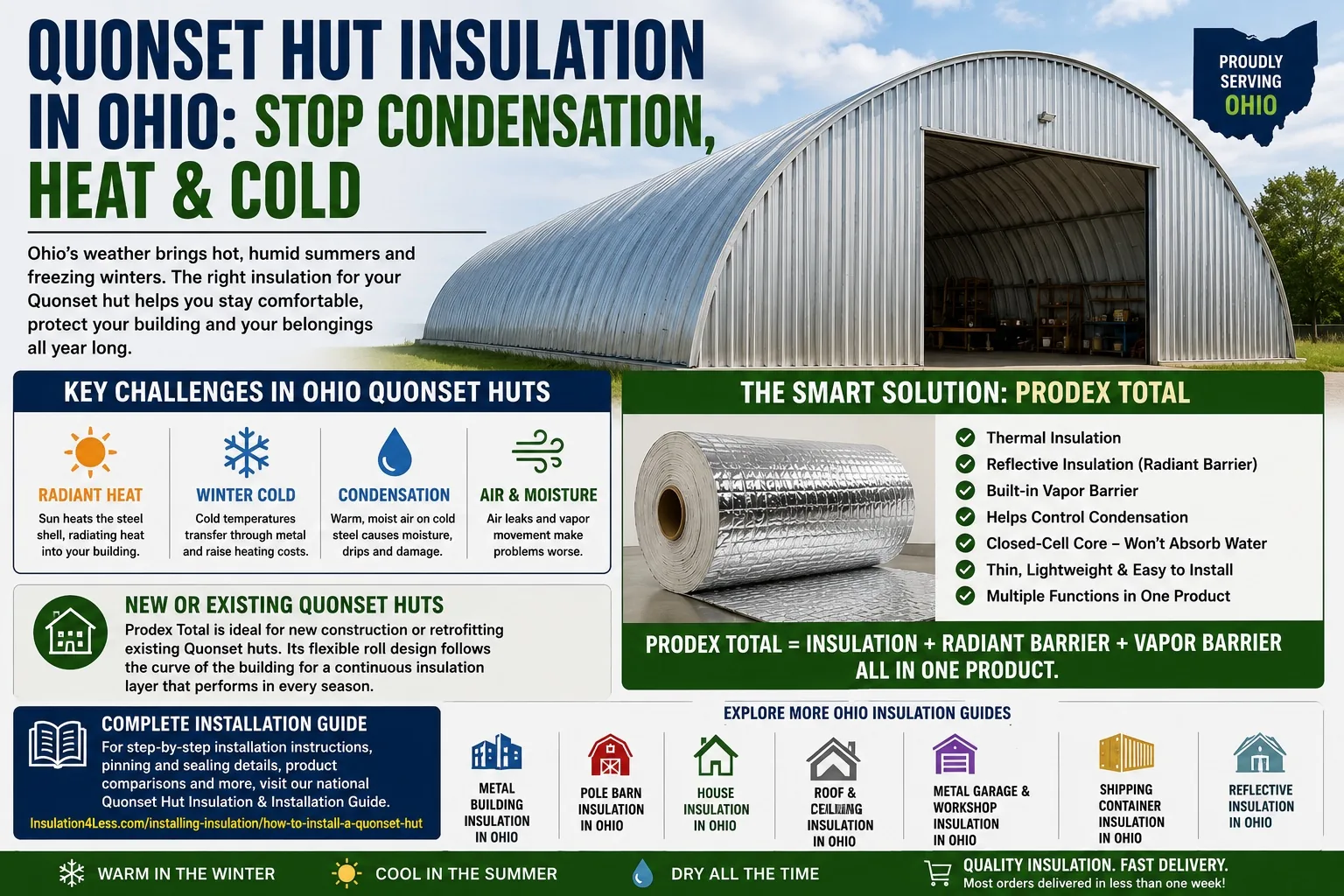
Quonset Hut Insulation in Ohio: Stop Condensation, Heat & Cold
Quonset huts are durable, versatile steel buildings, but their curved metal shells create insulation challenges that are very different from those found in conventional framed structures. In Ohio, those challenges can occur throughout the year.
Summer sun heats the curved steel shell, allowing radiant heat to move toward the interior. During winter, the same steel surface can become extremely cold and rapidly transfer heat away from the building.
Then there's condensation.
Warm, moisture-containing interior air contacting cold steel can produce condensation on the underside of the shell. In an uninsulated Quonset hut, that moisture may drip onto vehicles, tools, machinery, stored materials or finished interior spaces.
The right Quonset hut insulation should therefore do more than provide R-value.
It should help control:
Radiant heat
Winter heat loss
Condensation
Vapor movement
Air movement
Interior comfort
For detailed installation instructions, insulation comparisons and product-selection guidance, see our national Quonset Hut Insulation & Installation Guide. The national guide covers both new and existing Quonset buildings and provides the complete installation process. For insulation information covering other types of buildings throughout the state, visit our Ohio Insulation Guide.
Why Ohio Quonset Huts Are Different to Insulate
A Quonset hut doesn't have a conventional roof sitting on top of vertical walls. Instead, its curved steel shell forms most or all of the building envelope. That means a very large percentage of the structure is directly exposed to outdoor temperatures and solar radiation. In summer, sunlight striking the metal shell can heat the steel rapidly. In winter, cold outdoor temperatures can cause the steel shell to become extremely cold. Because metal readily transfers heat, an uninsulated Quonset building can respond quickly to outdoor temperature changes.
This same characteristic also contributes to condensation.
When warm, humid interior air reaches sufficiently cold steel, water vapor can condense on the metal surface. For these reasons, insulating a Quonset hut requires thinking about the building as a complete steel envelope, rather than simply insulating a roof or wall. Many of these challenges are shared by other steel structures. Our Metal Building Insulation in Ohio guide explains the broader insulation issues affecting Ohio steel buildings. For the national resource, see our guide to steel building insulation.
What Should Quonset Hut Insulation Accomplish?
When evaluating insulation for an Ohio Quonset hut, consider more than one performance number. A well-designed insulation system should address several functions.
Reduce Radiant Heat
Radiant heat can be a major concern because so much of a Quonset hut's metal shell is exposed to the sun. The steel absorbs solar energy and becomes hot. That heated surface can then radiate energy toward the cooler interior. Reflective insulation is particularly useful in this situation because a reflective surface facing an appropriate air space helps reduce radiant heat transfer. For a deeper explanation of this process, see our national Reflective Insulation Guide. For Ohio-specific applications, see Reflective Insulation in Ohio.
Reduce Winter Heat Loss
The problem reverses during cold weather. If the Quonset hut is heated, insulation helps reduce heat transfer through the steel envelope.
This is particularly important when the building is used as a:
Workshop
Garage
Commercial building
Agricultural building
Storage facility
Aircraft shelter
Conditioned workspace
Quonset home
The insulation system should therefore help with both summer heat and winter cold.
Control Condensation
Condensation deserves special attention in a Quonset hut because virtually the entire curved steel shell can potentially become a cold condensation surface. A complete insulation system should help prevent warm, moisture-containing interior air from reaching that cold steel.
Control Vapor and Air Movement
Moisture can travel with moving air and as water vapor. Seams, penetrations and edges therefore matter. Creating a continuous insulation and vapor-control layer is especially important when condensation prevention is one of the primary objectives.
Why Condensation Forms Inside an Ohio Quonset Hut
Condensation isn't caused simply because a building is made of metal. It occurs when a surface becomes cold enough for moisture in the surrounding air to condense. Consider an Ohio Quonset hut during cold weather. The exterior steel shell becomes cold.
Inside the building, moisture may come from:
People
Vehicles covered with rain or snow
Wet equipment
Concrete floors
Ground moisture
Livestock
Unvented heaters
Washing
Humid outdoor air
Other building activities
Warm interior air containing this moisture can reach the cold steel shell. If the steel is below the dew point, water can form on its surface. Because a Quonset hut has such a large curved metal envelope, the result can be extensive condensation rather than a small isolated wet area. Our national Quonset guide identifies condensation as one of the primary challenges these buildings face and explains how a continuous interior barrier can help keep moisture-laden interior air away from the steel shell.
Why the Roof Area Is Especially Important
Although a Quonset hut doesn't have a conventional roof-and-wall transition, the upper portion of the curved shell performs the same critical functions as a roof. It receives direct solar exposure. It is also an important area for winter heat loss and condensation. That makes the overhead portion of the Quonset shell one of the most important areas to insulate correctly. This same principle applies to many other Ohio buildings. For more information about heat gain, heat loss, condensation and insulation systems at the roof, see Roof & Ceiling Insulation in Ohio. Our national Roof Insulation Guide provides additional information about selecting insulation for different roof assemblies.
Reflective Insulation for Ohio Quonset Huts
Reflective insulation is particularly well suited to the problems created by a curved steel building. Unlike conventional mass insulation, reflective insulation can address radiant heat transfer when installed with the appropriate air space. That can be important in a Quonset hut because the sun may strike different portions of the curved shell throughout the day. Reflective insulation can also be incorporated into a continuous interior system that helps address vapor and condensation. For a detailed discussion of reflective insulation performance, R-value, radiant heat and comparisons with other insulation materials, see our Reflective Insulation Guide. For state-specific information, visit Reflective Insulation in Ohio.
Prodex Total for Ohio Quonset Huts
Prodex Total is particularly useful for Quonset buildings because it combines several insulation functions in one material.
Prodex Total = Insulation + Radiant Barrier + Vapor Barrier — All in One Product.
Its flexible roll construction also allows it to follow the curved profile of a Quonset hut. That is an important distinction. A Quonset hut doesn't provide the flat rectangular cavities found in conventional framed construction. An insulation material that can follow the building's curved interior surface can simplify installation.
Prodex Total provides:
Thermal insulation
Reflective insulation
Radiant-barrier performance
Vapor-barrier protection
Condensation control
Closed-cell construction
Moisture resistance
Lightweight handling
Flexibility for curved steel surfaces
Our national Quonset guide specifically recommends Prodex Total for these conditions and provides installation instructions using insulation pins and caps for existing Quonset buildings.
Fiberglass Insulation for a Quonset Hut
Fiberglass is a conventional mass-insulation product and can provide substantial thermal resistance when installed at sufficient thickness. However, a Quonset hut creates several considerations that don't exist in a conventional framed cavity. The curved interior surface can make supporting thick fiberglass more complicated. Fiberglass also isn't itself a radiant barrier. And when fiberglass is used in an assembly where condensation may occur, the system needs appropriate vapor and moisture control. That doesn't mean fiberglass can't be used in a Quonset building. It means you should evaluate the complete insulation assembly, not fiberglass alone. Insulation4Less also sells Fiberglass Insulation for Metal Buildings for projects where conventional fiberglass is the preferred system.
Spray Foam Insulation for a Quonset Hut
Spray foam is another option sometimes considered for Quonset buildings. Because it is sprayed directly onto a surface, it can conform to curved steel. However, spray foam and reflective insulation perform differently. Spray foam provides thermal insulation and can help control air movement when properly installed. It doesn't function as a reflective radiant barrier. That distinction can matter in a sun-exposed steel structure where radiant heat is an important part of the cooling load.
Other considerations may include:
Installed cost
Required thickness
Professional installation
Future access to the steel shell
Repair or removal
Fire-protection requirements
Compatibility with the complete building assembly
The best choice depends on how the Quonset hut will be used and the performance objectives of the project.
Bubble Insulation vs. Prodex Total in a Quonset Hut
Reflective bubble insulation is another product sometimes used in metal buildings. Both bubble products and Prodex Total may have reflective surfaces, but the core materials are different. Prodex Total uses a closed-cell polyethylene foam core rather than an air-bubble core. This gives Prodex Total greater body and makes it especially suitable where durability and long-term shape retention are important. Our national Quonset Hut Insulation & Installation Guide provides additional comparisons among Prodex Total, fiberglass, spray foam and bubble insulation.
Insulating a New Ohio Quonset Hut
If the building hasn't yet been completed, insulation should be considered before construction is finished.
New construction can provide opportunities to plan:
Insulation placement
Air spaces
Seam locations
Vapor control
Penetrations
Interior finishes
The exact installation method will depend on the Quonset building design. The objective is to create a continuous insulation system while preserving the conditions required for the selected insulation to perform properly. If you're installing Prodex Total, follow the applicable manufacturer's and Insulation4Less installation instructions rather than treating a Quonset hut exactly like a conventional straight-wall metal building.
Can You Insulate an Existing Quonset Hut?
Yes.
An existing Quonset hut can be insulated from the interior without removing the exterior steel shell. This is one of the reasons flexible reflective roll insulation can be attractive for retrofit projects. The national Insulation4Less installation method uses perforated insulation pins secured to the metal with Super Metal Sealant. After the adhesive cures, the insulation is pushed over the pins and secured with caps. The recommended pin spacing varies by location because the overhead areas require greater support. The national guide provides the complete instructions, including pin placement, curing, caps, seam sealing and 10M heat-welding procedures. Rather than duplicate those detailed installation instructions here, use our step-by-step Quonset Hut insulation installation guide. That keeps this Ohio page focused on selecting and understanding the insulation system, while the national guide remains the definitive installation resource.
Quonset Hut Garages & Workshops in Ohio
Many Quonset huts are used as garages and workshops. These applications can create additional insulation concerns. Vehicles may introduce rain and snow. Tools and machinery benefit from a dry environment. If the workshop is heated during winter, reducing heat loss becomes important. During summer, radiant heat from the curved steel shell can make the workspace uncomfortable. Prodex Total can address several of these issues with one continuous insulation layer.
For the national resource, see our Metal Garage Insulation Guide.
Quonset Hut Storage Buildings in Ohio
Quonset huts are also commonly used for storage. Insulation can be important even when the building isn't continuously heated or cooled.
Stored contents may include:
Vehicles
Farm equipment
Machinery
Tools
Building materials
Household belongings
Commercial inventory
Condensation dripping from the shell can damage stored materials even when occupant comfort isn't a major concern. Reducing radiant heat can also help moderate extreme summer interior temperatures. For this reason, moisture and radiant heat control may be just as important as conventional R-value in a storage Quonset hut.
Quonset Huts and Other Ohio Steel Buildings
A Quonset hut is ultimately a specialized type of metal building.
Many of the same principles that apply to conventional steel structures also apply here:
Control radiant heat.
Reduce winter heat loss.
Control condensation.
Manage vapor.
Reduce unwanted air movement.
Protect the building and its contents.
For broader Ohio information, see Metal Building Insulation in Ohio. For our complete national resource on metal building insulation, see how insulation systems compare for steel buildings, barns, garages, workshops and other metal structures.
How Much Insulation Do You Need for a Quonset Hut?
Calculating insulation for a Quonset hut is different from calculating material for a conventional rectangular building. The curved shell increases the surface area that needs to be covered. Insulation4Less provides an insulation calculator on the website to help estimate the required number of rolls. For the wall-height entry, the national Quonset guide recommends estimating what the wall height would be if the structure were a straight-wall building. It's generally better to calculate the actual surface you're insulating rather than relying only on the building's floor square footage. Recommended Quonset Hut Insulation: 10M Prodex Total Insulation Plus
For many Ohio Quonset hut applications, our primary recommendation is 10M Prodex Total Insulation Plus. 10M Prodex Total is a roll insulation, allowing the material to follow the curved interior profile of a Quonset building.
It provides:
R22 performance
10 mm (0.4-inch) closed-cell polyethylene foam
Reinforced reflective foil on both sides
Radiant-barrier protection
Vapor-barrier protection
Condensation control
Moisture resistance
Heat-weldable seams
Flexible roll construction
Each roll is approximately 4 feet wide by 85.3 feet long, covering approximately 341 square feet. The national Quonset guide identifies 10M as the most popular Prodex Total option for this application.
Shop 10M Prodex Total Insulation Plus
Cool in the Summer. Warm in the Winter. Dry all the Time.
Orders are typically delivered in less than one week.
Other Prodex Total Roll Options for Quonset Huts
10M isn't the only option.
Depending on the building dimensions, installation method and desired performance, several 5M Prodex Total roll widths may also be appropriate. The national Quonset guide lists options including Prodex 48 Inch, Fast Action, 62 Inch Fast Action, White, 72 Inch, 24 Inch and 16 Inch products. Different roll widths can help accommodate different building dimensions and installation strategies. You can view the broader selection on our Reflective Insulation for Sale page.
Frequently Asked Questions About Quonset Hut Insulation in Ohio
What is the best insulation for a Quonset hut in Ohio?
The best system should address the characteristics of the building rather than simply provide a high R-value. For many Quonset huts, that means addressing radiant heat, winter heat loss, vapor movement and condensation. Prodex Total is particularly well suited to these buildings because it combines thermal insulation, reflective insulation and vapor-barrier protection in a flexible roll that can follow the curved steel shell.
How do I stop condensation inside my Ohio Quonset hut?
The objective is to prevent warm, moisture-containing interior air from reaching the cold steel shell while also improving the thermal characteristics of the interior surface. A continuous insulation and vapor-control layer can help accomplish this. Seams, penetrations and edges should be properly sealed. For the complete method, see our Quonset Hut Insulation & Installation Guide.
Can an existing Quonset hut be insulated from the inside?
Yes.
Existing Quonset huts can be retrofitted from the interior. Prodex Total can be attached using insulation pins and caps without removing the exterior steel panels.
Is reflective insulation good for a Quonset hut?
Yes. Reflective insulation is particularly useful in sun-exposed metal buildings because it can reduce radiant heat transfer when installed with an appropriate air space. The curved shell of a Quonset hut exposes a large area of steel to solar radiation, making radiant heat control especially relevant.
See Reflective Insulation in Ohio for state-specific information.
Can I use fiberglass insulation in a Quonset hut?
Yes, but the complete assembly needs to be considered. Fiberglass provides conventional thermal resistance but isn't itself a radiant barrier. It also needs appropriate support and moisture management.
Does a Quonset hut need a vapor barrier?
Vapor control is particularly important when warm, moisture-containing interior air could reach cold steel. Prodex Total incorporates vapor-barrier performance into the insulation product, reducing the need to create that function with a separate material.
Is Quonset hut insulation different from regular metal building insulation?
The underlying heat and moisture principles are similar, but the curved shell changes the installation. A conventional steel building has separate walls and roof planes. A Quonset hut has a continuous curved steel envelope. For that reason, use the dedicated Quonset Hut Insulation & Installation Guide when planning the installation rather than relying solely on conventional metal-building instructions.
Quonset Hut Insulation in Ohio: The Bottom Line
A Quonset hut's strength comes from its simple curved steel shell. That same design creates its biggest insulation challenges. The large metal envelope can absorb and radiate substantial summer heat, transfer heat rapidly during winter and create extensive surface area where condensation can develop. That's why Quonset hut insulation should be evaluated as a complete system.
For many Ohio Quonset buildings, Prodex Total provides an effective combination of thermal insulation, radiant-barrier performance, vapor protection and condensation control in a flexible roll designed to follow curved surfaces.
Prodex Total = Insulation + Radiant Barrier + Vapor Barrier — All in One Product.
For the detailed installation procedure, product comparisons, condensation-control information and additional Quonset-specific guidance, continue to our national Quonset Hut Insulation & Installation Guide.