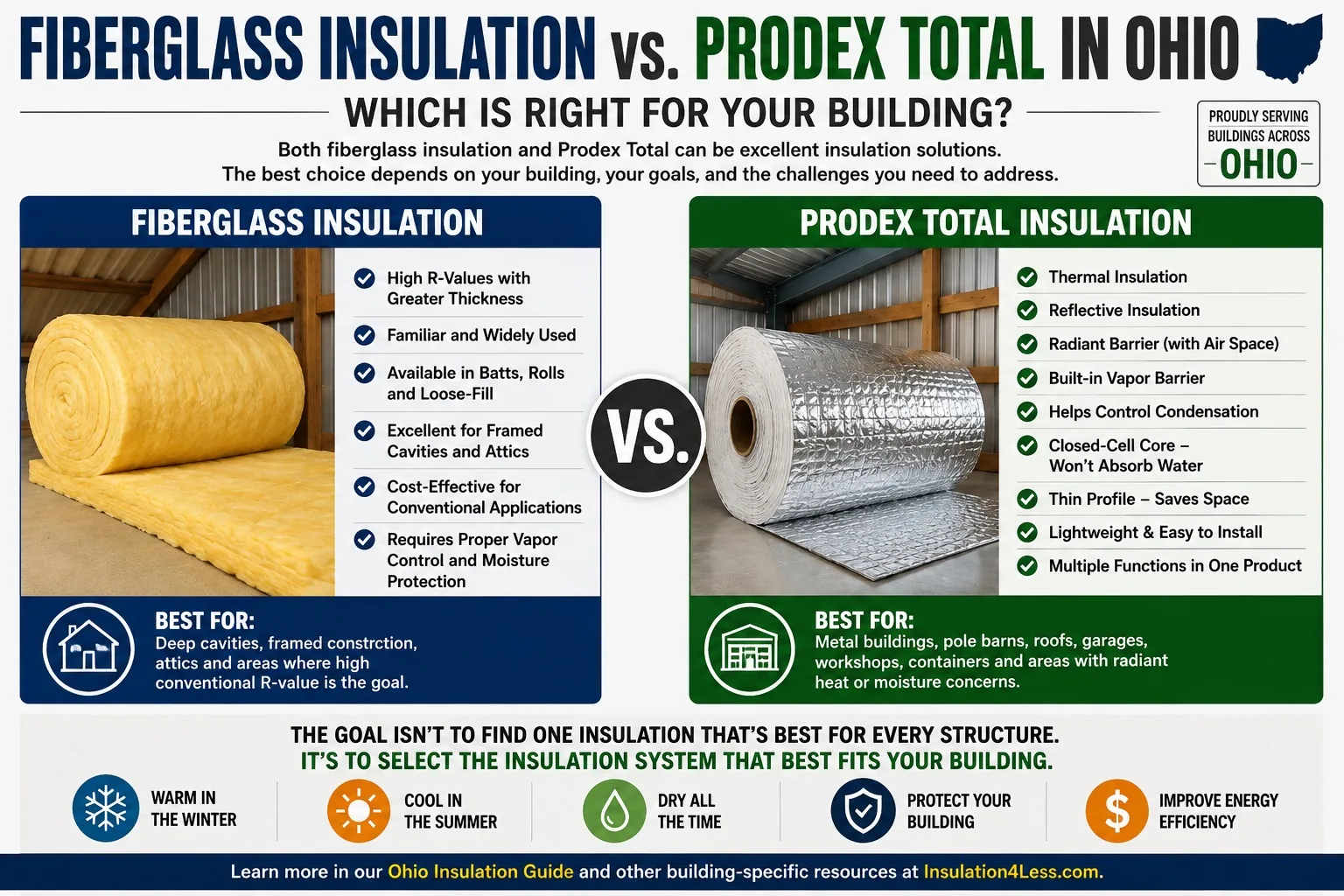
Fiberglass Insulation vs. Prodex Total in Ohio: Which Is Right for Your Building?
Ohio building owners have plenty of insulation choices, but two products that are often considered for the same project can work in very different ways. Fiberglass insulation is a conventional mass-insulation product used extensively in homes, commercial buildings and metal structures. Prodex Total is reflective insulation that combines a closed-cell foam insulation core with reflective surfaces, providing thermal insulation along with radiant-barrier and vapor-barrier functions. Both can be useful insulation products.
The better choice depends on what you're insulating and which problems you're trying to solve. That's particularly important in Ohio, where insulation may need to address cold winter temperatures, summer heat, humidity and condensation. For the broader science behind reflective insulation, radiant barriers and conventional R-value, see our national Reflective Insulation Guide.
If you're specifically looking to purchase conventional fiberglass for a steel structure, see our Fiberglass Insulation for Metal Buildings.
Fiberglass and Prodex Total Are Different Types of Insulation
Fiberglass and Prodex Total shouldn't be viewed simply as two brands competing to perform exactly the same job. They use different approaches. Fiberglass primarily provides thermal resistance by slowing heat flow through a thick layer of glass fibers.
Prodex Total combines several building-envelope functions:
Thermal Insulation + Reflective Insulation + Radiant Barrier + Vapor Barrier
That distinction matters because heat and moisture don't move through buildings in only one way.
An insulation system may need to address:
Conductive heat transfer
Radiant heat
Air movement
Vapor movement
Moisture
Condensation
The correct comparison therefore isn't simply:
Which product is thicker?
Or even:
Which product has the higher R-value?
A better question is:
Which insulation system addresses the problems present in my particular building?
Fiberglass vs. Prodex Total: Quick Comparison
| Feature | Prodex Total | Fiberglass |
|---|---|---|
| Reflective insulation | Yes | No |
| Radiant heat performance | Yes, with appropriate air space | Requires separate reflective component |
| Thermal insulation | Yes | Yes |
| Air barrier | Can contribute when properly sealed | Not inherently |
| Built-in vapor barrier | Yes | Depends on facing and assembly |
| Condensation control | Integrated into system approach | Depends on complete assembly |
| Water absorption | Closed-cell core does not absorb water | Must be protected from moisture |
| Mold & mildew resistance | Does not support mold or mildew | Moisture management remains important |
| Energy efficiency | Addresses thermal and radiant transfer | Primarily thermal resistance |
| Installation complexity | Multiple functions in one product | May require additional components |
| Number of products required | Can perform several functions | Depends on assembly |
| Thickness required | Thin profile | Generally thicker |
| Weight | Lightweight | Bulkier at higher R-values |
| Durability | Closed-cell construction | Durable when properly installed and kept dry |
| Suitability for steel buildings | Excellent | Widely used |
Neither product wins every category for every building.
The differences become particularly important when you're insulating metal buildings, pole barns, houses, roofs, garages, workshops, Quonset huts and shipping containers.
Where Fiberglass Insulation Has an Advantage
Fiberglass has been successfully used for decades and can be an excellent choice for the right application.
High Conventional R-Values
Fiberglass can provide substantial conventional thermal resistance when sufficient cavity depth is available. This makes it particularly useful in conventional framed construction where walls, ceilings and attic spaces are designed to accommodate thick insulation.
Familiar Construction Methods
Builders and insulation contractors are familiar with fiberglass.
It is available in several forms, including:
Batts
Rolls
Loose-fill insulation
Faced insulation
Metal-building fiberglass systems
There are also fiberglass products manufactured specifically for steel structures. If this is what your project requires, see our Fiberglass Insulation for Metal Buildings.
Residential Attics and Framed Cavities
Conventional homes often contain deep framing cavities where substantial levels of mass insulation are required. Fiberglass can make excellent sense in these applications.
Where Prodex Total Has an Advantage
Prodex Total becomes particularly attractive when the building has problems that extend beyond conductive heat transfer.
Radiant Heat Control
Fiberglass isn't itself a radiant barrier.
Prodex Total incorporates reflective surfaces designed to reduce radiant heat transfer when facing an appropriate air space. Insulation4Less's national reflective-insulation guide explains this distinction and the role the adjacent air space plays in reflective performance. This can be particularly important beneath roofs. Solar radiation heats the roofing material. The hot roof can then radiate energy toward cooler surfaces below. A reflective insulation system addresses this component of heat transfer directly.
For Ohio applications, see Reflective Insulation in Ohio. For the underlying principles, see our national Reflective Insulation Guide.
Built-In Vapor Barrier
Prodex Total incorporates vapor-barrier performance into the product. With fiberglass, vapor control depends on the facing and design of the complete assembly. This distinction can become particularly important when moisture and condensation are significant concerns.
Thin Profile
Prodex Total provides multiple insulation functions without requiring the cavity depth associated with thick fiberglass systems. That can be valuable in buildings where interior space is limited.
Moisture Resistance
Prodex Total uses a closed-cell core that doesn't absorb water. Fiberglass should be incorporated into an assembly designed to protect the insulation from unwanted moisture.
Multiple Functions in One Product
One of Prodex Total's primary advantages is the ability to combine several functions:
Prodex Total = Insulation + Radiant Barrier + Vapor Barrier — All in One Product.
Fiberglass vs. Prodex Total for Ohio Metal Buildings
Metal buildings are one of the applications where the differences between these insulation systems become especially important. Steel conducts heat readily. During summer, solar radiation can make metal roofing extremely hot. During an Ohio winter, that same roofing can become extremely cold. Cold steel can also become a condensation surface when warm, moisture-containing interior air reaches it.
A steel-building insulation system therefore needs to consider:
Conductive heat
Radiant heat
Air movement
Vapor movement
Moisture
Condensation
Fiberglass can work effectively in steel structures when incorporated into a properly designed complete assembly. Prodex Total approaches the problem differently by combining thermal insulation, reflective insulation and vapor-barrier performance. For state-specific information, see Metal Building Insulation in Ohio. For the complete national resource on insulation for metal buildings, including heat, cold, condensation and air control, see our metal-building guide.
Fiberglass Metal Building Insulation Is a Real Option
Because Insulation4Less sells both products, this comparison isn't intended to portray fiberglass as a bad insulation product. Some projects specifically call for conventional fiberglass.nFor those applications, Insulation4Less sells Fiberglass Insulation for Metal Buildings. This is particularly useful for customers looking for conventional fiberglass rolls for steel-building applications.
The choice isn't:
Good insulation vs. bad insulation.
It's:
Which insulation system better matches your building and the performance you need?
Fiberglass vs. Prodex Total for Ohio Pole Barns
Pole barns create many of the same challenges as other metal structures. During summer, the metal roof receives substantial solar radiation. During winter, the underside of the roofing can become extremely cold. Interior moisture can then contribute to condensation. Fiberglass can provide substantial conventional thermal resistance where sufficient cavity depth is available and the complete assembly properly controls moisture. Prodex Total combines thermal insulation, reflective insulation and vapor control. For many pole barns, addressing radiant heat + thermal transfer + condensation together can be particularly valuable.
For the complete national resource, see our Pole Barn Insulation Guide.
Fiberglass vs. Prodex Total for Ohio Roofs & Ceilings
The roof may be the easiest place to understand the difference between conventional and reflective insulation. Imagine an Ohio roof on a sunny summer afternoon. Sunlight heats the roofing material. The roof becomes hot. That hot surface can then radiate energy toward cooler surfaces below. Fiberglass provides resistance to heat flow through the assembly. Prodex Total provides thermal insulation while also providing a reflective surface designed to reduce radiant heat transfer when facing the appropriate air space. During winter, the challenge changes. The roof can become a cold surface, making thermal performance, vapor movement and condensation control increasingly important.
For Ohio-specific information, see Roof & Ceiling Insulation in Ohio. For the complete national resource, see our Roof Insulation Guide.
Which Insulation Is Better for Condensation?
Neither fiberglass nor Prodex Total should be expected to eliminate condensation regardless of how a building is constructed. Condensation is a building-system problem. It occurs when moisture-containing air reaches a surface cold enough for water vapor to change into liquid.
In metal buildings, interior moisture may come from:
People
Livestock
Wet vehicles
Snow brought indoors
Ground moisture
Concrete
Unvented heaters
Washing
Outdoor humidity
Prodex Total and Condensation
Prodex Total's advantage is that thermal separation and vapor-barrier performance are incorporated into the insulation system. This is one reason Prodex Total is frequently selected for metal buildings, pole barns and other structures where condensation is a major concern.
Fiberglass and Condensation
Fiberglass can be successfully incorporated into condensation-control assemblies, but the fiberglass itself isn't the complete solution. Facing, vapor control, air control and proper installation all matter. When condensation is important, compare the entire insulation assembly, not simply the insulation material.
What Happens if Fiberglass Gets Wet?
Fiberglass should be protected from unwanted moisture.
That means the complete installation needs to consider:
Roof leaks
Vapor movement
Condensation
Air leakage
Facing
Seams
Penetrations
This doesn't mean fiberglass can't be used in humid environments. It means the building assembly should be designed to keep the fiberglass dry. Prodex Total can also be installed as a complement to fiberglass in some metal-building applications to help protect the fiberglass from moisture and preserve its performance.
Fiberglass vs. Prodex Total for Radiant Heat
For radiant heat control, Prodex Total has a functional advantage because it incorporates reflective surfaces. Fiberglass by itself isn't a radiant barrier.
Radiant heat can be particularly important in:
Metal roofs
Steel buildings
Pole barns
Metal garages
Workshops
Agricultural buildings
Quonset huts
Shipping containers
These structures frequently have large metal surfaces exposed directly to sunlight. For Ohio applications, see Reflective Insulation in Ohio. For the national explanation of radiant barriers, reflective insulation and R-value, see our Reflective Insulation Guide.
Fiberglass vs. Prodex Total for Ohio Houses
The comparison becomes more nuanced in a conventional house. An Ohio home may contain deep framed cavities where substantial conventional thermal resistance is required. Fiberglass can make excellent sense in these applications. Prodex Total can be useful in appropriate residential assemblies where reflective performance, vapor control or limited thickness are particularly important. Roof applications are a good example because the roof experiences significant solar radiation.
The correct question isn't:
Is fiberglass or Prodex Total universally better for houses?
It's:
What does this particular roof, ceiling, wall or other assembly require?
For the national resource covering cold, moisture, air and heat throughout the residential building envelope, see our House Insulation Guide.
Fiberglass vs. Prodex Total for Ohio Metal Garages & Workshops
Metal garages and workshops are another application where looking beyond R-value is important. During summer, a sun-heated metal roof can become a major source of radiant heat. During winter, a heated workshop needs thermal resistance. Vehicles can also bring rain and snow indoors, increasing moisture. Tools, machinery and equipment are generally better protected in a dry environment. Prodex Total's combination of thermal insulation, radiant barrier and vapor barrier can therefore be particularly attractive. Fiberglass remains an option when the building is designed to accommodate a conventional fiberglass system.
For our national resource, see the Metal Garage Insulation Guide.
Fiberglass vs. Prodex Total for Ohio Quonset Huts
A Quonset hut presents a unique insulation problem because the curved steel shell serves as both the walls and roof.
That means much of the building envelope can:
Conduct heat
Absorb solar radiation
Radiate heat inward
Become extremely cold during winter
Become a condensation surface
Prodex Total's thin profile, flexibility and reflective properties make it particularly attractive for this application. Fiberglass can be incorporated into some Quonset hut systems, but supporting and protecting thick fibrous insulation inside a curved structure can make installation more complicated. For insulation selection and detailed installation information, see our national Quonset Hut Insulation & Installation Guide.
Fiberglass vs. Prodex Total for Ohio Shipping Containers
Shipping containers create another situation where insulation thickness deserves special consideration. Every inch devoted to insulation reduces usable interior space. At the same time, the steel shell can create substantial radiant-heat and condensation problems. During summer, solar radiation heats the roof and walls. During cold weather, the steel shell can become a condensation surface. Prodex Total's thin profile and combination of thermal, reflective and vapor-control functions can make it particularly useful for this application. For state-specific information, see Shipping Container Insulation in Ohio. For the complete national resource, see our Shipping Container Insulation Guide.
Is Thicker Insulation Always Better?
No. But thickness is important for conventional mass insulation. A thicker fiberglass system can provide greater thermal resistance. The mistake is assuming that thickness alone describes total building-envelope performance.
Ask two separate questions:
How well does the system resist heat flow?
And:
What other functions does the system provide?
Prodex Total adds reflective performance and vapor-barrier protection that aren't described simply by measuring thickness. Fiberglass can provide substantial conventional R-values through greater thickness. These are different performance characteristics. The insulation should therefore be evaluated according to the complete application.
What About R-Value?
R-value is important. It measures resistance to heat flow and is an important component of insulation selection. But R-value alone doesn't describe every function of an insulation system.
It doesn't tell you:
Whether the insulation is reflective
Whether it provides a radiant barrier
Whether it provides a vapor barrier
Whether the assembly controls air movement
How the product responds to moisture
How much interior space it consumes
How the complete assembly addresses condensation
That's particularly important when comparing two fundamentally different insulation technologies. For more about R-value, radiant heat and reflective insulation performance, see our Reflective Insulation Guide.
Fiberglass vs. Prodex Total for New Construction
New construction provides more freedom to design the complete insulation assembly.
You can plan:
Cavity depth
Continuous insulation
Air spaces
Vapor control
Facing
Seams
Penetrations
Thermal bridging
Depending on the building, fiberglass, Prodex Total or an engineered assembly incorporating multiple materials may be appropriate. For metal structures, new construction also gives you an opportunity to plan the insulation system before the exterior sheeting is completed.
Fiberglass vs. Prodex Total for Retrofit Projects
Existing buildings create different challenges. There may be limited cavity depth. Framing may already be covered. Existing insulation may be present. Interior finishes may make some areas difficult to reach. A thin, lightweight product capable of performing several building-envelope functions can therefore be advantageous. This is one reason Prodex Total is frequently used when retrofitting existing metal buildings, pole barns, garages and workshops.
Is Easier to Install?
Installation complexity depends on the building.
A fiberglass system may require a combination such as: Fiberglass + Facing/Vapor Control + Support + Sealing depending on the application.
Prodex Total combines several functions into one product. That can simplify certain installations. However, Prodex Total also needs to be installed correctly. Reflective performance requires an appropriate air space, and seams, edges and penetrations need to be properly handled to create the intended vapor and air-control layer. No insulation system performs as intended if it isn't installed correctly.
Fiberglass or Prodex Total? Start With the Building
The best way to make the decision is to start with your building and the problems you're trying to solve.
Consider Fiberglass When:
You need substantial conventional cavity R-value.
You have adequate cavity depth.
The building assembly is designed for fiberglass.
Proper vapor and moisture control can be provided.
Conventional framed construction makes fiberglass practical.
Consider Prodex Total When:
Radiant heat is a major concern.
You're insulating beneath a metal roof.
Condensation control is important.
You want built-in vapor-barrier performance.
Interior space is limited.
You want a thin, lightweight insulation system.
You're insulating a metal building, pole barn, garage, workshop, Quonset hut or shipping container.
You want several insulation functions combined into one product.
Evaluate the Complete Assembly When:
Building-code requirements apply.
High prescribed R-values are required.
Moisture conditions are complicated.
Multiple insulation materials may be appropriate.
You're changing an existing roof or wall assembly.
The goal isn't to find one insulation that's best for every structure. It's to select the insulation system that best fits your building.
Recommended Reflective Insulation: 10M Prodex Total Insulation Plus
For many Ohio metal buildings, pole barns, roofs, garages, workshops, Quonset huts and similar applications, our primary reflective-insulation recommendation is 10M Prodex Total Insulation Plus.
10M Prodex Total provides:
Thermal insulation
Reflective insulation
Radiant barrier
Vapor barrier
Condensation control
Moisture resistance
Lightweight handling
Thin-profile construction
Prodex Total = Insulation + Radiant Barrier + Vapor Barrier — All in One Product.
Cool in the Summer. Warm in the Winter. Dry all the Time.
Orders are typically delivered in less than one week.
Shop 10M Prodex Total Insulation Plus
Prefer Fiberglass? We Sell That Too
The purpose of this comparison isn't to pretend every project should use Prodex Total. If fiberglass better fits your building or specifications, Insulation4Less also offers Fiberglass Insulation for Metal Buildings. The objective is to choose the insulation system that makes the most sense for your building, your assembly and the problems you're trying to solve.
Fiberglass vs. Prodex Total: The Bottom Line
Fiberglass and Prodex Total can both be effective insulation products. They simply approach insulation differently. Fiberglass is an established conventional insulation capable of providing substantial thermal resistance when installed at the appropriate thickness and incorporated into a properly designed assembly. Prodex Total combines thermal insulation with reflective insulation, radiant-barrier performance and vapor-barrier protection in a thin, lightweight product. For many Ohio steel buildings, pole barns, metal garages, workshops and metal roofs, those additional functions can be particularly valuable. For conventional framed cavities requiring substantial mass-insulation R-value, fiberglass may be the better fit. Don't choose based solely on thickness. Don't choose based solely on one R-value.
Choose based on the building, the assembly, radiant heat, moisture, condensation and the complete performance you need.
For more about reflective insulation technology, continue to our national Reflective Insulation Guide.
If conventional fiberglass is the better fit for your steel structure, see our Fiberglass Insulation for Metal Buildings.