Ohio Pole Barn Insulation for Year-Round Comfort & Condensation Control
Pole barns are everywhere in Ohio for a reason.
They're practical, economical structures for agriculture, equipment storage, workshops, garages, livestock, commercial uses and countless other applications. Ohio State University Extension describes pole barns as the most common storage structures found on farms and notes their adaptability to different sizes and needs.
But the combination of a post-frame structure and metal exterior creates some important insulation challenges.
An Ohio pole barn may face cold winter temperatures, warm and humid summers, solar heat beating down on the metal roof and condensation forming when warm, moisture-containing air meets cold metal. Ohio's climate is generally humid continental, with substantial seasonal temperature variation and moisture throughout the year.
That's why good pole barn insulation needs to do more than provide an R-value.
For a complete overview of heat, cold, condensation and air control in post-frame buildings, see our national pole barn insulation guide. This Ohio guide builds on those principles with additional considerations for Ohio's seasonal temperature changes, humidity and agricultural building conditions.
It should help address:
- Winter heat loss
- Summer heat gain
- Radiant heat from the metal roof
- Condensation
- Vapor movement
- Air movement
- Moisture
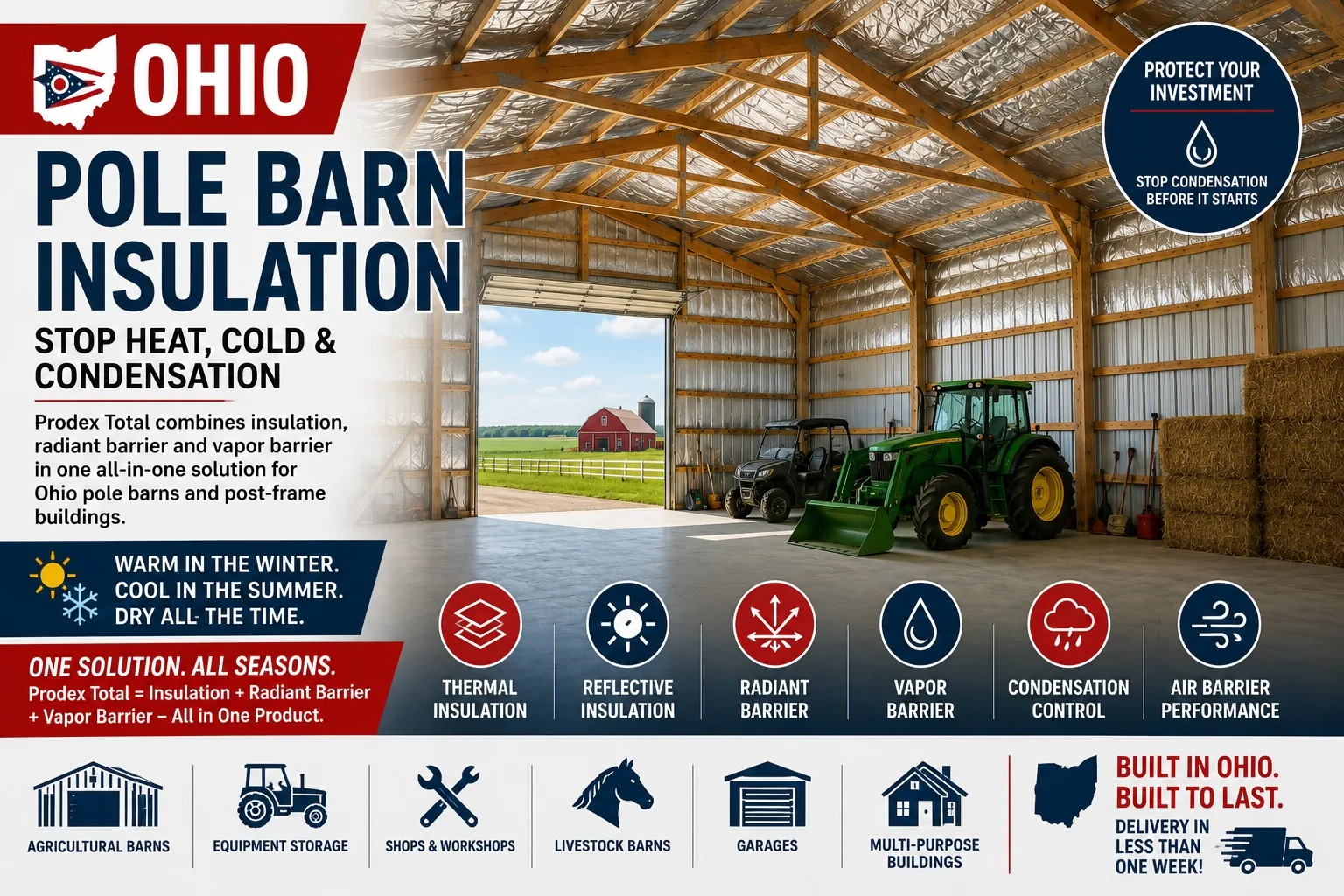
Prodex Total addresses these problems with one lightweight insulation system.
Prodex Total = Insulation + Radiant Barrier + Vapor Barrier — All in One Product.
Cool in the Summer. Warm in the Winter. Dry all the Time.
For many Ohio pole barns, our primary recommendation is 10M Prodex Total Insulation Plus.
Why Ohio's Climate Matters When Insulating a Pole Barn
Ohio doesn't have a single-season insulation problem. The state experiences four distinct seasons. Warm, moist air from the Gulf contributes to hot, humid summer conditions, while cold continental air can produce very cold winters. Northeast Ohio also experiences additional winter effects from Lake Erie. The 2025–26 winter illustrates the heating challenge: the State Climate Office of Ohio reported statewide winter temperatures generally around 25°F to 30°F, with colder conditions in parts of northern Ohio. For a pole barn, these changing conditions matter because the metal roof and siding respond quickly to outdoor temperatures.
Winter: Keep Interior Heat From Escaping
If your pole barn is heated, the temperature difference between the inside and outside creates continuous heat flow toward the colder exterior. Without effective insulation, maintaining comfortable working conditions can require substantially more heating. Cold exterior metal can also contribute to condensation.
Summer: Stop Radiant Heat From the Roof
Summer presents a different problem. Direct sunlight strikes the metal roof and heats it. The hot roof can then radiate energy toward the interior of the barn. This can make an uninsulated pole barn uncomfortable even when the outdoor air temperature itself doesn't seem extreme. Reflective insulation is especially useful here because it addresses radiant heat transfer, not merely conductive heat flow. Our Reflective Insulation Guide explains how reflective insulation and radiant barriers work.
Spring and Fall: Watch the Temperature Swings
Rapid temperature changes can be particularly important for metal structures. The steel skin can cool quickly while the air inside the building remains warmer and contains moisture. Those conditions can encourage condensation. This is one reason Ohio pole barn insulation should be selected as a year-round building-envelope system, rather than simply something that keeps the barn warm in January.
Condensation Can Be a Major Pole Barn Problem
You've probably heard it called a sweating metal roof. But the metal isn't actually sweating. Condensation occurs when moisture-containing air encounters a surface cold enough for water vapor to turn into liquid. In a pole barn, the underside of the metal roof can provide exactly that surface.
Depending on how the barn is used, interior moisture may come from:
- People
- Livestock
- Wet vehicles
- Tractors and equipment
- Snow brought inside on equipment
- Ground moisture
- Washing or cleaning
- Unvented heaters
- Humid outdoor air
When that moisture reaches cold roofing, droplets can form. Eventually those droplets can fall onto whatever is beneath them. That could include hay, tools, vehicles, machinery, equipment, inventory or work areas. A good insulation system should therefore address condensation before the barn starts dripping.
Why Prodex Total Works Well in Ohio Pole Barns
Prodex Total is particularly well suited to post-frame buildings because it addresses several building-envelope problems with one product.
Thermal Insulation
Prodex Total helps resist unwanted heat transfer through the roof and walls. During winter, that helps retain interior heat. During summer, it helps reduce heat moving toward the interior.
Reflective Insulation
The reflective surfaces help reduce radiant heat transfer when installed facing the appropriate air space. This becomes especially important beneath a sun-heated metal roof.
Radiant Barrier
The radiant barrier component gives Prodex Total an advantage in applications where radiant energy is a major source of heat gain. A pole barn roof is a perfect example.
Vapor Barrier
Prodex Total provides built-in vapor-barrier protection. That's particularly valuable in buildings where moisture and cold metal surfaces can combine to produce condensation.
Condensation Control
Thermal separation and vapor control work together to help address the conditions that cause metal roofing to sweat.
Air Barrier
When seams, edges and penetrations are properly sealed, Prodex Total can also contribute to controlling unwanted air movement. Instead of installing separate products for several different jobs, Prodex Total combines them.
Insulation + Radiant Barrier + Vapor Barrier — All in One Product.
The Pole Barn Roof Is the Most Important Area
If there's one part of an Ohio pole barn that deserves special attention, it's the roof. The roof receives more direct solar exposure than any other part of the building. That creates a summer radiant-heat problem. But during winter, the metal roof can become extremely cold. That creates both a heat-loss problem and a condensation problem. Warm air also rises, carrying heat and moisture toward the roof. The roof therefore sits at the intersection of three major issues:
Heat + Cold + Condensation
Prodex Total addresses all three.
Its reflective surface helps reduce radiant heat coming from a hot roof during summer. Its thermal properties help reduce unwanted heat transfer. Its vapor-barrier properties help address moisture and condensation. For more information about insulating this critical part of the building, see our national Roof Insulation Guide. You can also see Roof & Ceiling Insulation in Ohio for Ohio-specific roof applications.
Pole Barn Roof Insulation for Summer Heat
It's easy to underestimate how much heat can come through a metal roof. The problem isn't limited to hot outdoor air. Solar radiation strikes the roofing and raises the temperature of the metal itself. The heated metal then radiates energy toward cooler surfaces below. This is why a pole barn can feel oppressively hot beneath the roof even when there is plenty of ventilation. A reflective insulation system helps address that radiant component. When Prodex Total's reflective surface faces an appropriate air space, it helps reduce radiant heat transfer from the hot roofing toward the occupied space.
That makes reflective insulation especially relevant for:
- Workshops
- Equipment barns
- Livestock buildings
- Vehicle storage
- Agricultural work areas
- Commercial pole buildings
- Hobby shops
- Garages
For a deeper explanation, visit our Reflective Insulation Guide.
Pole Barn Insulation for Ohio Winters
A heated pole barn has a very different job during winter. Instead of trying to keep solar heat out, you're trying to keep valuable interior heat in. Ohio's winters can create substantial heating demand, and northern portions of the state can experience especially cold conditions. Insulating the roof and walls helps reduce unwanted heat transfer through the building envelope. But there's another reason winter insulation matters. Insulation helps separate warm interior conditions from cold exterior metal. That can reduce the conditions that lead to condensation on the underside of the roofing and siding. So winter pole barn insulation isn't only about comfort or heating costs. It's also part of the building's moisture-control strategy.
Insulating an Ohio Metal Barn
Many Ohio pole barns are essentially metal barns built around a post-frame structure. That makes the principles of insulating a steel building highly relevant. The metal roof and siding conduct heat readily, absorb solar energy and can provide cold condensation surfaces. For a broader look at metal barn insulation, our national metal-building guide explains how to address heat, cold, condensation and air in steel structures. Our Metal Building Insulation in Ohio guide provides additional Ohio-specific information about insulating steel buildings, barns, shops and agricultural structures.
If your building is a post-frame barn, our national guide to insulation for pole barns explains the broader insulation strategy for controlling winter cold, summer heat, condensation and air movement.
Pole Barns Used as Workshops
A pole barn converted into a workshop usually requires a higher level of comfort than a building used only for basic storage. You may be heating it during winter. You may spend hours working inside during summer. You may also have vehicles, machinery, power tools and materials that you'd prefer to keep dry. That makes insulation and condensation control especially important. The roof should receive priority, followed by completing the wall envelope where appropriate. For buildings primarily used as garages or shops, also see Metal Garage & Workshop Insulation in Ohio.
Agricultural Pole Barn Insulation
Agricultural buildings can have very different interior conditions depending on their use. An equipment barn may contain tractors and machinery. A livestock building can produce significant interior moisture. A storage barn may contain materials that need protection from dripping condensation. Whatever the use, the building envelope needs to be considered as a system. Ohio State Extension advises farm-building owners to consider local climate conditions, snow and wind loads, and to have a water-management plan to reduce moisture when planning farm structures. Insulation is another part of that moisture and temperature strategy. For metal agricultural structures, insulation for metal buildings should address the roof's radiant load as well as winter heat transfer and condensation. Prodex Total's combination of thermal insulation, radiant barrier and vapor barrier makes it particularly useful in these environments.
New Construction Pole Barn Insulation
A new pole barn gives you the best opportunity to integrate insulation into the building envelope from the beginning. With new construction, Prodex Total can be installed in conjunction with the framing and exterior metal. For many new-build applications, the insulation is run perpendicular to the framing with an appropriate sag to create an air space beneath the roof sheeting. That air space is important to reflective insulation performance.
Planning the insulation before the metal skin is installed also makes it easier to:
- Maintain the desired air space
- Create continuous insulation coverage
- Seal seams
- Address roof-to-wall transitions
- Work around penetrations
- Create vapor continuity
- Minimize gaps
The goal is not simply to put material between the inside and outside. It's to create a continuous insulation and moisture-control system.
Retrofitting Insulation in an Existing Pole Barn
Existing pole barns can also be insulated. The installation method depends on the framing, spacing, existing materials and how the building will be used. For retrofit applications, Prodex Total can be installed across framing rather than trying to fill every individual cavity. Covering the framing can also help reduce thermal pathways through structural members. Seams should be properly sealed, and the installation should be planned so the insulation remains securely supported over time. Before beginning a retrofit, look for existing moisture problems.
Check:
- Underside of roof panels
- Fasteners
- Purlins
- Wall panels
- Corners
- Roof-to-wall transitions
- Areas around doors
- Existing insulation
If water is entering from an actual roof leak, repair the leak first. Insulation is designed to manage heat and condensation—not to replace a watertight roof.
Prodex Total vs. Fiberglass in a Pole Barn
Fiberglass is widely used in post-frame construction and can be a good choice for projects requiring conventional thick insulation. Insulation4Less sells fiberglass insulation for metal buildings for customers who prefer that system.
But fiberglass and Prodex Total work differently.
| Feature | Prodex Total | Fiberglass |
|---|---|---|
| Thermal insulation | Yes | Yes |
| Reflective insulation | Yes | No |
| Radiant heat control | Yes | Requires separate reflective component |
| Air barrier | Can contribute when sealed | Not inherently |
| Built-in vapor barrier | Yes | Depends on facing/system |
| Condensation control | Integrated into system approach | Depends on complete assembly |
| Water absorption | Non-absorbent closed-cell core | Must be protected from moisture |
| Mold/mildew resistance | Does not support mold/mildew | Moisture management remains important |
| Installation complexity | Multiple functions in one product | May require additional components |
| Products required | Can address several functions | Assembly-dependent |
| Thickness | Thin profile | Generally thicker |
| Weight | Lightweight | Bulkier at higher R-values |
| Durability | Closed-cell construction | Depends on installation and moisture exposure |
| Steel/post-frame suitability | Excellent | Commonly used |
This doesn't mean fiberglass is automatically wrong for a pole barn. It means you should compare the complete insulation system, not merely one R-value. Our Fiberglass Insulation vs. Prodex Total in Ohio guide takes a closer look at those differences.
Reflective Insulation vs. Conventional Insulation
Traditional insulation and reflective insulation don't perform exactly the same job. Conventional insulation is primarily intended to resist conductive heat flow. Reflective insulation adds the ability to address radiant heat transfer when installed correctly with an air space. That's especially relevant beneath a pole barn's metal roof.
Prodex Total combines both approaches:
Thermal Insulation + Reflective Insulation
It then adds:
Radiant Barrier + Vapor Barrier + Condensation Control
That's why looking only at thickness doesn't tell the whole story. Learn more in our national Reflective Insulation Guide or see Reflective Insulation in Ohio.
How Much Insulation Does an Ohio Pole Barn Need?
Don't calculate insulation based only on the barn's floor area. A 40 × 60 pole barn has 2,400 square feet of floor space, but the roof and walls represent substantially more surface area. For a roof installation, calculate the actual roof surface rather than simply multiplying building length by width. Roof pitch increases the surface area. If you're insulating the walls, calculate each wall separately:
Wall Length × Wall Height = Wall Area
Then add the roof area and allow for the requirements of the installation, including overlaps, trimming and waste. For the most accurate quantity, use the insulation calculator on Insulation4Less.com with your building's length, width, wall height and roof pitch.
Recommended Pole Barn Insulation: 10M Prodex Total Insulation Plus
For many Ohio pole barn projects, our primary recommendation is 10M Prodex Total Insulation Plus.
10M Prodex Total Insulation Plus combines:
- Thermal insulation
- Reflective insulation
- Radiant barrier
- Vapor barrier
- Condensation control
- Moisture resistance
- Lightweight handling
- Thin-profile construction
It is particularly well suited to buildings where the roof is exposed to significant radiant heat and the metal skin creates a condensation concern. Instead of purchasing separate products to address thermal insulation, radiant energy and vapor control, Prodex Total combines those functions into one insulation solution.
Prodex Total = Insulation + Radiant Barrier + Vapor Barrier — All in One Product.
Orders are typically delivered in less than one week, helping contractors, farmers and DIY building owners keep projects moving.
Shop 10M Prodex Total Insulation Plus
More Ohio Insulation Resources
This article is part of our complete Ohio insulation resource. Start with our Ohio Insulation Guide for insulation information covering homes, metal buildings, pole barns, roofs, garages, Quonset huts, shipping containers and other Ohio applications.
Related Ohio guides include:
- Metal Building Insulation in Ohio
- Roof & Ceiling Insulation in Ohio
- Fiberglass Insulation vs. Prodex Total in Ohio
- Reflective Insulation in Ohio
- Metal Garage & Workshop Insulation in Ohio
These links are included now as part of the planned Ohio cluster so this article is complete when published.
Insulate Your Ohio Pole Barn for Every Season
A pole barn in Ohio needs to handle more than winter cold. The metal roof can absorb substantial radiant heat during summer. Cold weather can pull valuable heat from a conditioned building. Humidity and temperature differences can create condensation on the underside of metal roofing and siding. Prodex Total addresses these challenges together.
Thermal Insulation + Reflective Insulation + Radiant Barrier + Vapor Barrier + Condensation Control
Whether you're insulating a farm building, equipment barn, workshop, garage, metal barn or other post-frame structure, the objective is the same:
Keep unwanted heat out when it's hot.
Keep valuable heat in when it's cold.
Keep condensation under control.
Cool in the Summer. Warm in the Winter. Dry all the Time.
One Solution to heat, cold and Condensation - Prodex Total.
Shop 10M Prodex Total Insulation Plus