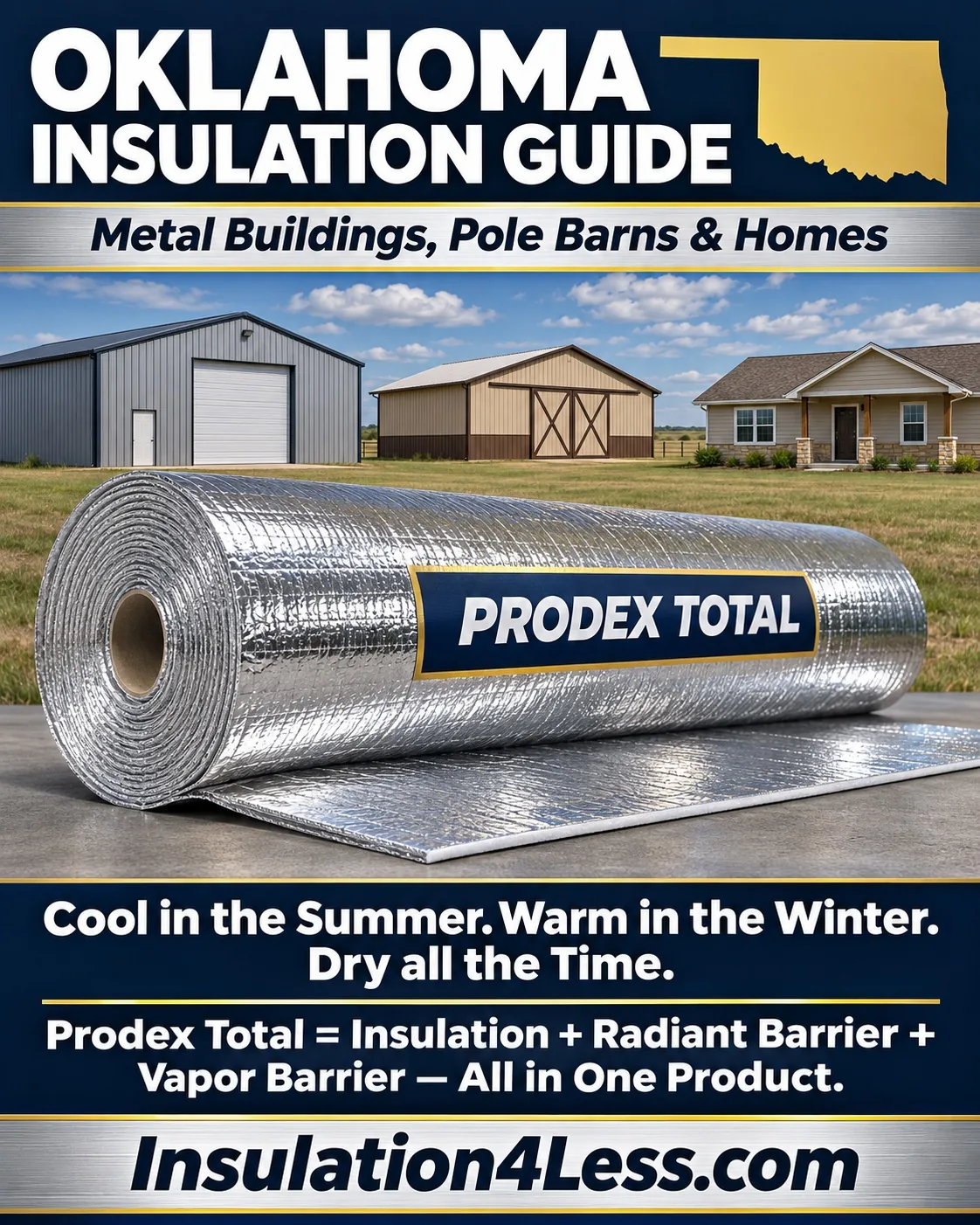
Oklahoma Insulation Guide for Metal Buildings, Pole Barns and Homes
A steel workshop near Oklahoma City can feel hot under a sun-heated roof in July and collect condensation on the underside of its panels on a cold morning. An equipment barn near Guymon and a home with a damp crawl space near Tulsa call for different insulation plans. Start by identifying where the problem occurs and how you use the space throughout the year.
Cool in the Summer. Warm in the Winter. Dry all the Time.
Prodex Total = Insulation + Radiant Barrier + Vapor Barrier — All in One Product.
What Oklahoma’s Climate Means for Your Insulation Project
Eastern Oklahoma and the Red River Valley
Eastern Oklahoma is generally more humid than western Oklahoma. Average annual precipitation ranges from about 17 inches in the far western Panhandle to about 56 inches in the far southeast. If you find water under a steel roof, note when it appears and where it collects. Widespread droplets on cold panels can point to condensation. Water concentrated around a penetration after rain calls for a leak check. In a crawl space, check drainage and ground moisture before changing the insulation.
Central and Western Oklahoma
If a shop becomes uncomfortable mainly in the afternoon, look first at the roof and west-facing walls. Sun-heated panels can radiate heat toward the interior. A reflective surface needs an appropriate adjacent airspace to reduce radiant heat transfer. The reflective insulation guide explains how the foil facing, foam core and airspace work together.
The Panhandle and Northwest Oklahoma
The western Panhandle typically sees its first fall freeze earlier than much of southern and eastern Oklahoma. For a shop you plan to heat through winter, consider the roof, walls and large doors together. Insulating the roof can help address summer heat, while gaps around overhead doors and uninsulated walls can still affect winter comfort.
Oklahoma Insulation by Building Type and Application
Oklahoma Metal Building Insulation
In a steel shop or warehouse, inspect the underside of the roof, the wall panels and the areas around overhead doors. Decide which surfaces need coverage and how the insulation will attach to the steel framing. Start with the Oklahoma metal building insulation guide. Explore the best metal building insulation for your project, then see how to insulate a metal building for new construction and retrofit methods.
Oklahoma Pole Barn Insulation
A post-frame equipment barn with doors open much of the day has different needs from a heated farm shop or finished barndominium. If you’re finishing the interior, decide early whether the insulation will follow the roofline or a flat ceiling. Read the Oklahoma pole barn insulation guide, review pole barn insulation options and see how to insulate a pole barn.
Oklahoma House Insulation
An upstairs room that gets hot on summer afternoons calls for a different inspection from a first-floor room with cold floors in winter. Check the attic, wall or floor assembly closest to the problem and see what insulation and air sealing are already in place. Use the Oklahoma house insulation guide and the national home insulation guide to decide where to start.
Oklahoma Roof and Ceiling Insulation
Before ordering insulation for a reroof or attic upgrade, decide where the conditioned space ends. A flat-ceiling assembly and a roof-deck assembly have different insulation and ventilation details. If you’re adding a reflective layer beneath new metal roofing, confirm how the roof assembly will create the adjacent airspace. See the Oklahoma roof and ceiling insulation guide and the national roof insulation guide.
Oklahoma Fiberglass vs. Prodex Total
Fiberglass provides thermal resistance in a cavity or a designed metal-building assembly. Prodex Total can complement it with added R, radiant heat and vapor control. Allow for an appropriate airspace at the reflective face and detail the seams and edges for vapor control. Compare ratings under equivalent installation conditions and check whether each R-value describes the material itself or an assembly that includes airspaces. See the Oklahoma fiberglass vs. Prodex Total comparison or explore fiberglass insulation for metal buildings.
Oklahoma Bubble Insulation
Bubble insulation, often called bubble wrap insulation, has an air-bubble core. Prodex Total uses a closed-cell polyethylene foam core. If you’re considering single bubble insulation, check the reflective bubble insulation product specifications for roll coverage and facing. The Oklahoma bubble insulation guide explains how to compare cores, seam details and test conditions.
Oklahoma Quonset Hut Insulation
A Quonset hut’s curved, corrugated steel shell affects material coverage and attachment. Measure along the curve of the shell to estimate coverage. If you’re using adhesive-mounted pins and caps, follow the specified pin spacing and let the adhesive fully cure before hanging the insulation. Read the Oklahoma Quonset hut insulation guide and the Quonset hut installation instructions.
Oklahoma Shipping Container Insulation
For a storage container or conversion, plan the ceiling, walls and doors before adding interior finishes. The corrugated steel shell and limited interior width affect the space available for insulation and airspaces. An adhesive pin-and-cap system can attach insulation while keeping the steel shell intact. Start with the Oklahoma shipping container insulation guide and review the national shipping container insulation guide.
Oklahoma Crawl Space Insulation
Check for standing water, plumbing leaks and damp soil before deciding whether to insulate beneath the floor or along the crawl space walls. That choice depends in part on whether the crawl space is vented or enclosed. The Oklahoma crawl space insulation guide and the national crawl space insulation guide cover ground moisture and insulation placement.
Choose a Prodex Total Roll and Estimate Your Quantity
10M Prodex Total Plus is the most popular and thickest reflective roll in the Prodex Total range. It has a 10 mm (0.4-inch) closed-cell polyethylene foam core with reflective foil on both sides. Each roll measures 4 feet × 85.3 feet and covers 341 square feet before cuts and overlaps. The heat-seal edges let installers heat-weld the seams. The 5M Plus range is 5 mm thick and includes versions with a white, black or rustic finish on one side and reflective foil on the other.
Measure the surfaces you’ll cover, including roof slopes, end walls and curved sections where applicable. Allow for seams, cuts and changes in direction. Use the Advanced Insulation Calculator to estimate quantities, then check the roll layout against the installation guide before you order.