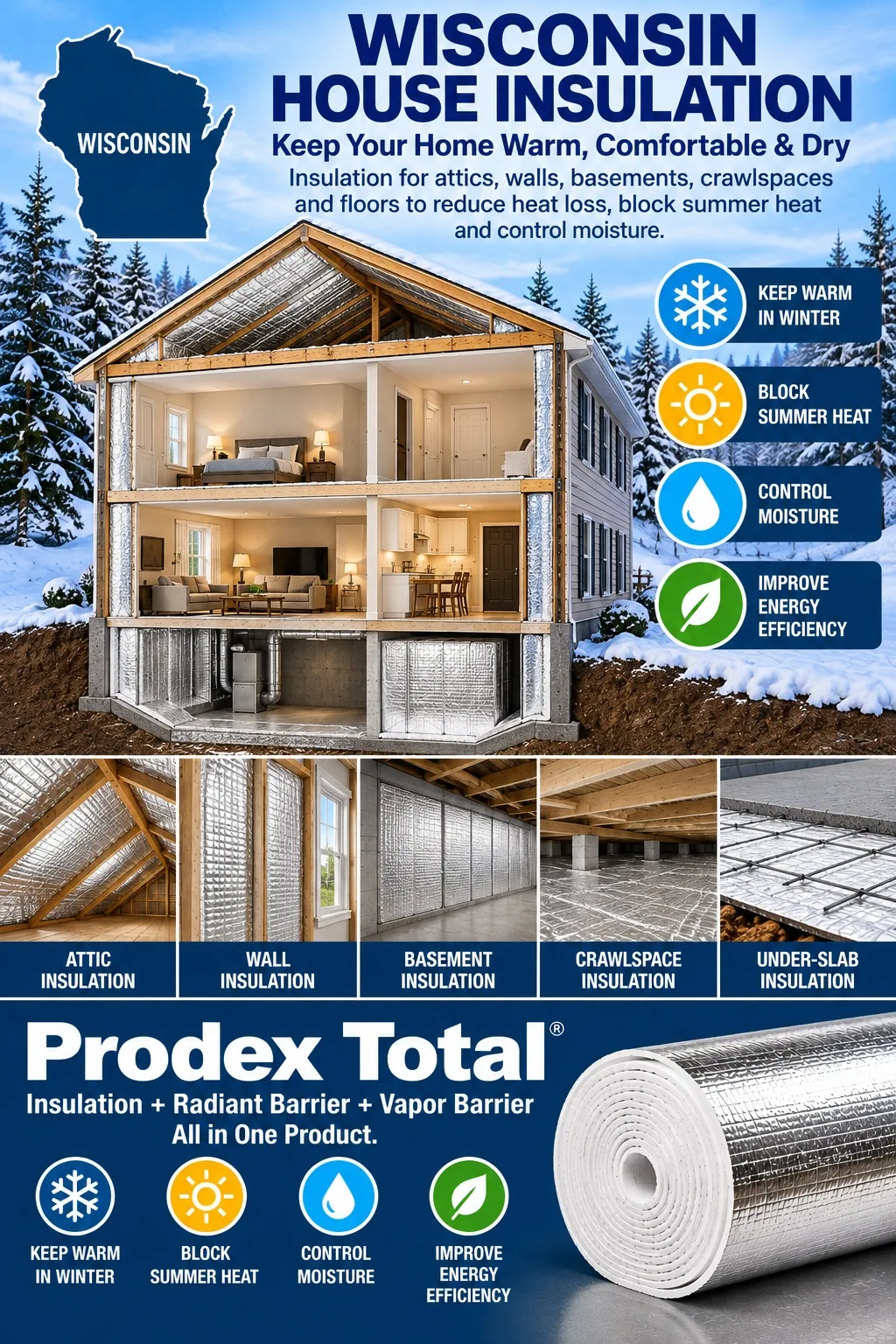
House Insulation in Wisconsin: Keep Your Home Warm, Comfortable & Dry
Wisconsin homeowners face some of the most demanding winter insulation conditions in the Midwest. Long periods of freezing temperatures, snowfall, strong winds and substantial heating demands make a well-insulated home especially important. Summer heat and humidity also create challenges, particularly in attics, roof assemblies and poorly insulated upper floors.
House insulation in Wisconsin involves more than selecting a product with a high R-value. An effective home insulation system must also address air leakage, thermal bridging, moisture movement and the location of the building's thermal boundary. Attics, exterior walls, basements, crawlspaces and floors have different insulation requirements, but they must work together as one building envelope.
Fiberglass, cellulose, mineral wool, spray foam, rigid foam board and reflective insulation all have potential roles in Wisconsin homes. The best material depends on the application, construction details, required thermal performance and moisture conditions.
This guide explains the major insulation challenges facing Wisconsin houses, compares common insulation materials and provides practical guidance for improving comfort and energy efficiency. For a complete national overview, visit our House Insulation Guide. You can also explore the Wisconsin Insulation Guide for additional building applications.
Why Wisconsin Homes Need Effective Insulation
Wisconsin experiences long heating seasons and substantial temperature differences between indoor and outdoor conditions. Northern communities such as Superior, Ashland and Rhinelander face particularly cold winters, while central and southern Wisconsin also experience extended periods of freezing weather.
During winter, heat moves through poorly insulated roofs, walls, foundations and floors. Air leakage around penetrations, framing connections, windows and doors can increase heating demands and create uncomfortable drafts.
During summer, solar heat gain through roofs and walls can increase indoor temperatures. Humid outdoor air may also enter through gaps in the building envelope, creating additional moisture-control challenges.
An effective insulation strategy should reduce unwanted heat transfer while controlling air movement and managing moisture.
Winter Heat Loss in Wisconsin Houses
Heat moves from warmer interior spaces toward colder exterior conditions through conduction, convection and radiation.
In Wisconsin homes, substantial heat loss can occur through underinsulated attics, exterior walls, basement rim joists and floors above unconditioned spaces.
Air leakage is another major contributor. Warm indoor air escaping through gaps can carry moisture into cold building cavities, potentially causing condensation or frost.
Insulation and air sealing should therefore be planned together rather than treated as unrelated improvements.
Summer Heat and Humidity
Although Wisconsin is known for cold winters, summer heat and humidity also affect home comfort.
Sunlight can heat roof surfaces, increasing attic temperatures and heat transfer toward occupied rooms. Air leakage may also allow humid outdoor air to enter the home.
Adequate attic insulation, appropriate air sealing and a properly designed roof assembly can help reduce summer heat gain.
Reflective insulation may also contribute to radiant heat control in suitable assemblies when installed with an appropriate adjacent air space.
Moisture and Condensation Control
Moisture management is especially important in cold climates.
During winter, warm interior air can carry moisture into colder parts of the building envelope. If that moisture reaches a surface below its dew point, condensation may occur.
In basements and crawlspaces, moisture can also enter from soil, foundation walls, water leaks and inadequate drainage.
The appropriate insulation assembly should manage vapor movement, air leakage and drying potential. Installing insulation without considering moisture can create problems rather than solve them.
What Is the Best Insulation for a House in Wisconsin?
The best insulation depends on where it will be installed.
An attic may require a different insulation material and installation method from an exterior wall, basement or crawlspace. Existing homes may also present different challenges from new construction.
Common residential insulation materials include fiberglass, cellulose, mineral wool, spray polyurethane foam, rigid foam board and reflective insulation.
The correct choice depends on required thermal resistance, available space, moisture conditions, air sealing, cost and applicable building codes.
Wisconsin Attic Insulation
Attic insulation is often one of the most important components of a Wisconsin home's thermal envelope.
In a typical vented attic, insulation is installed at the ceiling plane, separating the conditioned living space from the unconditioned attic above.
During winter, inadequate attic insulation allows heat to move upward toward the cold roof. During summer, heat from the roof and attic can increase cooling demands.
Fiberglass and Blown-In Attic Insulation
Fiberglass batts and blown-in fiberglass are commonly used in residential attics. Cellulose is another widely used option.
These materials provide conductive thermal resistance and can be installed at thicknesses appropriate for cold-climate requirements.
However, attic insulation should be installed after significant air leaks at the ceiling plane have been addressed.
Gaps around plumbing penetrations, wiring, recessed fixtures and attic access openings can allow warm, moisture-containing air to escape into the attic.
Attic Air Sealing and Ice Dams
Ice dams are a concern in Wisconsin homes with snow-covered roofs.
They can form when heat escaping from the home warms portions of the roof, causing snow to melt. Meltwater may then refreeze near colder roof edges.
Adequate insulation and air sealing can help reduce heat loss to the roof. Proper ventilation in vented attic assemblies may also contribute to more consistent roof temperatures.
However, ice dams can still occur under certain weather and roof conditions.
For additional guidance, visit our Roof Insulation Guide and Wisconsin Roof Insulation Guide.
Exterior Wall Insulation for Wisconsin Homes
Exterior walls are another important part of the home's thermal boundary.
Wisconsin homes may have wood-framed walls, masonry walls or other construction systems. Each requires an appropriate insulation and moisture-control strategy.
Wall insulation should reduce conductive heat transfer while addressing gaps, air leakage and thermal bridges through framing.
Fiberglass Wall Insulation
Fiberglass batts are commonly installed between wood studs in residential walls.
When properly fitted, they provide conductive thermal resistance. However, gaps, compression and poorly sealed penetrations can reduce assembly performance.
Fiberglass itself does not form a complete air barrier, so additional air-sealing measures are generally necessary.
Continuous Wall Insulation
Continuous insulation installed across framing can help reduce thermal bridging through studs and other structural components.
Rigid foam board is one option for continuous wall insulation. Other approved exterior insulation systems may also be suitable.
The insulation arrangement must be coordinated with wall sheathing, weather-resistive barriers, vapor control, cladding and drying potential.
For a comparison of rigid insulation materials, visit our Foam Board Insulation Guide.
Reflective Insulation for Walls
Reflective insulation can help reduce radiant heat transfer when installed with an appropriate adjacent air space.
Prodex Total combines reinforced reflective surfaces with a closed-cell polyethylene foam core. Depending on the assembly, it may contribute thermal resistance, air control and vapor control.
However, reflective insulation should not automatically be treated as a replacement for the full conductive thermal resistance required in a Wisconsin exterior wall.
For more information, see our Reflective Insulation Guide.
Basement Insulation in Wisconsin
Basements are common in Wisconsin homes, and their insulation requirements differ from those of above-grade walls.
Basement walls are exposed to soil moisture and relatively cool ground temperatures. Poorly designed insulation systems can contribute to condensation and moisture problems.
A suitable basement insulation strategy should account for foundation moisture, drainage, air sealing, thermal resistance and interior finishes.
Insulating Basement Walls
Rigid foam board and closed-cell spray foam are often considered for basement wall insulation because of their thermal and moisture characteristics.
However, the correct material and installation depend on the foundation type, existing moisture conditions and applicable code requirements.
Before insulating basement walls, address water intrusion, foundation leaks and drainage problems.
Insulation should not be used to conceal an unresolved moisture problem.
Basement Rim Joist Insulation
Rim joists are common sources of air leakage and heat loss in Wisconsin homes.
These areas connect the floor framing to the foundation and may include numerous gaps and penetrations.
Air sealing and insulation at the rim joist can help reduce drafts and heat loss.
Suitable methods depend on the framing, moisture conditions and applicable fire-protection requirements.
Crawlspace Insulation in Wisconsin
Crawlspaces require careful attention to moisture, air leakage and the location of the thermal boundary.
Some crawlspaces are vented and insulated at the floor above. Others are designed as sealed or conditioned spaces with insulation at the perimeter walls.
The correct approach depends on the crawlspace construction, moisture conditions and applicable building requirements.
Crawlspace Floor Insulation
In certain vented crawlspace assemblies, insulation is installed beneath the floor framing to separate the conditioned home from the unconditioned crawlspace.
Fiberglass, rigid foam and other suitable insulation materials may be used, depending on the assembly.
Air sealing and protection against moisture are important because insulation can lose effectiveness when gaps, air movement or wet conditions are present.
Crawlspace Wall Insulation
In sealed or conditioned crawlspaces, insulation may be installed along the foundation walls rather than between the floor joists.
This approach requires appropriate ground vapor control, drainage, air sealing and moisture management.
Rigid foam board and other suitable insulation systems may be used, subject to applicable code and fire-protection requirements.
For a detailed comparison of crawlspace insulation methods, visit our Crawlspace Insulation Guide.
Floor Insulation in Wisconsin Homes
Floors above unconditioned garages, crawlspaces or other cold spaces can contribute to uncomfortable indoor temperatures.
Insulation helps reduce heat transfer between conditioned rooms and the spaces below.
The appropriate method depends on floor framing, air leakage, moisture conditions and required thermal resistance.
In some assemblies, insulation is installed between floor joists. In others, continuous insulation may be added to reduce thermal bridging.
The insulation system should also account for air sealing and protection from moisture or physical damage.
Under-Slab Insulation for Wisconsin Houses
Concrete slabs can transfer heat into the ground, especially in heated buildings.
Under-slab insulation helps reduce conductive heat loss and can improve floor comfort.
Rigid foam board is commonly used where specific thermal resistance and compressive-strength performance are required.
Prodex Total Under Concrete is another product designed for suitable under-slab applications.
When installing Prodex Total Under Concrete, the white side faces UP toward the concrete, while the reflective foil side faces DOWN toward the ground.
For additional information, visit our Wisconsin Under-Slab Insulation Guide and national Under-Slab Insulation Guide.
Comparing Insulation Materials for Wisconsin Homes
Different insulation materials provide different functions.
Some primarily reduce conductive heat transfer. Others also contribute to air sealing, vapor control or radiant heat reduction.
A complete insulation strategy may involve more than one material.
Fiberglass Insulation for Wisconsin Homes
Fiberglass is widely used in residential attics, walls and floors.
It provides conductive thermal resistance and is available in different thicknesses and R-values.
Proper installation is important. Gaps, compression and air leakage around fiberglass can reduce assembly performance.
Fiberglass also requires an appropriate moisture-control strategy, particularly in cold-climate wall and roof assemblies.
Spray Foam Insulation for Wisconsin Homes
Spray polyurethane foam expands during application, allowing it to fill many gaps and irregular spaces.
Open-cell and closed-cell spray foams differ in thermal resistance, density and vapor permeability.
Closed-cell spray foam generally provides higher thermal resistance per inch and greater resistance to vapor movement than open-cell foam.
Spray foam can be useful for air sealing and insulation in certain walls, roof assemblies, rim joists and other locations.
However, application conditions, cost, moisture design and fire-protection requirements must be considered.
For a comparison of spray foam and other insulation systems used in steel structures, visit our Spray Foam Insulation for Metal Buildings and Pole Barns guide. Although it focuses on metal structures, the material characteristics discussed are also relevant when evaluating insulation options.
Foam Board Insulation for Wisconsin Homes
Rigid foam board is used in residential foundations, basement walls, continuous exterior wall insulation, certain roof assemblies and under-slab applications.
Common types include expanded polystyrene (EPS), extruded polystyrene (XPS) and polyisocyanurate.
These products differ in thermal resistance, moisture characteristics, compressive strength and temperature performance.
Foam board can help reduce thermal bridging when installed continuously across framing.
For a detailed comparison, explore our Foam Board Insulation Guide.
Prodex Total Reflective Insulation for Wisconsin Homes
Prodex Total combines a closed-cell polyethylene foam core with reinforced reflective surfaces.
Depending on the installation, it can contribute thermal resistance, radiant heat reduction, vapor control and air-barrier performance.
Reflective insulation is particularly relevant in assemblies where radiant heat transfer is an important consideration and an appropriate adjacent air space can be provided.
Prodex Total = Insulation + Radiant Barrier + Vapor Barrier — All in One Product.
For Wisconsin homes, Prodex Total may be considered as part of a broader insulation strategy, but the complete assembly must satisfy the applicable thermal, moisture and code requirements.
Wisconsin House Insulation Comparison
| Insulation type | Common residential applications | Important considerations |
|---|---|---|
| Fiberglass | Attics, walls and floors | Installation quality, air sealing and moisture control |
| Cellulose | Attics and certain wall cavities | Density, settling, moisture and installation method |
| Mineral wool | Walls, floors and certain roof assemblies | Fit, thermal performance and assembly details |
| Spray foam | Walls, roof assemblies, rim joists and air sealing | Cost, application conditions, moisture design and fire protection |
| Foam board | Foundations, basements, continuous walls and slabs | Panel joints, attachment, moisture and fire protection |
| Prodex Total | Suitable reflective insulation assemblies | Air space, assembly R-value and vapor-control placement |
The best choice depends on the location and performance requirements of the insulation.
How Much Insulation Does a Wisconsin House Need?
Wisconsin homes generally require substantial thermal resistance because of the state's cold climate.
However, the required R-value depends on the building component, location, construction method and applicable energy code.
Attics, walls, floors, basement walls and slabs may have different requirements.
Northern Wisconsin and southern Wisconsin may also fall under different climate-zone classifications.
Before selecting insulation, verify the applicable requirements for the specific home and location.
How to Estimate Insulation Quantities
For walls, multiply the wall length by height to estimate area, then account for openings and installation allowances.
For ceilings and floors, calculate the area to be covered.
Roof slope, framing geometry and insulation thickness may affect material quantities.
Use our Advanced Insulation Calculator to estimate insulation requirements for your project.
For additional measuring guidance, visit How Much Insulation Do I Need?.
Wisconsin Home Insulation Requirements
Insulation requirements depend on the home's location, construction type, building component and applicable building and energy codes.
Wisconsin's residential energy requirements may differ from those for commercial buildings or agricultural structures.
Homes with vented attics, unvented roof assemblies, basement foundations or slab-on-grade construction may also require different insulation arrangements.
Before beginning a major insulation project, verify the applicable requirements with the local building department or a qualified building professional.
Published insulation R-values should be interpreted according to the relevant test method and installation assembly.
Insulating Wisconsin Homes vs. Metal Buildings and Pole Barns
Residential homes and metal buildings face some similar challenges, including winter heat loss, summer heat gain, air leakage and condensation.
However, their construction methods and insulation requirements can differ substantially.
Conventional Wisconsin homes commonly use framed wall cavities, attic insulation and foundation insulation systems. Metal buildings and pole barns often have large steel roof and wall surfaces that introduce additional radiant heat and condensation considerations.
For metal structures, visit our Metal Building Insulation Guide and Pole Barn Insulation Guide.
Frequently Asked Questions About Wisconsin House Insulation
What is the best insulation for a house in Wisconsin?
The best insulation depends on the application. Fiberglass, cellulose and mineral wool are commonly used in attics and framed walls. Spray foam and rigid foam board may be useful in other assemblies. Prodex Total can contribute to suitable reflective insulation systems.
How much attic insulation does a Wisconsin home need?
The required insulation depends on the home's location, attic design, existing insulation and applicable energy code. Wisconsin's cold climate generally calls for substantial attic thermal resistance.
Should I insulate my basement walls in Wisconsin?
Basement wall insulation can reduce heat loss and improve comfort, but water intrusion and foundation moisture problems should be addressed before insulation is installed.
Is spray foam better than fiberglass for Wisconsin homes?
Neither is universally better. Spray foam can provide air sealing and thermal resistance, while fiberglass is widely available and effective when installed correctly. Cost, moisture design and assembly requirements influence the choice.
Is foam board good for Wisconsin basement insulation?
Rigid foam board can be suitable for basement walls when selected and installed as part of an appropriate moisture-control and fire-protection assembly.
Should I insulate my Wisconsin crawlspace?
Crawlspace insulation may improve comfort and energy efficiency, but the correct location depends on whether the crawlspace is vented, sealed or conditioned. Ground moisture and air sealing must also be addressed.
Can Prodex Total be used with fiberglass insulation?
Yes. Prodex Total and fiberglass can provide complementary functions in appropriately designed assemblies. The arrangement must account for thermal resistance, vapor control and drying potential.
How can insulation help reduce ice dams?
Adequate attic insulation and air sealing can reduce heat escaping toward the roof surface. Proper ventilation in vented attics may also help. Ice dams can still occur under certain conditions.
How do I calculate insulation quantities for my home?
Use our Advanced Insulation Calculator to help estimate the insulation required for your project.
Related Wisconsin Insulation Guides
Explore our Wisconsin Insulation Guide for a broader overview of insulation options throughout the state.
For additional applications, visit our Wisconsin Roof Insulation Guide, Wisconsin Under-Slab Insulation Guide, Wisconsin Metal Building Insulation Guide and Wisconsin Pole Barn Insulation Guide.
For a complete national overview of residential insulation materials and methods, see our House Insulation Guide.
Choose the Right House Insulation for Wisconsin
From homes in Milwaukee and Madison to properties near Green Bay, Wausau and Superior, Wisconsin houses must withstand long winters, summer heat and changing moisture conditions.
The right insulation strategy should address the entire building envelope, including attics, walls, basements, crawlspaces, floors and foundations.
Fiberglass, cellulose, mineral wool, spray foam, foam board and Prodex Total all have potential roles in properly designed insulation systems.
Cool in the Summer. Warm in the Winter. Dry all the Time.
For additional guidance, explore our national House Insulation Guide.
When you're ready to plan materials, use our Advanced Insulation Calculator.