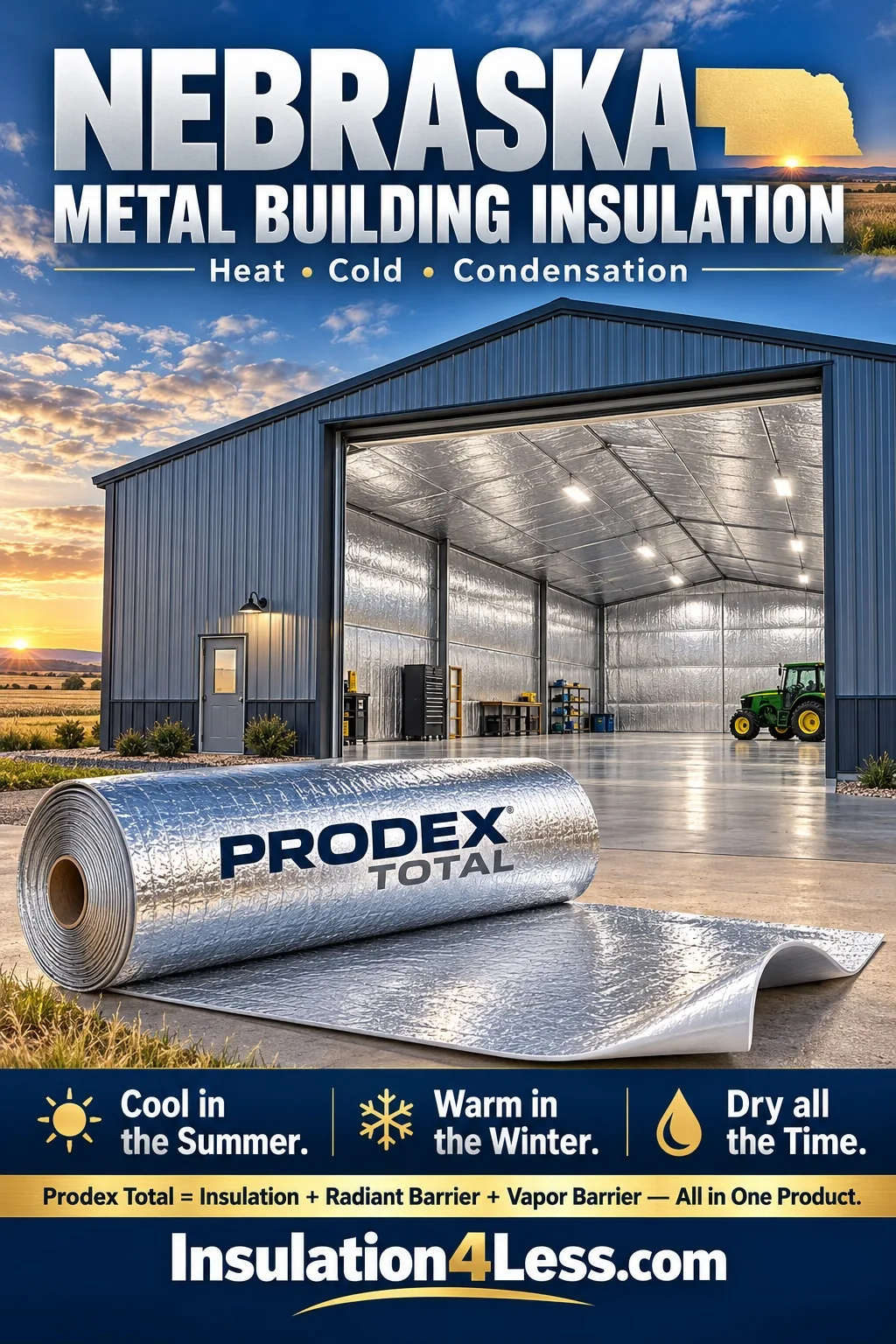
Nebraska Metal Building Insulation: Control Heat, Cold and Condensation
A Nebraska metal building may serve as a farm equipment shed, commercial warehouse, repair shop or year-round workspace. Whatever its purpose, the steel roof and walls expose the interior to changing outdoor conditions. Summer sunshine heats the panels, winter temperatures increase heat loss, and moisture can condense on cold metal surfaces.
Choosing insulation requires more than comparing roll prices or advertised R-values. The right assembly should address the building’s use, heating and cooling needs, air leakage and moisture conditions.
Prodex Total combines reflective facings with a closed-cell polyethylene foam core. It can be installed as a continuous layer across framing and incorporated into assemblies with additional insulation when required.
For product benefits and comparisons, explore our national guide to the best metal building insulation.
Cool in the Summer. Warm in the Winter. Dry all the Time.
Prodex Total = Insulation + Radiant Barrier + Vapor Barrier — All in One Product.
Why Nebraska Metal Buildings Need a Complete Insulation Plan
Summer Sun Heats Steel Roofs and Walls
A sun-heated metal roof can radiate heat toward the interior, making a building uncomfortable even when large doors are open. Agricultural shops, storage buildings and garages can all experience this effect.
Prodex Total’s reflective facing helps reduce radiant heat transfer when it faces an appropriate airspace. That airspace is part of the insulation assembly and should be preserved during installation.
Our reflective insulation guide explains how reflective surfaces, airspaces and assembly design affect performance.
Winter Comfort Depends on More Than Cavity Insulation
Heating a metal shop while leaving gaps around insulation seams, doors or roof-to-wall transitions can make comfortable temperatures difficult to maintain. Steel framing also creates paths for heat transfer through the building envelope.
Where the design calls for continuous insulation, Prodex Total should extend across the framing rather than only filling the spaces between members. The complete assembly still needs the thermal resistance required for the building’s intended use.
A continuously heated workshop may need a different system than an unheated machinery shed. Establish that use before choosing materials.
Condensation Can Affect Equipment and Interior Finishes
Condensation forms when moist air reaches a surface below its dew point. In a steel building, that surface may be the underside of the roof or wall panels.
Moisture can come from wet vehicles, soil, livestock, washing activities or other indoor sources. An insulation and vapor-control system helps manage contact between moist air and cold surfaces, but its effectiveness depends on continuity, sealed seams and properly detailed penetrations.
Ventilation and moisture-source control remain important parts of the plan.
Choosing Prodex Total for a Nebraska Steel Building
Prodex Total uses a closed-cell foam core rather than an air-bubble core. Its reflective facings and foam center provide different functions within the assembly, while properly sealed seams help establish a continuous air and vapor-control layer.
10M Prodex Total Plus is the most popular and thickest reflective insulation roll in the Prodex Total range. It features a 10 mm, approximately 0.4-inch, foam core, reinforced reflective foil on both sides and heat-welded seams. Each 4-foot by 85.3-foot roll covers 341 square feet.
The 5M Plus rolls provide a thinner option, including products with a white, black or rustic finish on one side and reflective foil on the other.
Choose the product according to the installation method, desired interior appearance and complete assembly requirements. Do not treat an assembly R-value that includes airspaces as the standalone R-value of the foam core.
Installing Insulation in a New Nebraska Metal Building
New construction provides an opportunity to plan a continuous insulation layer before installing the roof and wall panels.
For suitable roof assemblies, Prodex Total can be run perpendicular to the purlins and draped over the framing according to the installation instructions. The specified sag helps create an airspace. Fasteners, overlaps and seams must be detailed for the selected system.
Coordinate the insulation layout with panel attachment, roof penetrations, eaves and wall transitions. Avoid compressing or eliminating an airspace that the design depends on.
Follow our metal building insulation installation guide for the appropriate new-construction method.
Insulating an Existing Nebraska Metal Building
An existing building requires an installation method that works with the roof, walls and accessible framing already in place.
Before installing insulation, inspect for leaks, corrosion and moisture problems. Repair water entry and allow wet materials to dry. Insulation should not conceal an unresolved roof leak.
Suitable retrofit methods may use screws with locking washers or adhesive insulation pins with caps, depending on the framing and application. When adhesive pins are used, follow the adhesive manufacturer’s surface-preparation and curing instructions before loading the insulation.
Maintain the specified airspace between the reflective surface and metal panels. Where a continuous layer is required, cover the framing and seal seams and transitions.
Review the existing-building methods in our guide to installing insulation in a metal building before selecting fasteners or beginning work.
Prodex Total with Fiberglass Insulation
A Nebraska building that needs substantial thermal resistance may use Prodex Total together with fiberglass.
Fiberglass supplies bulk thermal resistance. Prodex Total adds insulation, radiant-heat control and vapor-control properties when incorporated into a properly designed assembly. The location of each layer matters, particularly in heated buildings where vapor-control decisions affect drying potential.
Fiberglass can contact Prodex Total where the specified assembly permits it. A reflective surface still needs an appropriate adjacent airspace to perform its radiant-barrier function.
Compare the materials and their combined use in our Prodex Total vs. fiberglass guide for metal buildings. Our Nebraska fiberglass vs. Prodex Total article provides additional guidance for the state’s building applications.
Comparing Other Metal Building Insulation Options
Spray Foam
Spray foam can provide thermal resistance and air sealing. Evaluate the proposed thickness, foam type, installation requirements and implications for future access to the metal panels.
Our spray foam insulation guide for metal buildings and pole barns discusses these considerations. For a direct material comparison, see Prodex Total vs. spray foam for metal buildings.
Foam Board
Rigid foam board may suit some roof and wall assemblies. Its effectiveness depends on board placement, joint sealing and detailing around framing and penetrations. Interior protection requirements also depend on the product and application.
Read our foam board insulation guide when evaluating this option.
Bubble Insulation
Bubble insulation uses an air-bubble core, while Prodex Total uses closed-cell polyethylene foam. Similar-looking foil surfaces do not make the products equivalent.
Compare tested performance under equivalent installation conditions, including airspaces and heat-flow direction. Our Nebraska bubble insulation guide explains the distinction in more detail.
Match the Insulation to the Building’s Use
An agricultural storage building, a heated repair shop and a commercial warehouse can require different insulation assemblies. Consider how often the space is occupied, whether it will be heated or cooled, and which activities introduce moisture.
If your structure uses wood posts and framing, visit our Nebraska pole barn insulation guide. For smaller workspaces, see Nebraska metal garage and workshop insulation.
Our Nebraska roof and ceiling insulation guide provides additional guidance when the roof is the primary focus.
Calculate Materials Before Ordering
Measure each roof and wall area you plan to insulate. Account for overlaps, cuts, transitions and the roll layout required by your installation method.
Use the Advanced Insulation Calculator to help estimate quantities, and review how much insulation you need before ordering.
Explore 10M Prodex Total Plus for product details, or return to the Nebraska Insulation Guide to compare other building applications.
Cool in the Summer. Warm in the Winter. Dry all the Time.
Prodex Total = Insulation + Radiant Barrier + Vapor Barrier — All in One Product.