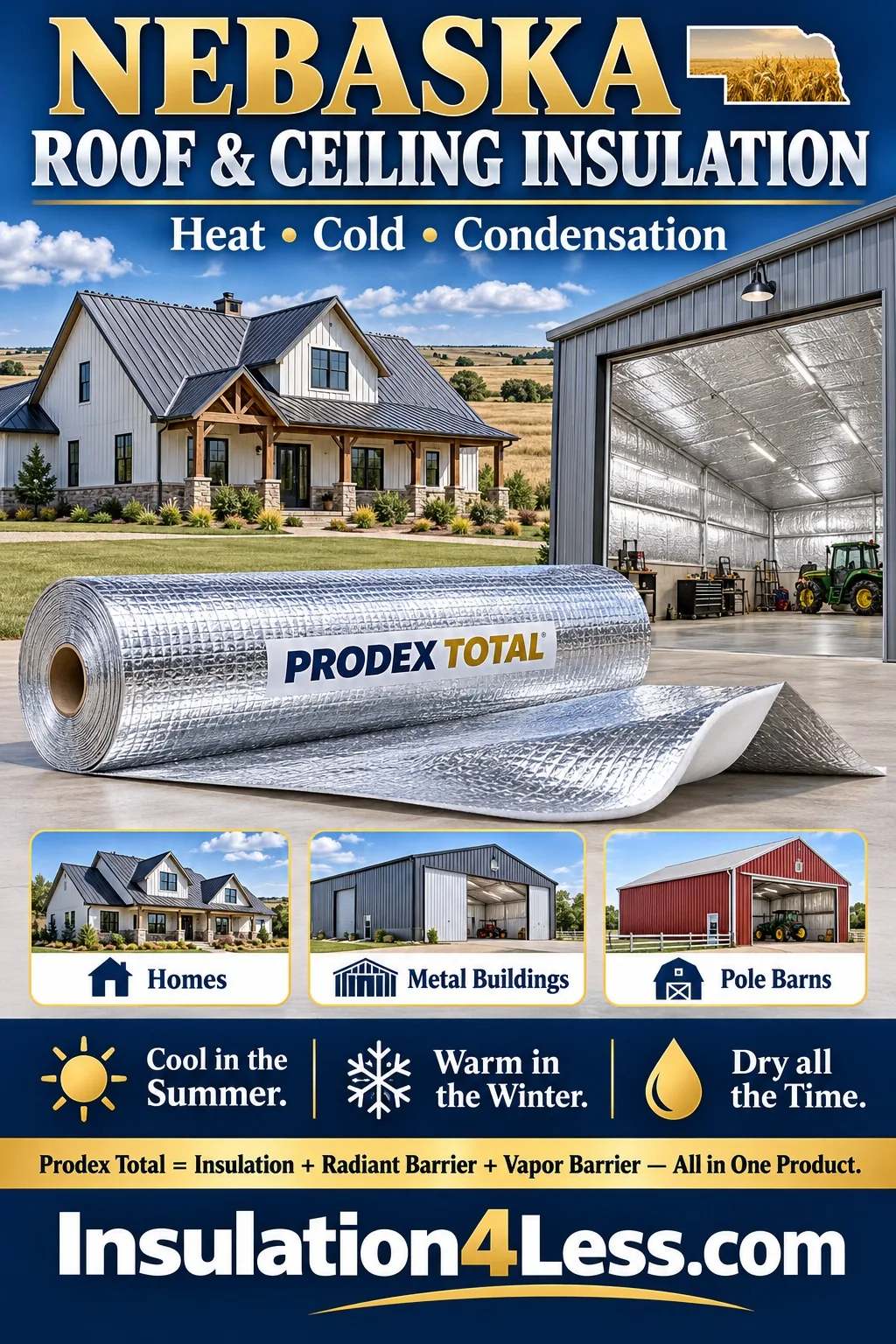
Nebraska Roof and Ceiling Insulation: Control Heat, Cold and Condensation
A roof separates your building from Nebraska’s summer sunshine and winter temperatures. In homes, workshops, agricultural buildings and warehouses, the roof and ceiling assembly can strongly influence comfort, heating and cooling needs, and condensation.
The right insulation plan depends on the building. A house with a vented attic needs a different arrangement than an open-ceiling pole barn or a heated steel workshop. Roofing materials, existing insulation and indoor moisture conditions also affect the design.
Prodex Total combines a closed-cell polyethylene foam core with reflective facings. In a suitable assembly, it adds insulation, radiant-heat control and vapor-control properties. It can also work alongside fiberglass or other insulation where additional thermal resistance is required.
Our national roof insulation guide explains applications for different roof types and building designs.
Cool in the Summer. Warm in the Winter. Dry all the Time.
Prodex Total = Insulation + Radiant Barrier + Vapor Barrier — All in One Product.
Should You Insulate the Roof or the Ceiling?
Homes with Vented, Unconditioned Attics
In a home with a vented attic outside the conditioned living space, the insulation boundary generally follows the ceiling below the attic.
Focus on continuous ceiling insulation, air sealing and properly detailed attic access. Preserve the ventilation paths required by the roof design.
A reflective layer within the attic can address radiant heat when installed with an appropriate airspace. Its role should be coordinated with the existing insulation and moisture-control strategy.
Conditioned Attics and Sloped Ceilings
When an attic is included within the conditioned enclosure, the insulation boundary follows the roofline. Cathedral ceilings and finished attic rooms also require roof assemblies designed around limited space and moisture management.
Decide whether the assembly will be vented or unvented before selecting the insulation arrangement. Layer placement must account for thermal resistance, air leakage, condensation risk and drying potential.
For related residential applications, see our Nebraska house insulation guide.
Open-Ceiling Metal Buildings and Pole Barns
Many agricultural buildings and workshops have no separate attic floor or finished ceiling. Their insulation commonly follows the underside of the roof.
In these buildings, plan continuous coverage, suitable fastening, the specified airspace and sealed connections to the walls.
Explore our Nebraska metal building insulation guide or Nebraska pole barn insulation guide for the appropriate construction type.
Three Problems a Roof Insulation System Should Address
Summer Radiant Heat
Sun-heated roofing can radiate heat toward the space beneath it. This can make upper rooms, workshops and storage buildings uncomfortable.
Prodex Total’s reflective surface helps reduce radiant heat transfer when it faces an appropriate airspace. Contact with another material removes the radiant-barrier function on that particular face.
Our reflective insulation guide explains why airspace, orientation and assembly design matter.
Winter Heat Loss
A heated building needs adequate thermal resistance across its roof or ceiling boundary. Gaps at eaves, penetrations, access openings and roof-to-wall connections can reduce the effectiveness of the insulation system.
Prodex Total can contribute to the assembly, including systems that use additional cavity insulation. Select the complete configuration according to the building’s use and applicable requirements.
Condensation
Condensation can form when moist air contacts roofing or another surface below its dew point.
An insulation and vapor-control layer helps manage this risk when it is continuous and properly detailed. Seams, penetrations and transitions require attention, along with ventilation and indoor humidity.
Repair roof leaks before installing insulation. Water entering through damaged roofing requires a roofing repair, even when condensation is also present.
Prodex Total Under a Metal Roof
New Metal Buildings
New construction allows insulation to be coordinated with roof-panel installation.
For suitable assemblies, Prodex Total can run perpendicular to the purlins and drape over the framing according to the installation instructions. The specified sag helps establish the intended airspace.
Plan the roll layout, fastening and seams before attaching the metal roofing. Coordinate details at the eaves, ridge, penetrations and roof-to-wall transitions.
Follow our metal building insulation installation guide for the selected method.
Existing Metal Roofs
Retrofit work requires a fastening method suited to the accessible framing and existing roof.
Suitable applications may use screws with locking washers or adhesive insulation pins and caps. Adhesive installations require appropriate surface preparation and sufficient curing time before the insulation is loaded.
Maintain the specified airspace and carry the insulation across framing where a continuous layer is intended.
For product benefits and material comparisons, explore our national page on the best metal building insulation.
Prodex Total Under Tile or Metal Roofing over Decking
Some roof assemblies place Prodex Total above the roof decking.
In the appropriate installation, Prodex Total lies on the decking, furring is installed above the Prodex to create an airspace, and the roofing attaches to the furring or specified support system.
For metal roofing, the panels sit above the furring rather than directly against the Prodex. Tile roofing requires the support, drainage and attachment details specified for that roofing system.
Furring dimensions and fastening must suit the roof design. Coordinate insulation with required underlayment, flashing and water-management layers; do not assume the insulation replaces those components.
Review the roof insulation guide and the roofing manufacturer’s requirements before beginning work.
Nebraska Pole Barn Roof and Ceiling Insulation
Pole barns may use insulation beneath the roof, above a separate ceiling or within a more complex assembly for a heated space.
An equipment-storage barn may prioritize roof condensation and summer heat, while a continuously heated workshop needs an assembly with adequate thermal resistance and air sealing.
Where continuous insulation follows the roof or ceiling, cover the framing rather than leaving exposed strips between insulated areas. Plan transitions around trusses, openings and wall connections.
Our pole barn insulation installation guide covers methods for new and existing buildings. The national pole barn insulation page provides product comparisons and benefits.
Combining Prodex Total with Fiberglass
Fiberglass provides bulk thermal resistance. Prodex Total can add insulation, radiant-heat control and vapor-control properties within a coordinated roof or ceiling assembly.
Fiberglass may contact Prodex Total where the specified assembly permits it. A reflective face still needs an adjacent airspace to provide radiant-barrier performance on that side.
Inspect existing fiberglass before enclosing it. Correct moisture sources and evaluate wet or damaged insulation. Layer placement should also account for existing vapor-control materials and drying potential.
Read our Nebraska fiberglass vs. Prodex Total guide and the national Prodex Total vs. fiberglass comparison for metal buildings.
Comparing Other Roof Insulation Materials
Spray Foam
Spray foam can provide thermal resistance and air sealing. Its suitability depends on the foam type, thickness, roof assembly and installation requirements.
Consider how the proposed system affects drying and future access to roof components. Our spray foam insulation guide for metal buildings and pole barns discusses relevant applications.
Foam Board
Rigid foam board can be incorporated into selected roof assemblies. Board placement, sealed joints, attachment and required protective layers must be designed together.
Our foam board insulation guide provides additional material guidance.
Bubble Insulation
Bubble insulation uses an air-bubble core, while Prodex Total uses closed-cell polyethylene foam.
Compare products using equivalent installation conditions, including airspaces and heat-flow direction. An assembly R-value that includes airspaces should not be compared directly with a material-only R-value.
See our Nebraska bubble insulation guide for a closer comparison.
Choose Your Prodex Total Roll
10M Prodex Total Plus is the most popular and thickest reflective insulation roll in the Prodex Total range. It has a 10 mm, approximately 0.4-inch, closed-cell foam core with reinforced reflective foil on both sides.
Each roll measures 4 feet by 85.3 feet and covers 341 square feet. Its heat-welded seams eliminate the need for seam tape at those welded connections.
The 5M Plus range offers thinner options, including rolls with a white, black or rustic finish on one side and reflective foil on the other.
Choose the product according to your roof or ceiling assembly, fastening method and desired interior appearance.
Calculate Roof and Ceiling Insulation Quantities
Measure the actual surfaces you intend to insulate. A sloped roof has more surface area than its horizontal footprint, so floor dimensions alone may underestimate the material required.
Allow for specified overlaps, cuts, transitions and roll orientation. Use the Advanced Insulation Calculator and review how much insulation you need before ordering.
Return to the Nebraska Insulation Guide to explore the complete series of building and application guides.
Cool in the Summer. Warm in the Winter. Dry all the Time.