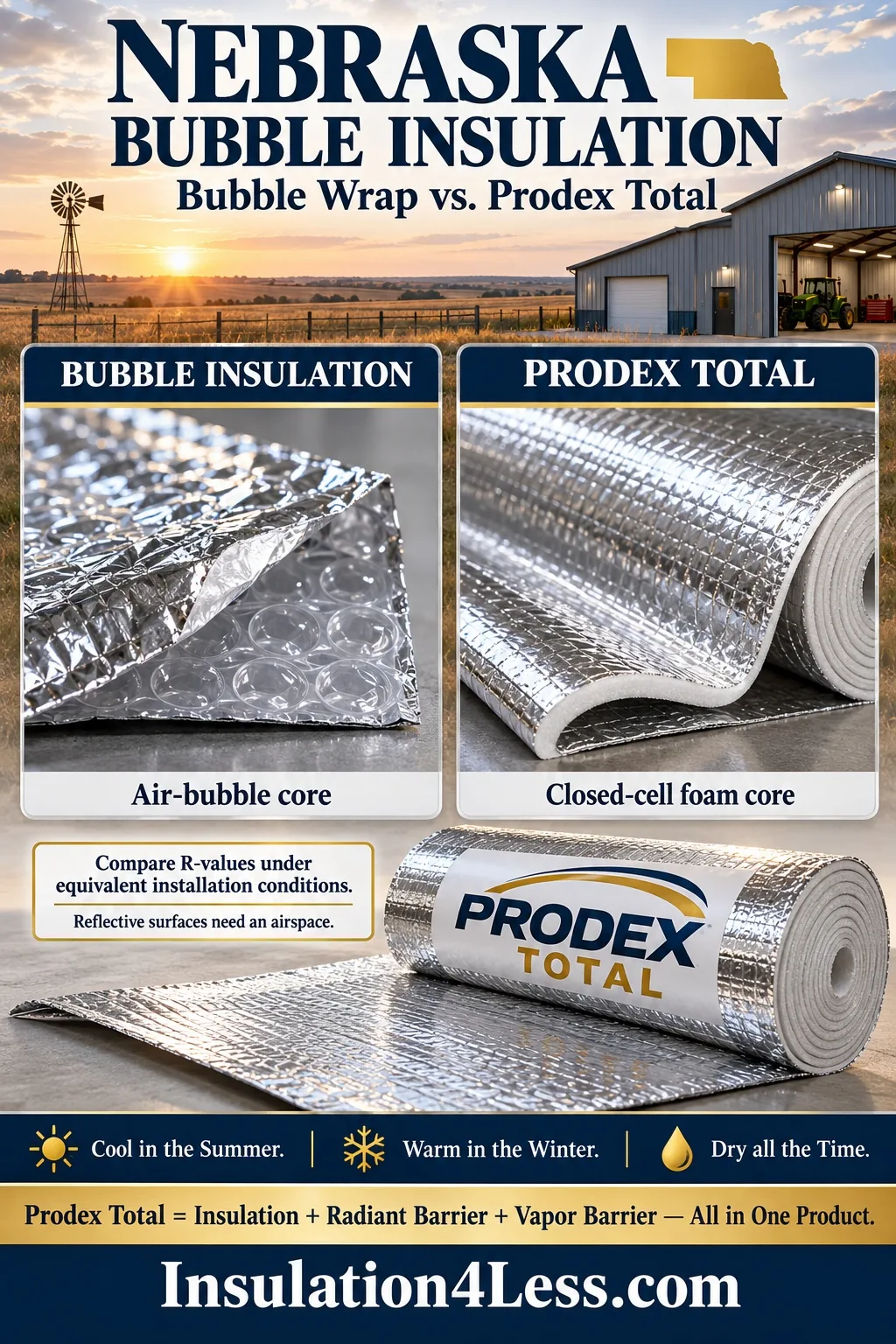
Nebraska Bubble Insulation: Bubble Wrap vs. Prodex Total
Reflective insulation products can look similar from a distance. A silver facing, a flexible roll and a compact profile may suggest that different products perform the same way. The materials beneath those reflective surfaces, however, can be quite different.
Bubble insulation uses an air-bubble core. Prodex Total uses a closed-cell polyethylene foam core. That distinction should be part of any comparison for a Nebraska metal building, pole barn, garage or home.
Before buying, evaluate the specific product, its intended application and the conditions behind its thermal-performance claims. Reflective surfaces, airspaces, seam details and the complete building assembly all influence the result.
Our Nebraska Insulation Guide connects you with guidance for each building type.
Cool in the Summer. Warm in the Winter. Dry all the Time.
Prodex Total = Insulation + Radiant Barrier + Vapor Barrier — All in One Product.
What Is Bubble Insulation?
Single Bubble Products
Single bubble insulation contains one layer of air bubbles between its facing materials. Products may have reflective surfaces on both sides or a reflective surface on one side and another finish on the other.
Check the actual product construction rather than relying on a general description such as “foil insulation.” Facing materials, reinforcement, thickness and installation requirements can vary.
Double Bubble Products
Double bubble products contain two bubble layers. That description identifies their construction; it does not establish a particular installed R-value.
The performance comparison still needs to account for the specific product and the assembly in which it was tested. Two bubble layers should not automatically be assumed to provide twice the thermal resistance of one.
Reflective Facings
Reflective bubble insulation uses reflective facings to reduce radiant heat transfer when those surfaces face appropriate airspaces.
A reflective face placed directly against another material does not provide an airspace-based radiant-barrier function on that side. This principle also applies to foil-faced foam products, including Prodex Total.
Our reflective insulation guide explains the relationship between reflective surfaces, airspaces and thermal performance.
How Prodex Total Differs from Bubble Wrap Insulation
Prodex Total uses closed-cell polyethylene foam rather than an air-bubble core. Its product range includes different thicknesses, finishes and seam arrangements.
10M Prodex Total Plus is the most popular and thickest reflective insulation roll in the Prodex Total range. It features a 10 mm, approximately 0.4-inch, foam core with reinforced reflective foil on both sides and heat-welded seams.
The 5M Plus range offers thinner options, including rolls with a white, black or rustic finish on one side and reflective foil on the other.
The core distinction matters, but it is only one part of the purchasing decision. Compare the complete product specifications and installation requirements.
| Feature | Bubble insulation | Prodex Total |
|---|---|---|
| Core construction | One or more layers of air bubbles | Closed-cell polyethylene foam |
| Facing options | Vary by product | Reflective foil on both sides of foil-faced rolls; selected finishes have foil on one side |
| Radiant-heat control | Requires a reflective face adjacent to an appropriate airspace | Requires a reflective face adjacent to an appropriate airspace |
| Thermal comparison | Use the specific product’s test conditions | Use the specific product’s test conditions |
| Vapor-control performance | Verify the product rating and required seam details | Coordinate product selection, sealed seams and layer placement |
| Selection criteria | Intended use, specifications, installation and cost | Intended use, specifications, installation and cost |
For a broader comparison, see our national guide to bubble insulation vs. Prodex Total.
Compare R-Values Under Equivalent Conditions
R-value comparisons are useful only when the numbers describe equivalent conditions.
A published value may refer to the insulation material alone or to an assembly that includes adjacent airspaces. Those are different measurements.
Before comparing bubble and foam-core products, determine:
- Whether the rating describes the material or a complete assembly.
- The number and dimensions of any included airspaces.
- The installation orientation and direction of heat flow.
- Whether those conditions match the proposed installation.
A product’s advertised assembly R-value should not be treated as the standalone R-value of its thin core. Likewise, adding layers does not automatically multiply the finished assembly’s thermal resistance.
For a heated Nebraska building, choose the complete system according to its intended use and applicable thermal requirements.
Nebraska Metal Buildings: Look Beyond the Silver Surface
A steel workshop or agricultural building needs an insulation plan that considers summer radiant heat, winter heat loss, air movement and condensation.
When comparing bubble wrap insulation with Prodex Total, examine how each product will be supported, how seams will be closed and where the required airspace will remain.
A low roll price does not establish the cost or performance of the completed system. Include accessories, installation labor and any additional insulation required.
Our Nebraska metal building insulation guide explains these priorities. Explore our national page on the best metal building insulation for product benefits and material comparisons.
For installation methods, use the separate metal building insulation installation guide.
Can Reflective Insulation Help Control Condensation?
Condensation forms when moist air reaches a surface below its dew point. In a metal building, that may be the underside of the roofing or siding.
A suitable insulation and vapor-control layer can help manage this risk when correctly located and continuously installed. Product selection alone does not establish an effective system.
Check seams, penetrations, edges and roof-to-wall connections. Indoor humidity, ventilation and moisture sources also need attention.
For bubble products, verify the specific vapor-permeance rating and approved installation details. For Prodex Total, follow the instructions for the selected roll and seam method.
Repair roof leaks before installing either material. Insulation cannot correct water entering through damaged roofing or flashing.
Nebraska Pole Barns: Plan for the Building’s Future Use
A pole barn used for equipment storage may eventually become a heated shop. That change affects the thermal resistance, air sealing and moisture control the building needs.
Compare insulation systems for the intended long-term use. A thin reflective layer should not automatically be assumed to supply all the thermal resistance required for a continuously heated space.
Where continuous insulation is specified, carry it across framing rather than leaving exposed strips between insulated sections.
Read our Nebraska pole barn insulation guide, then review how to insulate a pole barn for installation options.
Nebraska Homes: Choose the Assembly Before the Roll
Residential roofs, walls, floors and crawl spaces have different insulation and moisture-management requirements.
Before adding a foil-faced product, identify the existing insulation and vapor-control layers. Consider whether the proposed arrangement preserves the assembly’s intended drying paths.
A reflective product can contribute to a suitable assembly, but it should not be assumed to replace the bulk insulation required throughout a home.
Our Nebraska house insulation guide and Nebraska roof and ceiling insulation guide explain these application differences.
What About Fiberglass, Spray Foam and Foam Board?
Fiberglass provides bulk thermal resistance and can be combined with Prodex Total in a coordinated assembly. Read our Nebraska fiberglass vs. Prodex Total guide to explore their different roles.
Spray foam and rigid foam board may also suit selected applications. Evaluate their required thickness, attachment, protective layers and effect on future access to the building shell.
Our spray foam insulation guide for metal buildings and pole barns and foam board insulation guide provide additional comparisons.
Choose Your Product and Estimate Quantities
Start with the installation method, then calculate the material required for that layout.
10M Prodex Total Plus measures 4 feet by 85.3 feet and covers 341 square feet per roll. Its heat-welded seam system differs from products that require taped connections, so use the accessories and instructions appropriate to the selected roll.
Measure the surfaces to be insulated and allow for specified overlaps, cuts and transitions. Use the Advanced Insulation Calculator and review how much insulation you need before ordering.
Return to the Nebraska Insulation Guide to find the application guide that matches your building.
Cool in the Summer. Warm in the Winter. Dry all the Time.
Prodex Total = Insulation + Radiant Barrier + Vapor Barrier — All in One Product.