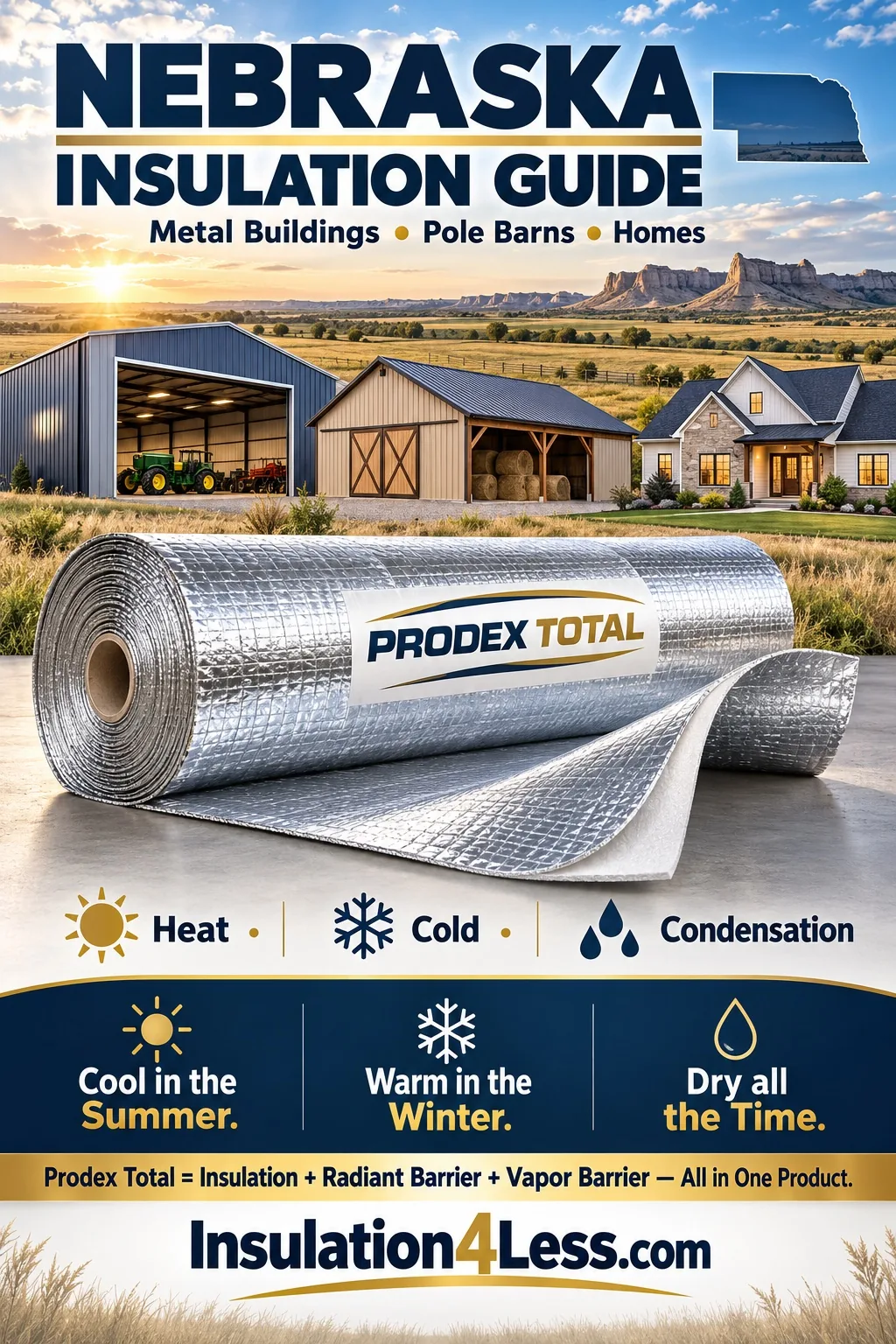
Nebraska Insulation Guide: Metal Buildings, Pole Barns and Homes
Nebraska buildings face changing demands throughout the year. Summer sunshine heats roofs and metal siding, winter temperatures increase heating needs, and moisture can collect on cold building surfaces. Choosing insulation means considering how the complete building assembly handles heat, air movement and condensation.
Whether you are insulating a farm building near Kearney, a workshop in Grand Island, a home in Omaha or a pole barn outside Lincoln, start with the building’s construction and intended use. A heated workshop needs a different insulation plan than an unheated equipment shed, even when both have metal roofs and walls.
Prodex Total combines a closed-cell polyethylene foam core with reflective facings to address several of these needs in one product. This Nebraska insulation guide connects you with application guides, material comparisons and installation instructions.
Cool in the Summer. Warm in the Winter. Dry all the Time.
Prodex Total = Insulation + Radiant Barrier + Vapor Barrier — All in One Product.
What Should Insulation Address in Nebraska?
Summer Heat Through Roofs and Walls
Sun-heated roofing and siding can radiate heat toward the interior of a building. This is especially noticeable in metal shops, agricultural buildings and garages.
Reflective insulation helps reduce radiant heat transfer when its reflective surface faces an appropriate airspace. Its performance depends on the assembly, including airspace dimensions, orientation and installation. Our reflective insulation guide explains these factors and how to evaluate thermal-performance claims. R-Value, Comparisons & Buying Advice
Winter Heat Loss and Air Leakage
An insulation plan should consider the roof, walls, floors and connections between them. Gaps around doors, penetrations and insulation seams can undermine comfort even when the insulation material itself performs well.
For heated Nebraska buildings, evaluate the complete assembly rather than selecting a product solely by thickness or an advertised R-value. Continuous insulation, properly sealed transitions and suitable cavity insulation can each contribute to the finished system.
Condensation on Cold Surfaces
Condensation can form when moist air reaches a surface cold enough for water vapor to condense. Metal roofs and walls are common locations because their interior surfaces can become cold quickly.
Insulation and vapor-control layers must be installed as a coordinated system. Seams, penetrations, indoor humidity and ventilation all matter. Adding insulation without addressing moisture sources or air leakage may leave condensation problems unresolved.
Find the Right Nebraska Insulation Guide
Nebraska Metal Building Insulation
Steel shops, warehouses, agricultural buildings and commercial structures need an insulation plan that considers radiant heat, winter heat loss and condensation at the metal panels.
Our Nebraska metal building insulation guide explains these priorities for local projects. For product benefits and material comparisons, explore our national page on the best metal building insulation.
When you are ready to plan the work, follow the separate metal building insulation installation guide, which covers new construction and existing buildings.
Nebraska Pole Barn Insulation
Pole barns serve many purposes across Nebraska, from equipment storage and livestock facilities to heated shops and barndominiums. The intended use determines how much thermal resistance, air sealing and moisture control the building needs.
Start with our Nebraska pole barn insulation guide. Compare product benefits on our national pole barn insulation page, then review how to insulate a pole barn for installation methods.
Nebraska House Insulation
Home insulation should work as part of a coordinated roof, wall and floor system. Existing insulation, available space, interior finishes and moisture conditions all influence the right approach.
Our Nebraska house insulation guide covers applications in traditional houses and other home types. The national home insulation page provides a broader look at using Prodex Total throughout a home.
Nebraska Roof and Ceiling Insulation
Roofs and ceilings deserve close attention because they separate occupied spaces from sun-heated roofing, cold exterior conditions or unconditioned attics.
Use our Nebraska roof and ceiling insulation guide to identify the appropriate assembly for your project. Our national roof insulation guide explains additional applications and installation considerations.
Nebraska Fiberglass vs. Prodex Total
Fiberglass and Prodex Total have different functions and installation requirements. Fiberglass provides bulk thermal resistance, while Prodex Total combines a foam core with reflective facings and vapor-control properties. Depending on the assembly, the two materials can also be used together.
Our Nebraska fiberglass vs. Prodex Total guide examines these choices. For steel structures, see the national Prodex Total vs. fiberglass comparison for metal buildings.
Nebraska Bubble Insulation
Bubble products and Prodex Total should not be treated as interchangeable materials. Bubble insulation uses an air-bubble core; Prodex Total uses closed-cell polyethylene foam.
Read our Nebraska bubble insulation guide before comparing products. Our national bubble insulation guide explains common product types and applications, while the single bubble insulation product page provides details on that specific option.
Compare R-values only under equivalent installation conditions, including airspaces, heat-flow direction and the tested assembly.
Nebraska Metal Garage and Workshop Insulation
A garage used for occasional storage has different needs than a workshop heated throughout winter. Consider occupancy, heating and cooling equipment, door openings and moisture-producing activities before selecting insulation.
Our Nebraska metal garage and workshop insulation guide helps you plan the project. Explore the national metal garage insulation page for additional product guidance.
Nebraska Shipping Container Insulation
Shipping containers have limited interior space and highly conductive steel surfaces. An insulation plan should address the walls, ceiling, floor and transitions around doors and penetrations.
Our Nebraska shipping container insulation guide covers these priorities. For broader application guidance, visit our national shipping container insulation page.
Nebraska Crawl Space Insulation
Crawl space work starts with understanding ground moisture, drainage and whether the space is vented or encapsulated. Those conditions influence whether the insulation belongs at the floor above or along the crawl space perimeter.
Read our Nebraska crawl space insulation guide, then explore the national guide to crawl space insulation.
Compare Other Insulation Materials
Spray foam and rigid foam board may also be considered for Nebraska projects. Evaluate each material according to the building assembly, installation requirements, available space and future access for repairs.
Our spray foam insulation guide for metal buildings and pole barns discusses that option. The foam board insulation guide explains rigid-board applications and considerations.
Use equivalent conditions when comparing thermal performance. A whole-assembly R-value that includes airspaces should not be compared directly with another material’s standalone R-value.
Choose a Prodex Total Roll for Your Project
10M Prodex Total Plus features a 10 mm, approximately 0.4-inch, closed-cell polyethylene foam core with reinforced reflective foil on both sides. Each 4-foot by 85.3-foot roll covers 341 square feet and features heat-welded seams. insulation4less.com
The 5M Plus range provides a thinner option, with selected products offering white, black or rustic finishes on one side. Choose the roll according to the application, desired appearance, coverage and installation method.
For any reflective assembly, preserve the specified airspace. Where the design calls for continuous insulation, carry the insulation across the framing and seal the required seams and transitions.
Calculate Your Nebraska Insulation Requirements
Measure the roof, walls, ceiling or floor areas you intend to insulate before ordering. Account for overlaps, cuts and the layout required by your installation method.
Use the Advanced Insulation Calculator to help estimate quantities. Our guide to how much insulation you need provides additional planning guidance.
Start with the Nebraska application guide that matches your building, review the installation instructions and select the product that fits the complete assembly.
Cool in the Summer. Warm in the Winter. Dry all the Time.
Prodex Total = Insulation + Radiant Barrier + Vapor Barrier — All in One Product.