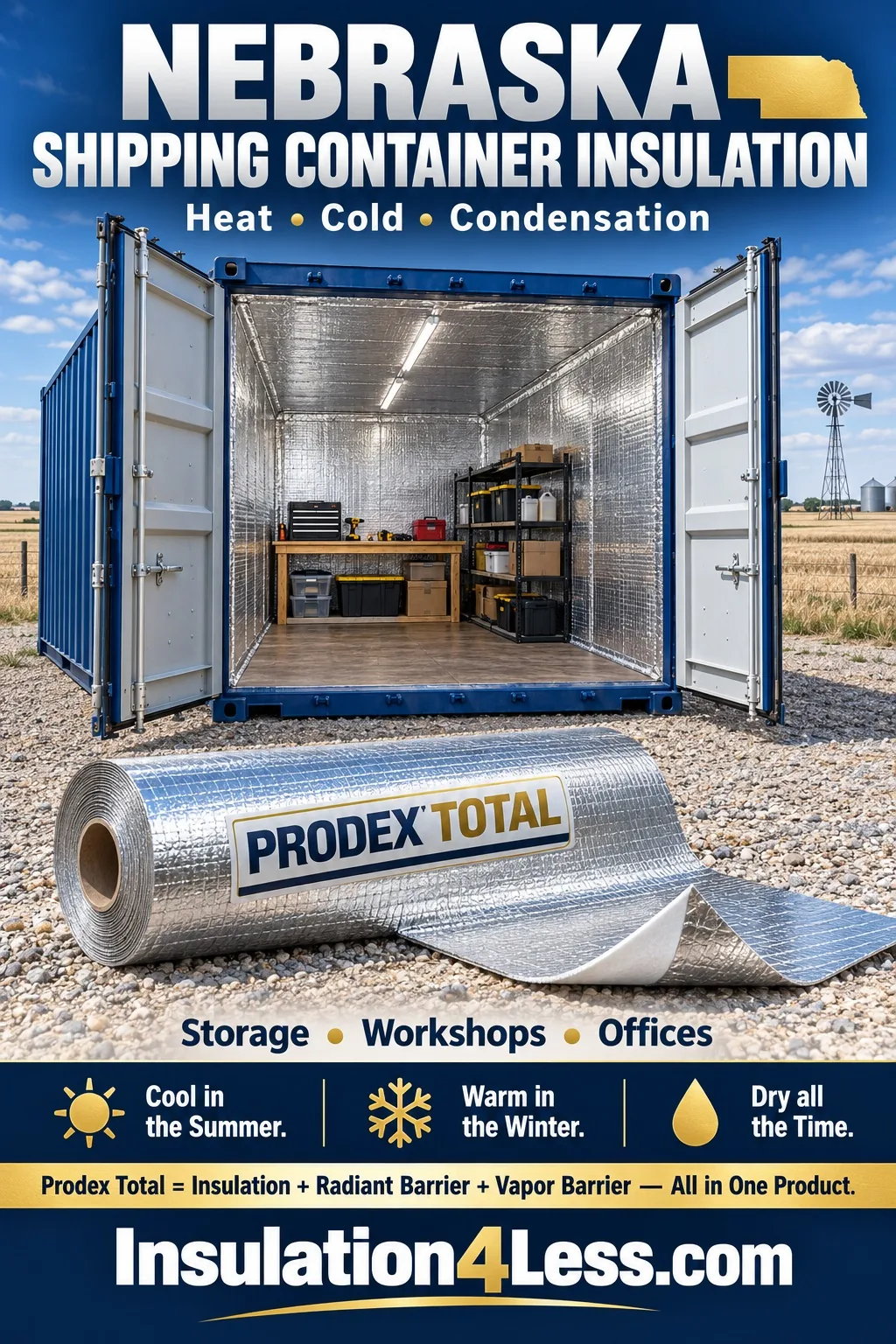
Nebraska Shipping Container Insulation: Control Heat, Cold and Condensation
A shipping container provides a durable steel enclosure, but converting it into a useful Nebraska workspace or storage building requires attention to indoor conditions. Summer sunshine heats the steel shell, winter temperatures increase heat loss, and moisture can condense on cold interior surfaces.
The insulation plan should reflect the container’s use. An unheated equipment-storage container has different requirements than a regularly occupied office, workshop or home.
Prodex Total combines a closed-cell polyethylene foam core with reflective facings. In a properly designed assembly, it adds insulation, radiant-heat control and vapor-control properties while using relatively little space.
Explore our national shipping container insulation guide for product benefits and application guidance.
Cool in the Summer. Warm in the Winter. Dry all the Time.
Prodex Total = Insulation + Radiant Barrier + Vapor Barrier — All in One Product.
Why Nebraska Shipping Containers Need an Insulation Plan
Summer Heat Through the Steel Shell
A container’s sun-exposed roof and walls can radiate heat toward the interior. Opening the doors may improve ventilation, but it does not prevent heat transfer from the heated shell.
Prodex Total’s reflective facing helps reduce radiant heat transfer when it faces an appropriate airspace. Preserve that airspace as part of the installation rather than assuming the reflective surface performs the same way in direct contact with another material.
Our reflective insulation guide explains how airspaces, orientation and assembly design affect performance.
Winter Heat Loss
Steel readily transfers heat. A container used as a heated workspace therefore needs a complete insulation system, including attention to the walls, ceiling, floor and openings.
Insulation does not generate heat. An unheated container can still approach outdoor temperatures during extended cold weather.
For an occupied container, determine the thermal performance required for the complete assembly before choosing products.
Condensation on Interior Surfaces
Condensation develops when moist air reaches a surface below its dew point. Cold steel walls and ceilings can become condensation surfaces inside a container.
Moisture may come from stored items, wet equipment, occupants or activities inside the enclosure. A suitable insulation and vapor-control system helps manage moisture movement, but continuity, ventilation and humidity control also matter.
Match the Insulation to the Container’s Use
Storage Containers
Start by identifying what will be stored and whether it introduces moisture. Wet machinery, recently washed equipment and damp materials can increase indoor humidity.
Protecting stored items requires attention to water entry, condensation and ventilation. Insulation is one part of that plan.
Container Workshops
A workshop may need heating, cooling and ventilation appropriate to the work performed inside.
Plan around benches, electrical services, lighting and wall attachments before installing insulation. Activities that produce fumes, dust or moisture require suitable ventilation independent of the insulation system.
For related workspace considerations, see our Nebraska metal garage and workshop insulation guide.
Container Offices and Homes
Regularly occupied containers require a coordinated enclosure design. Insulation, air sealing, vapor control, heating, cooling and ventilation should work together.
Windows, doors and service penetrations also affect performance. Interior finishes and protective coverings must suit the application and applicable requirements.
Our Nebraska house insulation guide provides additional guidance for residential uses.
Where Should Shipping Container Insulation Go?
Ceiling and Roof Area
The roof receives direct sunlight and can become a major source of summer radiant heat. It is also a potential condensation surface during cold conditions.
Plan continuous ceiling coverage, the specified airspace and sealed connections to the wall insulation. Detail lights, wiring and other penetrations without leaving uncontrolled gaps.
Our Nebraska roof and ceiling insulation guide discusses related overhead applications.
Container Walls
Insulate the intended wall surfaces continuously, paying particular attention to corners, corrugations and transitions around openings.
Where the assembly includes framing and calls for continuous insulation, extend the insulation across the framing rather than leaving exposed strips between insulated sections.
Airspace dimensions should follow the selected installation method. The shape of the steel corrugations alone should not be assumed to establish the airspace required by a thermal-performance claim.
Floors
A container’s floor assembly also influences comfort, especially in a regularly heated or cooled space.
Inspect the floor and underside before choosing an insulation arrangement. Account for moisture exposure, clearance, support and protection from damage.
A thin reflective floor layer should not automatically be treated as equivalent to a thicker insulation system specified for the project.
Doors and Added Openings
Original container doors, added entry doors and windows require attention to insulation continuity and weather seals.
Maintain safe operation and access. Plan transitions around frames and penetrations so the intended air and vapor-control layers remain connected.
Installing Prodex Total in a Shipping Container
Inspect and Prepare the Shell
Check for roof leaks, failed seals, corrosion and other damage before insulating. Repair water entry and allow wet surfaces to dry.
The substrate must be suitable for the chosen attachment method. Adhesives require the surface preparation and environmental conditions specified by their manufacturer.
Use the Appropriate Pin-and-Cap Method
Suitable container installations can use adhesive insulation pins and retaining caps to support Prodex Total.
Follow the specified pin layout and adhesive-curing instructions before loading the insulation. Install the material and retaining caps according to the selected method.
This approach uses adhesive-mounted supports rather than relying on screws driven through the container shell. Follow the container-specific instructions in our shipping container insulation guide.
Maintain Airspaces and Close Seams
Preserve the airspace required by the assembly. Close seams using the method specified for the selected roll, and detail edges and penetrations to maintain continuity.
10M Plus uses heat-welded seams. Other products may require different seam treatments, so choose accessories according to the product instructions.
Choosing Prodex Total for a Nebraska Container
10M Prodex Total Plus is the most popular and thickest reflective insulation roll in the Prodex Total range. It features a 10 mm, approximately 0.4-inch, closed-cell polyethylene foam core with reinforced reflective foil on both sides.
Each roll measures 4 feet by 85.3 feet and covers 341 square feet. Its heat-welded seam system eliminates the need for seam tape at those welded connections.
The 5M Plus range offers thinner options, including rolls with a white, black or rustic finish on one side and reflective foil on the other.
Choose according to the complete assembly, installation method and desired interior appearance. Account for the space occupied by airspaces, framing and finishes as well as the insulation itself.
Compare Other Shipping Container Insulation Options
Fiberglass
Fiberglass provides bulk thermal resistance but needs appropriate support, air control and moisture management.
It can be combined with Prodex Total in a coordinated assembly. Layer placement should account for condensation risk and drying potential, particularly where multiple vapor-resistant surfaces are present.
Our Nebraska fiberglass vs. Prodex Total guide explains their different functions.
Spray Foam
Spray foam can provide thermal resistance and air sealing. Evaluate the foam type, installed thickness, required protective covering and implications for future access to the steel shell.
Our spray foam insulation guide for metal buildings and pole barns discusses material considerations relevant to steel enclosures.
Foam Board
Rigid foam board may suit selected container assemblies. Plan board joints, attachment, perimeter sealing and transitions around the corrugated shell.
Read our foam board insulation guide when evaluating this option.
Bubble Insulation
Bubble insulation uses an air-bubble core, while Prodex Total uses closed-cell polyethylene foam.
Compare thermal ratings under equivalent installation conditions. Check whether a stated R-value applies to the material alone or an assembly that includes airspaces.
Our Nebraska bubble insulation guide explains these distinctions.
Calculate Your Container Insulation Requirements
Measure the actual ceiling, walls, doors and floor surfaces you intend to insulate. Container dimensions, modifications and interior layouts vary, so use measurements from your own unit.
Allow for specified overlaps, cuts, corners and transitions. Plan the roll orientation and seam locations before calculating the final quantity.
Use the Advanced Insulation Calculator and review how much insulation you need before ordering.
Return to the Nebraska Insulation Guide to explore the complete series of building and application guides.
Cool in the Summer. Warm in the Winter. Dry all the Time.
Prodex Total = Insulation + Radiant Barrier + Vapor Barrier — All in One Product.