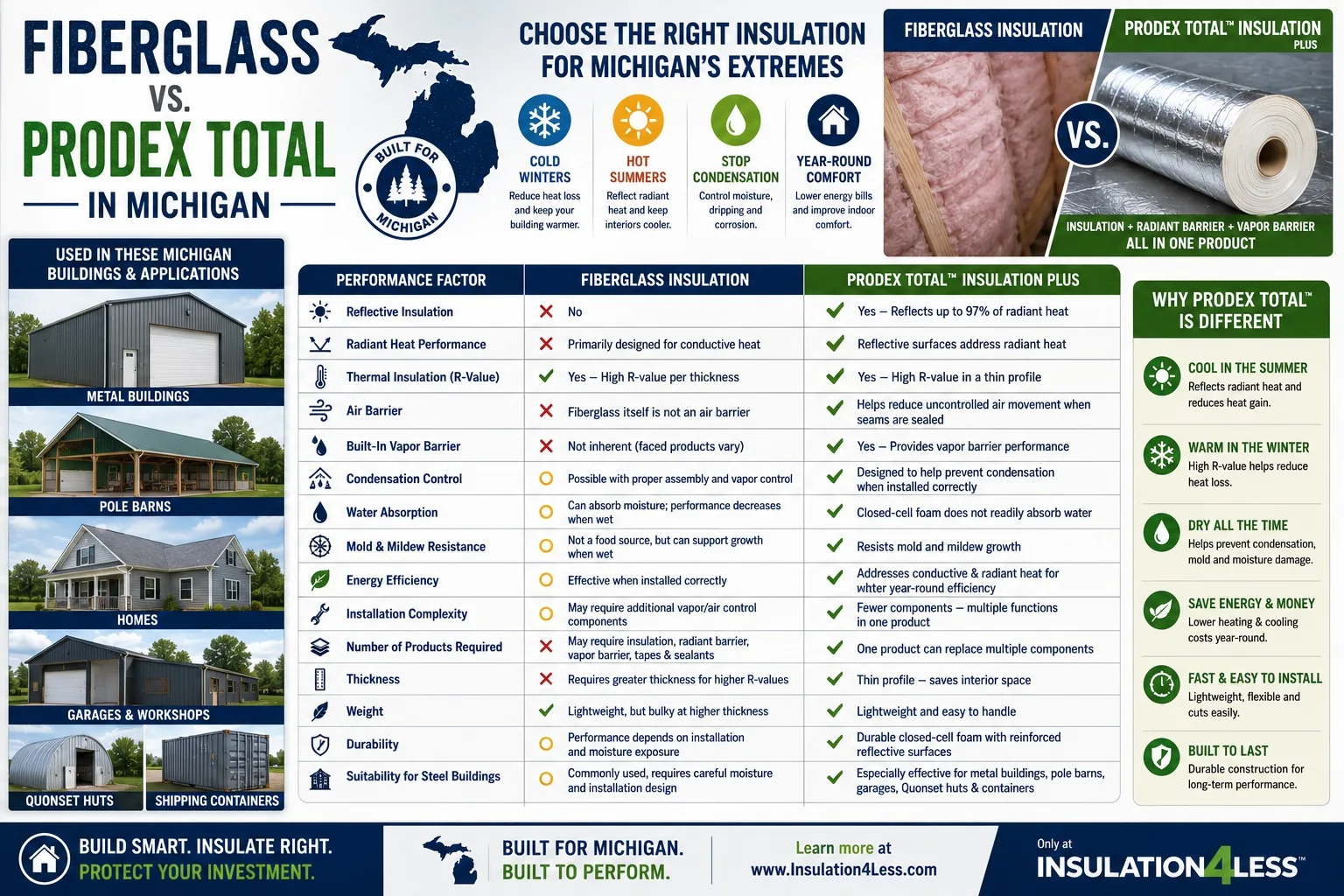
Fiberglass Insulation vs. Prodex Total in Michigan: Which Is Better?
Fiberglass is one of the most familiar insulation materials in America.
Prodex Total takes a different approach.
Instead of relying solely on mass insulation to slow conductive heat transfer, Prodex Total combines a closed-cell foam core with reflective surfaces designed to address radiant heat.Depending on the specific product and assembly, Prodex Total can also provide vapor-barrier characteristics.
So which is better for a Michigan building?
It depends on the building, application and performance you need from the insulation system
Michigan's cold winters, warm summers and seasonal humidity make it particularly important to consider more than R-value.
Thermal resistance matters, but so can:
- Radiant heat
- Air movement
- Water vapor
- Condensation
- Moisture absorption
- Installation quality
- Available space
- Long-term durability
This guide compares fiberglass and Prodex Total across those characteristics.
Fiberglass vs. Prodex Total: Quick Comparison
| Performance Factor | Fiberglass Insulation | Prodex Total |
|---|---|---|
| Reflective insulation | No | Yes |
| Radiant heat performance | Primarily designed for conductive heat | Reflective surfaces address radiant heat when properly installed |
| Thermal insulation | Yes | Yes |
| Air barrier | Fiberglass itself is not an air barrier | Can contribute to air control when seams and penetrations are properly sealed |
| Built-in vapor barrier | Not inherent to unfaced fiberglass; separate facings may be available | Vapor-barrier characteristics depending on product and installation |
| Condensation control | Requires appropriate assembly and moisture strategy | Designed for applications where condensation control is an important consideration |
| Water absorption | Performance can be affected by moisture exposure | Closed-cell foam does not readily absorb water |
| Mold/mildew resistance | Fiberglass itself does not provide food for mold, but surrounding materials can support growth when wet | Closed-cell construction resists moisture and mold/mildew growth |
| Energy efficiency | Can be effective when correctly sized and installed | Addresses conductive and radiant heat as part of an appropriate assembly |
| Installation complexity | May require additional vapor/air-control components depending on assembly | Multiple functions can be incorporated into one product |
| Number of products required | May require separate components for radiant, vapor or air control | Can combine insulation, radiant-barrier and vapor-barrier functions |
| Thickness | Typically requires greater thickness for higher R-values | Thin profile |
| Weight | Lightweight but bulky at higher thicknesses | Lightweight and thin |
| Durability | Depends on installation and protection from moisture/compression | Closed-cell foam and reinforced reflective construction |
| Suitability for steel buildings | Commonly used but requires careful moisture and installation design | Particularly relevant to metal-building applications |
The table provides a general comparison. Actual performance depends on the specific product, thickness and complete building assembly.
Fiberglass Insulation Works
Fiberglass insulation contains fine glass fibers that create many small air spaces. Those trapped air spaces help slow conductive heat transfer.
Fiberglass is available in several forms, including:
- Batts
- Rolls
- Loose-fill
- Specialty products and facings
It is widely used in residential walls, ceilings, attics and other building assemblies. Fiberglass can provide excellent thermal resistance when correctly selected and installed. But installation quality matters.
How Prodex Total Works
Prodex Total combines reflective surfaces with a closed-cell polyethylene foam core. The reflective surfaces are designed to reduce radiant heat transfer when the product is installed in an appropriate assembly. The closed-cell foam contributes thermal resistance and does not readily absorb water. Depending on the product and installation, Prodex Total can also provide vapor-barrier performance. This allows several building-envelope functions to be incorporated into one insulation system:
Prodex Total = Insulation + Radiant Barrier + Vapor Barrier — All in One Product.
For a deeper explanation of reflective insulation, see our Reflective Insulation in Michigan guide.
Conductive Heat: Fiberglass vs. Prodex Total
Conductive heat transfer occurs when heat moves through a material. Fiberglass is primarily designed to resist conductive heat transfer. Its effectiveness is commonly expressed using R-value. Prodex Total's foam core also provides thermal resistance, but Prodex is intended to work as part of an assembly that can address more than conduction alone. This distinction becomes important in buildings where radiant heat and condensation are significant concerns.
Radiant Heat: A Major Difference
Radiant heat is where reflective insulation differs most clearly from conventional fiberglass. Sunlight can heat a Michigan metal roof significantly during summer. The hot roof then radiates energy toward cooler surfaces inside the building. Fiberglass slows conductive heat movement but is not a radiant barrier. Prodex Total has reflective surfaces specifically intended to reduce radiant heat transfer when facing an appropriate air space.
This can be especially useful in:
- Metal buildings
- Pole barns
- Metal garages
- Workshops
- Agricultural buildings
- Quonset huts
- Shipping containers
See our national Reflective Insulation Guide for more information.
Fiberglass vs. Prodex for Michigan Metal Buildings
Metal buildings create conditions that differ significantly from conventional wood-framed homes. Steel readily conducts exterior temperatures. During Michigan winters, metal roofing and siding can become extremely cold. During summer, the same surfaces can become hot under direct sunlight.
Metal buildings can therefore require consideration of:
- Conductive heat
- Radiant heat
- Condensation
- Vapor
- Air movement
Fiberglass can provide substantial thermal resistance, but the complete assembly must manage the other factors as well. Prodex Total is particularly relevant where multiple functions need to be addressed in a thin insulation system.
See Metal Building Insulation in Michigan for application-specific guidance.
You can also review our national guide to metal building insulation.
Condensation: Fiberglass vs. Prodex Total
Condensation is especially important in Michigan metal buildings and pole barns. When warm, moisture-containing air reaches sufficiently cold metal, liquid water can form. If fiberglass is installed beneath a metal roof, the overall assembly must be designed to prevent problematic moisture from reaching cold surfaces and accumulating within the insulation system. Prodex Total's closed-cell construction and vapor-barrier characteristics can make it particularly useful where condensation management is an important objective. But no insulation product should be expected to correct every moisture problem automatically. Roof leaks, excessive interior humidity and inadequate ventilation should be identified and addressed separately.
What Happens When Fiberglass Gets Wet?
Fiberglass itself is inorganic, but moisture can still create problems within an insulation assembly.
Water can:
- Reduce effective thermal performance while present
- Add weight
- Affect facings and adjacent materials
- Contribute to corrosion in metal assemblies
- Create conditions where mold grows on nearby organic materials
Wet insulation should not simply be ignored or covered. The source of moisture should be determined. Prodex Total's closed-cell foam does not readily absorb water, which can be an advantage in moisture-sensitive applications.
Air Movement
Fiberglass insulation is not inherently an air barrier. Air can move through and around poorly installed fiberglass. That means an effective fiberglass assembly may require a separate air-control strategy. Prodex Total can contribute to air control when it is installed continuously and seams, edges and penetrations are properly sealed. The quality of installation remains important for either system.
Vapor Control
Vapor control is another important distinction. Unfaced fiberglass does not itself function as a vapor barrier. Some fiberglass products include facings that change the vapor characteristics of the assembly. Prodex Total incorporates surfaces that can provide vapor-barrier characteristics when the product and seams are installed appropriately. This can reduce the number of separate components required in certain applications.
Fiberglass vs. Prodex in Michigan Pole Barns
Pole barns frequently combine large metal surfaces with widely spaced structural framing.
They may also be used for very different purposes, including:
- Equipment storage
- Workshops
- Livestock
- Garages
- Agricultural storage
- Commercial workspaces
Fiberglass can provide thermal resistance, particularly when adequate cavity depth is available. Prodex Total can be attractive when radiant heat, condensation, moisture resistance and limited thickness are important considerations
For more information, visit Pole Barn Insulation in Michigan.
Our national Pole Barn Insulation Guide provides additional installation and performance information.
Fiberglass vs. Prodex for Michigan Roofs
The roof is often the most important area to evaluate.
Michigan roofs experience:
- Winter heat loss
- Summer solar heating
- Temperature extremes
- Moisture exposure
- Condensation potential
Fiberglass can provide substantial conductive thermal resistance when enough space is available. Reflective insulation can provide an additional mechanism for addressing radiant heat. In metal-roof applications, vapor and condensation control also become especially important. See Roof & Ceiling Insulation in Michigan.
Fiberglass vs. Prodex for Michigan Homes
Residential construction is an area where fiberglass can be particularly effective. Conventional wood-framed walls, ceilings and attics often provide cavities designed to accommodate thicker mass insulation. Fiberglass is widely available and familiar to builders. Prodex Total may be considered in selected residential applications where reflective insulation, vapor control or limited thickness is important. The two products do not necessarily need to be viewed as universal substitutes for one another. The appropriate choice depends on the assembly.
For residential applications, see House Insulation in Michigan.
Michigan Garages & Workshops
Metal garages and workshops can benefit from the same considerations used for larger steel buildings. An uninsulated garage may become very cold during winter and hot during summer. If the garage is heated, condensation can also become a concern. Prodex Total can be particularly attractive where the owner wants a thin insulation system addressing radiant heat and vapor as well as thermal performance.
See Metal Garage & Workshop Insulation in Michigan.
For broader information about insulation for steel buildings, see our national metal-building guide.
Quonset Huts
Quonset huts present another application where installation geometry matters. Their curved steel shells create a large continuous surface that can become cold during winter and hot during summer. Thick conventional insulation can be more difficult to install neatly around the curved structure. Prodex Total's flexibility and thin profile can make it particularly suitable for these applications.
See Quonset Hut Insulation in Michigan.
Shipping Containers
Shipping containers present similar challenges on a smaller scale. The steel shell readily transfers temperature and can develop interior condensation. Interior space is also valuable. A thick insulation system can substantially reduce usable width and height. Prodex Total's relatively thin profile can therefore be attractive where conserving interior space matters.
See Shipping Container Insulation in Michigan.
Installation Complexity
Insulation performance depends heavily on installation quality.
Fiberglass
Fiberglass installation may require attention to:
- Correct thickness
- Avoiding compression
- Filling cavities completely
- Preventing gaps
- Vapor control where required
- Air sealing
- Moisture protection
Prodex Total
Prodex installation may require attention to:
- Correct orientation
- Appropriate air spaces
- Continuous coverage
- Properly sealed seams
- Penetrations
- Mechanical attachment
- Product-specific installation requirements
Neither material should be installed without considering the entire building assembly.
Thickness and Available Space
Space can influence the insulation decision. Fiberglass typically achieves higher thermal resistance by increasing thickness. That works well when deep framing cavities are available. Some buildings have limited space.
Examples include:
- Shipping containers
- Quonset huts
- Certain metal buildings
- Retrofit garages
- Low-clearance roof assemblies
Prodex Total's thin profile can be advantageous where maintaining usable interior space is important.
Which Insulation Is Better for Michigan?
There is no universal winner for every building.
Fiberglass May Make Sense When:
- Deep framing cavities are available
- High conductive R-value is the primary objective
- The assembly already includes appropriate air and vapor control
- Conventional residential construction methods are being used
Prodex Total May Make Sense When:
- Radiant heat is important
- Condensation is a major concern
- Vapor control is required
- Interior space is limited
- The building has metal roofing or siding
- A thin, lightweight system is desirable
- Multiple building-envelope functions are beneficial
For many Michigan metal structures, the question shouldn't simply be:
"Which product has the highest R-value?"
A better question is:
"What does the entire building envelope need to accomplish?"
Compare the Complete Insulation System
When evaluating fiberglass and Prodex Total, compare the complete system rather than a single specification.
Consider:
- Conductive heat resistance
- Radiant heat
- Air movement
- Vapor control
- Condensation
- Moisture resistance
- Available installation space
- Installation complexity
- Durability
- Building use
This provides a much more meaningful comparison than looking at thickness or R-value alone.
Michigan Insulation for All Four Seasons
Michigan buildings must perform in very different conditions throughout the year. Fiberglass can provide effective thermal resistance and remains an important insulation option, particularly in conventional residential assemblies. Prodex Total offers a different combination of characteristics that can be especially useful in metal buildings, pole barns, garages, workshops, Quonset huts and shipping containers. For these applications, the objective is broader than simply slowing conductive heat. It's about creating a building that is:
Cool in the Summer. Warm in the Winter. Dry all the Time.
Choose the insulation system based on the building, climate, moisture conditions, available space and required performance—and verify applicable building and energy-code requirements before selecting the final assembly.
Explore Michigan Insulation Guides
Continue exploring insulation solutions for Michigan buildings:
- Michigan Insulation Guide
- Metal Building Insulation in Michigan
- Pole Barn Insulation in Michigan
- House Insulation in Michigan
- Roof & Ceiling Insulation in Michigan
- Quonset Hut Insulation in Michigan
- Reflective Insulation in Michigan
- Metal Garage & Workshop Insulation in Michigan
- Shipping Container Insulation in Michigan