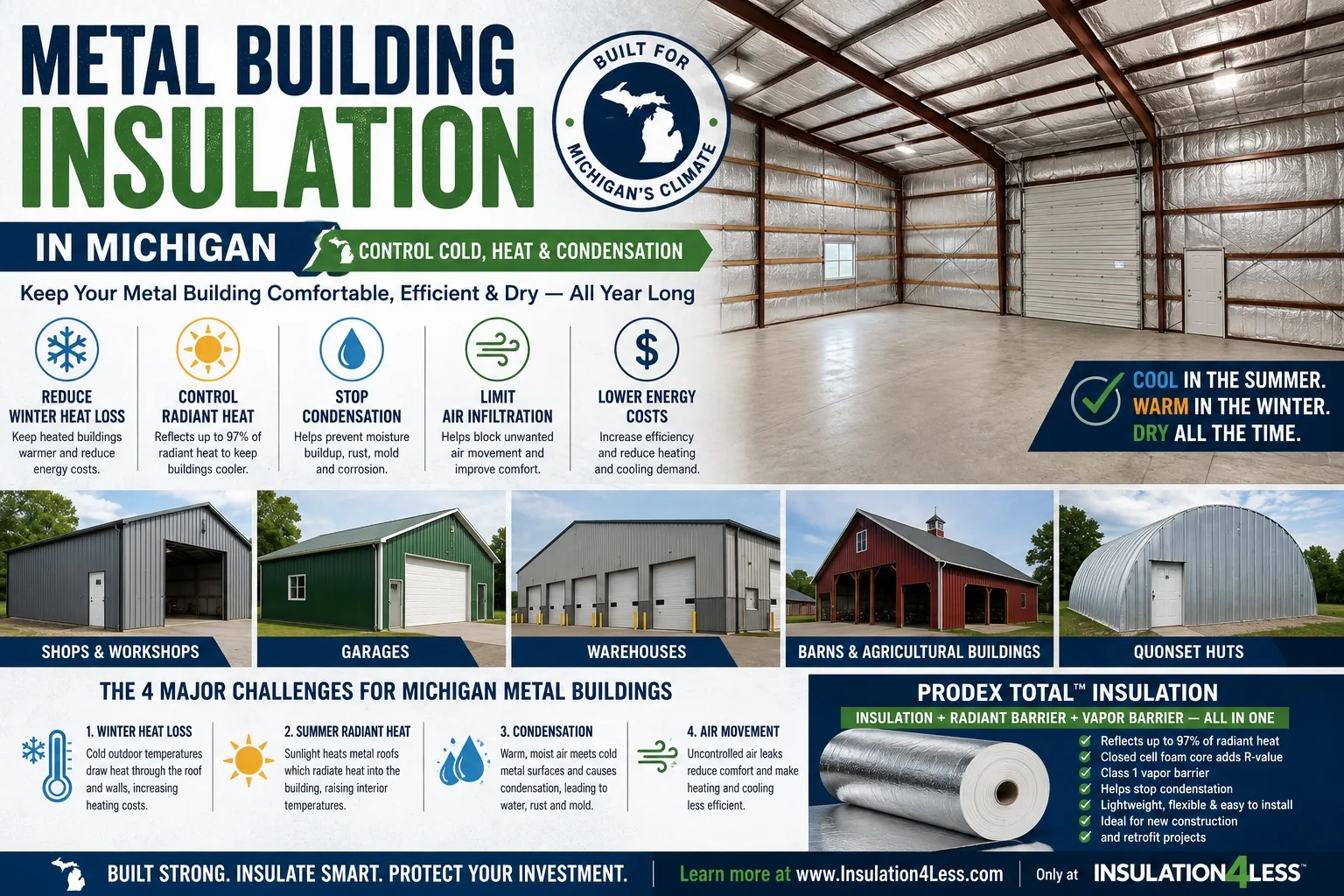
Metal Building Insulation in Michigan: Control Cold, Heat & Condensation
Michigan's climate can be demanding on metal buildings.
Cold winters can create substantial heat loss and extremely cold interior steel surfaces. During warmer months, direct sunlight can heat metal roofs and walls and increase radiant heat inside the building. Temperature differences between indoor air and exterior steel can also create conditions where condensation develops.
For these reasons, insulating a Michigan metal building requires more than simply choosing an R-value.
A successful insulation system should consider cold, radiant heat, condensation, air movement and moisture together.
For a complete national overview, see our guide to metal building insulation.
Why Michigan Metal Buildings Need Insulation
Steel is strong and durable, but it conducts heat readily. Without insulation, exterior temperatures can quickly influence interior conditions. During a Michigan winter, steel roofing and siding can become extremely cold. If the building is heated, the temperature difference between the interior and exterior increases the potential for heat loss. The opposite happens during summer. Solar radiation striking a metal roof can substantially raise its surface temperature. That energy can then radiate toward the interior of the building. Insulation can help moderate both conditions and make the interior environment easier to control.
The Four Major Insulation Challenges
When evaluating insulation for a Michigan steel building, consider four major issues.
1. Winter Heat Loss
Michigan's cold season can create a large temperature difference between heated indoor spaces and outdoor air. Heat naturally moves toward colder areas. Without an effective thermal envelope, a heated metal building can lose substantial energy through its roof and walls. Reducing this heat transfer can improve comfort and decrease the amount of energy required to maintain interior temperatures.
2. Summer Radiant Heat
Metal roofs exposed to sunlight can absorb substantial solar energy. The heated roof can then radiate energy toward the building interior.
This is particularly important in:
Workshops
Warehouses
Agricultural buildings
Equipment buildings
Metal garages
Manufacturing spaces
Reflective insulation can be useful in assemblies where radiant heat transfer is an important concern.
3. Condensation
Condensation is one of the most important issues when insulating metal buildings. Warm air can contain significant moisture. When that air encounters sufficiently cold steel, its temperature may fall below the dew point and water can form on the metal surface. The result may appear as droplets on roofing or siding—or even water dripping inside the building.
Persistent moisture can contribute to:
Corrosion
Mold or mildew on susceptible materials
Wet stored materials
Damaged interior finishes
Moisture problems in framing and other building components
An insulation strategy for a Michigan metal building should therefore consider condensation from the beginning.
4. Air Movement
Uncontrolled air infiltration can undermine insulation performance. Cold outside air entering through gaps can increase heating requirements during winter, while warm humid air entering during other seasons can affect comfort and moisture conditions. A complete insulation strategy should address air movement as well as thermal resistance.
Why the Roof Is Especially Important
If you are deciding where insulation matters most in a metal building, start with the roof. The roof experiences direct solar exposure during summer and is a critical part of the thermal envelope during Michigan winters. It can also be one of the most visible locations for condensation. Roof insulation should therefore be considered carefully for both new and existing metal buildings.
For a broader discussion, see our Roof & Ceiling Insulation in Michigan guide and national Roof Insulation Guide.
New Michigan Metal Buildings vs. Existing Buildings
The best installation method depends partly on whether the building is under construction or already completed.
New Metal Buildings
New construction offers the greatest opportunity to integrate insulation into the building envelope before exterior metal panels are installed.
Planning insulation at this stage can make it easier to:
Create continuous coverage
Reduce gaps
Address roof and wall transitions
Plan appropriate air spaces
Incorporate vapor control
Reduce thermal bridging
The insulation should be selected before roofing and siding installation whenever possible.
Existing Metal Buildings
Retrofit projects require a different approach because the exterior panels and structural framing are already in place.
The insulation system may need to work around:
Purlins
Girts
Bracing
Electrical systems
Doors and windows
Existing interior finishes
See our installation guide explaining how to insulate a metal building for additional information.
Reflective Insulation for Michigan Steel Buildings
Reflective insulation is particularly relevant to metal structures because it can address radiant heat in addition to conductive heat transfer when installed in an appropriate assembly. Prodex Total combines reflective surfaces with a closed-cell foam core. Depending on the specific product and installation assembly, it can provide several building-envelope functions.
Prodex Total = Insulation + Radiant Barrier + Vapor Barrier — All in One Product.
This makes it worth considering when evaluating insulation for steel buildings.
For more information about reflective insulation itself, visit our Reflective Insulation in Michigan guide or the national Reflective Insulation Guide.
Fiberglass Insulation in Michigan Metal Buildings
Fiberglass is another commonly used insulation material. It can provide effective thermal resistance when installed correctly and kept dry, but metal-building applications require careful consideration of moisture, compression, gaps and vapor control. If fiberglass becomes wet or is improperly installed, its performance can be affected. Michigan building owners should therefore compare the complete assembly rather than choosing an insulation material based only on nominal R-value. See Fiberglass Insulation vs. Prodex Total in Michigan for a detailed comparison.
Metal Barns and Agricultural Buildings
Michigan has a substantial number of agricultural and post-frame structures.
Metal barns may be used for:
Equipment storage
Livestock
Feed storage
Workshops
Vehicle storage
General agricultural operations
The amount of interior moisture can vary dramatically depending on how the building is used. A heated workshop may have very different insulation requirements from an unheated equipment barn, while livestock can introduce considerable moisture into the interior environment.
For post-frame construction, see our Pole Barn Insulation in Michigan guide.
You can also review our national guide to insulation for metal buildings.
Michigan Metal Garages and Workshops
Garages and workshops often benefit significantly from insulation, particularly when the space is heated or cooled.
Insulation can help:
Maintain more stable temperatures
Reduce winter heat loss
Reduce summer radiant heat
Control condensation
Improve comfort while working
Reduce heating and cooling demand
See Metal Garage & Workshop Insulation in Michigan for a more detailed discussion.
Quonset Huts
Quonset huts present a special insulation challenge because their curved steel shell functions as both roof and wall. Large areas of exposed steel can become extremely cold during winter and hot under summer sunlight. The continuous curved surface also means installation techniques differ from conventional post-frame or rigid-frame buildings.
Visit Quonset Hut Insulation in Michigan or our national Quonset Hut Insulation Guide.
How Much Insulation Does a Michigan Metal Building Need?
The answer depends on the building.
Important factors include:
Building dimensions
Roof configuration
Whether walls and roof will both be insulated
Building use
Heating and cooling
Interior moisture generation
Local climate
Desired thermal performance
Applicable energy and building codes
Before ordering material, determine the actual surface area being insulated rather than relying solely on the building's floor area.
Our How Much Insulation Do I Need? guide can help with planning.
Choosing Metal Building Insulation in Michigan
Before selecting insulation, answer several questions.
Will the building be heated?
Heating increases the temperature difference between interior air and cold exterior steel during winter.
Will the building be air-conditioned?
Cooling introduces a different temperature and moisture relationship during summer.
What will the building be used for?
A warehouse, livestock barn, garage and manufacturing facility can have very different moisture and comfort requirements.
Is condensation already occurring?
Existing condensation should be evaluated before simply covering the affected surfaces.
Is this new construction or a retrofit?
Installation options can differ significantly.
What do local codes require?
Insulation and energy-code requirements can vary according to building use and jurisdiction. Verify applicable requirements with the appropriate building officials before selecting the final assembly.
Michigan Metal Building Insulation and Year-Round Performance
Michigan steel buildings face two very different seasons. Winter brings cold exterior steel, heat loss and condensation concerns. Summer brings solar heat and potentially uncomfortable interior temperatures. A properly designed insulation system should address both.
The objective is:
Cool in the Summer. Warm in the Winter. Dry all the Time.
Rather than evaluating insulation solely by thickness or R-value, consider how the entire system handles conductive heat, radiant heat, air movement, vapor and condensation.
Explore Michigan Insulation Guides
Continue exploring insulation solutions for Michigan buildings: